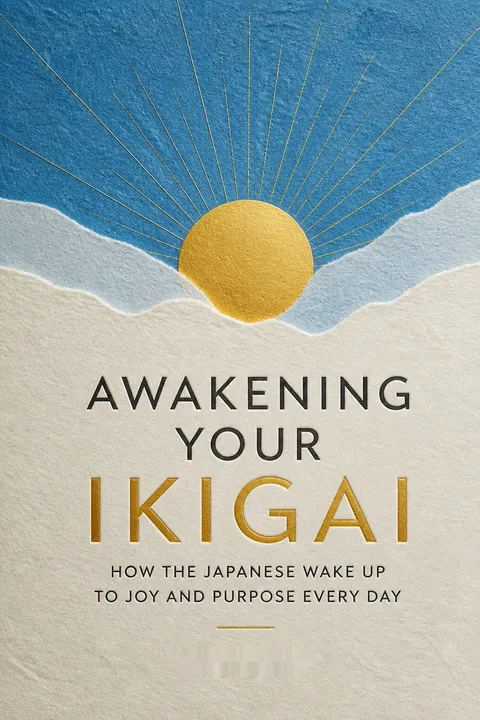


Key Takeaways
Treat ikigai as a reason to live, not a trophy to win
Meaning without medals. Ikigai is a Japanese term for the meaning and pleasures of living. It can be a major ambition, but it can also be a morning coffee, a favorite task, or a moment of affection. Jiro Ono, the celebrated sushi chef, finds meaning not only in professional acclaim but in the daily craft of selecting and preparing fish. A professor’s rough wooden chair, made by his father, offers another example: its value comes from personal attachment, not market price.
A practical map. Mogi organizes ikigai around five recurring supports: beginning with small actions, loosening the grip of ego, living in ways that sustain relationships and surroundings, noticing modest pleasures, and attending to the present. A study of more than 54,000 Japanese adults found that people reporting ikigai had lower mortality, especially from cardiovascular disease, but the study could not establish that ikigai caused the difference.
The shift from achievement to lived meaning is the book’s most useful correction to status-driven definitions of a good life. It also resembles the distinction in psychology between hedonic well-being, the pleasure of an experience, and eudaimonic well-being, a sense that life is worth inhabiting. The chair matters because it shows how meaning can be intensely personal without being publicly legible. The health finding is suggestive, not proof that purpose extends life: health, mobility, work, and social connection can also make purpose easier to feel. Ikigai is best treated as a humane orientation, not a medical prescription.
Give tomorrow a small pleasure worth getting up for
A reason before sunrise. Ikigai can be the small expectation that gives a day its first tug: a familiar exercise group, a good breakfast, or work that feels worth doing. Tokyo tuna broker Hiroki Fujita rises at 2 a.m. because his customers rely on him to select exceptional fish at the market. The search itself gives his early start meaning. In a very different setting, older residents gather at 6:30 a.m. for radio exercises, turning movement into a light, social ritual.
Make the cue inviting. Mogi’s point is not that everyone should copy Fujita’s hours. It is that modest routines can make life feel approachable. A pleasant morning ritual, or the familiar faces on a commute, can connect effort with anticipation. The author also argues that sleep and daylight rhythms matter, while acknowledging that a routine must fit the person living it.
This is a practical insight about motivation: a modest reward can make an otherwise demanding routine easier to repeat. Behavioral science similarly finds that habits are shaped by context and immediate feedback, not just distant goals. The social element matters too. A recurring group can supply belonging as well as exercise, making attendance worthwhile even when enthusiasm is low. Yet the book’s morning ideal needs a limit: people differ in sleep timing, health, caregiving duties, and work schedules. A useful ritual is one that supports a life, not one that turns waking early into a test of character.
Set a personal standard beyond what the market rewards
Care in the details. Kodawari is a personal standard pursued with unusual care, often in the details of a craft. It is one way ikigai becomes visible in work. A ramen maker may refine broth, noodles, and toppings far beyond what customers can easily distinguish. Jiro Ono improves techniques and tools in his sushi restaurant without knowing whether anyone will notice. The immediate reward is not necessarily money or praise, but the satisfaction of making something well for another person.
Beyond good enough. Japanese growers take this impulse to remarkable lengths. At Sembikiya, premium muskmelons are cultivated one fruit per stalk, so the selected melon receives more of the plant’s resources. Their high price reflects labor and rarity as well as taste. Such commitment can uncover qualities people did not know to value, though it can also consume time and effort with little return.
Kodawari links craft to both competence and service. The maker’s private standard is not merely perfectionism when its endpoint is a better meal, tool, or experience for someone else. This resembles the idea of deliberate practice: improvement comes from attention to specific elements, not simply repeating the whole task. But the story also raises a useful question about opportunity cost. Not every marginal refinement deserves unlimited labor, and a market may reward spectacle more readily than quality. The soundest version of this principle is to choose a standard that expresses care, while deciding consciously what the extra effort is for.
Let the work absorb you before asking it to reward you
Immersion as pleasure. Flow is a state of deep involvement in an activity, where attention is absorbed by the work and the activity becomes rewarding in itself. Animator Hayao Miyazaki, known for films such as My Neighbor Totoro, spends long hours drawing and refining scenes. Mogi presents the care visible in the finished work as evidence of that immersion. He also recounts Miyazaki’s regret over missing a chance to give a young visitor a convertible ride: a child’s particular moment cannot simply be recreated a year later.
Release the audience. Musicians in the ancient court tradition of gagaku sometimes perform within the Imperial Palace without a human audience. Their work still has meaning in the act of performing it. This is not a claim that wages or recognition never matter. Mogi’s point is that making external approval the only reward leaves creative energy exposed to outcomes no creator controls.
Flow explains why attention can feel nourishing rather than depleting: the mind is occupied by the activity instead of monitoring its own performance. The Miyazaki anecdote adds a distinct lesson about time. An opportunity can lose its meaning when its moment passes, even if a similar one appears later. Still, intrinsic motivation should not be used to excuse poor conditions. The book notes that animators may be poorly paid; passion can sustain meaningful work, but employers can also exploit it. Deep engagement and fair compensation are compatible goods, not competing ideals.
Pay attention to sensory moments that cannot be stored
Let experience be brief. Mogi argues that meaning often lives in particular sensory moments: the taste of a ripe fruit, the texture of a bowl, or the quiet of a tea room. The Japanese expression ichigo ichie, associated with the tea ceremony, emphasizes that each encounter happens only once in precisely that form. A tea gathering is carefully prepared, yet its value lies in attending to the meeting as it unfolds. A perfect mango offers a simpler illustration: however expensive or beautiful it is, the taste lasts only while it is eaten.
Notice without possessing. Mogi connects this attention to qualia, the felt qualities of experience, such as sweetness, color, or coolness. These are not objects to collect; they are experiences to notice. The idea echoes the book’s broader encouragement to take pleasure in small things without requiring them to prove anything about one’s status or future.
This account treats attention as a form of participation. Sensory experience cannot be fully replaced by a photograph or description, so the moment asks for presence rather than documentation. That resonates with mindfulness practices, which train attention toward immediate experience without rushing to evaluate it. The idea is strongest when it invites curiosity, not when it turns every meal into a performance of appreciation. Access to prized foods, ceremonies, and leisure is unequal. Ordinary pleasures are not inferior because they are inexpensive; the point is the quality of attention, not the price of the object.
Build purpose into relationships and systems that can endure
Meaning needs a setting. Mogi uses wa, a Japanese ideal of harmony, to describe the importance of living with consideration for other people and one’s surroundings. He links this to sustainability: a purpose is more durable when it does not depend on exhausting the people or systems around it. The Ise Shrine makes the idea concrete. Its buildings are reconstructed every twenty years, a practice maintained for more than 1,200 years, requiring forests, skilled carpenters, materials, and the transfer of knowledge between generations.
Maintenance is part of creation. Tokyo’s Meiji Shrine forest offers another example. Botanists planned a woodland intended to mature over time, and staff continue to care for it by returning fallen leaves to the soil. The lesson is not simply to preserve tradition. It is that long-lived projects require routines, shared roles, and care after the original act of creation.
The shrine examples make sustainability visible as organized maintenance rather than an abstract virtue. In ecology, resilience depends not only on a system’s initial design but on diversity, renewal, and the relationships that keep it functioning. The same logic applies to a family, workplace, or creative community. At the same time, a centuries-old institution has resources and continuity that an individual may not possess. Harmony should not mean suppressing legitimate disagreement or asking some people to bear all the cost. A sustainable purpose shares responsibility and leaves room for adaptation.
Find a worthwhile role outside the winner's circle
Rank is not the whole story. Professional sumo is brutally hierarchical: about one wrestler in ten reaches the top two divisions, where wrestlers receive the rank of sekitori. Yet lower-ranked wrestlers may remain because the sport offers more than promotion. Satonofuji, who did not reach that threshold, became known to fans for performing the ceremonial bow-twirling at the end of a tournament day. His valued role was real, even without a champion’s record.
A place can matter. Sumo’s rituals, training, and community give participants reasons to stay beyond winning bouts. Some stable websites also describe support for wrestlers considering retirement, including time to seek another career. Mogi uses the sport to argue that a person’s contribution need not match the official ranking system. A role can be meaningful because it serves a community or expresses a skill, even when it brings little prestige.
This is a sharp challenge to systems that equate measurable advancement with personal worth. A team often depends on roles that rankings and compensation do not fully represent, while mastery can take forms outside the most visible contest. Satonofuji’s ceremony makes that hidden contribution easy to see. The caution is equally important: meaning should not romanticize an unfair hierarchy or persuade people to endure harmful conditions indefinitely. A worthwhile niche is most valuable when it is chosen, recognized, and supported, and when people retain credible ways to leave.
Stop postponing happiness until you match somebody else's checklist
Question the missing piece. A focusing illusion occurs when one desired condition seems essential to happiness, making life feel deficient until it arrives. Mogi names familiar candidates: marriage, children, money, or an impressive job. These can matter deeply to a person, but none is a universal prerequisite for a satisfying life. The task is to distinguish a genuine need from the belief that one socially approved life pattern is the only route to happiness.
Practice self-acceptance. The book describes Kyoto sweets made in slightly different shapes because flowers in nature are not identical. People, too, vary in temperament and desire. Mogi also points to Comiket, a large Japanese gathering where fans create and sell self-published manga, often for the pleasure of making and sharing it rather than as a route to fame. These examples suggest that fulfillment can grow from a life fitted to the person, not from a standard template.
The focusing illusion is useful because it explains how a real desire can become an imagined condition for all happiness. Social comparison intensifies the effect: visible milestones look like proof that others have solved life, while the costs and trade-offs remain out of view. Self-acceptance can interrupt that comparison and make room for less conventional sources of belonging and accomplishment. It should not be confused with resignation. People can accept themselves while still seeking better relationships, security, or fair treatment. The distinction is between changing what can be changed and treating one idealized identity as the price of worth.
Keep several small reasons to continue, especially in hard times
Purpose can be plural. Mogi presents ikigai as a steady source of motivation through changing circumstances, rather than one grand mission that must explain an entire life. His closing image comes from Japanese critic Hideo Kobayashi: a yacht’s modest auxiliary motor can bring it safely back to harbor when the main route fails. Daily pleasures, commitments, and relationships can play a similar role. The book also describes the Japanese idea of eight million gods, a way of imagining sacred value throughout the living world and ordinary objects, rather than locating meaning in one source alone.
Resilience is not immunity. Japan’s history of earthquakes, tsunamis, fires, and wartime destruction gives Mogi a backdrop for discussing endurance. After the 2011 earthquake and tsunami, he emphasizes courage and the everyday ties that help people carry on. Small sources of meaning can support persistence, but they do not erase grief, replace practical aid, or make disaster a test of individual character.
A distributed sense of purpose may be more robust than one identity tied to a job, relationship, or achievement. If one source is disrupted, other commitments and pleasures can still offer continuity. This resembles resilience in complex systems, where variety creates more than one route through disruption. The metaphor has limits: severe loss can temporarily make every source of meaning inaccessible, and social support or material help may be essential. The humane implication is not that people should manage adversity alone, but that ordinary attachments deserve attention before a crisis makes their value unmistakable.
Analysis
The book’s central move is to replace the search for one commanding life purpose with a more distributed account of meaning. Ikigai can be a vocation, but it can also be a ritual, sensory pleasure, relationship, or modest role in a community. That shift makes the concept accessible to people whose work is not fulfilling or whose achievements do not attract recognition. The Five Pillars work less like a strict recipe than a set of overlapping conditions: small beginnings create traction, reduced self-consciousness enables immersion, social harmony supports continuity, and attention makes ordinary experience perceptible.
This account has a useful affinity with contemporary theories of well-being that distinguish pleasure, competence, autonomy, and connection. Its strongest examples show these dimensions in combination. The tuna broker’s work involves skill and service; the morning exercise group brings routine and belonging; the shrine depends on intergenerational cooperation. The book therefore offers more than a motivational slogan. It describes how purpose can be distributed across a life rather than assigned to a single job title.
Two cautions sharpen the argument. First, the Ōsaki health finding is an association, not evidence that ikigai itself lowers mortality. Better health may make it easier to sustain work, mobility, and social ties, all of which can strengthen a sense of purpose. Second, the author sometimes moves from specific Japanese traditions to broad claims about Japanese character. The examples illuminate particular institutions, but they cannot establish that a whole population shares one temperament. The text itself shows that harmony can limit individual expression and that work devotion can carry costs.
The most practical reading is therefore neither to imitate Japanese customs nor to demand constant gratitude. It is to ask what small, repeatable activities make life feel inhabited, which relationships help them endure, and when a pursuit has become self-sacrifice rather than meaning. Ikigai is not a guarantee against illness, injustice, or grief. It is a way of noticing and sustaining reasons to participate in life under imperfect conditions.
Review Summary
Awakening Your Ikigai explores the Japanese concept of finding purpose in life through five pillars: starting small, releasing yourself, harmony and sustainability, joy in little things, and living in the present. Readers appreciate the insights into Japanese culture but find the writing style and organization lacking. Some feel it's repetitive and doesn't offer practical advice. Others enjoy the cultural examples and find the book thought-provoking. Overall, opinions are mixed, with some finding it enlightening and others disappointed by its lack of depth and clarity.
People Also Read




Glossary
ikigai
meaning in everyday lifeA Japanese term for the pleasures and meanings of living. In this book, ikigai ranges from major aims to small routines and private attachments. It need not depend on career success, wealth, or public recognition; it is a personal source of motivation and value that can be found in ordinary activities and relationships.
Five Pillars of ikigai
supports for a meaningful lifeThe book’s five-part guide to conditions that help ikigai flourish: beginning with small actions, releasing excessive attachment to the self, living in harmony with people and surroundings, appreciating modest pleasures, and being attentive to the present. The pillars overlap and are not presented as a ranked sequence or an exhaustive formula.
kodawari
careful personal standardA Japanese term for a steadfast personal standard, often expressed through unusual attention to small details and quality. Mogi presents kodawari as a source of pride and motivation in work, from preparing food to making crafts. It can exceed what ordinary market incentives require, while ultimately connecting the maker’s effort to the experience of others.
flow
deep activity absorptionA psychological state in which a person becomes so involved in an activity that attention is absorbed and the work feels rewarding in itself. The book draws on psychologist Mihaly Csikszentmihalyi’s account of flow to explain how craft, creative work, and ordinary tasks can become sources of pleasure without depending entirely on praise or immediate reward.
ichigo ichie
each encounter happens onceA Japanese expression associated with the tea ceremony that emphasizes the singular nature of an encounter. A meeting, meal, or shared experience may resemble others, but it occurs in a particular moment that cannot be exactly repeated. The concept encourages careful attention to people and details while an experience is happening.
wa
harmony among peopleA Japanese concept of harmony that Mogi connects to cooperation and social consideration. In the book, wa is not simply politeness; it points to the relationships and shared practices that let people pursue personal meaning without damaging the wider community. The author links this idea to the long-term sustainability of cultural institutions and everyday life.
focusing illusion
overvaluing one conditionA bias in which attention becomes fixed on one desired condition, making a person believe that overall happiness depends on obtaining it. Mogi uses examples such as marriage, children, money, and employment. The concept helps explain why people may treat one socially valued milestone as a requirement for happiness, even though fulfillment can take many forms.
qualia
felt qualities of experienceThe subjective qualities of sensory experience, such as the redness of a color, the fragrance of a flower, or the taste of fruit. Mogi uses the term to emphasize that lived experience includes sensations that cannot be reduced to descriptions or external measurements. The book connects attention to these qualities with appreciating small, present-moment pleasures.
Ōsaki study
ikigai and health cohortA seven-year Japanese cohort study that analyzed questionnaire data from more than 54,000 adults aged 40 to 79. Participants answered whether they had ikigai in their lives. The study found associations between reporting ikigai and several health and social measures, including lower mortality, especially from cardiovascular disease. It did not establish that ikigai caused those outcomes.
eight million gods
sacred meaning in many thingsA traditional Japanese expression in which eight million signifies an effectively unlimited number of deities or sources of spiritual meaning. Mogi presents it as a way to understand religious value as dispersed through nature, living beings, and ordinary objects, rather than confined to one doctrine. In the book, it also reflects a plural, everyday approach to meaning.
FAQ
What's "Awakening Your Ikigai" about?
- Exploration of Ikigai: The book delves into the Japanese concept of ikigai, which translates to "a reason for being" or "a reason to get up in the morning."
- Five Pillars of Ikigai: It introduces the Five Pillars of ikigai: starting small, releasing yourself, harmony and sustainability, the joy of small things, and being in the here and now.
- Cultural Insights: Through various stories and examples, the book provides insights into how ikigai is naturally integrated into Japanese culture and daily life.
- Practical Guidance: It offers practical advice on how readers can find and cultivate their own ikigai to lead a more fulfilling and joyful life.
Why should I read "Awakening Your Ikigai"?
- Cultural Understanding: Gain a deeper understanding of Japanese culture and its approach to finding meaning and joy in life.
- Personal Growth: The book provides tools and insights for personal development and finding one's purpose.
- Practical Application: It offers actionable steps to incorporate the principles of ikigai into everyday life, enhancing well-being and satisfaction.
- Inspirational Stories: Through real-life examples, the book inspires readers to appreciate the small joys and find balance in their lives.
What are the key takeaways of "Awakening Your Ikigai"?
- Five Pillars Framework: The Five Pillars of ikigai provide a framework for living a meaningful life: starting small, releasing yourself, harmony and sustainability, the joy of small things, and being in the here and now.
- Ikigai's Universality: Ikigai is a universal concept that can be applied by anyone, regardless of cultural background, to find purpose and happiness.
- Balance and Simplicity: Emphasizes the importance of balance, simplicity, and mindfulness in achieving a fulfilling life.
- Resilience and Adaptability: Highlights the role of ikigai in building resilience and adaptability in the face of life's challenges.
What is Ikigai according to Ken Mogi?
- Definition: Ikigai is a Japanese term that means "a reason for being" or "a reason to get up in the morning."
- Components: It involves finding joy and meaning in life through small everyday things as well as larger goals and achievements.
- Democratic Concept: Ikigai is accessible to everyone, regardless of professional success, and celebrates the diversity of life.
- Cultural Context: In Japan, ikigai is a common concept that people use casually in daily life, often without realizing its deeper significance.
How can I find my own Ikigai?
- Start Small: Begin by identifying and appreciating the small things that bring you joy and satisfaction.
- Release Yourself: Let go of societal expectations and focus on what truly matters to you personally.
- Seek Harmony: Strive for balance and sustainability in your actions and relationships with others.
- Be Present: Practice mindfulness and enjoy the present moment, finding joy in the here and now.
What are the Five Pillars of Ikigai?
- Starting Small: Focus on small, manageable steps to achieve larger goals and find joy in the process.
- Releasing Yourself: Let go of ego and societal pressures to discover your true passions and desires.
- Harmony and Sustainability: Live in harmony with others and the environment, ensuring long-term well-being.
- The Joy of Small Things: Appreciate and find happiness in the simple pleasures of everyday life.
- Being in the Here and Now: Practice mindfulness and fully engage with the present moment.
How does Ken Mogi illustrate Ikigai through Japanese culture?
- Cultural Practices: Mogi uses examples like the tea ceremony, sumo wrestling, and traditional crafts to illustrate ikigai in Japanese culture.
- Real-Life Stories: The book shares stories of individuals like sushi chef Jiro Ono, who embody ikigai through their dedication and passion.
- Historical Context: It explores historical and cultural influences, such as Buddhism and Shinto, that shape the Japanese understanding of ikigai.
- Daily Life: Mogi highlights how ikigai is naturally integrated into the daily lives of Japanese people through small rituals and practices.
What role does resilience play in Ikigai?
- Building Resilience: Ikigai helps individuals build resilience by providing a sense of purpose and motivation to overcome challenges.
- Cultural Resilience: The book discusses how the Japanese have historically demonstrated resilience in the face of natural disasters and adversity.
- Adaptability: Ikigai encourages adaptability and finding joy in changing circumstances, contributing to mental and emotional strength.
- Personal Growth: Through resilience, individuals can grow and find deeper meaning in their experiences, enhancing their ikigai.
How does "Awakening Your Ikigai" relate to happiness?
- Happiness and Ikigai: The book suggests that finding and nurturing your ikigai leads to a more fulfilling and happy life.
- Beyond Material Success: It emphasizes that happiness is not solely dependent on material success or societal achievements.
- Inner Contentment: Ikigai fosters inner contentment by encouraging individuals to focus on what truly brings them joy and satisfaction.
- Mindful Living: By practicing mindfulness and appreciating the present moment, ikigai contributes to overall happiness and well-being.
What are some practical steps to incorporate Ikigai into daily life?
- Identify Joys: Reflect on the small things that bring you joy and incorporate them into your daily routine.
- Set Intentions: Start each day with a clear intention or purpose, focusing on what you want to achieve or experience.
- Practice Mindfulness: Engage in mindfulness practices, such as meditation or deep breathing, to stay present and centered.
- Cultivate Relationships: Build harmonious relationships with others, fostering a supportive and sustainable community.
What are the best quotes from "Awakening Your Ikigai" and what do they mean?
- "Ikigai resides in the realm of small things." This quote emphasizes the importance of finding joy and meaning in everyday moments and simple pleasures.
- "You can have ikigai, a value to live by, without necessarily having to prove yourself." It highlights that ikigai is accessible to everyone, regardless of external achievements or recognition.
- "The joy of little things seems particularly pertinent in this context." This quote underscores the significance of appreciating small joys as a foundation for a fulfilling life.
- "Ikigai gives your life a purpose while giving you the grit to carry on." It illustrates how ikigai provides motivation and resilience in the face of life's challenges.
How does Ken Mogi's background influence "Awakening Your Ikigai"?
- Neuroscientific Perspective: As a neuroscientist, Mogi brings a scientific understanding of the brain and behavior to the concept of ikigai.
- Cultural Insight: Being Japanese, Mogi offers authentic insights into how ikigai is naturally integrated into Japanese culture and daily life.
- Broad Experience: With a background in writing and broadcasting, Mogi effectively communicates complex ideas in an accessible and engaging manner.
- Personal Passion: Mogi's passion for sharing the concept of ikigai is evident throughout the book, inspiring readers to explore and embrace it in their own lives.
About the Author


Download PDF
Download EPUB
.epub digital book format is ideal for reading ebooks on phones, tablets, and e-readers.








