

Key Takeaways
When pain makes tomorrow unimaginable, let other people help you stay.
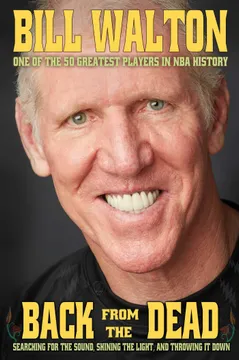
Despair narrowed his world. In 2009, Bill Walton had spent years in severe pain from a collapsing spine. He could barely move, eat, or sleep, and describes reaching a point where death seemed preferable to continuing. His wife, Lori, and a small circle of family and friends kept showing up even when he pushed them away. Their persistence mattered when he could not summon hope or manage the simplest tasks alone.
Help came before certainty. Friends kept urging him to hold on and helped connect him with a spine surgeon. Walton’s recovery did not begin with confidence or a grand plan. It began with other people carrying some of the burden while he was unable to carry it himself.
What's striking is how plainly the memoir separates endurance from solitary heroism. Walton had spent a life treating effort as the answer, yet his crisis demanded dependence: other people had to keep a future imaginable until he could do so himself. That is a useful correction to the sports-culture tendency to equate strength with self-sufficiency. Support, however, is not a substitute for competent care. His account also shows why loved ones need practical and institutional help when caregiving becomes relentless, rather than being praised for limitless sacrifice.
Choose mentors who teach you how to contribute, not merely how to win.
Coaches shaped his compass. Walton’s first basketball coach, Rocky, was a volunteer fireman who organized daily sports for children and kept doing it for decades without pay. Rocky made the game welcoming to a shy boy who struggled to speak. John Wooden, Walton’s UCLA coach, extended that lesson: basketball was a place to practice discipline, responsibility, and service to a group.
Every possession mattered. Walton learned to look beyond personal statistics and ask how each action could help the team. That mindset supported three NCAA championships at UCLA, but it also reached beyond basketball. He describes the court as a training ground for making a useful contribution wherever life places someone, whether in a classroom, workplace, or family.
The memoir’s idea of coaching is unusually expansive: a coach teaches a person how to inhabit a role, not just execute a play. Rocky’s unpaid work also makes mentorship tangible. It is time, attention, and continuity, not a slogan delivered from the sideline. At the same time, a coach’s authority can become too controlling if unquestioned. Walton’s own conflicts with Wooden show that useful mentorship can survive disagreement, especially when standards are consistent and the relationship remains larger than obedience.
Make preparation so thorough that pressure has fewer surprises to exploit.
Practice turned ideas into habits. At UCLA, Wooden taught skills by showing them, having players copy them, correcting errors, and repeating the work until execution became dependable. The players initially found his attention to socks, shoes, grooming, and routine absurd. They later understood that small preparations reduced avoidable distractions and helped them perform together.
The drills demanded the whole game. Walton especially loved the Three-on-Two Conditioner, a continuous transition drill involving offense and defense, passing, rebounding, shooting, and rapid decisions. Players worked at full speed for ten minutes, with little chance to pause. Wooden prepared practices carefully, then relied on the players to apply what they had rehearsed. Preparation was not a guarantee of victory, but it made a team more capable when the game became difficult.
The memorable point is not that discipline makes athletes obedient. It is that preparation can create room for intelligent improvisation. When fundamentals become familiar, attention can shift from remembering mechanics to reading the situation. The same logic applies to live performance, emergency response, and other high-stakes work. Yet repetition only helps when the model being repeated is sound. The book’s emphasis on the coach’s careful design matters: practice is not automatically useful because it is hard; it must rehearse the demands people will actually face.
Treat pain as evidence, not a character flaw to overcome.
Toughness had a cost. Walton says his malformed feet could not absorb the impact of years of basketball. He ultimately underwent thirty-seven orthopedic surgeries and missed the equivalent of nine and a half seasons in his fourteen-year NBA career. Early stress fractures were difficult to detect, and doctors and others repeatedly doubted that his pain reflected a real injury.
Playing through it worsened the damage. In Portland, a painkilling injection let him return to a game after a bone in his foot had split. The break was later confirmed by hospital radiologists. Walton accepts that he failed to stand up for himself, but his story also exposes the danger of treating pain as weakness before establishing its cause. Commitment cannot make an injured body safe.
This account complicates the familiar celebration of playing through pain. Persistence can be admirable in training, but in medicine it can become a hazard when athletes, coaches, or clinicians confuse visible performance with physical safety. Walton’s experience makes room for a more precise form of toughness: reporting symptoms clearly, asking for evidence, and refusing pressure to perform when the diagnosis is uncertain. His memoir is one person’s account, not a clinical guide, but the institutional lesson is strong: unexplained pain deserves investigation, not moral judgment.
A collection of stars cannot replace trust, fit, and shared purpose.
Talent alone did not hold UCLA together. Walton describes Greg Lee as the selfless passer who made the Bruins’ offense flow. During the 1973-74 season, Lee lost playing time while Tommy Curtis took on a larger role. Walton believed Curtis’s ball-dominant style disrupted the team’s rhythm. UCLA lost four of its final seventeen games after a long run of dominance, including the national semifinal against North Carolina State.
A different team found its balance. In Portland, coach Jack Ramsay rebuilt an unstable roster, and Maurice Lucas became a force for unity as well as a formidable player. Walton, Lucas, and their teammates won the 1977 NBA championship. Years later, with the Celtics, Walton joined a deep, disciplined group led by Larry Bird and won another title. In each case, individual ability mattered most when it served a functioning group.
Walton’s comparison points to team chemistry as something operational, not mystical. A passer, a coach, or a demanding teammate can connect skills into a coherent system; a poor fit can interrupt that system even when the roster is talented. The memoir is also candidly partial: Walton places much of UCLA’s collapse on Curtis, while injury, coaching choices, and the pressures of a historic streak were also part of the season. That bias does not erase the insight. It does remind readers to distinguish a vivid explanation from a complete one.
When your old role disappears, train your skills for a new one.
A new career began with an old obstacle. After surgery fused his ankle, Walton knew he would not return to professional basketball. His lifelong stutter had once made him avoid speaking, but broadcaster Marty Glickman treated speech as a skill that could be practiced. He advised Walton to slow down, focus on one word at a time, read aloud in front of a mirror, and gradually speak to audiences that would be patient with mistakes.
Practice opened another door. Walton applied the discipline he had learned in basketball and began taking any broadcasting opportunity available, including unpaid, local work. He eventually called games for major networks. The transition was neither instant nor smooth, but it gave him a new way to remain connected to sport after playing was no longer possible.
The shift from athlete to broadcaster is a striking example of transferable learning. Walton does not simply declare that adversity revealed a hidden talent; he describes a teacher identifying a skill, breaking it into manageable practices, and insisting on repetition. That makes reinvention less magical and more teachable. Still, transfer requires translation: basketball habits did not automatically erase a speech impediment or secure a job. A useful mentor can show how an existing discipline might apply, while the learner must build competence in a genuinely different craft.
Track recovery in small gains, especially when progress feels invisible.
Improvement needed witnesses. After major spine surgery, Walton struggled with basic movement and relied on his wife, Lori, and longtime physical therapist Bruce Inniss. Lori left notes marking small changes: sitting up, dressing, reaching the bathroom, or taking fewer pain pills. These were modest achievements, but they gave shape to days that otherwise felt like endless pain.
The pool made movement possible. His surgeon directed him toward careful activity, and a friend persuaded him to try a warm, accessible pool. Walton found that water let him move in ways that were difficult on land. He returned regularly, then gradually resumed the weight room and cycling. The path was not smooth: after his first short bike ride, a collision left him with additional fractures. Progress required patience, help, and adjustment, not a single triumphant breakthrough.
The notes work as more than encouragement. They make progress observable when a person’s own attention is consumed by pain, a practical form of feedback that can preserve motivation without pretending recovery is easy. The pool likewise changes the task by reducing the burden of movement. Walton’s setbacks are essential to the point: small gains do not promise a straight line or universal recovery. They offer a way to recognize what is changing and to make the next step more manageable.
Turn the help that carried you into help someone else can use.
Recovery gave him a new responsibility. Walton describes health as a privilege that carries an obligation to help others. He worked with the Better Way Back program to support people facing serious spine problems and volunteered with the Challenged Athletes Foundation, which helps people obtain adaptive sports equipment and community support.
The ride made the idea visible. On a California fundraising ride, Walton encouraged Kelly Fox, a paralyzed hand-cyclist who had already traveled more than six hundred miles, through the final climb. He also rode among teammates with major disabilities who were still finding ways to participate. The scene reframed athletic achievement: the purpose was not simply to finish first, but to help one another keep moving toward a goal.
Service here grows from recognition rather than abstract generosity: Walton knows how isolation feels, and he has seen how a practical intervention, a ride, equipment, or a persistent companion can reopen possibilities. The cycling story also shifts the standard of athletic success from bodily uniformity to shared effort. Such stories should not imply that attitude cures disability or pain. Their deeper value is in making participation, access, and companionship part of the achievement, rather than treating them as consolation prizes.
Analysis
Back from the Dead is a sports memoir structured as a repeated cycle: Walton reaches a summit, suffers a collapse, and tries to find another route forward. Basketball supplies the book’s central vocabulary, but its subject is broader than athletic success. Teamwork, teaching, medical failure, family, music, and service all become ways of understanding what it takes to keep participating in life when a familiar identity is taken away.
The narrative’s most persuasive tension is between Walton’s appetite for effort and the damage caused when effort becomes the only answer. As a young player, he treats pain as ordinary and accepts the pressure to keep competing. Years of missed games, surgeries, and medical disbelief show the cost of that assumption. His recovery requires a different discipline: listening to his body, accepting help, tolerating slow progress, and finding work that does not depend on playing basketball. Persistence remains central, but it changes form.
The memoir also argues that great performance is collective. Wooden’s preparation, Greg Lee’s passing, Maurice Lucas’s leadership, the Celtics’ depth, and Lori’s caregiving each show how individual ability depends on relationships and structure. Walton’s account of the 1974 UCLA collapse is emotionally powerful but also self-interested, particularly in its emphasis on one teammate as the cause of a wider failure. That limitation is revealing: this is not a neutral history of basketball, but a personal effort to make sense of regret.
The book’s ending does not claim that suffering produces wisdom automatically. Walton remains vulnerable to setbacks and loss. What changes is his use of experience. The survivor becomes a broadcaster, mentor, and advocate, helping others find practical ways back into meaningful activity. The durable message is not that every climb ends in triumph. It is that people can contribute, and belong, in more than one way.
Glossary
Pyramid of Success
character-building frameworkJohn Wooden’s framework for the personal qualities he believed supported achievement. Its foundation includes industriousness and enthusiasm, with other traits such as friendship, loyalty, cooperation, self-control, and skill development built above them. Walton recalls Wooden adding faith and patience at the top, and later acknowledging that love also belonged among the essential principles.
Four Laws of Learning
skill-teaching sequenceWooden’s teaching sequence for developing a skill: demonstrate it, let learners imitate it, correct mistakes, and repeat the process. Walton applies the idea beyond basketball, including to speech practice. The method treats performance as learnable rather than innate, and relies on clear models and continued practice rather than instruction alone.
Three-on-Two Conditioner
continuous transition drillA demanding UCLA basketball drill that repeatedly moves players between three-on-two attacking situations and defensive roles. It trains transition play, passing, shooting, rebounding, footwork, spacing, and quick decisions without long pauses. Walton describes it as both a conditioning exercise and a way to rehearse many parts of basketball in one continuous sequence.
Better Way Back
spine patient support programA program Walton describes building with NuVasive to support people dealing with serious spine problems. It aims to help patients understand options for recovery and reconnect with the possibility of a meaningful life after severe pain or surgery. Walton’s own experience informs its emphasis on encouragement, practical support, and a gradual return to activity.
Download PDF
Download EPUB
.epub digital book format is ideal for reading ebooks on phones, tablets, and e-readers.








