

Key Takeaways
Grow for winter before winter arrives, then harvest from protected beds
Winter is a harvest season. The book's central reversal is practical: a snowy garden need not be dormant. Warnock describes picking lettuce, chard, peas, and roots beneath January snow, even in a Utah climate where temperatures have fallen to 17 below zero. The key is not to sow everything in midwinter. Most crops must be established in spring, summer, or fall, then protected and harvested as needed through the cold months.
Start with a small trial. A few hardy crops under a simple cover can supply fresh food without a heated greenhouse, grow lights, or electricity. The author presents this as a skill ordinary households can recover, whether they have acreage or only a small growing space.
What's striking is the shift from treating winter as an empty interval to treating it as a distinct production season. That reframing resembles climate adaptation: success comes from matching a system to local conditions, not forcing summer routines into winter. Warnock's Utah garden makes a compelling demonstration, but one family's success is not a universal temperature guarantee. Wind, snow cover, daylight, soil, and local freeze patterns all matter. The useful principle is to test a modest bed in one's own microclimate, record what survives, and expand from observed results rather than assuming the same varieties and dates work everywhere.
Build low cold frames, and let decomposing matter heat hotbeds
Keep warmth near plants. A cold frame is a low box with a transparent lid that traps solar warmth over plants in garden soil. Warnock favors shallow frames made from two-by-four lumber and rigid plastic, arguing that tall frames lose more heat and catch more wind. A hotbed adds natural heat beneath the growing soil. His basic design uses a roughly 16-inch-deep pit, about 12 inches of fresh livestock manure or chopped green material, then 3 to 6 inches of soil or compost above it.
Match heat to the crop. Lettuces and many hardy greens need less warmth than tomatoes, beans, squash, or melons, for which Warnock recommends much deeper manure beds. Keep edible plants separated from manure, and follow the book's stated waiting periods before harvesting.
The designs make thermal management tangible: a cover captures daytime solar energy, while decomposing organic matter supplies heat after sunset. The shallow frame also reduces exposed surface area, a basic principle in heat conservation. This is a useful example of low-tech engineering, but the result depends on the material, moisture, bed dimensions, and weather. Manure handling also deserves care, especially where edible crops are involved. The author's sanitation guidance is part of the method, not a detail to improvise away. A thermometer and a simple garden log can turn a clever design into a safer, more repeatable one.
Plant by season, because winter crops need a head start
Calendar beats optimism. The book divides winter planting across the year. Spring is the time to establish carrots and Swiss chard. Summer is for crops such as beets and early cabbages. Autumn is especially important for lettuce, mustard greens, and peas that need time to grow before deep cold slows them. Warnock recommends sowing winter lettuce in August so plants have substantial growth before daylight dwindles.
Respect the solstice. The winter solstice, around December 22 to 24, marks the shortest day. Warnock reports that some seeds sprout poorly before it, while plants already established can persist under protection. Even after the solstice, short days and cold soil slow growth. His practical expectation is patience: seeds may take weeks, and growth can accelerate as days lengthen toward February.
This calendar is a form of phenological thinking, organizing work around biological cues rather than a fixed idea of spring planting. The solstice is a useful landmark, but it is not a magic switch: species, latitude, cloud cover, and soil temperature interact. The author's own observation that seedlings and mature plants behave differently is particularly useful, because germination and survival are separate problems. Gardeners can improve the schedule by noting sowing dates, emergence, and first harvest locally. Such records build a household's own evidence base, more reliable than copying a date without regard to climate.
Choose cold-hardy varieties, especially lettuces bred through winter
Variety changes the odds. Warnock's favorite winter lettuce is a selection of Parris Island Cos that he calls Winter Green Jewel. He says that saving seed from plants grown through cold seasons helped his line become more winter-hardy. Green oak leaf, Grand Rapids, and Winter Density are other options, with different strengths in open beds or under covers. He recommends sowing lettuce early enough in August to build substantial plants before winter.
Use more than one strategy. Spinach, Swiss chard, mustard greens, peas, and extra dwarf pak choi widen the harvest. Some tolerate open beds; others benefit from a cold frame or hotbed. The book's advice is to plant more lettuce than seems necessary, since winter growth is slow and a missed planting cannot be replaced quickly.
The seed story illustrates selection in action: repeated exposure to a local environment can favor traits that a seed catalog description may not capture. This is a powerful reason to save seed and share trial results. It is also important to distinguish the author's personal selection from a controlled, broadly replicated variety trial. Results can vary across locations, and even cold-hardy plants can suffer from prolonged freezing, wind, or poor drainage. A diverse planting is therefore more robust than betting the winter salad on one celebrated cultivar.
Treat the garden as a pantry, not just a summer factory
Leave food where it grew. The book's winter harvest is not limited to leafy greens. Spring-planted carrots can remain in the ground beneath roughly a foot of leaves or straw, then be dug as needed. Potatoes can be grown in compost or straw and protected from freezing with additional mulch. These methods let the soil act as storage, though rodents may find the same sheltered bed attractive.
Box what you need indoors. Beets and turnips can be stored in damp pine shavings in an unheated garage or cellar. The roots may produce tender leaves in the dark, giving the household another salad green. Winter apples, including the author's favored Keepsake, can be stored in a cool place. The aim is a mix of in-ground harvest, boxed roots, and stored produce.
A garden that also stores food is a more resilient system than one that must be harvested all at once. In ecological terms, it spreads risk across different storage methods and harvest dates. The trade-off is labor and exposure: digging through snow, monitoring damp boxes, and protecting roots from rodents are real tasks. The book is most persuasive when it treats storage as a set of options rather than a promise of effortless abundance. Households can choose methods according to mobility, storage space, pest pressure, and how often they want to go outside in bad weather.
Use a geothermal greenhouse only when its added harvest justifies cost
A greenhouse is optional. Warnock is explicit that a geothermal greenhouse is not necessary for winter vegetables. His own structure measured 12 by 9 feet, extended 8 feet below ground, and cost about $6,200 to build in 2011. It used daytime sunlight and heat from the earth rather than artificial heat or electricity. Buried pipes and rock-filled space formed part of his design, while vents managed the substantial daytime temperature rise.
Choose it for special uses. The greenhouse supported winter tomatoes, herbs, seedlings, and tender or unusual plants. Warnock also describes its value as a warm place to garden and play in winter. For most households, simpler cold frames and hotbeds offer a cheaper starting point. The greenhouse is a larger engineering project, not the entry ticket to winter food.
The greenhouse chapter shows how a practical experiment can join engineering, horticulture, and daily comfort. Its value is not only produce: it offers seed-starting space and a usable garden room during harsh weather. Still, the author's $6,200 project cost is a historical case, not a general estimate, and an underground structure raises site, drainage, structural, and maintenance questions. Its energy independence should not obscure its embodied materials and construction expense. The sensible decision rule is comparative: estimate local build costs and expected use, then ask whether a few protected beds meet the same household need more simply.
Save open-pollinated seeds to keep rare varieties alive
Seeds require growers. Open-pollinated varieties can generally be saved and grown true to type, unlike many hybrids whose next generation may not reproduce the parent reliably. Warnock argues that market demand for vegetables suited to shipping and storage has narrowed the varieties commonly grown. He recounts the search for Petite Noire, a once-valued French winter lettuce for which he could find no surviving seed, despite extensive archival research.
Preservation is active work. The book describes Seed Savers Exchange as a network of gardeners who maintain and share rare seed lines. It also notes that some root crops must overwinter before producing seed, so winter gardening supports seed saving as well as food harvest. Warnock cites an estimate that 96 percent of vegetable varieties available in 1903 have since disappeared, underscoring the scale of the loss he fears.
The Petite Noire story turns biodiversity from an abstraction into a missing food with a history. A seed line survives only when someone grows it, selects it, and passes it on, making gardeners custodians of a living commons. Genetic diversity can also preserve options for future climates and tastes. The cited 96 percent figure is striking, but its meaning depends on what counts as a variety and how loss was measured. That qualification does not erase the core point: commercial availability and biological diversity are not the same thing. Seed exchanges create a practical route for distributed stewardship.
Give children a plot so vegetables become theirs
Participation changes the meal. Warnock remembers envying cousins who received small garden plots, then gives his own children space and real tools. His grandson learns to plant, water, dig, and harvest, and proudly shows visitors around the garden. The book's argument is that children are more willing to eat vegetables they have grown and that shared work passes practical knowledge from one generation to the next.
Teach before there is a crisis. A family garden makes food production visible: seed becomes plant, care becomes harvest, and harvest becomes dinner. The author also emphasizes that a book cannot substitute for experience. Winter gardening has a learning curve, so children and adults benefit from seeing what works in their own yard while conditions are ordinary, not desperate.
The garden functions as an informal classroom, joining motor skills, observation, delayed reward, and food literacy in a single activity. A child's plot also gives ownership a physical form: the harvest is not merely prescribed food but something the child helped create. That can support curiosity, though it cannot guarantee that every child will enjoy every vegetable. The deeper value is competence. When children see how weather, soil, and care shape a meal, food becomes less abstract and the household gains a shared practical memory that cannot be delivered by a manual alone.
Make resilience practical, not an all-or-nothing escape from stores
Self-reliance can be partial. Warnock's family grows and stores a wide range of food, yet still buys milk, cheese, meat, flour, and other staples. That distinction matters: the book's lived example is not complete isolation but a smaller dependence on grocery trips. The author links home production to lower spending, continuity during layoffs or shortages, and the knowledge needed in a larger disruption.
Skills are insurance. His grandparents' Depression-era farm life shapes the story, as does the wartime use of backyard victory gardens. A garden alone cannot guarantee household security, but knowing how to grow, harvest, and store food gives a family more options when prices or supply chains change. The journal entries make this gradual, seasonal work more credible than a sudden survivalist conversion.
The strongest version of resilience is redundancy, not withdrawal. A garden can complement shops, neighbors, seed networks, and stored staples, reducing the consequences of any single disruption without pretending to eliminate dependence. This is also a more inclusive model than equating self-sufficiency with owning acreage or livestock. Warnock's own account supports that nuance: his family buys many foods and has limited time, yet cultivates meaningful skills. His broader claims about industrial food risks are sometimes more sweeping than the evidence presented. The practical case for gardening does not require those claims; agency, freshness, learning, and partial risk reduction are substantial benefits on their own.
Analysis
This book is both a how-to manual and a recovery narrative. Its central achievement is not merely demonstrating that some vegetables survive freezing conditions. It changes the reader's mental calendar: winter becomes a season for harvesting crops planted months earlier, protecting established plants, and drawing on stored roots and fruit. The practical chapters make that argument unusually concrete, moving from low-cost frames and manure-heated beds to detailed crop timing, storage, and a more ambitious underground greenhouse.
The most transferable insight is the hierarchy of effort. A household does not need a greenhouse to begin. It can plant a few hardy crops, learn its local freeze patterns, and build from observations. The book repeatedly grounds resilience in small routines: sowing lettuce in August, watering covered beds during mild midday hours, or keeping carrots under mulch. These are modest acts, but they build the competence that makes larger projects possible.
The stories also make gardening a social practice. Warnock's family history, his children's plots, and the search for the lost Petite Noire lettuce connect food to memory and stewardship. Seed saving becomes more than thrift: it is the maintenance of living diversity by many ordinary growers. This argument is strongest when it invites participation rather than nostalgia for a past that cannot simply be recreated.
The text's main limitation is rhetorical overreach in its criticism of commercial food, including broad claims about contamination, irradiation, and nutritional loss. Those claims are not necessary to establish the value of home gardening, and some rely on anecdotes or evidence presented without enough context. The strongest case is less dramatic and more durable: home production can improve access to fresh food, lower some costs, teach useful skills, and diversify supply. The book works best as an invitation to experiment, not as a promise of total independence or a universal prescription for every climate.
Review Summary
Backyard Winter Gardening receives mixed reviews, with an average rating of 3.82/5. Readers appreciate the practical tips and variety recommendations for winter gardening, particularly for cold climates. Many find it a good introduction to the topic, praising its accessibility and historical perspective. However, some criticize the lack of detailed instructions for building cold frames and hotbeds, and note that some techniques may not be suitable for small urban gardens. Several reviewers express enthusiasm about trying the methods described, while others wish for more comprehensive information.
People Also Read




Glossary
Cold frame
Low transparent plant coverA cold frame is a low enclosure with a transparent lid, placed over plants growing in garden soil. Sunlight warms the space during the day, while the cover reduces exposure to wind and cold. Warnock favors shallow frames because they keep warmth close to plants and lose less heat than taller structures.
Hotbed
Naturally heated growing bedA hotbed is a covered garden bed warmed from below by decomposing fresh manure or green plant material. In Warnock's design, the heating material sits in a pit beneath a layer of soil or compost where crops grow. The lid captures daytime solar warmth, while decomposition provides additional heat at night.
Walipini
Underground greenhouse designWalipini is an Aymara term meaning a place of warmth. In the book, it refers to an underground or pit greenhouse concept that uses the earth, sunlight, and a transparent roof to create a relatively stable environment for growing food. Warnock researches this design while developing his own geothermal greenhouse.
Nocturnal or Sleeping Beet Greens
Leaves grown from stored rootsThese are tender beet leaves that grow while mature beets are stored in darkness in damp pine shavings. The roots are boxed with their tops exposed so leaves can emerge above the packing material. Warnock describes the leaves as salad greens that can be cut and regrown without preventing use of the beet root.
Open-pollinated
Seed that breeds trueAn open-pollinated variety reproduces through natural pollination and can generally produce seed that retains the parent variety's characteristics when properly grown and isolated from unwanted cross-pollination. The book contrasts these seeds with many hybrids, which may not reproduce reliably from saved seed, and presents open-pollinated varieties as important to household seed saving.
Sacrificial plant
Pest-attracting decoy plantA sacrificial plant is a crop deliberately placed among valued plants to attract pests away from them. Warnock reports using Tai Sai Chinese cabbage to draw aphids and slugs away from other greenhouse crops. The decoy may still be damaged, but it can concentrate pest activity where it is easier to tolerate or manage.
Cloches
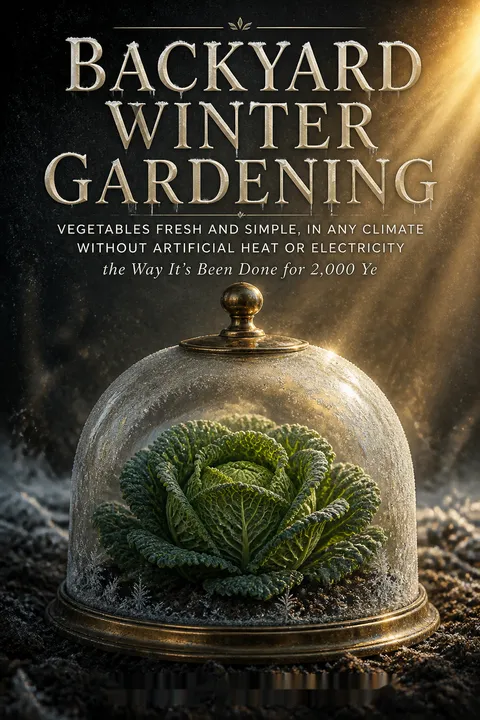
Individual plant coversCloches are small transparent covers, traditionally glass bell-shaped domes, placed over individual plants or small patches. They trap warmth and shelter crops from cold and wet. The book describes both historic glass versions and improvised modern alternatives, while noting that their small size and limited ventilation make them less useful than larger frames for many winter crops.
Download PDF
Download EPUB
.epub digital book format is ideal for reading ebooks on phones, tablets, and e-readers.








