

Key Takeaways
Use the Balanced Scorecard to turn strategy into measurable, shared action
The problem is execution. Organizations often invest heavily in measuring results yet struggle to implement strategy. Niven cites a survey in which only 35 percent rated their performance measurement systems effective or very effective, and reports that roughly nine in ten organizations fail to execute their strategies. Traditional financial reports explain what happened, but often miss the employee knowledge, customer relationships, and internal capabilities that shape future results.
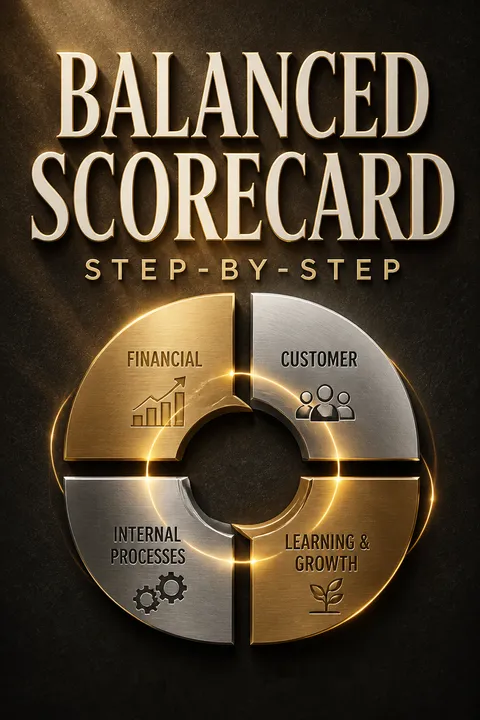
Balance the view. The Balanced Scorecard combines financial measures with indicators of customers, internal processes, and employee learning and growth. The point is not to collect more numbers. It is to translate strategy into a small, connected set of objectives and measures that employees can understand and act on. A good scorecard serves as a measurement system, a management tool, and a way to communicate what matters.
What's striking is that the scorecard treats measurement as a shared language, not merely a reporting task. That aligns with organizational learning: people can coordinate better when goals and evidence are visible across roles. But visibility alone does not guarantee good judgment. A measure is a proxy for a complex outcome, and optimizing the proxy can distort the outcome, a problem often associated with Goodhart's law. The scorecard is strongest when it invites interpretation and discussion, rather than presenting every number as an unquestionable verdict.
Link measures into a causal story, or the scorecard is just a dashboard
Connect the measures. The book's central technical idea is to link objectives and measures across four perspectives: financial, customer, internal processes, and employee learning and growth. These cause-and-effect linkages describe how the organization believes it will achieve its strategy. For example, training employees may improve product development, which could strengthen customer loyalty and, in turn, increase revenue.
Treat the map as a hypothesis. The connections should be explicit enough to test. If training rises but product development slows, the assumed relationship may be wrong, incomplete, or delayed. A scorecard is therefore more than a collection of useful indicators. Its linked measures make the organization's theory of value creation visible, so leaders can compare expected results with actual ones and revise their assumptions.
The map's intellectual value lies less in claiming certainty than in making assumptions inspectable. This resembles a scientific model: specify a mechanism, observe outcomes, and revise when evidence disagrees. Yet a chain of measures does not by itself establish causation. Training and innovation might rise together because both received new funding, for instance. Leaders should consider timing, outside influences, and plausible alternatives before changing strategy. Explicit maps improve the quality of questions, even when they cannot settle every causal dispute.
Start with your mission, then choose whom you serve and how you differ
Name the destination. Niven separates four building blocks. The mission explains why the organization exists. Values state the principles guiding behavior. Vision describes the future it seeks. Strategy identifies the choices and activities intended to reach that future. Without this foundation, a scorecard can become an assortment of indicators with no coherent direction.
Make a distinct choice. In the customer perspective, the organization identifies its target customers and its value proposition, meaning the particular benefit it promises to deliver. The book describes three common choices: operational excellence, product leadership, and customer intimacy. A low-cost, convenient provider makes different choices from a company competing through innovation or deep customer knowledge. Measures should reflect those choices, not simply copy competitors' metrics.
This sequence guards against a common planning error: confusing aspirations with strategy. A mission can inspire, and a vision can orient, but strategy requires choices about where to focus and what not to pursue. The value proposition makes those choices legible to customers and employees. Still, the categories are useful prompts, not universal boxes. Organizations may combine approaches or serve several constituencies. The practical test is whether the chosen measures reveal a coherent pattern of priorities rather than a slogan that promises everything to everyone.
Pair outcome measures with the drivers that make those outcomes possible
Track results and causes. Lag measures describe results already achieved, such as revenue or customer satisfaction. Lead measures track activities or conditions believed to drive those results, such as time spent with customers or staff access to customer information. The scorecard needs both. Outcomes without drivers do not show how to improve; drivers without outcomes do not show whether the activity creates value.
Choose measures deliberately. Niven recommends measures that connect to strategy, can be quantified and accessed, are understandable, and have clear definitions. He notes that many organizations use roughly 20 to 25 measures on their highest-level scorecard, though the right number depends on the strategy. A measure dictionary records its purpose, owner, calculation, data source, reporting frequency, and target, reducing confusion when results are shared.
The distinction between drivers and outcomes is a practical antidote to rearview-mirror management. It also exposes an important risk: an apparent driver may be only a convenient activity, not a genuine cause of success. Organizations should test whether the chosen lead measure predicts the intended result and whether employees can influence it. A compact scorecard helps preserve attention, but numerical limits are not a substitute for coherence. The decisive question is whether each measure changes a meaningful decision.
Secure an executive sponsor before asking the organization to change
Build the conditions first. A scorecard is a change effort, not simply a metrics exercise. Niven recommends defining why the organization is undertaking it, choosing a suitable unit to begin with, securing an executive sponsor, forming a cross-functional team, and planning communication and training. The sponsor must connect the project to strategy, commit resources, and show support through actions as well as statements.
Make participation credible. The team needs people with different operational knowledge, a clear leader, and enough time to do the work. Employees should hear why the change is necessary and what is expected of them. Niven warns that new systems can fail when leaders offer only shallow support, employees lack training, or earlier change efforts have damaged confidence. Communication, education, and visible leadership are part of implementation, not decoration around it.
The emphasis on sponsorship reflects a basic feature of institutional change: attention from senior leaders tells employees which initiatives are real. Yet sponsorship cannot be reduced to endorsement from the top. If leaders demand participation but make no time or resources available, the message contradicts itself. Credibility grows when executives use the same measures in their own decisions and acknowledge uncertainty. A cross-functional team also matters because strategy usually crosses organizational boundaries, while authority and information often remain trapped within them.
Cascade measures until every team can show its influence on strategy
Create a line of sight. Cascading means developing aligned scorecards at successively lower levels of the organization. Each group asks which higher-level objectives it can influence, then chooses measures that show its contribution. This is not simply dividing a corporate target into smaller quotas. A customer-service unit might track redesigned customer processes, while its information-technology team tracks the speed of support that enables that redesign.
Include the whole workforce. Cascading can extend to business units, departments, shared-service teams, and individual employees. At Nova Scotia Power, more than 100 scorecards connected work across the organization. Personal scorecards can also clarify employee goals and link them to team priorities. The process works only when people understand the higher-level strategy and receive help developing measures that are relevant to their actual responsibilities.
Cascading is most valuable when it creates alignment without pretending that every role has the same leverage. A frontline worker may influence service reliability directly but have little control over revenue or market share. Assigning the right local measures respects that difference and can strengthen agency. The danger is turning alignment into a rigid chain of quotas, where local teams optimize their own targets at the expense of the whole. Review across levels is essential to preserve collaboration and expose conflicting incentives.
Make funded initiatives prove their connection to strategic targets
Let strategy guide spending. Niven argues that budgets often develop separately from strategic plans, leaving resources tied to short-term financial expectations rather than long-term objectives. The scorecard offers a bridge: units identify the initiatives needed to meet their targets, estimate the resources required, and explain how each initiative supports strategy.
Sort projects before funding them. First inventory current initiatives. Then map each to scorecard objectives, consider ending or consolidating projects with no strategic contribution, identify missing initiatives, and prioritize the remaining proposals. Targets can be set at different horizons: long-term audacious goals, stretch targets over several years, and shorter-term milestones. Honeywell, for example, pursued a goal of reaching $10 billion in annual revenue by 2000 and reported sales of $9.9 billion in 1999. The scorecard helps turn such ambitions into funded steps.
Linking strategy to budgets makes priorities concrete because funding is one of an organization's clearest declarations of what it values. The process can also surface duplicated projects and neglected capabilities. But a strategic label should not automatically guarantee funding. Initiatives still need credible estimates, clear ownership, and evidence that expected benefits justify their costs. Similarly, a project without an immediate scorecard link may support resilience or compliance. The exercise should sharpen resource choices, not narrow judgment to whatever is easiest to quantify.
Tie rewards to balanced results only after the measures earn trust
Use incentives carefully. Linking compensation to scorecard results can focus attention on organizational priorities and help employees see how their work contributes. Organizations may base rewards on companywide results, cascaded team or individual scorecards, competency development, or gainsharing, where employees share benefits from measurable improvements. Some plans use thresholds that must be met before payouts begin.
Protect against distortion. Niven advises organizations to consider who participates, which measures count, how often rewards are calculated, and how the program is funded. A premature link is risky when measures are new, targets are untested, or data is unreliable. Rewards should include more than short-term financial outcomes if the scorecard is meant to balance multiple perspectives. The design must also be seen as fair. Otherwise, employees may focus on gaming the measures or distrust the entire system.
Incentives can reinforce a strategy, but they also change the behavior being measured. This is why a measure that works for learning may become a poor measure when money is attached. A team rewarded for call volume, for example, could rush conversations and damage service quality. Fairness, transparency, and a mix of outcomes reduce that risk, but cannot eliminate it. The scorecard's intrinsic appeal, including clearer purpose and participation, should remain valuable even when no bonus is available.
Use scorecard reviews to question assumptions, not punish missed targets
Turn reporting into learning. Results should be reviewed often enough to guide decisions, and the reporting process should make data clear, timely, and accessible. Software can support analysis, cause-and-effect maps, and broad sharing, but paper reports or an intranet may be adequate for some organizations. Technology enables the system; it does not create a sound strategy or good measures.
Keep the scorecard alive. Management meetings can shift from debating budget variances to examining what scorecard results suggest about the strategy. A missed target may reflect weak execution, a faulty assumption, an outside influence, or a poor measure. Organizations should review objectives, measures, and targets regularly, often annually, and change them when strategy or evidence warrants it. Changing a measure simply because results are uncomfortable defeats the purpose of learning.
This approach turns management review into a feedback loop, a principle shared with adaptive control systems: compare intended and actual states, diagnose the difference, and adjust the model or the action. The distinction between a performance problem and a mistaken assumption is especially important. Punitive reviews encourage people to hide bad news, weakening the data leaders need. At the same time, learning language should not excuse repeated execution failures. Inquiry and accountability work best together when owners explain results and propose a credible response.
Put mission above profit when measuring public and nonprofit work
Reorder the scorecard. Public agencies and nonprofits exist to achieve a mission, not to maximize shareholder returns. Their scorecards should therefore place mission at the top, followed by the customers or constituents they serve. Financial measures remain relevant as constraints or indicators of responsible resource use, while internal processes and employee capabilities show how the organization delivers its services.
Measure progress where outcomes are distant. Public-sector agencies may serve several customer groups, including funders and beneficiaries, and some social outcomes are hard to attribute to one program. The Texas State Auditor's Office used a mission-centered scorecard and developed aligned scorecards for its strategies, support units, and project teams. When long-term outcomes cannot be measured directly, agencies can track nearer-term outputs, while recognizing that these are proxies rather than proof of mission success.
Mission-centered measurement corrects a bias that can arise when private-sector models are transferred unchanged into public service. It keeps attention on beneficiaries rather than treating financial efficiency as the ultimate outcome. The complication is that public programs often serve multiple groups with conflicting interests, and social outcomes have many causes. Output measures can help track activity, but they must not be mistaken for impact. Transparent discussion of the proxy's limits makes public accountability more credible, not less.
Analysis
Niven's book is best understood as an implementation manual for a management idea, not as a defense of measurement for its own sake. Its core argument is that strategy becomes actionable when it is translated into linked objectives, measures, targets, and initiatives, then embedded in routines such as budgeting, management review, and compensation. The narrative moves from why financial-only reporting falls short, through scorecard construction, to the organizational changes required to make the tool durable. Its intended readers are managers and project leaders who must make the concept work inside real institutions.
The deepest insight is the insistence on relationships. A list of financial and nonfinancial indicators can look balanced yet remain strategically empty. The proposed causal map makes leadership's assumptions visible: which capabilities are expected to improve which processes, which processes should affect customers, and how those outcomes support financial or mission results. This is a valuable discipline because it converts strategy from language into a testable model. It also reveals the approach's main epistemic limitation. Measures and arrows are hypotheses, not causal proof. Delays, external forces, and interactions among variables can make simple chains misleading. The book is at its strongest when it presents the scorecard as a basis for strategic learning rather than certainty.
The implementation advice is similarly important. Executive sponsorship, employee participation, communication, cascading, and data routines are not secondary project tasks. They determine whether measures become part of decision-making or remain an attractive report. Cascading is especially powerful when it gives employees a line of sight without forcing identical targets onto dissimilar jobs. Budget alignment then makes strategy consequential by connecting it to finite resources.
The framework also carries risks. Incentives can narrow attention, proxies can become targets, and excessive measures can recreate the reporting burden the system was meant to solve. Public and nonprofit settings make these tensions sharper because outcomes are contested and difficult to attribute. The best use of the scorecard is therefore disciplined but provisional: keep the strategy explicit, make assumptions contestable, preserve a balance of indicators, and revise the model when evidence changes. Its value rests not in the dashboard, but in the conversations and choices the dashboard makes possible.
Review Summary
Balanced Scorecard Step-by-Step receives positive reviews for its clear structure and practical approach to implementing balanced scorecards. Readers appreciate the templates, checklists, and insights provided. The book is highly recommended for management consultants and those leading BSC projects. While some find it repetitive, most consider it a valuable resource for understanding and applying the balanced scorecard concept. The book's organization and examples are praised, though some suggest there may be easier introductions for beginners. Overall, it's viewed as a useful guide for business professionals interested in performance measurement and strategy implementation.
Glossary
Balanced Scorecard
Strategy translated into measuresA management approach that translates an organization's strategy into objectives, measures, targets, and initiatives. It balances financial results with indicators of customers, internal processes, and employee learning and growth. Its measures are intended to connect through cause-and-effect relationships, so the scorecard can support performance measurement, strategy execution, communication, and organizational learning.
Perspectives
Views of performanceThe broad categories used to organize Balanced Scorecard objectives and measures. The standard perspectives are Financial, Customer, Internal Processes, and Employee Learning and Growth. They provide different views of how an organization creates value, while remaining adaptable when another perspective is needed to describe its strategy or key stakeholders.
Cause-and-effect linkages
Connections among measuresThe proposed relationships connecting measures across scorecard perspectives. They express how an organization believes improvements in capabilities or processes will affect customers and, ultimately, financial results or mission outcomes. These linkages make the strategy's assumptions explicit and open to review. They are hypotheses to test, not automatic proof that one measure causes another.
Cascading
Aligning scorecards across levelsThe process of developing aligned Balanced Scorecards for successive levels of an organization, from the highest-level scorecard to business units, departments, teams, and sometimes individuals. Each lower-level group identifies the objectives and measures it can influence, showing how its work contributes to broader organizational goals without simply dividing high-level targets into smaller quotas.
Value proposition
Promised customer benefitThe particular value an organization promises to deliver to its chosen customers. The book highlights operational excellence, product leadership, and customer intimacy as common approaches. The selected proposition helps determine which customer outcomes and internal processes belong on the scorecard, and clarifies how the organization intends to distinguish itself.
Lag and lead measures
Outcomes and their driversLag measures describe results that have already occurred, such as revenue or customer satisfaction. Lead measures track activities or conditions believed to drive those results, such as time spent with customers or employee access to information. A useful scorecard includes both: outcomes show whether goals are being reached, while drivers help explain how results may be improved.
Big Hairy Audacious Goals (BHAGs)
Long-range, ambitious goalsA term used for bold, clear long-term goals intended to focus an organization and stimulate substantial progress. In Niven's discussion, these goals can take many years to achieve and should be supported by concrete mechanisms, intermediate targets, and management practices. Without that support, an ambitious statement can remain motivational rhetoric rather than guide action.
FAQ
What is "Balanced Scorecard Step-by-Step" by Paul R. Niven about?
- Comprehensive Balanced Scorecard guide: The book provides a detailed, step-by-step approach to developing, implementing, and maintaining the Balanced Scorecard as a strategic management system.
- Focus on strategy execution: It emphasizes translating organizational strategy into actionable objectives, measures, and initiatives across all levels.
- Bridging theory and practice: Paul R. Niven combines theoretical foundations with practical advice, real-world examples, and case studies to help organizations achieve strategic alignment and performance improvement.
Why should I read "Balanced Scorecard Step-by-Step" by Paul R. Niven?
- Proven, widely-used methodology: The Balanced Scorecard is adopted by over half of Fortune 1000 companies and is recognized as a top management innovation.
- Practical, actionable insights: Niven draws on his own implementation experience, offering step-by-step guidance, best practices, and lessons learned.
- Comprehensive coverage: The book covers everything from initial design and team building to embedding the Scorecard into management systems, budgeting, and compensation.
What are the key takeaways from "Balanced Scorecard Step-by-Step"?
- Strategic alignment: The Balanced Scorecard aligns organizational objectives, measures, and initiatives from top to bottom, ensuring everyone understands their role in strategy execution.
- Balanced performance measurement: It integrates financial and nonfinancial measures, balancing lagging and leading indicators across four perspectives.
- Sustained results: The book provides tools for maintaining and updating the Scorecard, linking it to budgeting, resource allocation, and compensation for long-term success.
What is the Balanced Scorecard, and why is it important according to Paul R. Niven?
- Strategic management tool: The Balanced Scorecard translates mission, vision, and strategy into a coherent set of performance objectives and measures across four perspectives: Financial, Customer, Internal Process, and Employee Learning and Growth.
- Holistic performance view: It overcomes the limitations of financial-only measures by incorporating drivers of future performance and value creation.
- Alignment and communication: The Scorecard aligns individual and departmental goals with overall strategy, serving as a powerful communication and engagement tool.
What are the four perspectives of the Balanced Scorecard as described by Paul R. Niven?
- Financial perspective: Focuses on growth, profitability, and value creation, reflecting the organization's financial objectives.
- Customer perspective: Measures how well the organization is delivering value to its chosen customer segments, based on its value proposition.
- Internal Process perspective: Tracks key internal processes that drive customer satisfaction and financial results, often requiring new process identification.
- Employee Learning and Growth perspective: Addresses employee skills, tools, motivation, and alignment, serving as the foundation for all other perspectives.
How does "Balanced Scorecard Step-by-Step" by Paul R. Niven recommend developing objectives and measures for each perspective?
- Start with strategy: Objectives and measures should be directly linked to the organization's strategy and value proposition.
- Brainstorm and evaluate: Generate a broad list of potential objectives and measures, then evaluate them for strategic linkage, quantifiability, and relevance.
- Limit and document: Aim for 20-25 measures on the high-level Scorecard, and use a measure dictionary to ensure clarity, accountability, and consistency.
What is the difference between lagging and leading measures in the Balanced Scorecard, and why are both important?
- Lagging measures: These are outcome indicators (e.g., sales, profit, customer satisfaction) that reflect the results of past actions.
- Leading measures: These are predictive indicators (e.g., training hours, process improvements) that drive future performance and outcomes.
- Balanced mix: Both types are necessary—lagging measures show if goals are met, while leading measures guide actions to achieve those goals and enable proactive management.
How does Paul R. Niven’s Balanced Scorecard method use cause-and-effect linkages to support strategy execution?
- Strategy hypothesis: The Scorecard articulates strategy as a series of "if-then" relationships among objectives and measures.
- Strategy map creation: Linkages connect financial, customer, internal process, and learning and growth objectives, telling the story of how value is created.
- Strategic learning: These connections allow organizations to test, validate, and refine their assumptions, ensuring coherence and alignment across all levels.
How does "Balanced Scorecard Step-by-Step" advise organizations to cascade the Balanced Scorecard throughout the organization?
- Alignment through cascading: Develop Scorecards at all organizational levels, aligning lower-level objectives and measures with the high-level Scorecard.
- Review and feedback: Use a two-phased approach—team review for consistency and peer review for feedback and improvement.
- Benefits: Cascading creates a consistent measurement language, increases employee involvement, and motivates groups to examine interdependencies and improve performance.
How does Paul R. Niven recommend linking the Balanced Scorecard to budgeting, resource allocation, and compensation?
- Budgeting alignment: Use a five-step process to connect budget spending directly to strategic objectives, reducing politics and improving resource allocation.
- Compensation linkage: Design reward systems that balance intrinsic and extrinsic motivation, focusing on critical drivers of success and aligning rewards with Scorecard performance.
- Initiative prioritization: Map current and new initiatives to Scorecard objectives, eliminate nonstrategic projects, and allocate resources to maximize strategic impact.
How is the Balanced Scorecard adapted for public sector and not-for-profit organizations according to Paul R. Niven?
- Mission-focused framework: Place mission at the top of the Scorecard, with customer perspectives next and financial measures as enablers or constraints.
- Sector-specific challenges: Address issues like multiple stakeholders, difficulty measuring outcomes, political pressures, and cultural resistance to business tools.
- Leadership and communication: Emphasize strong leadership, clear communication, and involvement to overcome skepticism and ensure successful Scorecard adoption.
What are the most common Balanced Scorecard implementation challenges and pitfalls highlighted by Paul R. Niven?
- Premature process links: Linking Scorecard measures to compensation or budgeting too early can cause dysfunction and loss of momentum.
- Lack of cascading and alignment: Failing to cascade the Scorecard limits alignment and employee engagement.
- Terminology and measure issues: Confusion over terms, using only existing metrics, and inconsistent management practices undermine effectiveness.
- Leadership and training gaps: Insufficient executive sponsorship, unclear objectives, lack of strategy, and inadequate training are major reasons for Scorecard failure.
Download PDF
Download EPUB
.epub digital book format is ideal for reading ebooks on phones, tablets, and e-readers.








