

Key Takeaways
Treat embodiment as gradual trust-building, not forced exposure.
A gradual return. Fay describes looking in a gym mirror and suddenly recognizing that a person lived inside her body. Despite years of yoga and meditation, trauma had left her feeling disconnected; when it surfaced, she became too distressed to function as before. Her response was to return to basic body awareness and develop practical skills, later shaped by her clinical work with trauma survivors.
A map, not a demand. Becoming Safely Embodied is a structured approach to making inner experience more understandable and manageable. It emphasizes building resources, connection, and present-moment awareness rather than rushing into traumatic memories. The goal is not to declare the body safe by force, but to develop a more workable relationship with it, one manageable experience at a time. Therapy may be important when independent practice is not enough.
The book's central strength is its distinction between contacting the body and flooding the body. That distinction matters because body awareness can be calming for one person and activating for another. In trauma-informed care, pacing and choice are not niceties; they are part of the intervention. The metaphor of becoming at home in the body is most useful when home is understood as a place that can be approached room by room, with exits available. The approach also resists a common mistake: treating insight into the past as sufficient when present-day regulation and support remain fragile.
Regulate first; explore painful material only at a tolerable pace.
Practice before the storm. Fay treats repeated practice as preparation for moments when distress makes choice harder. Mindfulness trains noticing without judgment; concentration trains directing attention toward a chosen anchor. Both can help someone avoid being swept into a trigger. She recommends starting meditation briefly, sometimes for one to three minutes, and practicing when relatively settled so the skill is more familiar under pressure.
Let the breath vary. Deep breathing is not universally calming and may intensify sensation. Fay suggests experimenting gently, including small breaths or an even, comfortable rhythm, and returning to normal breathing if dizziness or discomfort appears. Loving-kindness practice, or metta, can focus attention on phrases of care, adapted if standard phrases provoke resistance. The principle is experimentation, not performance: stop, change the practice, or seek support if it makes distress worse.
This approach resembles skills training in therapies that distinguish stabilization from trauma processing. The useful insight is that attention can be trained as both a wide lens, noticing what is present, and a narrow beam, returning to a chosen focus. That flexibility may matter more than any single meditation technique. It also corrects the assumption that breath work is automatically soothing. Interoceptive attention can amplify alarm in some people, so consent, pacing, and alternatives such as visual or tactile anchors are essential rather than signs of failure.
Treat protest as a signal of need, not proof you're difficult.
Look beneath resistance. Fay reframes protest, anger, withdrawal, and reluctance as possible signs that something important is missing. Drawing on attachment research about children separated from caregivers, she describes protest, despair, and detachment as responses to disrupted connection. In this book, resistance becomes information to approach carefully, not a defect to overpower.
Needs are ordinary. Fay identifies seven foundational attachment needs: protection and care, attunement, soothing, delight and affirmation, guidance, repair after conflict, and a sense of ease. When those needs go unmet, people may feel ashamed of having them at all. A belonging exercise uses cherished objects or memories, such as a sprig of rosemary that recalls a grandmother's garden, to reconnect with sources of care and identity beyond suffering. Sharing is optional.
Reading resistance as information can soften self-blame and make behavior more intelligible. Attachment theory adds an important relational dimension: regulation is often learned through being noticed and comforted, not through solitary willpower. The idea also has a practical limit. Protest may point toward an unmet need, but it does not automatically identify the need or the safest person to meet it. Curiosity works best alongside discernment, especially where relationships are harmful. Belonging can include community, place, memory, and values, not only closeness to another individual.
Name thoughts, feelings, and sensations before they become one storm.
Separate the ingredients. Fay uses T/F/S as shorthand for thoughts, feelings, and sensations. A thought interprets an event, a feeling names an emotional state, and a sensation describes bodily experience. Distinguishing them can slow an apparently overwhelming reaction and reveal where choice is possible. The Bridge of Attunement is her term for developing the capacity to notice inner experience and make sense of it, especially when early caregivers did not help a person interpret bodily signals.
A sensation is not its story. Anxiety and excitement can both involve a fast heartbeat, shallow breathing, and butterflies. The bodily signals overlap; context and interpretation shape how they are understood. Fay invites readers to describe sensations concretely before deciding what they mean. If inward attention is too much, start with an external object or a small, neutral sensation rather than forcing deeper exploration.
This method links interoception, the perception of internal bodily signals, with emotional labeling and cognitive distance. Naming a state can turn an undifferentiated alarm into information that can be considered. The anxiety and excitement comparison is particularly memorable because it shows that bodily arousal alone does not dictate a single interpretation. Still, labels are hypotheses, not verdicts: a racing heart can reflect emotion, exertion, illness, or several causes at once. The value lies in creating room to investigate, not replacing judgment with a new certainty.
Separate observable facts from emotional forecasts to recover the present.
Start with what happened. Fay describes the window of tolerance as the range in which a person can take in experience without becoming overwhelmed or shutting down. Trauma can push someone toward hyperarousal, such as panic, or hypoarousal, such as numbness and disconnection. Her exercise for widening this range begins with a moderately activating event, not the most painful memory, and separates observable facts from feelings and interpretations.
Facts reduce the charge. One client, anxious at a late dentist appointment because he also had to collect his child, identified the bare facts: he had an appointment, the dentist was late, and pickup was due. Repeating those details reduced the emotional intensity without making the anxiety unreal. The feelings still mattered; they were simply treated as responses to the facts, rather than additional facts about what was happening.
The exercise resembles cognitive defusion and reality testing: a person learns to distinguish an event from the meaning assigned to it. Its strength is that it does not ask readers to argue themselves out of emotion. Instead, it adds context and can help restore perspective when alarm has narrowed attention. The distinction should not be used to dismiss valid emotional responses or overlook actual danger. Observable facts are a stabilizing starting point, not a complete account of an event's meaning, history, or consequences.
When today's reaction is too large, ask what earlier moment it carries.
Notice the mismatch. Fay calls the intrusion of past distress into present experience a Parallel Life. A dissociation barrier is the mind's way of cordoning off unbearable material; fragments may later surface as strong sensations, emotions, or reactions without a clear narrative memory. The clue is often disproportion: the current event feels far more threatening than its observable details suggest. This is a prompt for gentle inquiry, not proof of a particular memory.
Rebuild the sequence. Fay's friend believed her wallet had vanished while traveling and became distraught. A calm companion helped her orient to the people and place around her. Later, the wallet turned up in another pocket. The reaction made more sense when connected to an old expectation that mistakes brought painful consequences and abandonment. Mapping the sequence of present cues, thoughts, feelings, and sensations can help distinguish current danger from an old alarm.
The Parallel Lives model offers a useful way to understand why a reaction can feel both immediate and strangely familiar. It shifts the question from 'Why am I overreacting?' to 'What is this response organizing around?' That shift can reduce shame and support more precise care. However, intensity alone cannot establish that trauma is the cause; present circumstances may genuinely be unsafe, and memory is not always a reliable record. The model is best used as an exploratory map, ideally with a trusted clinician when memories or dissociation become destabilizing.
Meet inner parts with curiosity, boundaries, and an adult point of view.
A part is not the whole. Fay draws on parts-based approaches to describe conflicting inner states: one may fear abandonment, another may be angry, while another tries to keep daily life functioning. These states can feel like competing conversations rather than a single coherent voice. The task is to notice them without identifying completely with any one of them, then respond from a steadier, more compassionate perspective.
Offer care with limits. Fay describes a client, Wayne, who used different colored pens to record inner voices and distinguish them by age and quality. Externalizing made the voices easier to observe. A person might acknowledge a distressed part, ask what it needs, and set a time to return if work or safety requires attention elsewhere. Compassion does not mean obeying every impulse; boundaries can protect both the person and the parts seeking attention.
Parts language can make internal conflict less mysterious and less morally loaded. It gives people a way to recognize protective strategies without treating them as their entire identity. The approach also combines warmth with agency: an inner state can be heard without being allowed to dictate every action. This is a valuable corrective to both harsh self-control and unbounded emotional indulgence. The metaphor should remain a metaphor unless used in a clinically appropriate framework; ordinary inner conflict alone does not establish a dissociative disorder.
Choose one small life-giving step, then expect resistance without obeying it.
Make change small enough. Fay calls moments of possible change choice points. They may involve a new thought, action, movement, or response, but stepping toward them can produce turbulence: anxiety, fatigue, fear, or an urge to return to the familiar. Small steps lower the risk of becoming overwhelmed while giving the person evidence that a different response is possible.
Build from a foothold. A woman anxious about meeting a partner might replace the daunting goal of finding a relationship with a smaller experiment, such as smiling at one person. The point is not that this single act solves loneliness. It makes approach more manageable and gives her a chance to notice what happens in her body and thoughts. If resistance rises, she can reduce the step further, pause, and choose again rather than treating discomfort as proof of failure.
The emphasis on tiny actions fits behavioral learning: repeated, manageable encounters can build confidence more reliably than dramatic resolutions. It also respects the protective function of avoidance, which may once have helped someone survive. A small step is not automatically the right step, however. It should move toward a personally meaningful life, not merely toward socially approved behavior, and it should not compromise safety. The crucial measure is whether the experiment increases usable choice and self-trust, not whether it produces immediate comfort.
Retell a stuck story from another angle to loosen its grip.
Beliefs filter experience. Fay argues that repeated stories can reinforce beliefs about the self and the world. Narrative therapy offers a way to externalize those stories and explore alternatives without pretending the original pain did not happen. Readers are invited to recount an emotionally charged event, then retell it from another perspective and notice how each version affects thoughts, feelings, and bodily experience.
Try a different vantage point. In one exercise, Alexis sat in a park with a friend while children played nearby. Asked to tell the scene from the children's perspective, she found a more playful and hopeful view; imagining the hawk overhead gave her a sense of expansiveness. The event itself did not change. What changed was the angle from which it was understood, revealing possibilities the first account had left out.
Narrative flexibility can loosen the assumption that one painful interpretation exhausts the truth. This is not simply positive thinking: alternative perspectives can reveal overlooked details, relationships, and sources of agency. The exercise is strongest when the new telling remains anchored to what actually happened. Otherwise, reframing can become a way to bypass grief or pressure someone into optimism. Multiple stories are useful not because every account is equally accurate, but because a person can hold more than one meaning without being trapped by the most punishing one.
Practice the wiser response until it is available when distress rises.
Rehearse steadiness. Fay's older, wiser self exercise asks readers to imagine a future version of themselves who has lived through difficulty and can offer perspective. The imagined self can listen to present worries and suggest a next step; writing or drawing afterward helps preserve what emerged. The point is not prediction. It is to practice accessing a compassionate, broader viewpoint instead of allowing the most frightened state to define the entire future.
Repeat and adapt. Fay recommends practicing one skill regularly, keeping a journal, and seeking safe community. Skills become more familiar through repetition, but there is no single technique that works for everyone. If an exercise increases distress, it can be changed or stopped. When trauma symptoms are severe, or inner exploration feels unsafe, a qualified therapist can provide support and pacing that a book cannot.
The future-self exercise resembles mental simulation: imagining a capable perspective can make a desired response easier to access in the present. Its usefulness depends less on believing that an ideal future is guaranteed than on rehearsing qualities such as patience, clarity, and care. Repetition also matters because under threat, familiar responses tend to dominate. The book's strongest practical safeguard is flexibility: practice is not a test, and support is not a failure. An imagined inner guide can complement, but cannot replace, dependable relationships or professional care.
Analysis
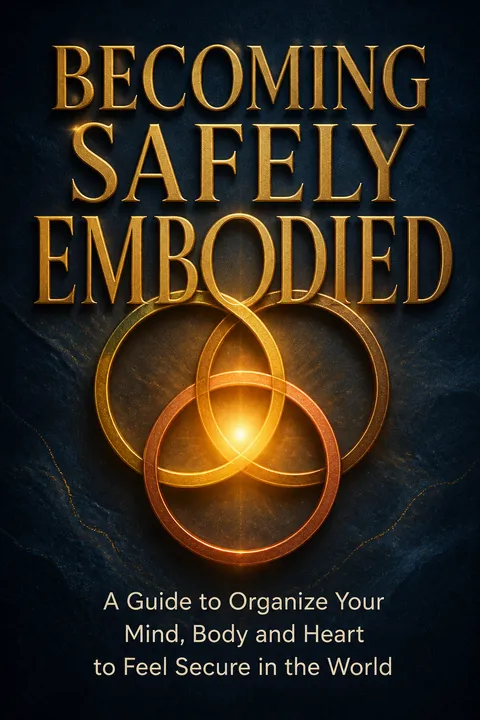
Becoming Safely Embodied is both a trauma-informed skills manual and a personal account of how its author came to prioritize the body in recovery. Its organizing claim is that healing requires more than remembering or explaining painful events. People also need ways to notice bodily activation, distinguish present circumstances from past associations, and build responses that can be used outside the therapy room. The book's sequence reflects that logic: establish safety and belonging, train attention, parse internal experience, map triggers, relate to inner parts, and experiment with alternatives.
Its most distinctive contribution is practical granularity. Instead of asking a reader to become calm or self-compassionate on command, Fay breaks those aims into observable actions: name one sensation, identify bare facts, use an external anchor, or make a step smaller. The examples show how ordinary situations, a late appointment, a missing wallet, a household leak, can become entrances to understanding a larger pattern. They also make the model memorable without requiring every reader to begin with traumatic autobiographical detail.
The central caution is that this is a clinically informed framework, not a controlled evaluation of each practice. Case narratives and the author's report of group experience establish plausibility and practical relevance, but do not prove that every technique works for every trauma survivor. Some physiological explanations are simplified for accessibility, and intense inward attention can be counterproductive for some people. The book does acknowledge this and repeatedly emphasizes choice, pacing, and professional help.
The most useful reading is therefore neither as a universal prescription nor as a substitute for treatment. It is a flexible menu for building awareness and agency. Its deepest message is that the body can be approached as a source of information, not merely as the site of symptoms, provided that safety, context, and individual limits remain central.
Review Summary
Glossary
Becoming Safely Embodied (BSE)
Trauma-informed self-regulation skillsA structured approach developed by Deirdre Fay to help people build a more secure relationship with their bodily, emotional, and mental experience. It combines attention practices, attachment-informed ideas, body awareness, and practical exercises. Its aim is to help people recognize triggers, stay oriented to the present, and develop more workable responses at a pace that feels manageable.
T/F/S
Thoughts, feelings, sensationsFay's shorthand for three distinguishable parts of inner experience: thoughts, which interpret or describe; feelings, which name emotional states; and sensations, which describe bodily signals such as tightness, warmth, or trembling. Separating them can make an overwhelming reaction easier to observe and understand, rather than experiencing it as one undifferentiated state.
Bridge of Attunement
Connection to inner experienceFay's term for the capacity to notice internal experience and make sense of it with care. It involves staying aware of oneself while attending to thoughts, emotions, and bodily sensations. The skill is especially relevant when early relationships did not help a person recognize or organize internal signals, leaving them to develop that self-attunement later.
Window of Tolerance
Manageable range of activationThe range of emotional, cognitive, and bodily activation within which a person can remain engaged with experience. Outside this range, someone may become hyperaroused, with panic or overwhelm, or hypoaroused, with numbness or shutdown. Fay uses the concept to encourage gradual expansion of what a person can tolerate, rather than pushing into overwhelming material.
Parallel Lives
Past distress entering present experienceFay's way of describing how unresolved experiences can become active alongside current life. A present cue may evoke old thoughts, feelings, and bodily responses so strongly that the person feels transported into another time. Distinguishing what is happening now from what belongs to the past can help restore perspective and guide a safer response.
Dissociation Barrier
Mental separation from unbearable experienceA protective process in which overwhelming experience is compartmentalized, reducing its immediate impact or keeping it outside conscious memory. Fay describes this barrier as sometimes becoming more permeable, allowing fragments of the past to intrude through symptoms, sensations, or memories. The term is used to explain protective disconnection, not to diagnose a particular disorder.
time capsules
Stored fragments of past experienceFay's metaphor for undigested memories or experience fragments that can include thoughts, feelings, sensations, and impulses. They may become active when a current event resembles something from the past, even when the person does not consciously recognize the link. The metaphor helps organize how old responses can influence present reactions without appearing as a clear narrative memory.
choice points
Moments for a different responseFay's term for moments when a person can experiment with an alternative thought, feeling, action, or movement instead of following a familiar pattern. Choice points may be small and can bring up anxiety or resistance. Repeated, manageable experiments help a person identify responses that better fit the life they want to build.
metta
Loving-kindness concentration practiceA meditation practice that focuses attention on phrases wishing well-being, ease, or freedom from suffering for oneself or others. Fay presents it as a way to cultivate concentration and positive regard, and suggests adapting the wording if standard phrases provoke distress. It can be directed toward a neutral person, a loved one, or a struggling part of oneself.
Download PDF
Download EPUB
.epub digital book format is ideal for reading ebooks on phones, tablets, and e-readers.








