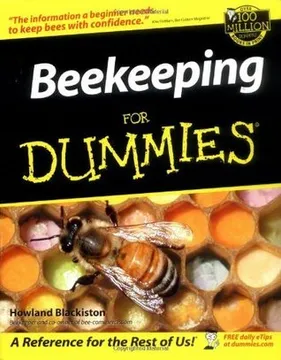


Key Takeaways
Keep bees for pollination and discovery, not just the jar of honey
A wider reward. Beekeeping joins food, gardens, and close observation of a living colony. The book estimates that bee-pollinated plants provide about 30 percent of food consumed in North America, and values US bee pollination at roughly $16 billion. In a backyard, the payoff can be tangible: the author describes increased fruit and vegetable yields after placing hives near a friend’s garden, in return for honey and pollination.
Stewardship takes work. Honey is only one product. Bees also make wax and propolis, while their daily behavior offers a hands-on education in nature. But keeping a hive is not simply installing a box to help declining bee populations. The colony needs inspection, food, space, and protection from pests and environmental stress.
What's compelling is the book's shift from a product-centered hobby to a relationship with an ecological process. A hive makes pollination visible at household scale, where changes in flowering, weather, and colony strength become things a keeper can notice. Yet the large pollination figures describe a broad agricultural system, not a benefit one backyard hive can guarantee. The most defensible case for keeping bees is therefore both modest and meaningful: learn to care for one colony well, improve nearby habitat, and understand that stewardship is a responsibility rather than a symbolic gesture.
Choose your hive for its job, not for its easiest-sounding harvest
Match design to purpose. The Langstroth hive, developed in the 19th century, uses removable frames and stackable boxes. That makes inspection, expansion, and honey extraction straightforward, and its standard parts are widely available. The Kenyan Top Bar hive uses bars rather than full frames, allowing natural comb construction and avoiding the need for an extractor, but its comb is fragile and harvest usually destroys it.
No shortcut to care. Warré hives favor a simple vertical design; observation hives make bee behavior visible but produce little honey; nucs are small colonies with specialized uses. A Flow hive lets honey drain from engineered frames, reducing harvest labor. It does not eliminate inspections, feeding, or pest management. Decide whether the priority is honey, pollination, observation, low lifting, or natural comb, then accept the trade-offs that come with that choice.
Hive design is a form of governance: it determines what the keeper can easily see, move, harvest, and intervene in. Removable frames make diagnosis and exchange easier, while fixed or natural comb designs reduce some manipulations but limit flexibility. That distinction matters more than aesthetics or novelty. The Flow hive is a useful case in human factors: simplifying one task can encourage participation, but it can also create the mistaken impression that the whole system is simple. Good equipment lowers friction; it cannot replace ecological attention.
Prepare the site, equipment, and bee source before spring delivery
Do the homework first. Check local ordinances and registration rules, assess sting-allergy risk, and talk with household members and neighbors before ordering bees. A suitable site is accessible, dry, ventilated, and sheltered from harsh wind, with dappled sun and a nearby water source. The book recommends orienting the entrance southeast when practical, and avoiding flight paths toward doors or walkways. In cities, roof access, load-bearing capacity, and secure hive straps matter as much as bee behavior.
Order ahead. A three-pound package contains about 10,000 bees and a queen. The author recommends reputable suppliers with inspected, healthy stock and suggests Italian, Carniolan, or Russian bees for beginners. Startup equipment is estimated at $300 to $400, with bees costing around $100 or more. Assemble and paint the hive well before spring, and consider a local club or mentor for help.
Preparation is not administrative housekeeping; it is risk management. A water source, safe flight direction, and reliable roof access prevent conflicts that might otherwise be blamed on the bees. The book's neighborly suggestions, including explaining the plan and sharing honey, recognize that an urban or suburban hive depends on social acceptance as well as biology. Costs and rules vary by location and time, so the figures and procedures are best treated as planning estimates. A local bee association or regulator can supply current guidance that a general handbook cannot.
Judge colony health by eggs, brood, stores, and behavior
Look for evidence. A queen can lay more than 1,500 eggs a day, but finding her during an inspection is difficult. Eggs provide a simpler sign that she was recently present. Healthy brood generally forms a compact pattern, with bright white larvae and smooth, slightly convex caps over developing pupae. A scattered pattern, multiple eggs in many cells, or sunken and perforated caps can signal trouble and call for closer investigation.
Keep a record. Check for food, brood, pollen, and signs of pests, and compare what you see with notes from earlier visits. The book recommends a journal or checklist so changes are not left to memory. Inspect new colonies frequently enough to learn what is normal, but handle frames slowly, avoid crushing bees, and keep the hive open only as long as necessary. A calm, systematic inspection is more useful than an anxious search for the queen.
The inspection method resembles good clinical reasoning: infer an unseen condition from several indicators rather than treating one observation as definitive. Eggs, brood pattern, food stores, and adult behavior are complementary signals, and written records make trends easier to detect. This is also a useful corrective to the urge to intervene whenever something looks unfamiliar. However, visual signs are clues, not diagnoses. Diseases can resemble one another, and a beginner may misread normal variation. The book's strongest practical advice is to observe consistently, document change, and seek experienced confirmation when symptoms are serious.
Let the local season set your schedule and your winter safety margin
Timing follows climate. Spring brings colony growth and inspections; summer brings peak foraging and possible honey harvest; autumn is for assessing stores and preparing for cold; winter is for monitoring entrances and avoiding unnecessary disturbance. The book's calendar sorts regions into broad temperature zones, but it stresses that weather, local blooms, and hive type alter the schedule. A calendar is a guide, not a command.
Food and dryness are critical. In cold northern climates, the book recommends entering winter with about 60 pounds of honey; milder regions may need 30 to 40 pounds. Winter bees cluster together and keep the center near 90 to 93 degrees Fahrenheit. Ventilation helps prevent moisture from condensing on a cold cover and dripping back onto the colony. The keeper's job is to leave enough food, shelter the hive from severe wind, and check that snow or dead bees do not block the entrance.
Seasonal management is a form of forecasting: the keeper acts on what the colony will need under the next conditions, not merely what is visible today. That is why winter preparation begins before winter, when food can still be stored and equipment adjusted. The book also resists a common weakness of calendars by making climate the organizing variable. Its numerical targets are useful reference points, but they cannot account for every local forage pattern, hive size, or winter. Observation of the actual colony must refine any general schedule.
Monitor pests before treating, and reserve medication for evidence-based need
Manage, do not guess. Integrated pest management, or IPM, means monitoring pests and using a range of controls while minimizing chemical exposure. For Varroa mites, the book describes powdered-sugar sampling and screened bottom boards as ways to estimate infestation. It also discusses nonchemical measures such as drone-comb trapping, alongside approved treatments. The practical principle is to check the colony rather than medicate automatically, and to follow product directions and local requirements.
Know urgent warning signs. American foulbrood is a serious bacterial disease. The book describes dark, sunken, perforated brood caps and a distinctive ropy consistency in affected larvae. Suspected cases should be confirmed promptly by a state bee inspector or experienced local beekeeper because rules and consequences can be severe. Other conditions, including chalkbrood and sacbrood, have different signs and may not require medication. Treatment options and regulations change, so current expert advice matters.
IPM is valuable because it replaces a false choice between treating everything and ignoring every problem. Monitoring creates a decision point: what is present, how serious is it, and which intervention creates the least collateral harm? That logic applies well beyond beekeeping. The book is also clear that natural methods are not synonymous with doing nothing. One important limit is that specific products, thresholds, and legal rules are time-sensitive. Readers should use the book's monitoring mindset, not assume every named treatment remains appropriate or approved today.
Prevent swarming and robbing by giving colonies space, airflow, and secure food
Anticipate crowding. Swarming is a colony's natural way to reproduce: roughly half the bees may leave with the old queen while the remaining colony raises a new one. The beekeeper loses much of the workforce and may lose that season's harvest. The book's practical remedy is to provide room before the hive is crowded, maintain ventilation, and watch for queen cells that indicate preparation to swarm. Strong colonies and young queens are less likely to swarm, though prevention is not guaranteed.
Close the easy doors. Robbing occurs when bees from another colony steal food from a vulnerable hive. Spilled syrup or exposed honey can trigger it. A reduced entrance helps a small colony defend itself, while covered feeders and careful harvest cleanup limit the scent of exposed food. A nearby clean water source also helps prevent bees from choosing a neighbor's pool or birdbath.
These problems illustrate a central management principle: many dramatic failures begin as ordinary mismatches between colony needs and the conditions around the hive. Congestion, poor ventilation, and accessible food are not mysterious forces; they are adjustable pressures. The most useful keeper is not the one who reacts fastest, but the one who notices the pressure building early. Still, interventions carry trade-offs. For example, restricting an entrance can aid defense but reduce ventilation in hot weather. Effective management requires reading conditions together rather than applying a single fix mechanically.
Harvest only what the bees can spare, then keep honey dry and clean
Leave the pantry stocked. Honey stored beyond the colony's needs is called surplus honey. The book estimates that a strong colony may produce 60 to 100 pounds or more in favorable conditions, but that is not a promise, especially in a first year. In cold climates, the keeper should leave roughly 60 pounds for winter. Harvest when honey is mostly capped and the main nectar flow has ended. Uncured nectar contains too much water and can ferment.
Choose a method. Langstroth frames can be uncapped and spun in an extractor. Top Bar comb is usually crushed and strained or pressed, which destroys the comb but yields wax and fresh building material. Honey absorbs moisture from the air, so containers should be airtight. Crystallization is natural and does not mean the honey has spoiled. Gentle warming can liquefy it, but excessive heat damages aroma and quality.
Harvesting makes the beekeeper's relationship to the colony unusually concrete: every jar taken represents food the bees gathered for their own use. The surplus concept is a practical ethical boundary, not simply a yield calculation. It also helps explain why a first-year harvest can be small without indicating failure. Honey's character depends on floral sources and handling, so careful processing preserves more than appearance. The book's broad yield figures describe favorable possibilities; local conditions and colony strength should take precedence over any expectation of a particular quantity.
Raise queens from colonies whose temperament and resilience you want repeated
Select the parent colonies. Queen rearing means raising new queens; queen breeding adds deliberate selection for traits such as gentleness, disease tolerance, hardiness, and productivity. A queen develops from a fertilized egg when worker bees feed the young larva royal jelly. The book describes several routes, from using naturally formed queen cells to the Miller method and grafting young larvae into queen cups.
Selection is not total control. A queen mates in flight with several drones, so the offspring inherit genes from more than one male. A small beekeeper can favor desirable traits by choosing strong queen-mother colonies and encouraging suitable drone populations nearby, but cannot fully control mating in an ordinary setting. Keeping records of temperament, health, and winter survival helps compare queens over time. Genetic diversity remains important; excessive related mating can produce poor brood patterns.
Queen rearing turns routine beekeeping into a modest form of animal breeding. The keeper is no longer only maintaining a colony, but deciding which traits deserve to shape future colonies. That can improve fit to local climate and temperament needs, especially when observations are recorded rather than remembered selectively. The limits are just as instructive: mating occurs beyond the keeper's full control, and a trait such as honey yield depends partly on weather and forage. Selection works best as patient, evidence-based stewardship, not a promise of engineering a perfect bee.
Analysis
This handbook is less a single argument than a guided apprenticeship. Its sequence moves from the appeal of bees, through equipment and installation, into observation, seasonal management, diagnosis, harvest, and the possibility of breeding queens. That progression mirrors the beekeeper's changing relationship to the hive: first curiosity, then practical responsibility, and finally a more informed capacity to make choices. The central lesson is that competent beekeeping depends on recognizing what the colony is doing before deciding what to do to it.
The book's most durable contribution is its translation of a complex colony into observable signs. Eggs indicate recent queen activity; brood patterns reveal more than a queen sighting alone; stores, ventilation, and entrance behavior offer clues to condition. Journals and calendars turn these signs into a record of change. In this way, the text teaches a method of attention, not merely a list of tasks.
Its practical recommendations also reveal unavoidable trade-offs. Langstroth equipment favors inspection and honey yield, while Top Bar designs favor natural comb and lower lifting but make some interventions difficult. Chemical treatments may address serious threats, yet habitual or poorly timed use can create new problems. Harvesting is rewarding, but only after the colony's winter needs are protected. The book is strongest when it treats these choices as conditional rather than universal.
Because the fourth edition appeared in 2017, its specific regulations, products, treatment instructions, costs, and health claims should not be treated as timeless authority. The text itself acknowledges that bee health practices change. Its best value is therefore the durable framework: learn the local rules, obtain sound bees, prepare before installation, inspect methodically, track seasonal needs, monitor pests, and ask a qualified local expert when signs point to disease. The result is not a guaranteed harvest or a simple cure for pollinator decline. It is a practical way to become a more capable caretaker of one living colony.
Glossary
bee space
Working clearance between hive partsBee space is the narrow gap bees can move through without filling it with comb or sealing it with propolis. In the Langstroth hive, consistent spacing lets frames be removed and inspected. If the gap is too small or too large, bees may alter it, making equipment difficult to handle.
queen substance
Queen's colony-wide pheromoneQueen substance is the book's term for pheromones produced by the queen and distributed through the colony by worker contact. These chemical signals help maintain colony cohesion and influence worker activity. Their presence also suppresses worker ovary development and the workers' impulse to raise a replacement queen.
brood pattern
Arrangement of developing beesThe brood pattern is the distribution of eggs, larvae, and capped pupae across the comb. A compact area of brood is generally associated with a productive queen, while a scattered pattern can indicate a queen or colony problem. Disease and other conditions can also produce irregular patterns, so it is a clue rather than a diagnosis.
integrated pest management (IPM)
Monitoring-led pest controlIntegrated pest management is an approach to controlling hive pests through prevention, regular monitoring, and a range of interventions. It favors nonchemical methods when they are effective and reserves chemical treatments for cases that warrant them. When chemicals are needed, careful use and rotation can help reduce the risk of pest resistance.
Varroa mite
Parasitic mite of honey beesVarroa mites attach to adult bees and invade developing brood, feeding on the bees and reproducing in brood cells. Heavy infestations weaken colonies and are associated with the spread of viruses. The book describes monitoring methods, including powdered-sugar sampling and screened bottom boards, and recommends responding to measured risk.
swarm
Colony division by departureA swarm is a group of bees that leaves an established colony with its queen to seek a new nest. The remaining colony raises a replacement queen. Swarming is natural reproduction for honey bees, but it reduces the original colony's population and food stores, which can lower honey production and complicate survival.
absconding
Colony abandons its hiveAbsconding occurs when nearly all bees leave a hive rather than dividing it as in swarming. The book lists possible causes including inadequate food, loss of the queen, uncomfortable heat or moisture, pests, mites, and disease. Distinguishing absconding from other colony losses requires looking at the hive and its remaining stores.
surplus honey
Honey beyond colony needsSurplus honey is the amount stored beyond what a colony needs for its own food, particularly during winter. It is the portion a beekeeper may harvest without depriving the colony. The amount that can safely be taken depends on climate, colony strength, and available stores, rather than on a fixed harvest target.
queenless nuc
Small colony without a queenA queenless nuc is a small group of bees without a queen, assembled with food and brood. Because the colony senses the absence of a queen, it may raise a replacement from suitable young larvae or accept an introduced queen. Beekeepers use queenless nucs in queen rearing and to establish or manage small colonies.
honey flow
Period of abundant nectarA honey flow is a period when flowering plants provide enough nectar for bees to collect substantial amounts. Its timing and strength depend on local blooms and weather. The flow affects colony growth, honey storage, and the beekeeper's timing for adding supers or harvesting.
Download PDF
Download EPUB
.epub digital book format is ideal for reading ebooks on phones, tablets, and e-readers.








