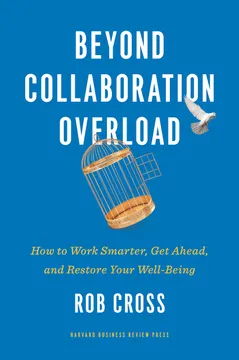


Key Takeaways
Treat collaboration as a scarce resource, not a virtue in itself
More is not better. Collaboration helps people solve complex problems, but unselective participation can consume the time and attention needed to think, decide, and recover. The book calls this collaboration overload: a flood of work-related interactions that leaves people reactive and blocks more valuable contributions. In research across more than 300 organizations, efficient collaborators reclaimed an estimated 18 to 24 percent of their time, roughly a day a week.
Scott shows the cost. A senior leader who prized openness and helpfulness drew 118 daily requests in just one of his units. More than half of those frequent requesters said they needed more of his time to meet their goals. His good intentions made him a bottleneck, weakened employees’ independence, and damaged his health and home life.
The book’s useful provocation is not that collaboration is bad, but that its benefits depend on design. Scott’s story exposes a hidden organizational cost: a leader can appear accessible while making the system less capable of acting without him. That distinction matters because reducing meetings alone will not fix a culture that rewards visible availability. The 18 to 24 percent estimate offers a compelling target, though it should be treated as a research-based benchmark, not a guaranteed personal result. Roles, industries, and genuine coordination needs differ.
Find the belief that keeps volunteering your time away
Overload has inner causes. The book calls the beliefs and feelings that pull people into unnecessary collaboration triggers. Nine recurring triggers include wanting to help, chasing the satisfaction of quick wins, seeking recognition, fearing a poor reputation, needing to be right, fearing loss of control, craving closure, resisting ambiguity, and fearing missed opportunities. These motives often feel virtuous or prudent, which makes them hard to notice.
A pause creates choice. Scott stepped into discussions because helping was part of his identity. A more useful response is to ask whether a request needs your unique contribution, then clarify its real purpose and offer options. A request need not produce an automatic yes or no: the requester can prioritize, accept a smaller scope, or choose a different route. Teaching someone to solve a problem can be more helpful than solving it for them.
This account shifts the diagnosis from poor time management to the rewards people get from being busy: usefulness, status, certainty, and small bursts of completion. That makes the advice more psychologically credible than simply telling people to set boundaries. It also suggests a practical test: notice which requests produce an immediate emotional payoff before evaluating their value. The counterpoint is that refusal is not equally safe for everyone. Junior employees and people with little decision power may need explicit team agreements, not just personal resolve, to change their response patterns.
Schedule your North Star before the inbox schedules your life
Choose a direction first. North Star objectives are a person’s guiding combination of desired expertise, values, and identity, not merely a target job title or promotion. Scott remembered that his work once mattered because it helped people gain access to financial services. Recalling that purpose helped him distinguish consequential work from routine requests that had accumulated around him.
Make priorities visible. He reviewed four months of past calendar activity and two months ahead, identifying recurring meetings and decisions where he added little. He raised the threshold for decisions requiring his input, named other people as go-to experts, and cut or shortened meetings. Strategic calendaring means regularly shaping the schedule around priority work, development, reflection, and personal commitments, rather than letting other people’s requests fill every open space.
The calendar becomes more than a productivity tool here. It is evidence of what a person is actually prioritizing, which can differ sharply from stated values. The book’s emphasis on expertise, values, and identity also guards against defining success solely through promotion. A useful extension is to treat the calendar review as a governance practice: recurring demands deserve periodic justification, just as recurring expenses do. Still, North Star priorities should remain revisable. A direction that once fit may stop fitting as responsibilities, relationships, or circumstances change.
Fix communication norms before trying to outwork constant interruptions
Tools inherit team habits. Meetings, email, and messaging become burdensome when groups do not agree on their purpose or use. Reina, an account manager, held a crowded launch meeting without a clear agenda, then spent another meeting checking email even though her attendance was unnecessary. The book recommends stating the outcome, inviting only essential people, sharing preparation, ending on time, and recording next steps.
Switch channels deliberately. Email works well for brief information and confirming agreements, but extended disagreement belongs in a richer conversation. The author estimates that an interruption can cost about 23 minutes to recover from fully. In Reina’s illustrative day, shortening meetings, reducing messages, and avoiding a few interruptions could reclaim more than three and a half hours. Team norms matter more than individual speed: faster replies can simply generate requests faster.
This section treats attention as a shared resource, not a private virtue. A person can mute alerts, but if a team rewards instant replies and vague meetings, the pressure returns through another channel. The strongest implication is that communication rules should specify what belongs where, how quickly a response is expected, and who actually needs to participate. The estimates about recovery time make interruption costs vivid, although actual recovery varies with task difficulty and context. A short, intentional interruption may be worthwhile when it prevents a larger coordination failure.
Diversify who shapes your thinking, not just how many people you know
Connections shape what you see. A noninsular network includes people with different expertise, perspectives, functions, and locations, rather than repeatedly drawing from one familiar circle. The book connects such network diversity with stronger performance and innovation, while warning that simply building a large network can create more demands. Successful people often rely on a small core of roughly six to two dozen useful, mutually rewarding ties.
Familiarity can distort judgment. Cristal led a product commercialization project but had most of her regular conversations with research colleagues, not sales or product development. The project stalled partly because she had not engaged the groups needed to bring it to market. Her story shows how trusted relationships can become a narrow information filter. Ask who is missing from a project’s conversations, especially people who will use, implement, or resist the result.
The distinction between network size and network structure is more useful than generic advice to network more. A modest set of bridging relationships can expose assumptions that a large, tightly connected circle reinforces. Cristal’s case also shows why diversity is operational, not decorative: commercial knowledge mattered because the work had to reach customers. There is a tension, though. Novel perspectives are not automatically useful, and relationship-building takes time. The practical standard is not maximal diversity, but enough difference to test the project’s key assumptions without creating needless coordination.
Create pull by making work purposeful, trustworthy, and shared
Energy draws contribution. An energizer is someone whose interactions leave others more engaged and willing to contribute. The book calls the resulting ability to attract ideas, talent, and support pull. Its organizational research found that energizers were three to four times as likely to receive top performance ratings and promotions as nonenergizers, and two to three times as likely to manage career transitions successfully. The author stresses that this is not a synonym for charisma or extroversion.
Pauline built commitment quietly. Leading a company-wide sustainability effort, she had spent years learning what business-unit leaders cared about and offering practical help. When she proposed common standards, they trusted her intent and expertise, raised a quality concern, and helped shape the solution. Purpose explains why the work matters; trust grows through competence, good intent, and follow-through. Together, these make participation feel worthwhile rather than imposed.
Pull offers a persuasive alternative to influence based on title or self-promotion. Pauline’s case makes the mechanism concrete: people contribute when they feel respected, see a reason to care, and believe the plan can work. The concept also helps explain why a quiet colleague can have broad organizational impact. Performance comparisons are striking, but they do not establish that energizing behavior alone causes promotion; role, opportunity, and prior success may also matter. Even so, the behaviors described are practical and observable, making the idea more actionable than a vague call to inspire.
Build life outside work into relationships, not leftover hours
Well-being needs dimensionality. The book uses this idea for having meaningful roles and connections beyond work. Life anchors are practices and relationships that help keep a person connected to those roles, values, and interests. Successful interviewees often maintained two or three groups outside work, such as a sports team, faith community, volunteer group, or club. These ties can provide accountability, physical activity, fresh perspectives, and a steadier identity.
Small stresses accumulate. Micro-stressors are recurring relational hassles that drain capacity, emotional reserves, or a person’s sense of values. Seth had lost fitness after work and injury displaced sports from his life. Returning to a church basketball league made exercise social and dependable; the group helped him persist and reconnect with other interests. The book argues that changing a social ecosystem is often more durable than relying on an isolated resolution.
The central insight is that a healthy activity becomes more sustainable when it also gives people belonging, identity, and mutual obligation. This reframes exercise or community involvement as part of a social life, not another task to optimize. It also offers protection against work becoming the only arena that supplies recognition and meaning. The approach should not imply that everyone has easy access to supportive groups: caregiving, disability, location, and time constraints can limit options. Small, recurring forms of connection may be more realistic than adding an ambitious new commitment.
Treat fleeting ideas and exploratory ties as part of the job
Use time at three scales. The book’s three time horizons describe different network investments. Short-horizon interactions respond to an emerging request or half-formed idea. Medium-horizon connections help deliver a defined project. Long-horizon conversations explore expertise and possibilities before a specific need appears. Anja saw that customer solutions were trapped inside separate functions, then used relationships and an internal conference to find people who could help develop a technology-based response.
Make the cycle repeat. The book’s infinite loop links reducing overload with reinvesting recovered time in broader project networks, energizing relationships, and personal renewal. Successful collaborators in the research typically spent about 16 to 24 hours a month on network activity across the three horizons. The purpose is not to add networking on top of overload, but to exchange low-value participation for connections that improve ideas, execution, and well-being.
This framework explains why useful networking is less like collecting contacts and more like maintaining an organization’s capacity to notice and act. Exploratory ties create options; project ties help turn options into work; short-horizon conversations allow an idea to be tested before it disappears. The loop matters because efficiency without reinvestment can simply produce more work. At the same time, the monthly time estimate is descriptive, not a universal prescription. The right investment depends on the role, the project’s uncertainty, and whether the relationships are genuinely reciprocal.
Analysis
The book’s strongest contribution is its unit of analysis: not the individual calendar, but the pattern of dependence moving through a network. Scott is not merely overbooked. His accessibility trains colleagues to route decisions through him, which simultaneously consumes his attention and weakens their autonomy. That is a more complete explanation than personal time-management advice because it shows how one person’s well-intended behavior can become a system-level bottleneck.
The book also resists a false choice between collaboration and solitude. Its argument is selective connection: reduce low-value coordination so there is room for early, diverse input, trust-building, and relationships that sustain life beyond work. The contrast between Scott and Anja gives that claim narrative force. One is pulled into every issue; the other makes targeted connections that help a project cross organizational boundaries.
The evidence is unusually broad for a practical management book, drawing on network analyses across hundreds of organizations and interviews with high performers. Still, the research base described here invites caution. Many findings are associations, and interviews with successful people can reveal useful practices without proving that those practices caused success. Nor can individual boundary-setting correct every structural problem. Organizations that reward perpetual availability or understaff teams cannot delegate the entire remedy to employees.
The most durable lesson is therefore two-sided. Individuals can examine their triggers, calendars, communication habits, and relationships; leaders can redesign expectations so independent work and healthy boundaries are not punished. Collaboration becomes essential when it improves the work, develops other people, or supports a life worth living. Without those tests, connectivity is not automatically a resource. It can become an unpriced demand that quietly consumes the very capacity collaboration was meant to create.
Glossary
Collaboration overload
Excessive collaborative demandsA condition in which the volume, variety, and pace of work interactions consume so much time and attention that people become reactive, lose focus, and struggle to perform valuable work or maintain well-being. It can arise from organizational demands and from personal habits that invite unnecessary dependence.
Essential collaboration
Purposeful, sustainable collaborationRob Cross’s term for reducing unnecessary collaboration while investing in the connections that improve performance and well-being. It combines greater efficiency in daily interactions with network-building for innovation, energy, and support outside work. It is not a call to collaborate less in every situation, but to make collaboration serve a clear purpose.
North Star objectives
Guiding work and life prioritiesA person’s orienting combination of expertise they want to develop or use, values they want to experience through work, and personal identity or commitments they want to preserve. These objectives help determine which collaborations merit attention, which requests can be declined or redirected, and how work and calendars should be shaped.
Noninsular network
Network spanning different groupsA network that connects a person to varied expertise, functions, locations, perspectives, or organizational groups, rather than relying mainly on people who are already connected to one another. Such connections can reveal different approaches, fill knowledge gaps, and help ideas travel across boundaries.
Organizational network analysis (ONA)
Mapping workplace relationshipsA set of methods for examining relationships within an organization, often by asking people whom they turn to for information, decisions, expertise, or support. ONA can reveal informal patterns that formal organization charts miss, including overloaded central people, isolated groups, influential connectors, and sources of energy or stress.
Three time horizons
Network action across timeA framework separating network activity into short-, medium-, and long-horizon interactions. Short-horizon ties help explore immediate requests or nascent ideas. Medium-horizon ties support execution of defined projects. Long-horizon ties build awareness of people and expertise before a specific need arises, creating future options and enabling more informed action.
Pull
Ability to attract contributionThe capacity to draw ideas, talent, support, and opportunities toward a person through relationships. In the book, pull is associated with energizing others and is strengthened by purpose and trust. It does not mean formal authority or political clout; it reflects others’ willingness to engage and contribute.
Micro-stressors
Small, recurring relational stressorsEveryday interactions or coordination problems that may seem minor individually but accumulate to drain time, emotional reserves, or a person’s sense of identity and values. Examples include unclear requests, misaligned team priorities, unreliable follow-through, and subtle negative reactions. Their high frequency makes them difficult to address one at a time.
Life anchors
Supports for a multidimensional lifePractices and commitments that help people preserve important roles and relationships instead of letting work dominate their identity. The book groups them as life roles, process orientation, and value anchors. They can include routines, community, faith, family, friendships, and activities that keep personal priorities visible and supported.
Download PDF
Download EPUB
.epub digital book format is ideal for reading ebooks on phones, tablets, and e-readers.








