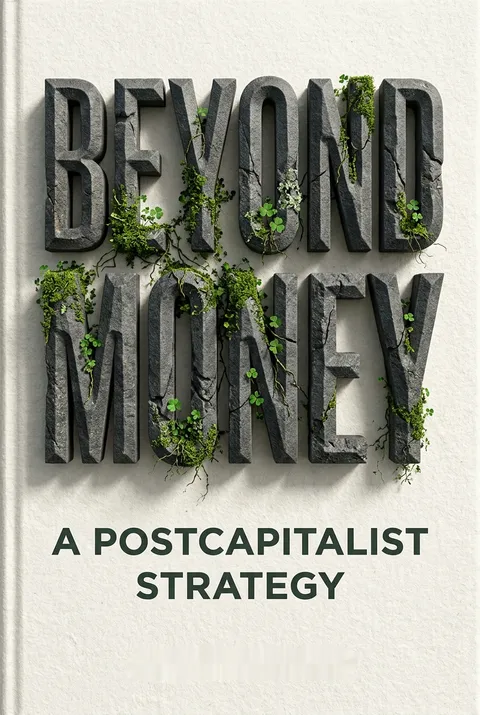


Key Takeaways
Treat money as a social rulebook, not a neutral tool
Money organizes relationships. Nelson’s childhood question about coins opened a larger puzzle: a coin’s value is not like the fixed length of an inch. It depends on shared confidence and the society that accepts it. Money is both a way to price and exchange goods and a claim on goods the market may provide in the future. Nelson calls this role the universal equivalent: money makes unlike things comparable through a single monetary measure.
The measure makes a system. Because work, necessities, and access to resources are mediated by money, the author argues that money is not merely an instrument capitalism happens to use. It helps define capitalist relationships, including who decides what gets made and who can afford it. Changing ownership while retaining monetary production, she argues, leaves that organizing logic intact.
What’s striking is the shift from money as an object to money as a social institution. This echoes a broader insight from sociology: tools do not simply serve people, they shape which relationships become routine and which forms of value become visible. The argument is most persuasive when it shows how monetary accounting narrows decisions about production. Its harder question is institutional: replacing money requires dependable ways to coordinate needs, obligations, and scarce goods. The book’s critique is strongest when it treats abolition not as removing coins, but as replacing the relationships that make money authoritative.
A profit-driven economy cannot simply choose to stop growing
Growth is built in. A business invests money to produce goods for sale and needs the sales to return more money than it spent. Nelson represents this cycle as money becoming money plus profit. Competition pressures firms to reduce costs, find buyers, and reinvest earnings. Even a cooperative selling products must cover expenses and stay viable in the market. For the author, growth is therefore not just a cultural preference or the greed of individual owners. It is a system requirement.
The costs are uneven. Nelson cites estimates that human activity used the equivalent of 1.75 Earths in 2020. From 1990 to 2015, the richest 10 percent produced half of consumption-related emissions, while the poorest half produced 7.5 percent. The same system that drives ecological overshoot also distributes wealth and environmental burdens unequally.
The distinction between individual motives and systemic pressure is important. It explains why well-intentioned managers can still make decisions that intensify extraction: surviving in a competitive market constrains the options. The emissions figures also make clear that responsibility is not evenly shared, so calls for restraint cannot mean equal sacrifice. A useful extension is to distinguish reducing damaging throughput from reducing essential provision. The book’s diagnosis supports that distinction, though a transition would still need explicit rules for protecting people whose livelihoods currently depend on expanding industries.
Stop asking prices to speak for forests, care, and justice
Price is not a whole value. Nelson uses real values to mean the diverse social and ecological qualities relevant to people’s and ecosystems’ needs. A forest, for instance, is habitat, a source of materials, and part of water and carbon cycles. A single price cannot capture all those functions, relationships, and possible losses.
Green markets inherit the problem. Carbon offsets let polluters pay for activities such as tree planting, on the promise that future benefits will counterbalance emissions elsewhere. Nelson argues that such promises are uncertain and can excuse emissions that should have been avoided. Australia’s Murray-Darling Basin shows a related conflict: water trading assigns a price to access, while ecosystems and Indigenous cultural sites have needs that the market price does not represent. The author rejects price as a substitute for direct ecological judgment.
The argument usefully separates a price signal from a complete account of what matters. Environmental economics can use prices to influence a specific behavior, but that does not mean a price captures a forest’s full worth or resolves competing claims to water. This distinction avoids a false choice between using any economic instrument and pretending markets can represent every value. The more difficult issue is how communities weigh genuinely conflicting needs without a common measure. Nelson’s answer is deliberation grounded in context, a richer idea than pricing, but one that demands time, knowledge, and legitimate decision-making.
Replace market signals with shared decisions about concrete needs
A money-free society needs a design. Nelson names her proposed local-to-global commons Yenomon. It is a thought experiment built from existing practices, not a claim that a complete moneyless society already exists. Communities would organize around ecotats, meaning habitats suited to meeting local needs while allowing people to care for the surrounding ecology. People would share use rights rather than own land as private property.
Provision follows needs. Households and community groups would estimate needs, assess what land, water, skills, and labor can support, then agree what to produce. A compact is a nonmonetary arrangement between communities to provide what one cannot supply alone. Surplus could be stored or shared where needed. The aim is collective sufficiency: meeting everyone’s basic needs without making endless production or accumulation the goal.
Yenomon’s strength is that it makes an abstract political argument tangible. Instead of asking whether a product can earn a return, a community asks what is needed, what can be produced responsibly, and what neighboring communities can contribute. Commons scholarship similarly emphasizes that shared resources need agreed rules, monitoring, and ways to resolve disputes. The model recognizes these institutional tasks, but planning would not be effortless: estimates can be wrong, needs can conflict, and meetings can reproduce informal power. Its practicality depends on transparent information, accessible participation, and agreements that allow communities to adjust when conditions change.
Build economies around care, not the wage that erases it
Unpaid work sustains paid work. Feminist analyses in the book show how cooking, cleaning, childrearing, and care keep people able to work, yet often disappear from economic accounts because no wage changes hands. An Oxfam estimate cited by Nelson puts the annual value of unpaid care by women over 15 at more than US$10.8 trillion. Women perform roughly three-quarters of unpaid care and domestic work globally, according to research she discusses.
Recognition has a dilemma. The Wages for Housework movement argued that unpaid labor should be recognized and materially supported. Nelson takes the demand seriously but warns that paying for every caring task could make money the measure of dignity and push care further into commodity markets. She favors a care-centered, collectively organized economy in which care and ecological repair count as essential work, not as private favors outside production.
The tension here is not between valuing care and refusing wages. Payment can give caregivers income, bargaining power, and protection from dependence. Yet payment alone may preserve the assumption that only monetized activity counts, while transferring care to lower-paid workers rather than sharing it more fairly. Care ethics adds a useful test: does an arrangement sustain relationships and meet needs, or merely record a cost? Common provision could expand that definition, but it needs safeguards against gendered expectations that women will simply continue doing invisible work for free.
Choose technology for human and ecological usefulness, not asset growth
Technology carries a politics. Nelson argues that capitalist technologies are selected and designed within a system that rewards profit, not necessarily social usefulness or ecological restraint. Machinery may reduce labor time for a firm while increasing extraction, waste, or workers’ dependence on owners. The clock, for example, helped make work measurable in abstract units of time, displacing more varied human and natural rhythms.
Assets require ongoing labor. The book calls the recurring obligations linking investment, production, wages, sales, and repayment the real debt cycle. A factory or machine may appear to store wealth, but its value depends on workers producing goods that can be sold. Nelson also challenges the claim that appliances automatically save resources: she discusses life-cycle research finding that handwashing dishes can produce fewer emissions, especially when households already conserve water. The right comparison includes manufacture and disposal, not just time of use.
This is a useful correction to the habit of treating innovation as inherently beneficial. Technology studies often ask who controls a system, whose labor it reorganizes, and which costs its accounting leaves out. A life-cycle comparison can reveal impacts hidden by the convenience of daily use, although results depend on household behavior and local energy and water conditions. The book’s contrast is not simply advanced versus simple tools. Its deeper criterion is whether people can understand, govern, repair, and use a technology without making ecological damage or dependency an invisible price.
Let Indigenous autonomy and commoning shape postcapitalist institutions
Land has histories and relationships. Nelson recounts how British settlers judged Australia by its potential for export trade, overlooking Indigenous societies and their sophisticated ways of living with local ecologies. In 2020, mining company Rio Tinto destroyed the Juukan Gorge caves, a site with evidence of Aboriginal occupation dating back 46,000 years. The episode exposes how legal permission and commercial value can override cultural and ecological meaning.
Autonomy can organize provision. The Zapatistas, an Indigenous-led movement in Mexico, use community assemblies and local governance to make decisions about production and shared needs. Their principle is not to capture state power, but to build autonomy through collective institutions. Nelson also points to Spanish collectives in 1936 and 1937 that recorded resources in kind and distributed some necessities without money. These examples show practical alternatives, not a single universal template.
The examples make the political stakes of valuation concrete: what appears commercially expendable may be central to a people’s history, identity, and ecological knowledge. They also challenge the assumption that democratic life must be mediated by markets or centralized states. Indigenous autonomy should not be romanticized as a ready-made solution for other societies, however. Communities differ, and traditions are neither uniform nor frozen. The strongest lesson is to treat sovereignty and local knowledge as foundations for institution-building, while ensuring that shared governance includes dissent, accountability, and relationships across communities.
Withdraw from market dependence by building commons people can use now
Alternatives must change production. Local currencies such as LETS can help people exchange services, but they often refer back to ordinary prices and leave production for sale unchanged. The Catalan Integral Cooperative developed broader networks and shared projects, yet its use of multiple currencies and exchange rates, Nelson argues, still reproduces monetary comparison. A different kind of experiment is Twin Oaks, a community of around a hundred people that shares income and organizes substantial self-provisioning, though some of its production is still for trade.
Build while resisting. Nelson urges practical steps: reduce dependence on market goods, share skills and tools, grow and repair locally, organize assemblies, and develop common access to land and resources. Such experiments are meant to make collective provision real, not merely to protest the existing system. She favors nonviolent creation and defense of spaces where people can meet needs together.
The distinction between exchanging differently and producing differently is sharp and useful. A local currency may strengthen relationships while leaving participants dependent on the surrounding market for necessities. Community experiments can instead build skills and routines for shared provision. Yet small projects do not automatically scale, and unpaid work, state rules, access to land, and unequal resources can limit them. The practical question is not only whether a community can operate internally, but how it shares specialized goods and supports people who cannot contribute in conventional ways. Those questions make commoning a demanding institutional project, not a lifestyle shortcut.
Analysis
Nelson’s central intervention is to move the debate about postcapitalism from ownership and distribution to the monetary form that organizes production itself. The book’s distinctive strength is its synthesis of political economy with ecofeminism, Indigenous sovereignty, ecological critique, and examples of autonomous community life. These connections show how one monetary measure can obscure very different kinds of value: unpaid care, cultural belonging, ecosystem regeneration, and basic material need. The Yenomon thought experiment then gives the critique a constructive destination, translating its principles into habitats, shared use rights, production planning, and intercommunity compacts.
The argument is strongest when it explains how profit competition constrains even well-intentioned organizations, and when it shows why prices cannot serve as complete accounts of ecological or social worth. Its broader claim, that money itself must disappear for postcapitalism to succeed, is more contestable. Money can enable coordination across distance, preserve purchasing power, and provide people with independent claims on resources. The author’s response is that these functions are inseparable from capitalist relations, but the adaptation leaves open how a nonmonetary system would protect personal autonomy and coordinate complex, specialized provision at scale.
That gap does not invalidate the proposal. It identifies its central research and political task: specifying governance that is democratic without being exhausting, attentive to local ecological limits without becoming parochial, and committed to care without reproducing gendered unpaid labor. The movement examples are valuable precisely because they offer partial evidence rather than proof of a finished system. Their institutional differences matter as much as their shared rejection of market primacy. Read as a strategic wager, the book asks readers to treat nonmonetary practices not as marginal charity, but as experiments in rebuilding how people meet needs and exercise power.
Review Summary
Beyond Money receives mixed reviews, with an overall rating of 2.96/5. Readers appreciate the critique of money and capitalism but find the proposed solutions lacking. The book's analysis is considered insightful, but many feel it fails to provide concrete pathways for moving beyond money. Some praise its fresh perspective on dismantling capitalism, while others criticize it for oversimplification and unrealistic scenarios. The fictional society "Yenomon" is seen as underdeveloped and fails to address practical concerns. Overall, readers find the book thought-provoking but ultimately unsatisfying in its execution.
People Also Read





Glossary
Universal equivalent
Money’s common measureNelson’s term for money’s role in making unlike goods, services, and activities comparable through a shared monetary unit. It includes money’s use in pricing and exchange, and its role as a claim on future goods available through markets. The term emphasizes that money is not just a convenient object, but a social relation that helps organize capitalist production.
Real values
Social and ecological qualitiesNelson’s term for the diverse actual and potential qualities of people, other living things, and the nonliving world that matter to human and ecological needs. Real values include practical uses, relationships, and effects on ecosystems. They are contextual and plural, unlike exchange value, which reduces goods and services to a common monetary measure.
Real valuism
Economy beyond monetary valueNelson’s name for arguments and practices that favor nonmonetary economies organized around real values. Real valuism rejects prices as the primary guide to production and distribution, emphasizing collective decisions about social needs and ecological limits. It is a political and economic orientation, rather than a single detailed institutional blueprint.
Yenomon
A proposed money-free commonsNelson’s fictionalized but intended-to-be-plausible model of a nonmonetary, postcapitalist society. Communities provision themselves as far as their local ecologies allow, share use rights, and arrange exchanges through compacts rather than monetary contracts. Assemblies and working groups determine production according to human needs and ecological conditions, with wider networks helping communities meet needs they cannot satisfy locally.
Ecotat
A suitable community habitatA term formed from eco-habitat, referring to an ecological area in which a human community can meet many of its needs while caring for the local environment. Its size and population depend on the area’s capacity, which may change. Ecotats can overlap in shared watersheds or other commons and remain connected through agreements with neighboring communities.
Collective sufficiency
Shared provision of needsThe collective organization of provisioning so that people’s needs are met through shared work, governance, and distribution. It can include self-provisioning, delegated tasks, and cooperation among communities. The goal is not isolated self-sufficiency or equal quantities for everyone, but a responsible level of provision based on different needs and ecological limits.
Commoning
Shared use and governancePractices through which people share the use, benefits, responsibilities, and governance of resources. Commoning differs from private ownership because access is organized through collective rules and use rights rather than exclusive ownership for sale. In Nelson’s argument, it supports shared provision and care for people and ecosystems beyond market exchange.
Community mode of production
Production governed by communitiesNelson’s term for a postcapitalist way of organizing production through community-oriented commoning and decisions based on real values. Communities identify needs, choose how to produce, and distribute goods and services while considering ecological limits. Its purpose is collective provision and care, rather than production for sale, profit, or monetary growth.
Real debt cycle
Recurring capitalist obligationsNelson’s interpretation of the connected obligations created by investment, production, wages, consumption, repayment, and reinvestment. Assets appear to hold value, but their income depends on continuing production and sales, while workers and society help sustain that value. The cycle makes debt and growth systemic features rather than occasional departures from normal economic activity.
Green materialism
Collective ecological transformationNelson’s adaptation of Marx’s materialist emphasis on human agency, directed toward ecological sustainability and social justice. It describes movements that learn from material conditions, organize horizontally, and act collectively to change how people provision themselves. It is distinct from green consumerism, which seeks environmental improvement through market purchases while retaining growth-oriented production.
Download PDF
Download EPUB
.epub digital book format is ideal for reading ebooks on phones, tablets, and e-readers.








