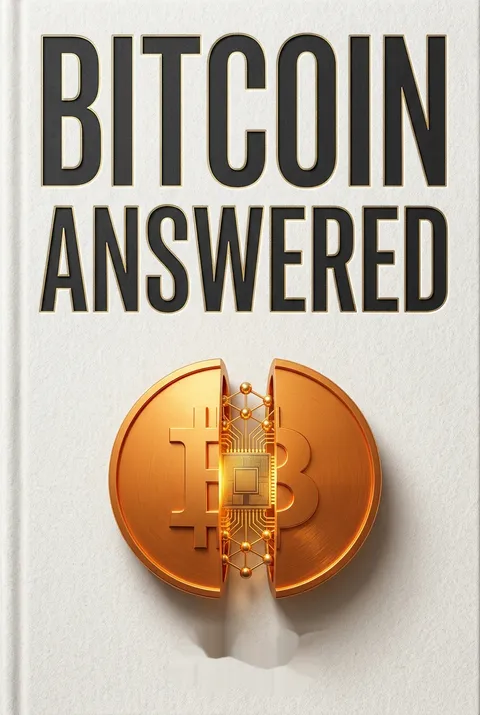


Key Takeaways
See Bitcoin as a public rulebook run by a network, not a coin alone.
More than digital money. Bitcoin combines a currency with open-source software, shared operating rules, and a peer-to-peer network. Computers on that network maintain and check a public record of transactions. It is not a company with a CEO, and no single institution owns or operates it. The book traces its launch to Satoshi Nakamoto's 2008 white paper and 2009 implementation, while noting that many ingredients had earlier roots in projects such as Hashcash and Bit Gold.
A first successful synthesis. Bitcoin was not the first attempt at digital cash or the first use of blockchain ideas. Its distinction was bringing existing ideas together in a system that operated at substantial scale. That history makes Bitcoin easier to understand as an experiment in organizing money without a central operator, rather than as a mysterious object that appeared from nowhere.
What's striking is that Bitcoin's novelty lies less in inventing every component than in coordinating them. This resembles a successful engineering platform: standards, incentives, and users reinforce one another until a working system emerges. The same lens helps explain why a technically superior alternative may not automatically displace Bitcoin. A network's usefulness depends partly on shared expectations and participation, not just on code. The phrase “not owned” needs care, though. No company owns the protocol, but people and organizations do own bitcoin, influence software development, and provide services around the network.
Trust the verification process, but do not mistake decentralization for magic.
Many computers check. A blockchain is a shared record organized into linked blocks. Bitcoin nodes keep copies of its history and independently check whether proposed transactions follow the network's rules. Miners use proof of work to propose new blocks, while nodes verify that those blocks obey the rules. This division matters: mining is not simply every connected computer solving puzzles, and a computer running a node does not automatically earn mining rewards.
Security has boundaries. Altering the network's history would require overcoming its distributed validation and mining power. The book describes a majority-power attack as prohibitively difficult at Bitcoin's scale, but “difficult” is more accurate than “impossible.” Protocol rules also do not change through a simple vote of coin owners. Changes depend on people and organizations choosing to adopt compatible software, a social coordination process as well as a technical one.
Bitcoin's design shifts trust from a central bookkeeper to a process that many participants can inspect. That is a meaningful change, but not the abolition of trust: users still depend on software, network incentives, and the people who maintain tools and infrastructure. Distributed systems research often treats security as a set of threat models, not a single yes-or-no property. Asking what an attacker can do, at what cost, and against which layer is more useful than calling any network unhackable. The book's explanation is an accessible starting point, provided its simplifications are not mistaken for guarantees.
Protect your keys like cash, because a confirmed mistake has no help desk.
Access lives in keys. A Bitcoin wallet is software or a device for managing the credentials that control funds recorded on the blockchain. The coins are not stored inside the wallet. A public address lets others send funds to a user, while the corresponding private key authorizes spending. A seed phrase is a human-readable backup for recovering that access. Anyone who obtains it can control the funds, and losing it may mean losing access permanently.
Convenience trades against exposure. A hot wallet is connected to the internet and is easy to use, but creates more opportunities for online theft. Cold storage keeps keys offline, reducing some digital risks while adding practical risks such as loss or damage. Hardware wallets aim to combine offline key protection with easier use. A transfer to an incorrect address that is confirmed generally cannot be reversed by a bank or network administrator.
This is the sharpest practical contrast with ordinary banking. Traditional institutions can sometimes freeze, reverse, or restore access; self-custody removes those protections along with the intermediary. In cybersecurity, this is a shift from account recovery to key management, and the user becomes part of the security system. The book's advice to keep backups secure is sound, but a backup is also a target. Security depends on how access is stored, who can reach it, and whether the owner can recover it under stress, not simply on choosing an offline device.
Bitcoin's ledger is public, so pseudonymity is not invisibility.
Transactions leave a trail. Bitcoin transactions are recorded on a public ledger that anyone can inspect. Users generally transact through addresses rather than attaching their names directly to each payment, which can create a degree of pseudonymity. But an address is not the same thing as guaranteed anonymity. Once an address is associated with a person, activity connected to it may become visible to others.
The surrounding system matters. The book notes that exchanges may require identity checks, depending on local rules, linking a real person to activity on the network. It also distinguishes Bitcoin's open transaction record from private personal information: the ledger shows transactions and addresses, not necessarily the identity behind each address. In practice, privacy depends on how people use the system and what information is revealed outside it.
The useful distinction is between hiding a name and hiding a pattern. Public records can reveal relationships through repeated behavior even when individual entries lack names, a familiar issue in data privacy and network analysis. Bitcoin's transparency can support independent auditing, but the same property can expose financial behavior. Neither “anonymous” nor “fully traceable” captures every case. Privacy is better understood as a spectrum shaped by address reuse, exchange practices, and what observers can connect, rather than as a feature switched on by default.
A 21-million cap limits issuance, but scarcity cannot manufacture demand.
A programmed ceiling. Bitcoin's rules cap the total supply at 21 million coins. New bitcoin enter circulation through mining rewards, and those rewards are cut in half roughly every 210,000 blocks, or about four years. The book's 2021 snapshot reported 18.7 million coins in circulation and a mining reward of 6.25 bitcoin per block after the 2020 halving. The next scheduled reduction was expected in 2024; the final coins are projected to be issued around 2140.
Scarcity is only one ingredient. The supply cap makes future issuance more predictable, but it does not ensure that people will want to hold or use bitcoin. Lost keys can make coins inaccessible, reducing the amount practically available, but that is different from the protocol lowering its maximum supply. Price still depends on demand, confidence, and the alternatives available to users.
Bitcoin's fixed issuance is a clear contrast with currencies whose supply can be adjusted by central authorities. It can make the rules legible and limit one source of uncertainty. But scarcity is not a complete theory of value: rare objects with little demand remain cheap, while useful things can be valuable despite abundant supply. The book sometimes slides from a falling rate of new issuance to the claim that each existing coin must rise in value. The stronger conclusion is conditional: scarcity can support value when users continue to regard the asset as worth holding.
Mining buys security with computation, making energy and throughput strategic costs.
Work secures the ledger. Bitcoin uses proof of work, a system in which miners expend computational power to compete to add blocks and receive rewards. In the book's 2021 description, new blocks were expected about every ten minutes, and the network could process roughly seven transactions per second. These figures help explain the trade-off: a design intended to make transaction history costly to rewrite can also limit how quickly the base network processes activity.
Costs shape adoption. Mining requires hardware and electricity, so profitability depends on bitcoin's price, mining competition, power costs, equipment expenses, and the changing reward. The book identifies energy use and transaction capacity as major concerns, while pointing to faster alternatives and add-on systems such as the Lightning Network. Such layers can support quicker payments, but do not erase the base network's design trade-offs.
Proof of work makes security economically tangible: attackers must compete with real computational resources, while legitimate miners have an incentive to follow the rules. The price of that approach includes electricity use, specialized equipment, and limited base-layer throughput. Comparisons of energy per transaction need caution, because network energy does not rise and fall neatly with the number of payments; the security service is shared across the whole system. The key question is therefore not whether energy use is simply good or bad, but whether the security and settlement properties justify its cost relative to alternatives.
Separate Bitcoin's digital-gold role from blockchain's wider technological ambitions.
Different tools, different jobs. The book presents Bitcoin mainly as a store of value and a way to transfer money without relying on a central institution. It contrasts this with Ethereum, which is designed to support smart contracts and decentralized applications. It also surveys proposed blockchain uses in areas such as supply chains, data management, and asset records. These examples describe the wider technology landscape, not functions that Bitcoin itself necessarily provides.
Usefulness is a test. Bitcoin's acceptance by businesses and payment services has grown, but the book emphasizes that it is not frictionless: fees, transaction speed, and limited everyday acceptance can make it less convenient than familiar payment methods. Calling Bitcoin “digital gold” captures its scarcity and store-of-value pitch, but leaves open whether that role is enough to sustain broad adoption.
This distinction prevents a common category error: treating every blockchain project as a Bitcoin competitor, or assuming Bitcoin inherits every capability associated with blockchains. A monetary asset and a programmable platform answer different needs. The book's wide catalog of possible applications is useful as a map of experimentation, but a list of potential uses is not proof that a blockchain improves them. Any proposed application still needs to outperform a conventional database or institution on meaningful criteria such as cost, reliability, and accountability.
Treat spectacular past returns as a warning about risk, not a forecast.
Growth came with brutal drops. The book reports that Bitcoin had fallen by 80% or more three times since 2012, while also describing multiyear cycles of rallies, corrections, and quieter periods. Its 2021 account cites an extraordinary average annual return over the prior decade, but explicitly warns that such growth cannot continue indefinitely. Historical performance shows what happened under past conditions, not what a future buyer will earn.
The decision is personal. The book frames Bitcoin as highly risky, with both the possibility of large gains and the possibility of severe losses. It suggests that simply holding has historically been easier than successful short-term trading, which demands timing, attention, and discipline. Those observations do not establish that holding is safe or that a past recovery pattern must repeat. Any decision should account for the investor's finances and tolerance for loss.
The book usefully counters social-media survivorship bias: dramatic winners are visible, while losses and abandoned projects are less likely to be celebrated. Yet the claim that Bitcoin recovered from earlier crashes can create its own bias, encouraging readers to treat recovery as a law of nature. In investment analysis, the relevant question is not only how much an asset once rose, but what assumptions, risks, and future demand would support its price now. No return history can replace an assessment of whether a loss would be financially survivable.
Judge crypto by market structure and purpose, not the price of one coin.
A low unit price proves little. Market capitalization is calculated by multiplying the circulating supply by the price per coin. A coin priced at a fraction of a dollar can represent a larger overall market value than a coin priced in the thousands if many more units exist. The book urges readers to consider other measures, including utility, trading volume, and the asset's role, rather than treating a small sticker price as evidence of a bargain.
Build a process before trading. Its investing rules emphasize accepting that markets change, learning from mistakes without endless regret, avoiding emotional decisions, and diversifying rather than concentrating everything in one asset. The book also warns that leverage magnifies both gains and losses. These principles do not remove uncertainty, but they can keep a speculative position from becoming an uncontrolled bet.
Market capitalization is a better first comparison than unit price, but it is not a complete measure of quality. It multiplies the last traded price by supply; it does not reveal how easily large holders could sell, whether reported volume is reliable, or whether the asset has durable use. The book's broader emphasis on process is valuable because crypto markets invite impulsive decisions. Diversification can reduce exposure to one project, but it cannot make a portfolio of highly correlated crypto assets genuinely safe.
Analysis
The book's chief strength is its question-and-answer design. It meets beginners where they are, moving from basic vocabulary to mining, custody, investment, history, and future applications without demanding prior technical knowledge. Its most durable contribution is not a forecast about price, but a mental model: Bitcoin is simultaneously software, a network, a public transaction record, and a monetary asset. Those layers explain why simple labels such as “currency,” “investment,” or “blockchain” never tell the whole story.
Its central narrative is a shift in how value can be recorded and transferred. Earlier digital-cash experiments supplied parts of the design, while Bitcoin joined cryptography, distributed verification, and economic incentives into a widely used system. The mysterious identity of Satoshi Nakamoto adds drama, but the more consequential story is institutional: participants can coordinate around rules without a single owner, although coordination still depends on human choices and shared software.
The book is also a product of its 2021 moment. Several technical comparisons, adoption figures, forecasts, and service recommendations are time-sensitive, while some explanations compress important distinctions. Mining is not the same as ordinary node operation; a wallet manages keys rather than holding coins; and a fixed supply does not guarantee price appreciation. These corrections strengthen, rather than undermine, the basic account. They show why a beginner should treat the book as an introduction to concepts, not a current reference manual or investment guide.
Its investment advice is most persuasive when it emphasizes uncertainty, emotional discipline, diversification, and the danger of leverage. It is less reliable when historical cycles or extraordinary returns begin to sound predictive. The most useful reader stance is informed skepticism: understand the system well enough to ask precise questions, distinguish the Bitcoin network from adjacent crypto projects, and separate a protocol's technical properties from claims about what its market price should be.
Review Summary
Bitcoin Answered receives high praise from readers for its straightforward approach and Q&A structure. While experienced cryptocurrency enthusiasts may find limited value, it's recommended for those new to Bitcoin. The book covers Bitcoin's evolution, legitimacy, and global acceptance as digital money. It explores blockchain cryptography, mining processes, and institutional involvement. Readers appreciate the detailed explanations and clear presentation of facts and figures. The book is considered a must-read for those seeking general knowledge about Bitcoin and blockchain technology.
Glossary
Blockchain
Linked transaction recordA blockchain is a shared digital record arranged into blocks of data, with each block linked to earlier blocks. In Bitcoin, network participants check proposed transactions against common rules, and accepted blocks extend the record. The design makes past entries difficult to alter, but it does not by itself guarantee privacy, usefulness, or rising asset prices.
Node
Network rule-checking computerA node is a computer running software that connects to a blockchain network. Bitcoin nodes receive and relay information and can independently check whether transactions and blocks follow the network's rules. Nodes help distribute verification across participants. A node is not automatically a miner, and ordinary computers do not earn mining rewards merely by connecting.
Public key
Public receiving credentialA public key is one part of a cryptographic key pair used to control digital assets. It is related to a private key and supports the creation of a public address that others can use to send funds. The book sometimes treats addresses and public keys as equivalent, but they are technically distinct concepts.
Private key
Secret spending credentialA private key is secret information that authorizes a user to spend bitcoin associated with a corresponding public key. Anyone who obtains the key may be able to control those funds, so it must be protected. Losing the key without a usable backup can make the funds inaccessible, because the Bitcoin network has no central password-reset service.
Seed phrase
Wallet recovery wordsA seed phrase is a sequence of words used to recover a cryptocurrency wallet's keys. The book describes phrases commonly containing 12 to 24 words. It functions as a powerful backup, not an ordinary password: anyone who learns it may gain access to the wallet, and losing the only copy can permanently remove access to the associated funds.
Proof of work
Computation-based block competitionProof of work is Bitcoin's method for selecting miners to propose new blocks. Miners compete by performing computational work, and the successful miner can receive a block reward and transaction fees. Other nodes check that the proposed block follows the protocol. The method helps make attacks costly, while requiring hardware and energy.
Halving
Scheduled reward reductionHalving is a programmed reduction in Bitcoin's block reward. It occurs every 210,000 blocks, approximately every four years, cutting the rate at which new bitcoin enter circulation. The reward reduction continues according to the protocol's schedule as the network approaches its 21-million-coin limit. It changes new issuance, not the supply of existing coins.
Cold storage
Offline key storageCold storage means keeping the keys that control cryptocurrency offline, reducing exposure to internet-connected attacks. It can involve hardware devices or other offline methods. Compared with a hot wallet, cold storage may improve protection from some online threats but can be less convenient and remains vulnerable to loss, damage, poor backup practices, or physical theft.
Market capitalization
Price times circulating supplyMarket capitalization is calculated by multiplying an asset's price by the number of units in circulation. For Bitcoin, the result estimates the market value represented by its circulating coins at the current quoted price. It is useful for comparing assets with different unit prices, but it is not the same as cash invested or a guarantee that all coins could be sold at that price.
Hard fork
Incompatible protocol splitA hard fork occurs when a blockchain's rules change in a way that is incompatible with the previous rules. If participants continue using both rule sets, the chain can split into separate networks and assets. Bitcoin Cash arose from a 2017 fork of Bitcoin. A fork reflects disagreement over protocol direction, not simply a routine software update.
Download PDF
Download EPUB
.epub digital book format is ideal for reading ebooks on phones, tablets, and e-readers.








