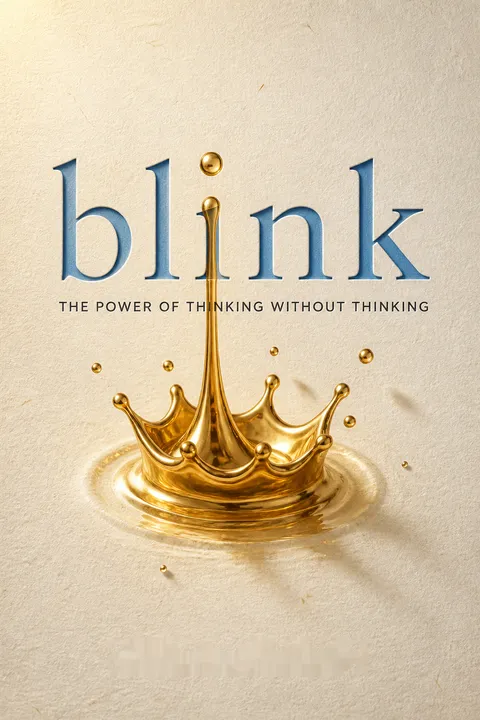


Key Takeaways
Treat a snap judgment as evidence, not as a verdict
Fast thinking finds patterns. Rapid cognition is the mind’s quick, often unconscious processing of cues. Thin-slicing, a key term in the book, means detecting a meaningful pattern from a small sample of experience. At the Getty Museum, art experts doubted an apparently ancient statue almost immediately, while months of research initially supported buying it. The experts were right: the statue was a modern forgery.
Hunches can arrive early. In an Iowa gambling experiment, participants’ palms began reacting to risky card decks after about ten cards. Their behavior shifted before they could explain the pattern, which took many more turns. The lesson is not that instinct is magic. It is that judgment can precede conscious explanation, and its accuracy depends on what experience has taught the mind to notice.
The opening contrast is powerful because it distinguishes speed from carelessness. In fields such as emergency medicine and aviation, skilled recognition often depends on accumulated examples that make subtle cues legible. Yet a correct hunch in one case does not establish a reliable method for every case. A useful discipline is to record the first impression, then ask what evidence would confirm or overturn it. That preserves rapid perception as a valuable signal while resisting the seductive leap from “I feel certain” to “I must be right.”
Learn a domain’s recurring patterns before trusting its quick judgments
Brief encounters can reveal structure. Psychologist John Gottman studied couples discussing a point of conflict while researchers coded their expressions, words, and physical responses. His system, SPAFF, assigns categories to emotional behavior second by second. The book reports that an hour of interaction predicted which couples would remain married fifteen years later with 95 percent accuracy; even a short clip carried useful signals.
Look for diagnostic cues. Gottman found that criticism, defensiveness, stonewalling, and contempt were especially revealing, with contempt a particularly damaging sign. The point is not to imitate a laboratory from a dinner table. It is that repeated interaction can have a stable pattern, and an informed observer can learn which small cues matter instead of trying to process everything at once.
Gottman’s work illustrates a crucial distinction between a quick judgment and an untrained guess: the former may be compressed expertise. In predictive science, however, accuracy depends on what is being predicted, who is being assessed, and whether the method works beyond the original sample. A relationship is not a fixed machine, and a forecast can itself change how people behave. The strongest practical use is therefore diagnostic rather than fatalistic: notice recurring contempt or defensiveness as reasons to intervene, not as proof that a couple’s future is settled.
Do not confuse a plausible explanation with the cause of your choice
The mind hides its workings. The book calls the part of the mind that handles quick, below-awareness processing the adaptive unconscious. It can shape action without supplying a clear account of why. In psychologist John Bargh’s experiment, students exposed to words associated with old age walked more slowly afterward. In another study, students primed with polite words were much less likely to interrupt a conversation than students primed with rude words.
Explanations can be improvised. Tennis players confidently described a wrist movement in their forehand that video analysis showed was not happening at the moment they thought it was. Speed-daters also described ideals that did not reliably match whom they chose. People may sincerely report a reason, but sincerity does not make the explanation accurate. When the process is hard to inspect, “I don’t know” can be the most truthful answer.
This is a useful corrective to the assumption that introspection provides transparent access to motivation. Cognitive science distinguishes between the causes of a response and the story a person can tell about it; the story may be coherent without being causal. That matters in interviews, marketing, and personal conflict, where confident explanations can be mistaken for reliable evidence. At the same time, the book’s priming examples should not be treated as proof that every subtle cue reliably controls behavior. Effects can depend on context, and a single demonstration is not a universal prediction tool.
Interrupt appearance-based assumptions before they decide who seems capable
A polished impression can mislead. Harry Daugherty saw handsome, imposing Warren Harding and imagined a president. Harding became president despite being a weak politician, and historians rank his administration among the worst. The book uses this as a warning: appearance can activate familiar associations and crowd out more relevant evidence.
Bias can shape routine decisions. In one study of Chicago car dealerships, buyers with similar qualifications received sharply different opening prices. White men were offered an average of $725 above invoice, while Black men were offered $1,687 above invoice. The Implicit Association Test measures how quickly people connect concepts, revealing automatic associations that may conflict with their stated beliefs. Such measures do not prove a person’s whole character, but they expose how unexamined assumptions can affect behavior.
The strongest implication is procedural: fairness cannot depend solely on individuals believing themselves unbiased. Organizations can reduce opportunities for irrelevant cues to influence decisions by using consistent criteria, structured interviews, and documented comparisons. This resembles debiasing in statistical modeling, where explicit variables and transparent rules can make hidden assumptions easier to detect. Still, an implicit association score is not a verdict on a person or a direct measure of every consequential action. The study of bias is most useful when it leads to careful measurement and changes in practice, not moral labeling alone.
Rehearse simple rules so pressure can release good spontaneity
Improvisation needs preparation. Marine commander Paul Van Riper opposed elaborate decision procedures during fast-moving combat, but his approach was not to wing it. He trained his unit, set a clear intent, and let people in the field adapt without waiting for detailed instructions. In a major military exercise, his team used couriers and unconventional tactics to surprise a better-equipped opponent.
Rules can enable flexibility. Improvisational actors also practice extensively. One basic rule is to accept a partner’s contribution and build on it rather than blocking it. That shared structure gives performers room to respond spontaneously. The broader lesson is to do careful analysis and training before a crisis, then avoid demanding lengthy explanations when quick action is essential.
Van Riper’s approach connects to a central idea in expertise research: practiced routines can free attention for unexpected events. The point is not to reject analysis, but to put it in the right phase. Planning is valuable when time allows; in a rapidly changing situation, excessive approval loops can make yesterday’s plan govern today’s problem. This principle has limits. Decentralized action works best when people share goals, training, and boundaries. Without those foundations, freedom can produce inconsistency rather than intelligent adaptation.
Use simple validated rules when extra information clouds diagnosis
More data can make judgment worse. At Chicago’s Cook County Hospital, doctors struggled to decide which chest-pain patients needed intensive care. Cardiologist Lee Goldman developed a decision rule using a small set of indicators, including the ECG, unstable angina, fluid in the lungs, and low systolic blood pressure. In a two-year comparison, the rule was better at identifying patients who were not having heart attacks and more accurate at identifying those at serious short-term risk.
Keep expertise in its lane. Doctors often considered age, lifestyle, and other details that were relevant to long-term health but could muddy the immediate triage decision. The rule did not replace clinical care. It supplied a reliable first filter, leaving physicians more attention for what the patient needed beyond that narrow diagnosis.
This example is a strong case for decision support: a concise model can outperform unaided judgment when evidence is noisy and the task is well defined. It also shows why a rule should be assessed against outcomes rather than against whether it feels sophisticated. The boundary matters. A triage rule designed for a specific question should not be mistaken for a complete account of a patient’s health. Good systems specify what a tool can decide, monitor its errors, and leave room for human review when the case falls outside its intended use.
Test reactions in the context where people actually choose
A test can measure the wrong experience. In blind sip tests, many participants preferred Pepsi to Coke, partly because a small taste favors sweetness. But a sip is not the same as drinking a full can, and neither reproduces the real experience of choosing a familiar branded drink. Coke changed its formula after extensive tests favored New Coke, only to face a public backlash and restore the original product.
Novelty also distorts feedback. Early users rated Herman Miller’s unusual Aeron chair poorly on appearance, even as its comfort scores improved. It later became the company’s best-selling chair. Kenna’s music, similarly, tested weakly with general listeners but drew strong reactions from experienced industry figures and live audiences. Ask whether a test matches the real setting, and whether people are reacting to poor quality or unfamiliarity.
These examples expose a measurement problem, not simply a flaw in consumer taste. A preference depends on the task, the setting, and the person’s experience; a quick sample may capture one response while missing the behavior a company actually cares about. In research design, this is a question of validity: does the measure represent the real-world outcome? Expert judgment can add context, especially for unfamiliar products, but experts also have interests and blind spots. Strong evaluation combines realistic testing, informed interpretation, and evidence from actual use.
Slow dangerous encounters before stress narrows what anyone can see
Extreme stress constricts attention. In high-stakes encounters, people can fixate on one threat, miss other signals, and interpret ambiguous movements as dangerous. The book examines the fatal shooting of Amadou Diallo, who was unarmed, and argues that officers’ assumptions, proximity, and escalating arousal contributed to their failure to read his fear accurately. It describes research in which time pressure made people more likely to mistake a tool for a gun after seeing a Black face.
Create time and distance. Security expert Gavin de Becker calls the separation between a protected person and a potential attacker “white space ”: more distance gives a guard more time to assess and respond. The book also describes training that repeatedly exposes officers to simulated stress. Better decisions depend not just on good intentions, but on procedures that keep people from being forced into a reflexive split-second choice.
The account is at its best when it shifts attention from individual character to conditions that shape perception. Stress can make a person less able to integrate context, so training, distance, backup protocols, and time to assess are safety tools, not bureaucratic niceties. That explanation does not erase responsibility for harmful choices; it clarifies where prevention can operate. The concept also invites caution: physiological stress responses vary, and a model of narrowed attention cannot reconstruct every person’s motives in a specific event. System design and accountability need to proceed together.
Hide irrelevant identity cues when judging performance
Change the conditions of judgment. Before screened auditions became common, orchestra committees could see musicians while they played. The screen was meant to prevent appearance from influencing assessments of sound. After blind auditions spread through U.S. orchestras, the number of women in top orchestras rose sharply. Trombonist Abbie Conant won a Munich Philharmonic audition while hidden behind a screen; once the judges saw her, gendered assumptions became a barrier to her role and pay.
Design for the task. If the goal is to judge musical ability, conceal cues that do not help assess musical ability. The same principle can guide hiring, grading, and product evaluation: decide which information is relevant, then structure the process to keep irrelevant information from taking over. The change is small in appearance, but it can alter who gets recognized.
Blind auditions show how an institution can improve both fairness and performance without first requiring every evaluator to master their own unconscious associations. In causal terms, a screen changes the decision environment and makes the effect of one class of cues smaller. Similar methods can help in other settings, though concealment is not always possible or desirable. A hiring process may need to evaluate communication or collaboration, for example. The practical question is not whether to remove all context, but which information genuinely predicts success and when it should enter the decision.
Analysis
Blink is an argument about judgment told through linked case studies rather than a single formal theory. Its central contribution is a two-sided account of rapid cognition: short exposures can reveal real patterns, but the same speed can magnify stereotypes, stress, and irrelevant cues. The book’s most useful distinction is not simply fast versus slow thinking. It is between a quick judgment built on relevant experience and a quick reaction produced by a distorted setting.
The strongest examples pair an intuitive response with a method for testing or improving it. Gottman turns brief relationship behavior into structured observations. Goldman tests a concise medical rule against doctors’ decisions. Blind auditions alter the conditions under which musical ability is evaluated. These cases suggest that good judgment is not merely a private talent. It can be trained, audited, and supported by institutional design.
The evidence, however, does not all carry equal weight. Predicting a narrow outcome from a specific interaction does not show that the same method generalizes to every relationship or hiring decision. The priming and implicit-association examples are vivid, but the existence of an automatic association does not establish how strongly it shapes every real-world action. Consumer tests likewise depend on context, and expert intuition can reflect genuine learning or entrenched taste. The book’s narratives sometimes make complex research feel more conclusive than a careful reader should assume.
A durable reading of the book is therefore neither “trust your gut” nor “ignore intuition.” Use trained pattern recognition where the task is familiar, the cues are relevant, and the decision maker has feedback. Use explicit rules where outcomes can be measured and human judgment is inconsistent. Redesign high-stakes settings to reduce bias and pressure. And when asked to explain a fast decision, distinguish what is known from what merely sounds convincing.
Review Summary
Blink explores the power of snap judgments and intuitive thinking. Gladwell presents compelling examples of how quick decisions can be both surprisingly accurate and dangerously flawed. Some readers find the book insightful and thought-provoking, praising Gladwell's engaging storytelling and diverse case studies. Others criticize its lack of scientific rigor and clear conclusions. While many appreciate the book's ability to challenge conventional thinking about decision-making, some find it contradictory or oversimplified. Overall, Blink sparks discussion about the role of intuition in our lives.
People Also Read





Glossary
adaptive unconscious
Fast unconscious processingThe mental processes that rapidly and quietly interpret information outside conscious awareness. In the book, the adaptive unconscious helps people recognize danger, form impressions, and guide action without first reasoning through every detail. It differs from the Freudian unconscious described as a storehouse of troubling desires and memories.
thin-slicing
Pattern recognition from little evidenceThe ability to identify meaningful patterns from a small sample of experience. A brief conversation, a few seconds of behavior, or a quick look at an object can sometimes reveal a stable feature of a more complex situation. Thin-slicing is most dependable when the observer has learned which cues matter.
SPAFF
Couple interaction coding systemShort for specific affect, SPAFF is John Gottman’s system for coding emotional behavior during couples’ interactions. Trained observers assign categories to expressions, speech, and other cues second by second. The coded sequence allows researchers to examine patterns, including positive and negative emotion, that may be difficult to notice during ordinary conversation.
Four Horsemen
Four destructive conflict behaviorsGottman’s name for four relationship behaviors associated with serious conflict: criticism, defensiveness, stonewalling, and contempt. The framework helps observers focus on a few especially informative patterns rather than trying to track every expression and remark. The book identifies contempt as particularly damaging because it treats a partner as inferior.
Implicit Association Test
Measures automatic mental associationsA reaction-time test that estimates how readily a person associates concepts, such as social groups and positive or negative words. Faster responses to one pairing than another suggest stronger automatic associations. The test can reveal a difference between stated beliefs and rapid associations, but it does not by itself define a person’s character or predict every action.
verbal overshadowing
Words disrupt visual recognitionA finding associated with psychologist Jonathan Schooler: describing a visual memory in words can make later recognition less accurate. Verbal description may replace or interfere with a more effective visual memory, especially when the task relies on recognizing a face or reaching an insight. It illustrates that explanation can sometimes weaken rather than improve judgment.
Facial Action Coding System
System for coding facial movementsA system developed by Paul Ekman and Wallace Friesen that describes visible facial movements through distinct muscular actions and their combinations. Researchers use it to classify expressions systematically rather than relying only on broad labels such as happiness or anger. The book presents it as a technical method for studying fleeting facial signals.
Goldman algorithm
Chest-pain triage decision ruleLee Goldman’s decision rule for assessing emergency-room patients with chest pain. It combines an ECG with a limited set of urgent risk indicators to help determine which patients need intensive care. At Cook County Hospital, comparisons found it more accurate than unaided physician judgment on key triage outcomes.
white space
Distance that allows assessmentSecurity expert Gavin de Becker’s term for the physical separation between a protected person and a possible attacker. Greater distance can provide more time to observe, interpret, and respond. The concept emphasizes that sound judgment in a dangerous encounter depends partly on the environment, not only on an individual’s reflexes.
FAQ
What's Blink: The Power of Thinking Without Thinking about?
- Exploration of Rapid Cognition: The book examines "thin-slicing," our ability to make quick judgments based on limited information. These snap decisions can be both beneficial and detrimental.
- Real-World Examples: Gladwell uses stories like the Getty kouros and military exercises to show the power and pitfalls of rapid cognition, highlighting the impact of first impressions.
- Understanding the Unconscious: It emphasizes the role of the adaptive unconscious in decision-making, suggesting our brains process information and reach conclusions without conscious awareness.
Why should I read Blink?
- Insight into Decision-Making: The book offers valuable insights into everyday decision-making, helping readers understand their thought processes and improve their judgment.
- Engaging Narratives: Gladwell's storytelling makes complex psychological concepts accessible and relatable, captivating readers with real-life examples.
- Practical Applications: Lessons from Blink can be applied in fields like business, education, and healthcare, making it a practical read for improving judgment and intuition.
What are the key takeaways of Blink?
- Power of First Impressions: First impressions can be incredibly accurate, often more so than decisions made after extensive deliberation, due to our adaptive unconscious.
- Thin-Slicing Explained: Thin-slicing allows quick judgments based on limited information, leading to both accurate and inaccurate conclusions, depending on context.
- Caution Against Overthinking: Overanalyzing can cloud judgment; creating environments that allow effective rapid cognition is crucial.
What is thin-slicing in Blink?
- Definition of Thin-Slicing: It refers to making quick, accurate judgments based on minimal information, allowing almost instantaneous assessments.
- Examples of Thin-Slicing: Examples like John Gottman's marital predictions illustrate how thin-slicing works in real life, showing we can gauge complex situations quickly.
- Implications of Thin-Slicing: While it can lead to accurate judgments, it can also result in biases and errors, such as the Warren Harding error.
What is the Warren Harding error in Blink?
- Definition of the Warren Harding Error: This error involves making snap judgments based on superficial traits, like appearance, rather than substantive qualities.
- Historical Context: Warren Harding, the 29th U.S. President, was elected largely due to his appealing looks, despite lacking qualifications.
- Consequences of the Error: It can lead to poor decision-making in contexts like hiring or elections, where essential qualifications are overlooked.
How does Blink relate to decision-making in high-pressure situations?
- Rapid Cognition in Crisis: Rapid cognition is crucial in high-stress environments, like military operations or emergency medical situations, where quick decisions can be more effective.
- Examples from Military and Medicine: Stories of Paul Van Riper's military success and doctors in emergency rooms illustrate the importance of rapid decision-making.
- Balancing Intuition and Analysis: While valuable, rapid cognition needs a balance with analytical thinking; structured decision-making can enhance its effectiveness.
How does Blink define "priming"?
- Definition of Priming: Priming is a psychological phenomenon where exposure to stimuli influences subsequent thoughts and behaviors, often unconsciously.
- Examples of Priming: Experiments show how priming affects behavior, like walking speed or politeness, illustrating the subtle impact of environmental cues.
- Implications for Understanding Behavior: Recognizing priming effects helps individuals understand how external factors influence decisions and interactions.
How does Gladwell illustrate the concept of the adaptive unconscious in Blink?
- Definition of Adaptive Unconscious: It's a mental process allowing quick decisions based on limited information without conscious thought, processing data rapidly.
- Examples of Adaptive Unconscious: Examples like the Iowa gambling experiment show how people make accurate assessments without fully understanding why.
- Implications for Decision-Making: Understanding it helps recognize the value of instincts while being aware of potential errors, encouraging a balance of intuition and critical thinking.
What role does expertise play in rapid cognition according to Blink?
- Expertise Enhances Judgment: Experts can make more accurate snap judgments due to their ability to recognize patterns and nuances.
- Examples of Experts: Art historians and emergency room doctors are examples of experts who make quick, informed decisions based on training and experience.
- Training and Practice: Expertise can be developed through training and practice, improving rapid cognition and decision-making abilities.
How does Blink address the issue of mind-reading failures?
- Definition of Mind-Reading Failures: These occur when individuals misinterpret others' emotions or intentions, leading to misunderstandings or conflicts.
- Case Study of Amadou Diallo: The tragic shooting of Amadou Diallo exemplifies mind-reading failure, where police misread his actions, resulting in a fatal outcome.
- Factors Contributing to Failures: Stress, biases, and lack of context can impair emotion reading, highlighting the need for improved interpersonal communication.
What practical advice does Blink offer for improving decision-making?
- Create the Right Context: Structuring environments to minimize biases and distractions enhances sound judgment.
- Practice Thin-Slicing: Developing thin-slicing skills through practice and experience sharpens decision-making instincts.
- Be Aware of Biases: Recognizing and challenging biases helps make more informed and equitable decisions.
What are the best quotes from Blink and what do they mean?
- “The mind operates most efficiently...”: Highlights the power of the adaptive unconscious in decision-making, suggesting much thinking happens unconsciously.
- “Decisions made very quickly...”: Emphasizes that rapid decisions can be as effective as those made after careful consideration, challenging conventional wisdom.
- “We are all capable of making snap judgments...”: Reminds us that while instincts are powerful, they are not infallible, and we must be vigilant against biases.
About the Author
Other books by Malcolm Gladwell







Download PDF
Download EPUB
.epub digital book format is ideal for reading ebooks on phones, tablets, and e-readers.








