

Key Takeaways
Start with a real test, then let results earn bigger ambitions.
A late beginning. Yates began serious weight training at 21, after an unsettled youth that included losing his father at 13 and living independently at 16. He did not start by declaring himself a future champion. He committed to bodybuilding for two years, expecting to move on if the results did not justify continuing. That gave ambition a deadline and a way to test itself against reality.
The first proof. After roughly two years of training, he entered a novice contest in 1985 and surprised the audience with his size and condition. The following week, he competed at the World Games and placed seventh of 13. Those results convinced him to keep going. The lesson is not that everyone can reach the professional stage, but that the next credible step is more useful than an imagined final destination.
What's compelling is the combination of ambition and a willingness to evaluate it. In behavioral science, small, observable tests can turn a vague identity claim into feedback: does the work produce progress, and is the process worth sustaining? Yates's two-year commitment gave him a fair trial without requiring certainty about his future. The limit is important, though. His exceptional outcome cannot establish that effort alone determines success. Genetics, health, money, time, and access to coaching also shape what is possible. The practical value lies in testing a serious commitment, not promising a champion's result.
Write down the work so progress stops depending on memory.
Make progress visible. Yates kept a training log with exercises, weights, repetitions, sets, body weight, diet, and goals. Looking back helped him identify periods when his physique improved and connect those gains to what he had been doing. It also revealed when a routine or eating plan was not working. Without records, a lifter can mistake effort for progress or change several things at once and lose track of what mattered.
Use small milestones. Rather than fixating on a large goal such as adding several inches to an arm, Yates set smaller targets, such as a quarter-inch gain over a defined period. Each step made the larger ambition less abstract and supplied evidence about whether the plan was working. Measurements were not his sole judge: he also used the mirror, strength, and body-fat estimates to build a fuller picture.
A log is more than a record; it is a basic feedback system. It reduces reliance on memory, which tends to preserve dramatic workouts and forget ordinary weeks, and it makes cause and effect easier to inspect. Similar practices help in fields such as rehabilitation, where symptoms and activity are tracked to guide adjustments. The important safeguard is to treat each measure as partial evidence. Body weight fluctuates, measurements can be noisy, and strength can rise through improved technique without equivalent muscle gain. Several imperfect indicators are more useful than worshipping one precise-looking number.
Build muscle with a hard stimulus, then leave room to recover.
Brief, demanding work. Yates rejected the high-volume routines common in his era. After warm-ups, he usually performed one or two demanding working sets per exercise, aiming to bring the target muscle close to or to failure. He argued that a few focused sets could provide the growth stimulus without exhausting the body's capacity to recover. His approach drew on high-intensity training ideas associated with Mike Mentzer and Nautilus.
Growth needs downtime. Yates's schedule changed as his training became more demanding. He eventually trained each body part about once every six or seven days, with full days away from the gym. His central model was simple: training challenges the muscle, while recovery allows adaptation. This was his personal system, not a universal prescription. The useful question is whether a workout provides a meaningful stimulus that can be repeated after adequate recovery, not whether it fills a long session.
The book's strongest training argument is that effort and volume are different variables. A session can be long without being productive, while a focused set can be demanding. Contemporary exercise research supports the broader principle that muscle growth can occur across a range of loads and set volumes when effort is sufficient, but it does not show that everyone should copy Yates's very low volume. Training history, exercise selection, and recovery capacity matter. His method is best read as a challenge to automatic volume accumulation, not a rule that one or two sets are optimal for every lifter.
Make the target muscle work, not your ego or the heaviest bar.
Technique directs effort. Yates insisted that lifting more weight only helps if the intended muscle is doing the work. In a row, for example, he emphasized keeping the back set and drawing the elbows back so the lats could contract, rather than rounding forward and turning the movement into work for the arms and shoulders. He advised lowering weights under control and using a range of motion that allowed the target muscle to work without pain.
Fit the exercise to you. He chose movements according to body mechanics and response. For chest, he favored pressing angles that reduced unwanted shoulder involvement. For legs, he often preferred leg presses, hack squats, and Smith-machine squats over free-weight squats because they let him focus more on his thighs. He used both machines and free weights, treating experimentation and careful execution as more important than equipment loyalty.
This emphasis anticipates a useful distinction in motor learning: performance is not the same as the adaptation being sought. Moving a larger load can look impressive while changing leverage or shifting effort away from the intended muscle. A technically consistent movement also makes training records more interpretable. Still, form is not a single ideal shape that fits every body. Joint structure, mobility, pain, and training goals affect what is appropriate. Yates's exercise preferences are practical examples of individual adjustment, not proof that a Smith machine or a particular bench angle is safest or most effective for everyone.
Use failure techniques as occasional tools, not the whole workout.
Extend a hard set. Yates used several methods to increase effort after ordinary repetitions became difficult. Partial repetitions continue the movement through a shortened range after full repetitions stop. Forced repetitions use a partner's limited assistance to complete one or two additional reps. A triple drop reduces the weight twice during a set, with brief transitions and more repetitions at each lighter load. Rest-pause breaks a heavy set into short clusters separated by roughly 10 to 15 seconds of rest.
Choose the tool carefully. He did not present every technique as suitable for every exercise or workout. Forced repetitions were used sparingly because they added fatigue and depended on a competent spotter. He recommended experimenting to see which techniques suited a particular muscle group. Heavy work also required attention to control and safety, especially during exercises such as the bench press. These methods intensify training; they do not replace sound technique or recovery.
These methods manipulate fatigue, not magic. They can make a set more demanding in less time, which fits Yates's preference for brief workouts. But each also raises the cost of a set, and the extra effort may compromise technique or recovery if used indiscriminately. Contemporary training practice often treats momentary failure as an option rather than a requirement for growth, especially on technically demanding lifts. A good test is whether an intensity technique improves the intended stimulus without causing pain, unsafe repetitions, or a drop in the quality of later sessions.
Treat recovery as part of the program, and adjust when readiness drops.
Plan for fatigue. Yates noticed overtraining through a cluster of changes: persistent tiredness, irritability, restlessness, poor concentration, and declining enthusiasm. He described training hard for about four or five weeks, then reducing intensity for a week or two. His schedule was flexible rather than fixed: if he felt unready, he reduced the effort or took another day off instead of forcing a maximal workout.
Recover beyond the muscle. He emphasized sleep, complete rest days, and manageable training frequency. He aimed for at least eight hours of sleep and used moderate aerobic exercise, often cycling, during the off-season. He also saw stress outside the gym as relevant to training. His practical point is that recovery is not laziness or lost progress. It is a condition for returning to demanding work with enough capacity to perform it well.
Readiness-based adjustment resembles autoregulation in modern training: the day's plan responds to current capacity instead of pretending performance is constant. Tracking sleep, soreness, mood, and strength can help distinguish a temporary bad day from accumulated fatigue. The idea needs careful boundaries, since soreness alone does not prove that a muscle is unrecovered, and avoiding every uncomfortable session can become avoidance rather than intelligent adjustment. Yates also simplifies stress physiology when he describes cortisol as directly harmful to muscle. The sounder takeaway is that sleep and life strain affect performance, not that one hormone explains every setback.
Set calories from measured intake, not from what you think you eat.
Count before adjusting. Yates argued that weight gain requires eating more energy than the body uses, while fat loss requires the opposite. He recommended recording food intake so a lifter could make small, deliberate changes instead of guessing. His own off-season example was about 5,500 calories across five or six meals, with roughly 60 percent from carbohydrate, 30 percent from protein, and 10 percent from fat. He suggested one to one-and-a-half grams of protein per pound of body weight.
Separate fundamentals from supplements. His preferred foods included meat, fish, eggs, grains, potatoes, vegetables, and fruit. He treated protein and carbohydrate powders, vitamins, minerals, and amino acids as additions to a solid diet, not substitutes for it. He also promoted a post-workout nutrition window, but the wider principle is to supply enough total food and nutrients to support the goal. His exact intake reflected his size and training, not a template for every person.
The durable insight is measurement before intervention. Food logs can expose the gap between perceived intake and actual intake, making weight change less mysterious. The specific ratios, meal frequency, protein target, and supplement choices are time- and person-dependent, however. Current sports nutrition generally treats total daily protein and energy intake as more consequential than eating six times daily or rushing a special drink immediately after training. Yates's high-calorie example belongs to an elite bodybuilder with unusual demands. Readers should not infer that the same calorie count, or a supplement stack, is appropriate for their own body.
Use a reliable partner to make high-effort training safer and harder.
Support made the work possible. Yates described his wife, Debbie, as a steady source of support through training and competition. She was part of his life outside the gym, while his training partners helped him manage demanding sessions. A partner could motivate him, help with heavy weights, provide a spot during difficult lifts, and assist with forced repetitions. The relationship also created a practical commitment: someone else expected him to show up.
Accountability has limits. Yates noted that a partner was not necessary for everyone. Some lifters made progress alone, while others benefited from the shared focus and safety support. The match mattered: a partner needed good judgment, reliability, and a willingness to respect the lifter's limits. The broader lesson is to build support around the parts of a demanding goal that are difficult to sustain alone, without assuming that more pressure is always better.
This is a useful account of social support as infrastructure, not merely encouragement. A spotter can make certain high-effort sets safer, while a dependable appointment lowers the friction of showing up. Research on accountability and social support broadly supports the idea that other people can help sustain behavior, although the effect depends on the relationship and the task. A training partner can also create pressure to perform when rest or restraint is wiser. Good support makes honest adjustment easier; it does not simply demand more effort.
Turn a narrow loss into specific changes, not a larger training load.
Second place supplied feedback. At his first Mr. Olympia in 1991, Yates placed second to Lee Haney. He won the muscularity round, but Haney's presentation and experience helped secure the title. Yates did not treat the result as proof that his effort had been wasted. He identified areas to refine, including posing, upper chest and arm development, and competition presentation.
The next contest was different. Before the 1992 Mr. Olympia, Yates adjusted his preparation and arrived at 242 pounds. He won the title in Helsinki, where Haney did not compete. Yates respected Haney and wanted another direct contest, so the victory did not settle every comparison. The useful point is more precise: a result can help identify what to improve, but improvement means changing the relevant parts of the plan, not simply adding more work.
The story is strongest as an example of feedback-driven iteration. Yates had a clear standard, a result that fell short, and identifiable areas to refine. That is more useful than interpreting every loss as either bad luck or proof of personal inadequacy. The comparison also deserves precision: his 1992 title followed a year of changes, but Haney was absent, so it was not a rematch that directly resolved the 1991 contest. That qualification does not diminish the achievement. It keeps the lesson focused on preparation and improvement rather than a simplified triumph narrative.
Analysis
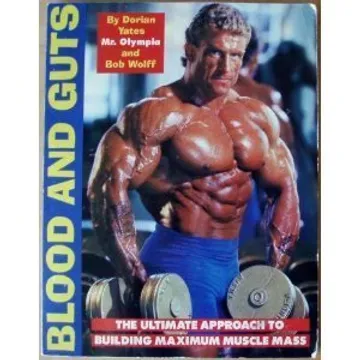
Blood and Guts is part athlete memoir, part training manual, and part argument against bodybuilding's high-volume habits in the early 1990s. Its narrative gives the advice stakes: Yates moves from a novice contest in 1985 to the Mr. Olympia title in 1992, with the near miss against Lee Haney providing a concrete moment of reassessment. The book's most useful organizing idea is not simply training harder. It is to create a strong, trackable stimulus, then protect the recovery needed to adapt.
The method is unusually coherent because its parts reinforce one another. Logs make progress and stalls visible. Strict technique keeps effort directed at the intended muscle. Low-volume, high-effort sessions create a reason to allow longer recovery. Nutrition records turn weight gain or loss into a solvable adjustment rather than a mystery. The advice to change one variable at a time is especially valuable: it makes personal experimentation more informative and less like random program-hopping.
The limits are equally instructive. Yates was an elite bodybuilder with years of experience, unusual training capacity, and strong support. His low-volume prescription, all-out effort, and advanced techniques should not be treated as universally optimal, especially for beginners or people lifting without a spotter. Contemporary evidence supports progressive resistance training and adequate recovery, but muscle growth can be achieved through a range of workloads and does not require forced reps or absolute failure on every set. Likewise, his calorie figures, supplement advice, meal frequency, and post-workout timing are historical personal recommendations, not current universal rules.
Read the book as a model of disciplined adaptation, not a fixed template. Its enduring contribution is the insistence that a workout, meal plan, or goal should have a reason, a record, and a result that can be evaluated. The vivid champion's story makes that process memorable, while careful readers can separate the durable principles from the era-specific prescriptions.
People Also Read





Glossary
Blood and Guts training cycle
Hard training followed by easingYates's term for a pattern of several weeks of very demanding training followed by a period of reduced intensity or extra rest. He describes roughly four or five hard weeks, then a week or two of easing back, while emphasizing that individual recovery needs differ. The cycle is meant to manage fatigue from intense work, not to impose an identical calendar on every lifter.
triple drops
Two quick weight reductionsAn intensity technique in which a lifter takes a set to failure, reduces the weight, performs more repetitions, then reduces the weight again for another short effort. Yates recommends keeping the transitions brief and describes drops of about 10 percent with several additional repetitions at each load. He presents the method as demanding and best used selectively.
staggered grips
Changing grip during a setA technique Yates describes for changing the hand spacing during an exercise, such as an incline press. The lifter briefly racks the weight, moves the hands closer together, and continues the set, potentially changing the emphasis across the chest. The method is intended to extend a set with little rest; it requires safe handling and does not guarantee isolation of a precise muscle region.
rest-pause
Brief rests within a setA method of dividing a demanding set into short clusters. The lifter performs a few repetitions, rests for roughly 10 to 15 seconds, then performs more repetitions with the same weight, repeating as needed. Yates counts the clusters together as one set and uses the method to accumulate repetitions with a heavy load.
instinctive cycle
Training adjusted to readinessYates's approach of adapting training effort or rest according to how prepared he feels on a given day, rather than following a rigid intensity schedule. If energy or concentration is low, he may train more lightly or take an extra rest day. The idea is to preserve consistency while avoiding maximal work when the body does not seem ready for it.
Download PDF
Download EPUB
.epub digital book format is ideal for reading ebooks on phones, tablets, and e-readers.








