

Plot Summary
Prologue
Twenty-two years before the main story, Royal Seer Vivienne is wrenched from sleep by a vision of bloodshed. She rides to a cottage in Valeford and finds the king’s sister and her husband murdered, while healer Elisabeth protects their infant daughter, Illiana.
Vivienne and Elisabeth flee with the child to the palace, where the king and queen take her in. When Illiana is placed in the king’s arms, Vivienne delivers a prophecy: the magicless child is destined to become a heroine, and love will awaken her against the darkness threatening Brookmere.
The opening binds the kingdom’s political future to a child who begins life as both survivor and secret. The storm, the murdered parents, and the seer’s prophecy make fate feel less like reassurance than an emergency imposed on the adults around Illiana. Her survival depends on Elisabeth’s immediate courage and the king’s protection, establishing care as the first force that counters violence. The prophecy then turns that care into public destiny, a burden Illiana will inherit before she can understand its cost.
The Henchman Meets Shadows
Twenty-two years later, Illiana Dresden, whom her friends call Lana, is a princess who sneaks beyond Ellevail’s walls to help struggling villages as the Hidden Henchman. She has no magic, a secret that could disqualify her from the throne, but years of sword training and help from Captain Ian Stronholm let her operate in disguise.
A request for provisions brings her to a forest meeting with Storm and his imposing companion, Kade. Before the strangers can explain much, crazed Fae attack.
Lana freezes at first, then fights beside Ian as the assailants multiply. Kade pulls her from an attacker’s reach, and Storm reveals fire magic against their pursuers. The survivors leave with more questions than supplies: the attackers carry a strange, violent power none of them recognize.
Lana’s double life is not merely an escape from palace routine. It gives her a form of political agency in a kingdom where her lack of magic makes her feel disqualified before she can rule. The attack collapses the distance between charitable work and war: the people she helps are already living inside the crisis her father calls contained. Kade’s rescue complicates her first impression of him, while Storm’s elemental ability signals that the kingdom’s familiar rules of magic may no longer explain what is happening.
A Wound Beneath the Mask
Ian gets Lana back into the palace through hidden passages, where adviser Andras Braumlyn catches them returning at night. Elisabeth heals Lana’s deep arm wound before anyone can investigate how she got it.
The danger of exposure sits beside a more private truth: unlike other Fae, Lana cannot heal herself or summon any magic at all. Her parents and a few trusted companions have kept this from the court after years of failed attempts to awaken her abilities.
At breakfast, the king guesses she has been training beyond the gates and forbids further excursions. His worsening cough interrupts their argument, and Lana realizes the king, usually Brookmere’s most powerful Fae, is becoming seriously ill while refusing to explain the growing danger at the borders.
Lana’s secrecy has two purposes that pull against each other. Concealing her magiclessness protects her claim, while concealing her work prevents her father from stopping her service to the kingdom. Andras’s sudden appearance makes the palace itself feel unsafe, even before Lana can name why. The king’s illness reverses the usual parent-child arrangement: the person who has defined protection for Lana now needs it himself. Her impulse to act is therefore both civic and intimate, driven by fear that the kingdom and her family are failing at once.
The Drop Turns Deadly
Lana, Ian, Leif Ivans, and Corbin Jansen prepare a supply carriage for Georgina and Harold, villagers seeking food and money. At the drop, dark ones ambush the group before the aid can be delivered. Lana fights without retreating, but Georgina and Harold are killed in the attack.
Kade and Storm arrive and help the others drive off the raiders, then agree to carry the supplies to the village. Their intervention saves the goods, not the people who came for them.
Back in Ellevail, Ian argues that Lana cannot keep joining the drops while the attackers remain unknown and increasingly numerous. He later leaves her behind on another mission, a decision that strains their long friendship and makes Lana feel that protecting her is becoming another way to cage her.
The deaths transform Lana’s charitable network from a hopeful workaround into a dangerous responsibility. The harm is not abstract: specific people arrive expecting provisions and never return home. Ian’s exclusion of Lana is emotionally painful because it repeats the logic of her upbringing, where safety has meant others deciding what she can bear. His judgment is not simply controlling; he knows she lacks healing magic and may die from a wound that another Fae could survive. Their conflict exposes how protection can be loving and still diminish the person it intends to preserve.
Eight Men Seek the Crown
As the king’s illness worsens, he tells Lana that Brookmere’s laws require her to marry before she can inherit the throne. Rather than arrange a match privately, he revives ancient marriage trials, despite Lana’s objections that the prophecy does not give her consent.
At the opening ball, Captain Ian enters to protect her from a powerful stranger taking the crown. Hale Bardot, a familiar court companion, also joins, as do several noble contenders. Kade arrives last, openly confident and unwilling to flatter the king with a title.
His dance with Lana draws every eye in the room, and their effortless attraction unsettles her even as she resents being presented as a prize. The trials begin with eight contenders, including the two men she trusts least to understand her choices.
The trials convert a crisis of succession into public entertainment, allowing the court to treat Lana’s marriage as a solution to the king’s mortality. Her resistance is not a rejection of responsibility; she wants authority over the decisions that will define her rule. Ian enters from loyalty, but his choice also makes their existing intimacy politically legible as an advantage. Kade’s presence offers a different threat: he attracts Lana without offering the reassurance of history or obedience. The competing forms of safety and desire begin to make her choice less a contest of suitors than a contest over who will recognize her agency.
A Kiss in the Shadows
After the ball, Lana follows Ian to protest his decision to compete, then nearly collides with Casimir West and Ryland Lockbane arguing near her rooms. Casimir draws a dagger and searches for whoever overheard them.
Kade conceals Lana in his shadows, guides her through a rising panic, and kisses her once the danger passes. His use of her private nickname makes her realize he has recognized her as the Hidden Henchman, though he keeps the secret.
When Lana later tells Ian, his concern sharpens: Kade now knows both her identity and the supply network. The encounter leaves Lana drawn to Kade and wary of him in equal measure. His protection has been real, but so has his interest in power, and she cannot tell where one ends and the other begins.
The shadows function as both concealment and intimacy: Kade can hide Lana from an armed threat, but doing so places her physically and emotionally in his care. Her panic is not a flaw to be corrected; it is a bodily response shaped by past danger, and Kade’s patient breathing gives her a way back to the present. The kiss does not resolve the question of trust. Instead, it intensifies it, because the man who can make her feel safe also possesses information that could expose her most important secret.
The Trials Draw Blood
The first trial tests strategy, judgment, and endurance. The contenders begin with the game Chance and Destiny, then choose among four potions, only one of which safely opens the next passage.
Lord Levi Thatcher drinks a dangerous poison and collapses; Edmund Fairweather suffers an itching potion but recovers enough to solve the final riddle, whose answer is nature. Ian, Frederich Hansley, and Kade finish among the top three. Later, the king announces that Thatcher has died despite the healers’ efforts.
At dinner, Frederich and Casimir challenge Ian’s closeness to Lana, and the king removes him from her personal guard to quiet accusations of unfairness. The trial has now killed a contender, weakened Lana’s access to Ian, and shown that the marriage contest carries risks beyond humiliation.
The first trial teaches Lana to read conduct rather than polish. A board game tests patience, the potions expose how contestants respond to uncertainty, and the riddle tests whether they can recognize a principle larger than self-interest. Yet the event’s most consequential lesson is institutional: the king knows death is possible and proceeds anyway. Thatcher’s death makes the trials’ spectacle morally unstable. The court calls it a test of fitness, but the contenders are being asked to prove their worth inside a system that treats mortal danger as an acceptable price of succession.
The Henchman Gains Allies
Lana’s conversations with the contenders offer a clue to the crisis: Frederich boasts that his town of Starhaven has endured the darkness longest while his trade continues to thrive. Because no one has found records of Kade or Storm, she and Ian remain suspicious, but the attacks leave them short of fighters.
Lana invites the pair into her private garden and explains the Hidden Henchman network, its secret supply caches, and the danger faced by Leif and Corbin if the crown discovers their work.
Kade gives his word to protect Lana’s secret and offers his sword; Storm agrees to help investigate. They plan to travel toward Starhaven after a delivery at Logan Lake, while Kalliah Brennan arranges a false illness to hide Lana’s absence from the palace.
Lana’s private court grows through earned loyalty rather than rank. Leif and Corbin risk execution for her work, while Kade and Storm enter an operation they do not control because the same crisis threatens people they care about. Her acceptance of help is a meaningful change: she remains suspicious, but no longer mistakes self-reliance for the only form of strength. The false illness also reveals how much of her authority depends on performance. To investigate the kingdom, the heir must first persuade the palace that she is too sick to leave her room.
The Road Becomes a Trap
The group completes the Logan Lake supply drop without incident and camps beneath the open sky before riding toward Starhaven. On the forest road, arrows drive them out of the trees and into a field crowded with dark ones.
Ian shifts into hawk form to fight, Storm unleashes fire, and Kade’s shadows break attackers’ necks. Lana is stabbed in the side. Kade removes the blade and discovers she is not healing, while Ian admits she has no magic. He carries her back toward Ellevail as Kade and Storm hold off the attackers.
Lana wakes later in the palace to find Kade beside her, exhausted from returning through the rain. His care turns their attraction into a deeper attachment, though he still refuses to explain why he and Storm sought the Hidden Henchman’s aid.
The ambush converts Lana’s hidden vulnerability into a fact other people can see. Her body cannot perform the basic healing expected of a Fae, and the injury makes clear that training cannot replace every kind of power. Kade’s panic at her wound and his return to her bedside create a credible intimacy through action rather than reassurance. Still, the rescue does not erase the imbalance between them: he knows her secret, while his own history remains closed. Care makes trust possible, but it does not make uncertainty disappear.
The Arena Turns Savage
Once Lana has recovered enough to attend the second trial, the contenders face a dangerous obstacle course. A razorven, a beast thought absent from the palace grounds, attacks Ian. Casimir drains Ian’s shapeshifting magic, then uses it himself to cross the course.
Elsewhere, Edmund, previously one of the least imposing contenders, turns on Frederich and uses a frightening power to draw blood from him until he dies. Ian and Kade abandon their own progress to stop Edmund, with Kade’s shadows finally killing him.
They reach the finish just before time expires. The king tells the crowd Edmund was simply overcome by the contest, but Lana sees how eagerly Andras watches the violence and suspects the attack reflects something larger than a contestant’s ambition.
The course exposes the difference between possessing a power and using it responsibly. Casimir treats Ian’s magic as a tool to steal, while Ian and Kade sacrifice their standing to protect others from Edmund. Lana’s attention shifts from choosing a husband to judging the systems around the choice: the king’s public reassurance contradicts the evidence in the arena. Andras’s pleasure further unsettles the official account. The court’s ability to rename a crisis as ordinary competition becomes a danger in itself, because denial gives the violence room to grow.
Elisabeth Cannot Be Saved
In the confusion after the trial, Lana and her companions race through the palace toward her chambers and find Elisabeth gravely wounded in the corridor. Lana searches the healer’s medicine satchel and begs her to identify a remedy, but Elisabeth knows her injuries cannot be repaired.
She dies with Lana beside her, leaving the princess devastated and convinced that her own helplessness has failed someone she loves. Kade later helps Lana bathe and listens as she remembers their weekly tea and hidden lemon cookies. He does not force her to explain the scar on her ribs, but promises to help when she is ready. His tenderness gives Lana a brief refuge from grief, not a cure for it.
Elisabeth’s death strikes at the practical and emotional foundations of Lana’s life. The woman who has repeatedly healed her cannot heal herself, and Lana’s inability to act becomes a fresh wound layered over old shame about being magicless. The scene refuses to make grief productive immediately: Lana searches, pleads, and fails. Kade’s care matters because it does not demand that she recover on schedule or turn pain into a lesson. He offers presence, and for a moment that is the only help she can accept.
Good Suitors, Bad Omens
After one day to mourn, Lana resumes the required dates. Casimir takes her through the city, boasts about Starhaven’s prosperity, and shows little concern for poorer residents; children’s flowers and a baker’s condolences matter more to her than his claims of business success.
Ryland makes a thoughtful sparring date, but Lana sees companionship rather than a future king. Hale offers a gentle lunch at Millie’s café, remembers Lana’s favorite soup, and speaks honestly about their friendship.
Meanwhile, Kalliah accepts an invitation from Dimitri to make Leif recognize his feelings, and Leif’s flustered reaction suggests her tactic has worked. These encounters help Lana distinguish public performance from genuine regard, while grief and the approaching final trial keep every pleasant moment edged with uncertainty.
The dates turn courtship into a diagnostic exercise. Lana does not evaluate the men only by attraction; she watches how each treats shopkeepers, children, and the people whose labor sustains the capital. Casimir’s wealth cannot hide his contempt, while Hale’s attentiveness is meaningful precisely because it remembers small details rather than claiming grand virtues. Kalliah’s subplot echoes Lana’s own dilemma on a smaller scale: waiting silently for affection can become another form of surrender, so she creates an opportunity and risks being disappointed.
The Festival Unmasks Andras
At the Festival of Blessings, Andras insists on dancing with Lana and refers openly to her childhood suffering in the palace dungeons. His touch and words unsettle her, and she senses him pressing into her thoughts before Hale intervenes and helps her regain control. Ian comforts her afterward. Later, Kade dances with Lana and admits that being near her makes him feel more like himself.
She returns to her rooms, where Kade joins her, and they choose to act on their attraction. The night brings them closer, but it does not erase Kade’s secrecy or Lana’s uncertainty about the crown. When he visits again before the final trial, she tells him she has no magic and that Andras tortured her for years under the excuse of trying to awaken it.
The festival exposes two kinds of intimacy. Andras uses knowledge of Lana’s trauma to destabilize her, while Kade’s growing closeness gives her room to choose what she discloses. The contrast is ethically important: both men can affect her inner state, but one treats access as entitlement and the other, at his best, waits for consent. Lana’s confession tests whether desire can survive a truth that threatens her political worth. Kade’s response matters because he sees her courage and judgment as sources of authority, not as substitutes for magic.
Vivienne Sees the Tide
Before the last contest, Lana and Kade acknowledge their attachment, and she shares the history she has kept from nearly everyone. Kade believes her and condemns Andras, but gives no full account of his own origins or plans.
On the day of the weapons trial, Lana arrives in fitted armor, determined not to be treated as a decorative heir. Vivienne’s prophecy becomes unusually urgent: she warns of danger tied to the trials and begs the king to stop, but he proceeds. During the archery test, two tremors strike the arena.
A battle cry rises, and infected Fae pour into the grounds alongside dangerous creatures from Brookmere’s forests. The final trial collapses into an invasion, placing Lana’s family, friends, and the entire capital in immediate danger.
The last trial makes the book’s central conflict literal: Lana is expected to prove herself as a ruler while the institution defining her worth becomes the site of catastrophe. Vivienne’s warning arrives in language the court cannot easily use, but its urgency is unmistakable. The king’s decision to continue suggests that tradition and public confidence have become stronger than responsiveness to danger. Lana’s armor marks a personal refusal to be displayed as a prize. She enters the final crisis already claiming the posture of a combatant and future sovereign.
The Eye Behind the Invasion
Lana and Kalliah descend into the arena to help evacuate spectators and fight the dark ones. When Andras uses vines to seize Lana, Casimir reveals they are allies and that he expects to rule beside her. Andras threatens Kalliah, while a guard carries her unconscious body away. Leif takes a vine through his thigh as he shields Lana, and Corbin stays to help him.
Lana burns through Andras’s grip with a strange flare of light, then confronts him in the palace corridor. Andras admits he poisoned the king over many years and killed Elisabeth when she came close to countering it. He escapes before Lana can strike him down. Kade, Ian, and Storm reach her, but the coup and the assault on Ellevail are still underway.
Andras’s betrayal reorganizes Lana’s entire understanding of danger: the enemy is not merely approaching from the border but has been trusted inside the palace for years. His alliance with Casimir connects private ambition to the kingdom-wide infection. Lana’s burst of light hints that her lack of familiar magic may not mean an absence of power, but it arrives under coercion, not triumph. The scene also refuses to make revenge simple. Lana wants Andras punished, yet his escape leaves the immediate task unchanged: keeping her people alive and finding her family.
A King’s Last Command
Kade finds the king cornered by Casimir and the infected attackers. The king explains that Casimir can siphon his immense magic and that Andras will use it to control Lana; he asks Kade to kill him before that can happen. Kade resists, then gives in when the king insists it is the only way to protect his daughter and the kingdom.
Lana enters in time to see Kade’s dagger in her father’s chest. She tries to heal him with the new light in her hands, but cannot save him. As the king dies, he urges her to be strong. Kade breaks the remaining danger by snapping the king’s neck, which Lana sees as another murder. He and Storm knock Ian unconscious and carry Lana from the palace after she fights them.
The king’s request turns protection into an act that looks indistinguishable from betrayal to the person it is meant to save. Kade makes a choice under the king’s authority, but Lana witnesses only the violence and its consequence: her father dead in his arms. Her desperate attempt to heal him repeats the old wound of being unable to save those she loves, even as light briefly answers her. Kade’s decision may be strategic, but its emotional cost is immediate and irreversible. The relationship that had offered Lana safety becomes, in her eyes, another source of loss.
Beyond the False Horizon
At an inn, Lana reads the king’s sealed letter. He reveals that he and Queen Roxana raised her as their own after the infected Fae killed her birth parents, Princess Fallon and Sebastian Rykes, in Valeford. The letter says her mother left a royal journal hidden at their former home, and that it may hold what Lana needs to save Brookmere.
Lana is furious that the truth was withheld, but decides to escape Kade and Storm and retrieve it. The next morning, Kade refuses to take her to Demarva. He leads her to what looked like an ocean, then dispels the illusion to reveal a wall of mist. He takes Lana and Storm through it into Mysthaven, the place Lana knows from a story as the Forgotten Kingdom.
The letter makes Lana’s identity both more secure and more unstable: the king’s love was real, but the history on which she understood her family was incomplete. Her birth parents’ murder links the opening massacre to the present infection, while the hidden journal gives her a concrete next task rather than a final answer. Kade’s crossing into Mysthaven overturns the map that has governed the story. The novel closes not with a restored kingdom but with Lana at a threshold, grieving, mistrustful, and newly responsible for discovering what her mother left behind.
Analysis
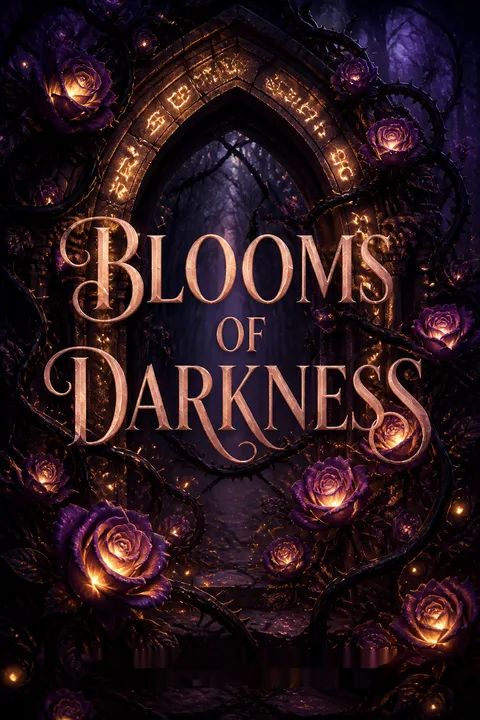
Blooms of Darkness makes the struggle for succession personal by tying political legitimacy to a heroine who has been taught to see her body as evidence against her. Lana is magicless in a society that treats magic as both status and proof of fitness, yet she performs the work of rule before receiving the title: she listens to villages, organizes supplies, trains to defend herself, and judges contenders by how they treat people with less power. Her central conflict is therefore not whether she can become powerful, but whether she can recognize forms of power her culture does not reward.
The novel also scrutinizes protection. Ian’s devotion is genuine, but his decisions to exclude Lana reproduce the restrictions that have shaped her life. Kade offers a more destabilizing alternative: his shadows protect and comfort her, yet his secrecy makes intimacy dangerous. The romance gains force from this contradiction. Attraction does not resolve trust; it makes trust consequential. Lana’s disclosure of her magiclessness and abuse tests whether she can be loved without performing royal adequacy, while Kade’s response is meaningful because he values her judgment and courage rather than promising to replace what she lacks.
Institutions repeatedly mistake order for safety. The king hides the border crisis, the court stages trials despite mounting deaths, and Andras exploits his position inside the palace. In each case, official authority preserves appearances while ordinary people bear the cost. The Hidden Henchman network is an improvised counter-institution, built from trust and material aid rather than rank. Yet the book does not let Lana’s compassion become a simple cure: deliveries are ambushed, allies are wounded, and Elisabeth’s death leaves her unable to save someone she loves.
The ending deliberately withholds political restoration. Lana loses the father who raised her, learns that her origins and the history of the infection are older than she knew, and crosses into a realm outside her map. Her emerging light offers possibility, not mastery. The final movement is from inherited destiny toward active inquiry: the royal journal, the hidden history, and the nature of Kade’s mission remain questions Lana must confront rather than truths the book settles for her.
Review Summary
People Also Read



Characters
Illiana Dresden, called Lana
The unpowered heirIlliana is the crown princess of Brookmere, known among her closest friends as Lana. Born without the magic expected of a royal, she hides her vulnerability while building a secret aid network for struggling villages. Her training with a sword, quick political instincts, and stubborn concern for ordinary Fae give her forms of authority the court does not readily recognize. She wants freedom to act, but her fear of being exposed as inadequate makes protection feel dangerously close to confinement. Her loyalty to her people, Ian, Kalliah, and her family drives her to take risks before she has all the information. She is observant and compassionate, though she can mistake self-sacrifice for proof that she deserves a place in the world.
Kade Blackthorn
The shadow-wielding contenderKade is an enigmatic warrior whose extraordinary shadow magic makes him one of the most formidable contenders for Lana’s hand. He travels with Storm, keeps his origins close, and initially treats courtly rules as obstacles rather than obligations. His sharp teasing masks a guarded temperament, while his actions repeatedly show a capacity for protection and tenderness that complicates his pursuit of power. Lana’s independence unsettles and attracts him because she refuses to be impressed into obedience. He is not easy to trust: he withholds information even as he becomes emotionally involved. His central tension is between a long-standing purpose and the intimate loyalty he develops toward someone whose future could alter that purpose.
Ian Stronholm
The loyal guard and friendIan is Lana’s closest friend and the young captain of the Royal Guard. He has protected her since childhood, helped build the Hidden Henchman network, and trained her to fight despite her lack of magic. His shapeshifting and disciplined combat skills make him a capable leader, but his devotion can become overprotective when he believes Lana is in danger. He enters the marriage trials because he wants to shield her from a ruler who might restrict or exploit her. Beneath his competence lies a deep fear of losing the person who has anchored his life. His bond with Lana rests on years of shared survival, humor, and trust, not on the political role others try to assign it.
Storm
The fire-wielding allyStorm is Kade’s long-time companion and a powerful Fae who commands fire. He is steadier and more diplomatic than Kade, often stepping in when his friend’s provocation threatens to derail a useful conversation. His loyalty is practical: he fights beside people in danger and helps investigate the spreading darkness. Though he shares little of his past, he shows respect for Lana’s choices and for the dangers faced by the Hidden Henchman’s helpers.
Kalliah Brennan
Lana’s steadfast confidanteKalliah is Lana’s lady-in-waiting, closest female friend, and a politically perceptive presence within the palace. Her magic is modest, but her judgment and loyalty are not. She helps Lana manage court appearances, conceal her absences, and recover from panic without treating her as fragile. Kalliah can be blunt when Lana’s choices endanger her, yet she understands that safety without agency would become another prison. Her own uncertainty about romance and Leif gives her a personal stake beyond service to the princess.
Elisabeth
The palace’s trusted healerElisabeth is the palace healer who has cared for Lana since infancy and offers her a rare place of warmth outside royal protocol. She treats injuries, nightmares, and anxieties with equal patience, never demanding an explanation before offering help. Her quiet rituals of tea and conversation give Lana a model of care based on attention rather than command. Elisabeth is experienced, practical, and deeply affectionate, with a steady belief that Lana is more than her magical limitations.
The King
Lana’s devoted sovereignThe King is Brookmere’s powerful ruler and the loving father Lana believes she has always known. He values their private jokes and affection, yet his determination to protect the kingdom often leads him to withhold information and make decisions for her. As his health declines, his authority becomes more visibly fragile even while he tries to preserve public confidence. He trusts prophecy and tradition as safeguards, but his daughter’s independence increasingly challenges the limits of that approach.
Queen Roxana
The quiet royal partnerQueen Roxana is Lana’s loving mother and the King’s devoted partner. In public she often lets him command attention, but she is more politically active in private than observers assume. She understands the costs of rule and supports decisions meant to protect the succession, even when those decisions hurt Lana. Her compassion is expressed through close observation and gentle honesty, especially as the royal family faces mounting uncertainty.
Andras Braumlyn
The king’s polished adviserAndras is the Royal Adviser, a court insider whose authority gives him access to the king and to Lana. He is observant, self-assured, and skilled at turning etiquette into a means of control. Lana has distrusted him for years, though the reasons behind her fear remain buried for much of the story. His polished manner does little to soften the unease his presence creates.
Vivienne Nazar
The troubled Royal SeerVivienne is Brookmere’s Royal Seer, whose visions shape the royal family’s understanding of Lana’s future. Her speech often comes in riddles, and the court sometimes dismisses her as confused, but her prophecies carry unusual weight. She is both an institutional figure and a person burdened by knowledge she cannot always communicate clearly. Her concern for Lana emerges most strongly when danger becomes imminent.
Leif Ivans
The resourceful kitchen allyLeif works in the palace kitchens and helps secure food and other supplies for the Hidden Henchman’s deliveries. Warm and quick to laugh, he is also willing to risk his position for people beyond the palace. His growing feelings for Kalliah make him less composed than his practical work usually demands.
Corbin Jansen
The stable’s quiet organizerCorbin works in the royal stables and coordinates transport for the Hidden Henchman network. He is reserved, observant, and dependable, often contributing more through preparation than speech. His loyalty to Lana is not based on courtly advancement; he believes her work responds to needs the royal system has failed to meet.
Casimir West
The ambitious noble contenderCasimir is a nobleman competing for Lana’s hand and the Brookmere throne. He boasts of Starhaven’s prosperity and his own protective magic, but his attention to wealth and status leaves him dismissive of ordinary Fae. He views the trials as a contest to be won and treats Lana’s future as something that can be claimed. His confidence makes him politically dangerous even before his deeper motives are known.
Hale Bardot
The considerate old friendHale is a familiar member of the nobility who has shared years of formal gatherings and private escapes with Lana. Their history gives her ease around him, and he demonstrates care through small, specific gestures rather than grand promises. He is kind and sincere, though Lana must distinguish affection and friendship from the qualities required of a king.
Ryland Lockbane
The skilled, reserved contenderRyland is a physically capable contender with blast magic and a comparatively easy manner. He performs well in the trials and shows curiosity about Lana’s interests, including her sword training. His reserve makes him difficult to read, and his conversations with Casimir raise questions about where his loyalties lie.
Edmund Fairweather
The quiet contenderEdmund is an understated contender who initially appears less forceful than the nobles around him. His careful participation in the trials offers little warning of the violence that can overtake the competition.
Levi Thatcher
The poisoned nobleLevi Thatcher is a noble contender whose confidence and status make him expect consideration from others. His brief role in the trials underscores that rank and magical strength cannot guarantee safety.
Ruppert
The rule-bound former guardRuppert is Lana’s former personal guard, a rigid believer in rules and formal boundaries. His return complicates her freedom of movement, though his strictness comes from duty rather than personal ambition.
Lucien
The fire-breathing palace petLucien is a small, dangerous-looking palace creature with a friendly attachment to Lana and Ian. His fire breath makes him more than a pet, and his loyalty becomes clearest when the palace is under attack.
Dimitri
Kalliah’s festival companionDimitri is a man who invites Kalliah to the Festival of Blessings. His presence gives her a chance to pursue her own romantic hopes rather than waiting indefinitely for Leif to act.
Plot Devices
The prophecy
Destiny under disputeVivienne’s prophecy gives the royal family a framework for interpreting Lana’s magiclessness and future. The king uses it to justify the marriage trials, believing love will awaken what Lana lacks and protect the kingdom from its blight. Because the prophecy arrives through a seer whose speech is often difficult to interpret, it creates uncertainty as well as direction. It shapes Lana’s life before she can consent to its meaning, while its warnings become harder to dismiss as the danger escalates.
The Hidden Henchman
Secret aid beyond the palaceLana’s disguised network diverts surplus food, money, clothing, and supplies toward villages in need. Ian, Leif, and Corbin help move requests through hidden routes and staged drops, allowing the princess to act where royal assistance appears inadequate. The network gives Lana a practical role outside court ritual and reveals the worsening needs of Brookmere’s people. Its secrecy also makes every delivery vulnerable to exposure, ambush, and political consequences.
The dark ones
The kingdom’s spreading infectionThe dark ones are Fae changed by an unfamiliar force that produces erratic movement, heightened aggression, and a strange charge in the air. They attack supply drops, border towns, and eventually the palace itself. A black eye-like mark appears on one attacker, linking separate outbreaks to a wider organization or purpose. The infection transforms a succession story into a survival crisis, while the king’s secrecy makes it harder for Lana and the reader to know how far the threat has spread.
The marriage trials
A public succession contestThe king revives a tradition in which contenders complete mental, magical, and physical tests to compete for Lana’s hand and the future kingship. Each round is a public spectacle, but the tasks reveal character as well as ability: patience in a strategy game, judgment under poison risk, and willingness to protect others during danger. The trials give Lana limited influence over her future while placing her marriage at the center of political stability. Their escalating danger exposes the gap between ceremonial control and the violence already threatening Brookmere.
The mist at Mysthaven
A doorway beyond BrookmereNear the end of the book, Kade reveals that what seemed to be an ocean conceals a wall of mist. He leads Lana and Storm through it into Mysthaven, a place Lana recognizes as the Forgotten Kingdom from a childhood story. The crossing overturns her assumption that the crisis is contained within Brookmere and leaves her inside an unfamiliar realm with her allies and captors, depending on how she interprets Kade’s actions. This threshold launches the next phase of her search for answers.
Download PDF
Download EPUB
.epub digital book format is ideal for reading ebooks on phones, tablets, and e-readers.








