

Key Takeaways
Track land rents and prices, because houses conceal the boom's real engine
Separate land from buildings. In the book, land means natural sites and resources. Economic rent is the surplus value attached to access to them, not the payment for a building. A house price combines the value of its structure with the value of its location. Harrison points to British figures: from 1979 to 1989, land prices rose 900%, while building costs rose 82%. In the five years after 1997, land prices rose 333%, against a 30% rise in rebuilding costs.
Follow the surplus. These gaps, he argues, show that speculation targets land, not bricks and labor. As land prices rise, homes become less affordable, while rising property values support more borrowing. The resulting debt and spending can pull the wider economy into the property cycle.
What's striking is the analytical distinction between a reproducible structure and a scarce location. A machine can be built elsewhere; a central site cannot be moved. That difference helps explain why improvements to transport or public services may raise land values even when buildings themselves depreciate. The argument is strongest when land is treated as a channel through which expectations and credit affect the economy, rather than as a lone cause. Local prices also reflect planning rules, amenities, and demand, so separating land value from building value is essential before drawing broad conclusions.
Use the 18-year cycle as a warning model, not a date guarantee
Start with the housing clock. In 1775, a group meeting at a Birmingham pub formed a building club that pooled members' savings to finance homes. At 5% interest, the club's financial arrangement took about 14 years to run its course. Harrison links that period to a larger pattern: an approximately 18-year cycle from downturn to downturn, shaped by housing construction, land prices, credit, and a mid-cycle slowdown.
Read it as a hypothesis. The book traces similar intervals through British history and uses the pattern to predict a major downturn around 2010. Its model describes recovery, a middle interruption, a renewed upswing, and a late speculative surge before recession. The history is suggestive, but the cycle is not a universally accepted law or a guarantee that every downturn arrives on schedule.
The model's appeal is that it connects household finance to construction and then to the wider business cycle. Mortgage duration and building lead times can create real rhythms in economic activity. But repeated dates are not, by themselves, proof of a clockwork mechanism. Historical turning points can be classified differently, and wars, policy changes, and new credit instruments alter timing. The useful discipline is to treat the cycle as a falsifiable warning: specify the dates and indicators in advance, then assess the forecast against a consistent record.
Treat household debt as the bridge from property speculation to recession
Collateral magnifies a boom. When land prices rise, property owners appear wealthier and banks can lend more against their homes. Households then borrow to buy homes, extract equity, and spend. The book argues that Britain avoided a formal recession in 2001 partly because household borrowing sustained consumption even as manufacturing output fell by more than 5% from the end of 2000 to the end of 2003. By July 2004, household debt had reached £1 trillion.
The cushion becomes a trap. Borrowing can keep spending afloat temporarily, but it leaves families exposed to interest-rate increases, unemployment, or falling house prices. When borrowers cannot meet payments, foreclosures and defaults damage banks, reduce household spending, and deepen the downturn. In this account, debt did not cure the recessionary pressure. It delayed and enlarged the reckoning.
This account aligns with a familiar balance-sheet mechanism: rising collateral values permit more borrowing, which supports demand and can push asset prices higher still. The feedback is especially dangerous when households hold much of their wealth in one illiquid asset. Debt is not inherently destabilizing, however. It can help families smooth income or finance productive investment. The key distinction is whether borrowing expands future earning capacity or depends on ever-rising property values. A useful warning signal is not debt alone, but debt growing faster than incomes while borrowers and lenders rely on continued appreciation.
The digital economy still depends on scarce land and spectrum rents
New technology, old scarcity. The dot-com boom was sold as a break from the industrial economy. Harrison argues that the internet still depended on physical assets: office sites, cables, antenna locations, and access to the electromagnetic spectrum. In Silicon Valley, high housing costs were so severe that some employed people reportedly slept on a bus rather than pay local rents. Meanwhile, internet companies bid for office space, pushing rents higher and displacing older businesses.
Separate innovation from hype. Digital tools can genuinely cut costs and connect distant sellers to customers. But the book argues that productivity gains can be absorbed into land values when access to desirable sites is scarce. Speculation in company shares added another layer: investors paid for anticipated future income, sometimes before firms had profitable products. The technology was new; the lure of unearned gains was not.
The distinction between innovation and the distribution of its gains is valuable. A technology may increase total output without ensuring that workers or consumers keep the benefit. If a new business makes a location more valuable, landowners may capture part of the gain through higher rents. Yet the book's account should not collapse every digital success into land speculation. Better communication can also create new products, reduce search costs, and broaden competition. The important question is empirical: which gains come from improved production, and which come from control over scarce access?
Interest rates cannot cure land inflation without taxing productive borrowers
A narrow inflation gauge misleads. The book criticizes inflation targets that focus on consumer prices while excluding much of the rise in land values. British house prices rose far faster than the official inflation target during the 2000s, yet the Bank of England was not tasked with controlling asset prices directly. Responsibility for housing therefore fell back on fiscal policy, which the author says failed to restrain speculation.
One lever hits many sectors. Raising interest rates may cool borrowing, but it also raises costs for businesses that need loans to invest and operate. Cutting rates may support business while making property more attractive to buyers. The author argues that this blunt tool cannot stabilize an economy when policymakers neither measure land well nor address the rules that reward speculative gains.
The section highlights a genuine tension in monetary policy: interest rates influence many decisions at once, while asset-price excesses may be concentrated in particular markets. That does not mean rates are useless. Central banks can affect credit conditions and aggregate demand, but they cannot precisely target one asset without consequences elsewhere. The stronger policy case is for combining monetary tools with transparent land data and carefully designed lending rules. The book is persuasive in criticizing overconfidence, though its claim that land-based fiscal reform is the decisive solution requires separate evidence.
Make public investment return its land windfall to the public
Infrastructure changes location value. A new road, rail line, or school can make nearby land more useful and valuable. Harrison argues that taxpayers often finance the improvement while nearby owners receive much of the resulting gain. He describes a Spanish property syndicate that bought a coastal villa in 2001 before a publicly supported motorway extended along the coast. Within three years, selling two building plots could recover the original purchase price while the syndicate retained the villa.
Capture value at its source. The book's principle is that public investment should not quietly become a private windfall. Charges related to the benefits of new infrastructure, or public capture of the resulting land value, can help fund the investment and reduce speculative gains. Poorly designed levies can also overcharge some sites or miss the value created at others, so valuation and local benefit matter.
This is a classic problem of public goods and capitalization. Infrastructure creates benefits beyond the direct users, and nearby property markets can register those benefits in prices. Capturing some of that increase can align who pays with who benefits, while making projects easier to finance. The difficult work lies in estimating the value attributable to the project, distinguishing it from broader market growth, and protecting lower-income residents from sudden costs. The principle is clearer than any single levy: measure the gain, disclose the method, and design payment around actual benefit.
Shift taxes off work and onto the land value communities create
Change what government taxes. Harrison's proposed remedy is to reduce taxes on wages, investment, and consumption while raising more public revenue from land and natural-resource rents. He defines rent as value that exceeds the costs of labor and capital, often created by a site's scarcity and the surrounding community. An annual charge on land would require occupants to pay for the advantages of the locations they use, while reducing the private gain from holding valuable land idle.
Change gradually, not by shock. The book argues that taxing productive activity discourages work and investment, while capturing land rent can fund shared services without the same direct penalty. It presents the change as a transition, not an overnight seizure of property. The practical case depends on accurate valuations, fair treatment across locations, and a clear account of how public revenue will be spent.
The proposal connects an incentive argument with a claim about fairness: tax the value tied to location rather than the effort used to create goods and services. That distinction is economically meaningful, but implementation is not automatic. Land assessments can be contested, and owners with valuable sites but little cash income may face hardship. A credible transition would need transparent valuation, deferrals where appropriate, and visible reductions in other taxes. The policy's strength is that it asks who creates value and who receives it; its credibility depends on addressing the real distributional details.
Australia's land-tax history shows that partial collection leaves cycles alive
A natural experiment with limits. Australian governments have taxed land values for generations, and a federal land tax introduced in 1910 remained in place until 1952. Harrison argues that this policy helped limit land speculation during part of the period, while emphasizing that it was later abolished. By the 1990s and 2000s, land values again rose sharply while land-based taxes captured only a small share of the gains. In New South Wales, the book estimates that owners retained about 88% of a large increase in land values from 1993 to 2003.
Coverage determines the effect. Australia had abundant territory, yet its major cities still experienced steep housing costs and property cycles. The book's point is not that any land tax prevents recessions, but that a low or inconsistent charge leaves much of the incentive to speculate intact.
Australia provides a useful corrective to the idea that land abundance automatically makes housing affordable. The value of land depends on access to jobs and services, not simply national acreage. Its history also suggests that policy coverage and continuity matter: a modest tax that captures little of the gain may not alter behavior much. At the same time, historical comparisons cannot isolate tax effects from credit, population shifts, or other policy changes. The case supports testing land-value taxation seriously, not treating it as a guaranteed cure.
Demand land data before trusting confident claims of economic stability
Measure what the models omit. The book compares economists' neglect of land data to NASA's failure to recognize a dangerous ozone trend in readings its systems recorded but treated as abnormal. Governments and central banks tracked consumer inflation while land values could rise dramatically outside the main indicators. In 2004, analysts offered sharply conflicting forecasts for British house prices, and senior policymakers admitted they could not reliably predict where prices would go.
Ask for evidence, not reassurance. Harrison's criticism is institutional, not just personal: weak theories and incomplete statistics make it easier for officials to mistake a temporary boom for durable stability. Readers should ask whether a forecast includes land prices, credit growth, household debt, and the distribution of gains. Confident language is not a substitute for a model that explains what would prove it wrong.
The book's strongest civic lesson is that measurement choices shape political attention. If a key asset is poorly measured, its risks can remain invisible even to competent officials. Modern economic analysis benefits from distinguishing prediction, monitoring, and explanation: a model may be weak at forecasting exact turning points yet still identify vulnerabilities worth tracking. The book's own periodic forecast deserves the same scrutiny it applies to official forecasts. Reproducible data, stated uncertainty, and preannounced tests would make its central claims more persuasive and public debate more useful.
Analysis
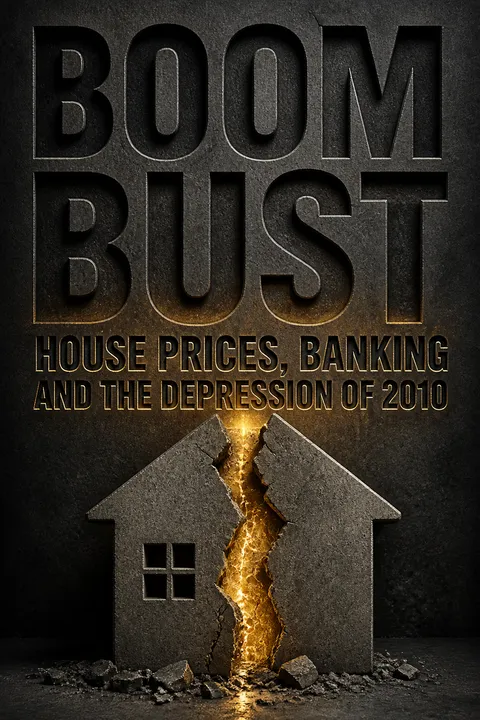
Boom Bust is an economics argument built around a neglected distinction: land is not a produced asset like a building, and its value can rise through scarcity, location, public investment, and collective activity. Harrison uses this distinction to reinterpret housing booms as land-price booms, then links rising land values to bank collateral, household debt, speculative construction, and recession. His narrative moves from a Birmingham building club in 1775 through British cycles, the dot-com boom, Australia, and the crisis forecast for 2010. The proposed remedy is a shift away from taxes on work and investment toward public capture of land and resource rents.
The argument's durable contribution is its insistence that macroeconomic models should track the asset households depend on most and the collateral banks rely on most. It also asks who receives the gains from roads, railways, and other public investments. These are concrete questions about measurement and distribution, not merely ideological preferences. Its critique of confident central-bank forecasts is especially compelling when officials acknowledge weak models but continue to present policy as precise control.
The least secure part is the recurring 18-year cycle. A coherent story about mortgage duration and construction does not establish that recessions follow a stable timetable. Historical events are numerous, dates can be selected or classified flexibly, and the source itself identifies wars and policy shifts as disruptions. The cycle should therefore be treated as a testable hypothesis, not settled economic law. The causal claim that land taxation would substantially eliminate instability also needs comparative evidence beyond historical episodes and illustrative estimates.
A strong empirical test would separate land prices from structures across regions and countries, then compare credit growth, construction, employment, and downturns before and after changes in land taxation. Such work could establish when land values lead crises, when they merely reflect wider demand, and which tax designs capture value without burdening cash-poor owners. The book is most useful as a research agenda and a challenge to conventional measurement, even where its strongest forecasts and policy claims remain open to proof.
Glossary
Economic Law of Absorption
productivity gains flow into rentHarrison's term for the tendency of gains from technology, lower costs, or public policy to be captured in land rent when competition and wages do not absorb them. For example, a new transport link may raise the value of nearby sites. The concept explains why productivity can increase while landowners receive a growing share of the benefit.
18-year cycle
proposed property-led cycleHarrison's account of a recurring economic pattern lasting roughly 18 years from downturn to downturn. He associates it with housing construction, land prices, credit, a mid-cycle slowdown, and a late speculative boom. The book uses the pattern to interpret historical recessions and predict future ones, but it should be understood as a hypothesis rather than an established universal law.
Terminating society
mutual home-financing clubAn early building society in which members pooled regular subscriptions to finance homes. Members who received a house early continued contributing, while others waited until enough funds accumulated for their turn. The group ended once its members had obtained homes. Harrison uses the model to explain how 5% interest and roughly 14 years of payments shaped housing finance.
Winner's Curse
winning by overpayingAn auction concept describing how the successful bidder may be the person who most overestimates an asset's value. Harrison applies it to late-stage land speculation: buyers compete on expectations of future price rises and can bid beyond what rents or incomes justify. The resulting high price harms the buyer and makes land less affordable to others.
rent
surplus from land accessIn the book, economic rent is income attributable to land or natural resources after the costs of labor and produced capital are accounted for. It is distinct from the payment for a building or other improvement. Rent may reflect fertility, location, infrastructure, or control of a scarce resource, and Harrison argues that it can serve as public revenue.
Tax State
government funded through taxesHarrison's term for a system in which government primarily funds public services by taxing incomes, purchases, and productive activity rather than collecting land and resource rents. He argues that this arrangement can discourage work and investment while leaving land gains largely private. His proposed alternative is to reduce taxes on earned income and collect more of the value attached to land.
Titanic Doctrine
confidence despite unseen risksHarrison's label for the confidence with which central bankers and political leaders claim they can steer the economy despite failing to identify major risks. The image is of officials guiding a vessel while unable to see dangers ahead. The term criticizes reassurance unsupported by adequate land data, reliable forecasts, or a clear account of how financial instability develops.

Download PDF
Download EPUB
.epub digital book format is ideal for reading ebooks on phones, tablets, and e-readers.








