

Key Takeaways
A head start is not a triple: wealth carries obligations, not proof of merit.
A park meeting changed the math. At 26, Chuck Collins sat with residents of a mobile-home park facing eviction if they could not buy their land. Their association was about $35,000 short. Collins could cover the gap from an inherited fortune, but the residents instead pooled nearly all their savings and succeeded without his check. Their determination made him confront the scale of his own advantage: his inheritance was several times larger than all their combined wealth. He later gave away his roughly $500,000 trust fund, while recognizing that money was only one part of his head start.
Privilege is not a personal sin. Collins does not prescribe giving away an inheritance as a universal solution. His point is that success stories often omit the advantages that came before effort, and that acknowledging those advantages creates a responsibility to help change the rules.
The story separates two questions that are often collapsed: whether someone worked hard, and whether the rewards they received reflect effort alone. Recognizing an inheritance or safety net does not erase persistence; it improves the accuracy of the account. That distinction matters because public debate tends to turn structural advantage into a verdict on individual character. Collins's personal renunciation is vivid, but it should not become the standard by which everyone is judged. The more general challenge is to convert awareness into durable obligations, through taxes, civic engagement, or support for institutions that widen opportunity.
Tell success honestly: effort matters, but no fortune grows alone.
Count the unseen investors. Business owner Martin Rothenberg described how public schools, libraries, the GI Bill, university research, and government-funded technology helped build his companies. He sold one for $30 million and argued that paying estate tax was a fair way to support the opportunities that helped him succeed. Collins contrasts this account with business owners who remember sacrifice but overlook public investment. The point is not that individual effort is irrelevant. Leadership, creativity, and hard work matter, but roads, laws, education, research, and a functioning market also make private wealth possible.
Call it the commonwealth. This term describes the natural and social resources people inherit or build together, from clean water and public infrastructure to legal systems and scientific knowledge. Private wealth depends on this shared foundation, even when it is hard to see or assign a price to it.
This account offers a more complete model of achievement than either extreme: wealth as pure personal creation, or wealth as nothing but social circumstance. In complex systems, outcomes usually emerge from interaction between individual decisions and enabling conditions. The difficulty is that visible effort attracts stories, while background infrastructure does not. Taxes become easier to understand when framed as upkeep for the shared platform of enterprise, rather than punishment for success. That argument still requires scrutiny of how public funds are spent. Acknowledging collective contribution should lead to stronger public accountability, not a blank check.
Notice the tailwind you call talent, and the headwinds others face.
Advantage accumulates quietly. Collins compares privilege to a wind at a cyclist's back: the rider is working, but the unseen push changes how far and fast the ride goes. His childhood included private schooling, health care, safe recreation, and plentiful first jobs arranged through neighbors. Those jobs taught practical skills and offered supportive adult supervision. He contrasts that experience with urban teenagers who had fewer chances to find work. The book calls this intergenerational transmission of advantage: the many ways families pass opportunity to children through money, contacts, education, housing, and a safety net.
Public programs also compound. After World War II, millions benefited from the GI Bill and government-backed housing. Yet those programs were applied unequally, and many Black and Latino veterans were shut out of the same wealth-building path.
The cyclist metaphor makes a difficult idea legible without denying effort: people can pedal hard and still face radically different conditions. It also encourages a useful audit of what is usually treated as personal virtue, such as confidence, polish, or career readiness. Those qualities can be shaped by years of access and coaching. The book's account points toward a policy lesson: if private family resources compound across generations, public institutions must be strong enough to counterbalance them. Such interventions cannot guarantee equal outcomes, but without them, the starting conditions are mistaken for individual merit.
Equal rules cannot repair wealth built through racially unequal starting lines.
Wealth preserves old exclusions. Income alone misses the effects of savings, property, and assets passed between generations. In figures Collins cites for 2013, median white household wealth was about thirteen times median Black household wealth and ten times Latino household wealth. The postwar housing and education programs that helped many white families build assets were often inaccessible to people of color because of discriminatory lending, segregation, and unequal schools. The book also recalls the destruction of Tulsa's Black business district in 1921 and the compensation paid decades later to descendants of Rosewood residents after racist violence destroyed their town.
Repair requires reckoning. Collins argues that formal equality today cannot by itself erase accumulated losses. Reparations may take different forms, including scholarships, support for institutions, and targeted wealth-building programs. He supports a national commission to study the history and possible remedies.
This section shifts the debate from personal blame to cumulative effects. A wealth gap is not simply a snapshot of present-day income; it records who could buy appreciating homes, inherit assets, and avoid losing ground during hardship. That historical view makes policies aimed only at equal treatment going forward seem incomplete. At the same time, a serious reparations debate must clarify who was harmed, how harms are measured, and which remedies can command public legitimacy. The book does not pretend those questions are easy. It argues that avoiding them preserves a comforting story of fairness at the cost of confronting unequal outcomes.
Pair pressure with empathy; anger alone cannot build broad coalitions.
Respect can open a door. Collins recounts meeting Hank, a retired Boeing executive who had heard a speech criticizing the corporation's tax record. Rather than responding defensively, Hank described a trip to Kenya, where meeting children at an orphanage changed how he understood poverty and his own priorities. He began raising money and helping build facilities, then asked whether it was too late to change. Collins uses the story to argue that people can change when they are treated as human beings rather than as caricatures.
Empathy is a strategy, not surrender. Collins still supports organizing against wealthy people and corporations that rig rules. He argues that movements can combine direct pressure with respect, challenge, and opportunities for wealthy allies to act. Shame can provoke withdrawal; respectful engagement may make participation possible.
The strongest version of this argument is not that anger is misguided, but that anger alone is an incomplete organizing tool. Social movements need pressure to make power respond, and they also need a way to recruit people who are not fixed opponents. Collins's story shows how direct human contact can disrupt abstract justifications for inequality. The risk is that appeals to empathy can soften demands or center the feelings of the powerful. The useful balance is to make the invitation generous while keeping the political demand clear: an ally is welcome, but the rules still have to change.
Charity cannot replace taxes, and subsidized giving can preserve privilege.
Generosity has limits. Collins calls the formal foundation world the charitable industrial complex, a network of private giving institutions that can steer tax-favored money according to donors' priorities. He describes wealthy families funding elite schools, cultural institutions, or private amenities while comparatively little giving reaches groups confronting structural problems. Some foundations hold large endowments, distribute only the minimum required amount, or spend heavily on administration. Tax deductions also mean the public gives up revenue when donors choose where money goes.
Justice needs public investment. Philanthropy can test ideas and fund direct services, but it cannot reliably provide universal infrastructure, schools, health care, or income support. Collins contrasts lavish private construction around Boston hospitals and universities with neglected public transit nearby. His proposed reforms include more transparency, independent boards, higher payouts, and limits on perpetual foundations.
The central democratic question is not whether private giving can do good. It can. The question is whether donors should receive public subsidies while retaining near-total control over priorities. Private philanthropy can move quickly and take risks, but it is selective by design; public revenue can support broad, long-term systems and is answerable, however imperfectly, to voters. Collins's critique is strongest when it asks who benefits and who pays. It needs a distinction between abusive tax avoidance and ordinary giving, since not every donor-directed gift entrenches privilege. Accountability and public investment are the key tests.
Stay invested in public institutions instead of buying your way out.
Opting out weakens the commons. When Collins and his daughter arrived at a public pool ready to swim, there was no lifeguard. Other families said the problem happened often. Rather than switch to a private club, Collins contacted city officials, documented missed shifts, and kept pressing until staffing and facilities improved. His campaign took about ten to twelve hours, but it depended on access and confidence many residents do not have.
A stake creates leverage. Wealthy families can replace public schools, recreation, and transportation with private options. As they withdraw, they have less reason to defend shared services, which can further reduce quality and push others to leave. Collins argues that people with money, time, and networks should opt in, participate, and help make public institutions work for everyone, while recognizing that no one can take on every broken system.
The pool story illustrates a feedback loop: private alternatives reduce the number of influential people invested in public services, and declining services make private exit more attractive. Remaining engaged can interrupt that cycle. Collins also exposes a tension in his own example: his access to a mayor and city officials helped him get heard. That is precisely why opting in is not enough. Public institutions need mechanisms that make ordinary residents' complaints count too. Still, personal participation can create a constituency for shared goods, and the habit of treating public services as one's own is a practical form of citizenship.
Build security through mutual aid, not isolation and private purchasing.
Resilience starts with connection. After the 2008 financial crisis began, Collins and members of his church formed Resilience Circles, small groups that met to learn about the economy, exchange practical help, and organize for local change. Members shared budgets, traded rides and meals, and matched offers with needs. One participant had a pickup truck she rarely used and needed help with household tasks. The group found ways to help her, while borrowing the truck when needed.
Need is reciprocal. These circles help people practice both giving and receiving support, rather than treating help as charity flowing in one direction. They can strengthen social ties and household resilience, but they cannot replace public services for serious needs such as homelessness or mental illness. Community support works best alongside capable public systems.
The book's account challenges a narrow definition of security as money held privately. Savings matter, but a neighbor who can lend tools, offer a ride, or notice a crisis is also a form of protection. Mutual aid adds a social layer to resilience: people become known to one another before an emergency forces contact. The model also has limits. Informal groups can reproduce unequal burdens, especially when care work falls on a few dependable members. Clear boundaries and public services remain essential. Mutual aid is not a substitute for institutions; it is a way to make interdependence visible and usable.
Move capital from secrecy and extraction into locally shared ownership.
Bring wealth into the open. Collins urges wealthy people to stop hiding assets through offshore secrecy jurisdictions and to pay taxes on wealth that depends on public systems. He also supports shifting investments away from fossil fuels and speculative finance toward renewable energy and local enterprises. The book cites estimates that about 8 percent of global individual wealth was held in tax havens in 2015.
Ownership shapes who benefits. In Boston, the worker-owned CERO cooperative collects commercial food waste and turns it toward composting. It struggled to get conventional bank financing, but community investors and the Boston Impact Initiative helped it start. Collins calls the alternative generative capitalism: enterprises designed to create lasting value for workers, communities, and the environment, rather than extract gains for distant owners. Local investment is not a complete answer to national problems, but it can build practical alternatives.
The proposal links where money sits to who has power over production. A community investment is not merely a more ethical asset choice if ownership remains concentrated; the book's emphasis on worker and local ownership makes that distinction explicit. Moving capital closer to communities can support businesses that conventional finance overlooks and keep more economic activity circulating locally. Yet local enterprise cannot replace large-scale public investment or regulation, especially for climate infrastructure. The strongest reading is therefore plural: local ownership changes relationships and distributes agency, while public policy changes the conditions under which all businesses operate.
Build power with workers, then change rules that concentrate wealth.
Movements need all hands. Collins describes nurses traveling overnight to Washington to demand a tax on financial transactions. One nurse said she had watched economic hardship arrive in the emergency room through exhausted workers, illness, and a patient who had just lost his home. Her story represents the people most directly affected organizing for change. Collins argues that wealthy allies can help by lending money, networks, and public credibility, but should not take control of movements led by workers and marginalized communities.
Change the structure. The book's policy agenda has three aims: raise the floor through wages and social protections, make rules fairer through taxation and political reform, and reduce concentrated wealth through progressive taxes and broader employee ownership. The wealthy are urged to organize their peers, pay taxes, and support the leadership of others.
This ending resolves a tension running through the book: concentrated power must be challenged, yet not every person who benefits from it is an unreachable adversary. The nurse's account keeps the stakes grounded in lived consequences; the policy agenda then moves from sympathy to institutional change. Wealthy allies can affect access and amplify demands, but their participation carries a risk of dominating strategy. The book's most democratic principle is therefore also its best safeguard: support leadership from those bearing the costs. Coalition is not consensus on everything. It is coordinated pressure for rules that distribute security and power more widely.
Analysis
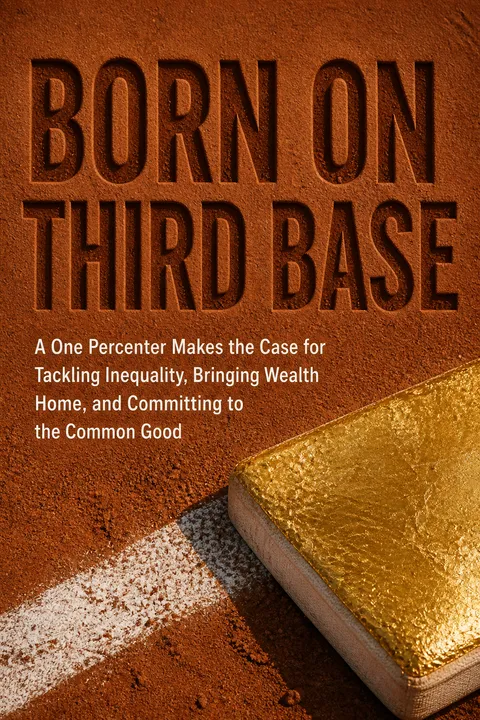
Born on Third Base joins memoir, policy argument, and community portrait to challenge the idea that wealth is a clean measure of individual merit. Its strongest move is narrative: Collins begins with an inherited fortune and a mobile-home community, then uses encounters with veterans, workers, donors, and organizers to make invisible advantages tangible. The reader sees how public investment, family transfers, race, and social connections shape opportunity across generations.
The book's political strategy rests on a productive tension. It insists that concentrated wealth must be challenged through taxation, organizing, and institutional reform, while arguing that personal contempt for the wealthy can foreclose useful alliances. Empathy is not offered as a substitute for power-building. It is presented as a way to widen the coalition capable of changing power. The distinction matters because calls for understanding can easily become an excuse to soften demands. Collins's best examples avoid that trap: the invitation is warm, but the responsibility remains concrete.
The argument about philanthropy is similarly strongest when it distinguishes private generosity from public obligation. Donors can fund experiments, services, and movements, but private preference cannot provide universal infrastructure or guarantee democratic accountability. At the same time, community institutions need resources and experimentation, so the answer is not simply to reject philanthropy. It is to question its tax treatment, transparency, and distribution of decision-making power.
The book's local emphasis offers a compelling middle scale between isolated personal virtue and national system change. Resident ownership, mutual aid, public services, and community investment let people practice the economy they want. But local projects cannot by themselves counter national capital concentration or ecological threats. The most persuasive synthesis is that place-based work builds skills, relationships, and visible alternatives, while public policy supplies scale and enforceable rules. The book asks readers to see wealth not only as private possession, but as a claim embedded in a shared world, with responsibilities that follow from that dependence.
Review Summary
Glossary
commonwealth
Shared foundations of wealthThe natural resources, public institutions, knowledge, and social systems that make individual prosperity possible. Collins uses the term to challenge the idea that wealth is created by individuals alone. Roads, education, legal protections, scientific research, clean water, and community institutions are examples of shared assets that support private enterprise and collective well-being.
intergenerational transmission of advantage
Family advantages passed downThe process by which parents pass economic and social advantages to their children across generations. It includes inheritance, housing help, education, professional contacts, unpaid internship support, and protection from financial setbacks. These advantages can accumulate over time, shaping school readiness, employment options, and the ability to build assets.
the privilege drug
Privilege that dulls awarenessCollins's metaphor for the way economic and racial advantages can numb people to the benefits they receive and the obstacles others face. Like a drug, privilege can make its effects difficult to notice from inside the experience. The resulting distance can weaken empathy and encourage people to mistake supportive conditions for purely personal achievement.
charitable industrial complex
Formal system of private givingA term Collins uses for the institutional world of foundations and organized philanthropy, especially when wealthy donors direct tax-favored funds according to private priorities. This system can support valuable work, but it may also preserve donor influence, favor established institutions, warehouse wealth, or direct public subsidies toward projects that do little to reduce inequality.
Resilience Circles
Groups for mutual supportSmall groups that meet to understand economic challenges, exchange practical assistance, and organize for local change. Participants may share budgets, trade services, identify needs, and support one another through insecurity. Collins presents them as a way to reduce isolation and strengthen community ties, while emphasizing that they cannot replace public systems for needs such as health care or housing.
generative capitalism
Economy that shares valueAn alternative economic model, associated in the book with Marjorie Kelly, that aims to create lasting value for workers, communities, and the environment. It contrasts with extractive business models that concentrate rewards among distant owners while shifting costs onto workers, communities, or nature. Broader ownership, local accountability, and productive investment are central features.
accompaniment
Presence alongside othersA practice of joining people in their work or struggle without claiming to lead or control it. Collins describes accompaniment as showing up, listening, sharing risks, and remaining present, especially when people with privilege enter movements led by those directly affected. It complements advocacy and funding while emphasizing humility and relationship.
Download PDF
Download EPUB
.epub digital book format is ideal for reading ebooks on phones, tablets, and e-readers.








