

Key Takeaways
Treat bourbon's origin story as folklore, not settled history
The famous founder is disputed. Elijah Craig, an influential Baptist minister and Kentucky mill owner, became known as bourbon’s inventor. Yet the book finds no contemporary evidence connecting him to bourbon’s creation. The familiar tale that a barn fire charred his barrels appears much later, after the industry began promoting Craig as its founding hero in the 1950s and 1960s.
The records point elsewhere. The book considers Jacob Spears the most plausible early maker, drawing on nineteenth-century accounts that link him to Bourbon County distilling and a 1789 tax record placing him nearby. Even this case is not conclusive. The first known newspaper advertisement for bourbon whiskey appeared in 1821, and the earliest known record of whiskey stored in charred barrels dates to 1826. The recipe’s inventor may never be known.
What's striking is that bourbon's founding story is itself part of the product's history. Invention myths simplify a messy process into a memorable person and scene, much as companies use founders to make complex production feel personal. That can build attachment, but it can also erase the many undocumented farmers, women, and enslaved workers who contributed to early distilling. The book's careful distinction between plausible evidence and certainty offers a useful model for reading food history: a persuasive story is not the same thing as a proven one.
Follow the river: bourbon grew where corn, water, and transport converged
Kentucky offered practical advantages. Settlers found fertile land for corn and water filtered through limestone. Early whiskey makers often distilled surplus farm grain, turning a perishable crop into a product that could be sold or traded. A technique called sour mash, in which acidic liquid from an earlier fermentation helps start a new batch, was among the methods used by Kentucky and Tennessee distillers by the early nineteenth century.
Shipping created the market. Flatboats carried whiskey down the Ohio and Mississippi rivers to New Orleans, a valuable port opened to American trade after the Louisiana Purchase in 1803. A quarter-million gallons of whiskey entered the city in 1817. James C. Crow later helped make production more systematic, using measurement, cleanliness, and charred-barrel aging to improve consistency. He did not necessarily invent these methods, but helped make them industry practice.
Bourbon’s rise resembles the development of other regional industries: local resources matter, but transport determines whether a local product can become a market. Rivers lowered the cost of moving heavy barrels, while New Orleans connected inland producers to wider trade. Crow’s contribution also shows how craft becomes an industry: repeatable measurements and cleaner processes let buyers expect a more consistent result. The book rightly resists explaining quality through geography alone. Good ingredients create potential, but skilled production and reliable distribution turn potential into reputation.
Make trust visible: bourbon's identity was built through labels and law
Consumers needed proof. Before strong labeling rules, rectifiers, meaning traders who altered or blended purchased whiskey, could sell products whose contents were difficult to verify. In 1897, the Bottled-in-Bond Act offered a clearer standard. To use the designation, whiskey had to be at least four years old, bottled at 100 proof, and made at one distillery during one distilling season. Government supervision and identifying information on the bottle helped buyers know what they were purchasing.
Definitions remained contested. The 1906 Pure Food and Drug Act did not settle what counted as whiskey. President William Howard Taft’s 1909 decision clarified that whiskey could include grain spirits made through different processes, while labels had to distinguish straight whiskey from whiskey made with neutral spirits. These rules did not make every bottle excellent. They made important differences more legible to consumers.
Bottled-in-bond is an early example of trust being designed into a product rather than left to advertising. Its rules resemble modern origin labels and certification marks: buyers cannot inspect every stage of production, so a credible institution supplies information. Such standards can strengthen a market, especially when imitation is easy. They also reflect political compromise. The legislation protected consumers, but it served distillers who wanted control over how their whiskey reached the public. Regulation can do both at once, which is why its effects deserve scrutiny rather than automatic praise.
Prohibition did not kill bourbon; medicinal permits kept distillers in business
A legal exception mattered. When national Prohibition began in 1920, the law allowed limited alcohol for medical use, though the rules were restrictive and varied across states. Physicians could prescribe whiskey, and licensed druggists could dispense it. The medical value of whiskey was disputed, including during the Spanish flu, but many doctors continued to use it as a treatment. Meanwhile, bootleggers also sought legitimate medicinal stocks because the whiskey was aged and regulated.
The industry stayed visible. About 50 million gallons of whiskey were estimated to be in bonded warehouses at Prohibition’s start. As supplies dwindled, the government permitted a small number of distillers to make more medicinal whiskey, beginning in 1930. The exception did not rescue every producer, but it preserved brands, expertise, and commercial relationships. When Prohibition ended in 1933, distillers had a foothold from which to restart.
The medicinal exception illustrates how policies rarely operate as clean switches. Prohibition formally banned ordinary production and sale, yet the government retained a narrow channel for medical access. That channel protected some industrial capacity while creating new opportunities for fraud and enforcement disputes. The historical case also warns against treating medical practice of the past as settled science. Whiskey’s accepted use reflected the treatments and beliefs of its time, not proof that alcohol was an effective cure. A useful distinction is between a policy’s economic effect and its medical justification.
War orders kept distilleries working, but concentrated whiskey in fewer hands
World War II redirected production. In 1942, the government ordered distilleries to make industrial alcohol for wartime materials instead of drinkable whiskey. Industrial alcohol was used in products including smokeless powder, synthetic rubber, and medical supplies. Distillers adapted their facilities, but whiskey production stopped, and they did not resume it until 1945.
Scarcity accelerated consolidation. As existing whiskey stocks ran down, large firms bought smaller distilleries and their inventories. By late 1943, the four largest companies controlled about 73 percent of whiskey stocks. The government needed these firms to meet wartime production demands, yet worried that the same concentration could give them too much influence over supply and prices. The episode captures bourbon’s recurring bind: government cooperation can preserve an industry while changing who owns it and how much power its biggest players hold.
This is a classic concentration problem. When a crisis rewards scale, firms with capital can buy assets that smaller competitors cannot afford to keep. The resulting efficiency may be useful during an emergency, but it can outlast the emergency and weaken competition. The book also shows that government is not simply an outside regulator: it helped create the conditions for consolidation by redirecting production and setting the terms of wartime supply. Evaluating a policy therefore requires asking not only what it produces today, but what market structure it leaves behind.
Do not chase vodka by making bourbon forget what it is
Vodka changed the competition. Sales of vodka rose sharply in the 1960s as younger drinkers favored neutral spirits in mixed drinks. In 1961, vodka accounted for 19.5 million gallons of US sales, while whiskey overall reached 178.4 million gallons. Bourbon companies tried to follow the new taste. Some promoted bourbon with juice; Brown-Forman introduced Frost 8-80, an aged whiskey stripped of its color to resemble a white spirit. Consumers did not understand the product, and the company recalled it.
A new category disappointed. In 1969, the industry established light whiskey, distilled at higher proof and aged in used barrels, as a cheaper, milder product for blending or drinking. The bet did not restore bourbon’s position. Jim Beam instead kept promoting bourbon’s American identity, while other companies invested heavily in light whiskey. The book suggests that copying vodka’s advantages did not give bourbon a compelling reason to be chosen.
The failed experiments illustrate a problem of strategic imitation. A product can borrow a competitor’s format without acquiring the reasons customers prefer that competitor. Vodka’s neutrality suited certain cocktails; bourbon’s character and aging made it a different proposition. That does not mean a category should never innovate. It means innovation works best when it extends an existing strength rather than conceals it. Beam’s emphasis on bourbon’s identity was a clearer position, although the book cannot prove that one marketing choice alone determined the category’s longer decline.
Build bourbon culture through bars, bottles, tourism, and recognizable people
The revival needed places to gather. Maker’s Mark welcomed visitors early and gained national attention after a 1980 Wall Street Journal story. In the 1990s, the Kentucky Bourbon Festival, the Kentucky Bourbon Trail, and limited releases helped make distilleries destinations rather than anonymous factories. Chicago’s Delilah’s and Louisville’s Bourbons Bistro gave enthusiasts places to compare bottles and learn about them.
People made the story tangible. Writers, online forums, and tastings connected fans across regions. Master distillers such as Booker Noe, Jimmy Russell, Elmer T. Lee, and Parker Beam became public ambassadors, explaining production and giving the category recognizable personalities. Their visibility helped consumers see bourbon as more than a drink on a shelf. The revival grew through a network of experiences, discussion, and distinctive products, not through one advertising campaign alone.
Bourbon’s comeback resembles a cultural network effect: bars create occasions to try it, enthusiasts share discoveries, and tourism gives the interest a physical destination. The distillery visit adds something a label cannot, a sense of place and production. Public-facing distillers also make an industrial process human without pretending it is purely artisanal. There is a limit, though. Tourism and personality can attract attention, but neither guarantees that the liquid meets expectations. The strongest cultural storytelling connects the experience to the product rather than using spectacle as a substitute for quality.
Meet bourbon's boom without disguising shortages as product improvements
Popularity strained supply. By the mid-2000s, bourbon sales were growing, premium products were growing faster, exports were expanding, and distilleries were building warehouses. The book describes a Kentucky industry valued at about $3 billion in 2015, with roughly 15,400 jobs and more than a million distillery visitors annually. New craft producers also widened the category with different grains, smoking methods, and barrel finishes.
Growth can test trust. As demand outpaced stocks, some brands lowered proof or removed age statements, while scarce bottles fed an informal resale market. Consumers objected when changes seemed hidden or inconsistent with brand promises. Maker’s Mark’s brief proof reduction in 2013 drew a backlash before the company restored its previous proof. The revival created opportunity, but also a practical challenge: expand production without asking loyal buyers to accept less while being told nothing has changed.
The central management problem is a mismatch between slow production and fast-moving demand. Aging whiskey ties up capital for years, so forecasting errors cannot be corrected quickly. That makes transparent communication unusually valuable: customers may tolerate a shortage more readily than a change framed as an improvement when it mainly protects supply or margins. The book’s strongest warning is not that bourbon must remain untouched. Craft experimentation shows change can enrich the category. The challenge is to distinguish honest innovation from dilution of the qualities that earned consumer loyalty.
Analysis
Bourbon’s history is not a smooth tale of a regional drink becoming a national favorite. It is a story of repeated renegotiation among producers, lawmakers, distributors, and consumers. The whiskey’s identity was never secured by recipe alone. It was shaped by river commerce, consumer-protection laws, Prohibition exceptions, wartime mandates, trade barriers, advertising, and changing tastes. The disputed origin story is a fitting opening: bourbon’s cultural importance is real, but some of its most memorable claims were constructed for commercial and political purposes.
The book is especially persuasive when it shows how practical rules became part of bourbon’s appeal. Bottled-in-bond labeling, the standards for bourbon production, and the later designation of bourbon as a distinctively American product helped consumers and producers defend a category. Yet authenticity is not simply discovered in an ancient recipe. It is also defined through law, repeated in marketing, and recognized by buyers. That makes the history less like a legend of timeless tradition and more like the ongoing construction of a shared identity.
The narrative also complicates the familiar idea that government is bourbon’s natural enemy. Taxation and restrictions repeatedly burdened distillers, but public rules also protected labels, enabled medicinal sales, and helped preserve production. Wartime policy both mobilized distilleries and accelerated consolidation. The state appears not as a single antagonist but as a shifting arena in which economic interests, public health, and consumer trust compete.
The book’s strongest caution concerns strategic self-erasure. When companies tried to make bourbon behave like vodka, they often weakened the category’s distinctive appeal. Yet a bourbon revival also depends on adaptation, from new producers to tourism and cocktail culture. The useful distinction is between innovation that gives bourbon new contexts and imitation that strips away its reasons for being bourbon. One limitation is that the business and legal archive dominates the account; the labor of enslaved people, women, and other less-documented makers remains harder to recover. That absence should temper any simple story of individual invention or uninterrupted tradition.
Review Summary
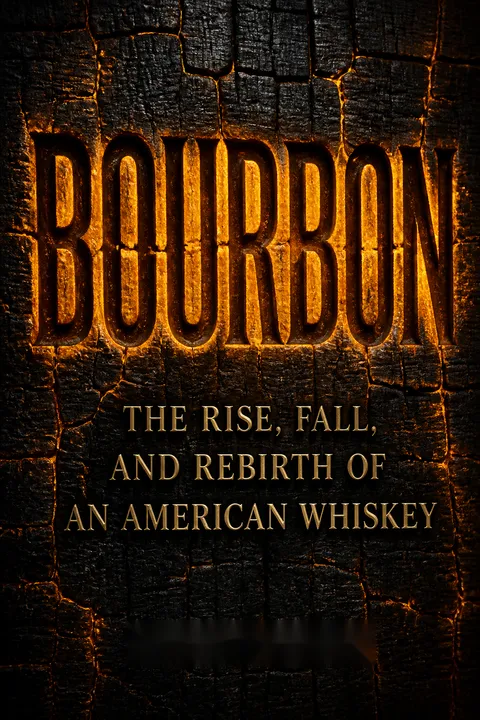
Bourbon: The Rise, Fall, and Rebirth of an American Whiskey receives mixed reviews. Readers appreciate its comprehensive history and beautiful presentation but criticize its organization and writing style. Many find the book informative but difficult to read due to disjointed formatting and excessive focus on legislation and taxes. Some praise Minnick's passion and research, while others feel it lacks depth in explaining bourbon's taste and production. Despite its flaws, many consider it a valuable resource for bourbon enthusiasts and those interested in American whiskey history.
Glossary
Bourbon whiskey
American corn-based whiskeyThe book describes bourbon as whiskey made in the United States from a fermented mash containing at least 51 percent corn. It must leave the still at no more than 160 proof and enter a new charred oak container at no more than 125 proof. Kentucky is its historic center, but bourbon can be made elsewhere in the United States.
Bottled-in-Bond Act
Government-backed whiskey standardPassed in 1897, this law created a regulated way to bottle whiskey under government supervision. To qualify, whiskey had to be made at one distillery in one distilling season, aged at least four years, and bottled at 100 proof. The bottle identified its producer and production details, helping consumers distinguish this product from whiskey altered after leaving the distillery.
sour mash
Fermentation using acidic backsetA whiskey-making method that uses acidic liquid remaining from a previous distillation to help control the next fermentation. The book notes early descriptions of related practices in Kentucky and Tennessee and credits James C. Crow with helping standardize the method. Although Crow is sometimes described as its inventor, the book finds evidence of sour-mash practices before his work.
rectifier
Whiskey blender or modifierA liquor merchant who bought distilled spirits and altered or blended them before sale. Rectifiers might combine different whiskeys or add other substances for color, flavor, or volume. Before stronger labeling rules, consumers could have difficulty knowing what a bottle contained. Their commercial role became a major point of conflict between distillers seeking control of their brands and wholesalers seeking to keep bottling rights.
Taft Decision
Ruling clarifying whiskey labelsPresident William Howard Taft’s 1909 decision addressed competing claims about what could be labeled whiskey. It treated whiskey as a broad category of potable spirits distilled from grain while requiring clearer distinctions for straight whiskey and products made with neutral spirits or other additions. The decision aimed to reduce misleading labels without limiting the word whiskey to the most highly valued production method.
Bourbon Institute
Bourbon trade organizationFounded in 1958, the Bourbon Institute represented distillers and promoted bourbon in the United States and abroad. It worked to establish bourbon as a distinctive American product and to improve its access to foreign markets. The organization also helped popularize the Elijah Craig origin story, illustrating how industry promotion shaped the public memory of bourbon’s past.
light whiskey
High-proof, milder whiskeyA category established in 1969 for American whiskey distilled at higher proof than traditional bourbon and aged in used cooperage. Its comparatively mild flavor and lower production cost made it useful for blending and gave distillers a product intended to appeal to drinkers moving toward vodka. The book presents the category as a major attempt to compete with white spirits, but one that did not restore bourbon’s market position.
Download PDF
Download EPUB
.epub digital book format is ideal for reading ebooks on phones, tablets, and e-readers.








