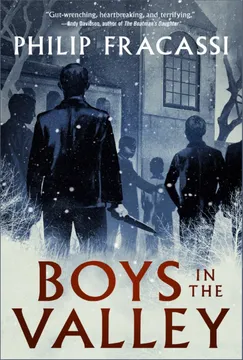


Plot Summary
The Winchester at Midnight
In 1898, Peter Barlow1 wakes to his parents arguing over food and winter. His father, Jack, returns drunk and angry from a failed hunting trip; when hot coffee spills into his lap, he raises the Winchester and shoots Peter’s mother.1 Fire catches the curtains as burning oil scatters across the room.
Peter1 watches from his bedroom doorway, frozen, while Jack sits beside his wife’s body and then turns the rifle on himself. The flames consume the family’s small home, but the memory survives intact. Seven years later, Peter1 still wakes from nightmares of that night, carrying a childhood terror that will shape what he sees when violence comes to St. Vincent’s.
Peter’s paralysis begins as a child’s response to an event he cannot control, but it becomes more than a memory: he learns to watch danger rather than intervene. The fire also joins guilt to survival. He lives because he is behind a door, while his parents die in full view. That helplessness later makes his desire to protect other children feel almost like a debt. The story opens with a private act of family violence, establishing that the institution’s horrors will not arrive in a morally clean world.
A Valley Built on Rules
At sixteen, Peter1 is among the oldest boys at St. Vincent’s, a remote Pennsylvania orphanage governed by Father Poole’s7 punishments and strict routines. Peter1 watches over younger children, including Simon8 and fragile Basil,9 while David,2 another senior orphan, hides his own hurt beneath sarcasm.
Father Andrew,3 Peter’s mentor,3 encourages him toward the priesthood, but Peter’s1 visits to nearby Hill farm18 have made him close to Grace Hill,5 the farmer’s daughter.5 When Basil9 struggles with a shovel, Peter1 exchanges tools with him and stands up to the brutal Brother Johnson.6 Johnson6 threatens him, but Andrew3 intervenes. The lesson is plain: Peter’s1 instinct is to protect, yet the orphanage’s rules reward obedience more than kindness.
St. Vincent’s makes care and control difficult to distinguish. Peter has become a surrogate older brother because the adults often fail the boys, yet he still imagines that priesthood might let him serve them from within the system. David’s guardedness shows another adaptation: he survives by refusing the role of protector, even when he cares. Their contrasting habits will be tested when the orphanage’s ordinary cruelties are overtaken by something that makes every choice more urgent.
The Sheriff's Brother
During a snowstorm, Sheriff Baker15 arrives with his wounded brother Paul,16 captured after a group sacrificed a little girl in the woods. Paul16 is bound to Father Poole’s7 bed, his body marked with occult symbols and his face altered by something the men cannot explain. Father Andrew3 reads the Roman ritual while Poole7 applies holy water.
Paul convulses, breaks free, and kills a deputy with a shattered bedpost. He claims to be many, but Sheriff Baker15 shoots him before he can attack again. The priests prepare the bodies for burial. That night the dormitory doors burst open by themselves, and the iron cross falls from its place. Peter1 and David2 hear unnatural laughter, but the adults offer no explanation.
The arrival of Paul Baker cracks the orphanage’s settled worldview. The priests possess rituals for naming evil, but the ritual does not restore order: it provokes violence, costs a deputy his life, and leaves the boys with evidence they cannot interpret. Poole treats the event as a problem to contain, while Andrew’s uncertainty registers a more honest limit. The fallen cross turns that failure outward, suggesting that the danger has crossed the threshold and will not remain confined to one body.
The Cross Falls
The morning after the exorcism, Johnson6 releases Bartholomew4 from the punishment pit, where Poole7 had sent him for defying a food order. Bartholomew4 walks back through the snow smiling, apparently untouched by the cold. Peter1 notices that Simon8 and other boys begin gathering with children who had been their rivals.
At meals, Bartholomew’s4 offer of food to the starving Simon8 had already brought Poole’s7 wrath; now the boy seems suddenly confident, and the dormitory’s mood grows harder to read. David2 discovers that the ground over Paul Baker’s16 grave has turned black and burned. Peter,1 meanwhile, glimpses shadows and hears laughter. The boys’ altered alliances, the dead earth, and the fallen cross make the orphanage feel newly occupied.
The threat spreads through relationships before it announces itself through open violence. Boys who once depended on familiar loyalties begin forming new groups, making Peter’s knowledge of their personalities unreliable. Bartholomew’s smile matters because it resembles recovery while concealing a change Peter cannot name. The burned grave provides a physical counterweight to the supernatural signs, but neither evidence nor faith can yet tell the boys what is happening. Their first loss is confidence in one another.
A Kiss at Hill Farm
Andrew3 takes Peter1 to Hill farm18 for supplies, and Peter1 reunites with Grace,5 who lends him a coat and draws him into the barn to gather eggs. Their friendship began years earlier when she shared her books and started a secret correspondence with him.
Now Grace5 kisses Peter,1 and he understands that his feelings are not a passing distraction from religious training. On the return journey, Andrew3 admits he knows about the letters and supports Peter1 making an informed choice rather than entering the priesthood out of obligation.
Peter1 decides he wants a life with Grace.5 Their conversation is interrupted when they see Johnson6 carrying a small coffin into St. Vincent’s. Peter’s1 hoped-for future is suddenly set against the death of one of the boys he loves.
Grace represents a life Peter can choose through affection, curiosity, and shared imagination, rather than through sacrifice prescribed by adults. Andrew’s support is meaningful because he does not treat love as evidence of weak faith. Peter’s decision remains private, however, just as the letters have been hidden. The coffin makes that secrecy feel suddenly fragile: the future he has begun to imagine may not be available to everyone at St. Vincent’s.
Basil on the Cross
While Peter1 is away, Simon8 lures Basil9 toward the shed with the promise of a snake, where several boys attack and kill him. They hang his naked body from the chapel cross and cut his arms. Ben10 discovers the corpse and escapes the attic where the attackers had trapped him. Poole7 ignores the evidence and announces that Basil9 took his own life, then punishes Bartholomew4 and Ben10 for challenging him by sending them to the pit.
Bartholomew4 had asked whether a supposed suicide could be buried in consecrated ground; Ben10 had named murder. Michael is found after chewing his fingers bloody. When Peter1 returns, David2 tells him Basil9 was killed, but Poole’s7 official account has already made truth another punishable offense.
The murder exposes how institutional authority can manufacture a second injury after the first: Poole’s lie denies Basil justice and makes witnesses seem disobedient. Hunger and punishment have already trained the boys to compete for survival, but the attackers now turn those conditions into cover for deliberate cruelty. Peter’s absence sharpens his helplessness. The story’s supernatural threat does not erase human responsibility; it enters a place where adults have already taught children that power decides what counts as truth.
The Memorial Turns Violent
At Basil’s9 memorial, Poole7 repeats the suicide story while Andrew3 struggles to face the coffin and the blood-stained altar. Peter1 offers a brief account of Basil’s9 kindness. Then Simon8 cuts his own arm and kills Father White17 when the priest approaches to help.
Boys hidden among the congregation draw stolen weapons and attack their classmates. Terrence beats a younger child with a candlestick; other boys stab Aaron, while fires catch the chapel tapestries and Basil’s9 coffin.
Johnson6 fights through the chaos to pull Poole7 and Andrew3 away from attackers. Peter1 and David2 lead children toward the dormitory, where they wedge the fallen iron cross into the doors. Johnson6 leaves to seek help, while the survivors wait, trapped with the injured and the dead.
The memorial collapses the boundary between ritual and violence. The chapel’s symbols do not prevent the assault; the cross becomes a barricade, and the coffin becomes fuel. Peter’s attempt to honor Basil is overwhelmed by events, while Johnson’s physical intervention briefly protects adults without restoring safety. David and Peter’s improvised defense marks a shift in responsibility: the boys cannot wait for authority to act, because the adults are wounded, divided, or absent.
Ben in the Burial Pit
The storm buries the yard as Johnson6 searches for help. He finds the orphanage horses butchered, then hears Ben10 and Bartholomew4 calling from the punishment pit, where they have been abandoned in the cold. Bartholomew4 pulls Johnson6 inside and uses his buried memories of his wife and infant son to break his resistance. He gives Johnson6 a hammer and presents a choice: kill Ben,10 or be killed himself.
Under the pressure of Bartholomew’s4 influence, Johnson6 strangles the terrified boy. The act completes Johnson’s6 submission to the force within Bartholomew.4 Elsewhere, Peter1 and Andrew3 return from the barn and find the pit empty, but do not know what happened below. Andrew3 still resists Peter’s1 belief that the evil in Paul Baker has spread.
The pit turns punishment into a theater of coerced choice. Johnson has spent years helping Poole discipline children, but his own fear and buried guilt make him vulnerable to the same machinery of domination. Bartholomew does not merely command him; he makes the killing feel like the only route away from unbearable memory. Peter’s inability to see what happened below underscores the limits of observation: he can recognize a pattern without yet being able to stop it.
The Priest's Room
After Ben’s10 death, Bartholomew4 and his followers break into Poole’s7 room. Poole7 tries to command them, but Bartholomew4 exposes the shameful childhood memory behind his fear of seeing and orders Johnson6 to take his eyes. Johnson6 obeys. The boys then hood him with the sack Paul Baker16 wore, pour oil over it, and smash a lantern against his head, burning his face.
The injured Johnson6 becomes a terrifying instrument under their control. Peter1 and Andrew,3 having found the horses dead and the pit empty, return to the orphanage and seek the dormitory’s shelter. They do not know that Poole7 has been blinded or that Johnson6 now serves Bartholomew.4 Their refuge is about to be opened from within.
Bartholomew’s assault on Poole is tailored, not random: he turns the priest’s private shame into public punishment, making institutional authority answerable to its own cruelty. Johnson’s transformation is similarly built from coercion and guilt, not simple allegiance. The boys have learned the adults’ methods and sharpened them into weapons. Peter and Andrew’s return to the dormitory brings them back into the center of danger, but without the information they need to judge whom they can trust.
The Dormitory Opens
Jonathan,13 who had escaped the first chapel assault, removes the cross barring the dormitory doors and calls Bartholomew’s4 followers inside. Johnson6 hurls David2 through a window, but deep snow breaks his fall.
David2 enters the chapel and finds the blinded Poole,7 who persuades him to fetch kerosene and a hatchet for a plan he describes as necessary. David2 carries barrels into the foyer and spills oil toward the dormitory passage. Back inside, the attackers begin slaughtering the sleeping children.
Andrew3 swings a metal crozier to protect the survivors, while Peter1 tries to get the youngest boys away from the fighting. Johnson6 throws David2 out before he can return to them, but David2 reaches the hallway with the lantern and prepares to ignite the oil.
Jonathan’s betrayal makes the refuge fail at its most basic task: keeping danger outside. David’s survival initially looks like a chance to return, but Poole’s appeal exploits the obedience that years of punishment have taught him. Peter and David are now separated, each making a choice under incomplete information. The kerosene gives David power to alter the fight, but it is a blunt instrument in a crowded building, where rescue and destruction may become inseparable.
Baptism Before Fire
Johnson6 strangles Byron11 while Bartholomew4 orders him to kill Peter.1 Peter1 throws holy water across Johnson’s6 burned face and baptizes him, using the rite Andrew3 taught him. The swarm controlling Johnson6 falls silent, and Johnson6 releases Byron.11 David2 throws his lantern into the kerosene trail.
The explosion tears through the foyer and dormitory; Johnson6 turns to shield the youngest boys from the blast, while flames cut off every ordinary exit. Peter1 and the survivors climb into the attic, but fire breaks through the floor. Bartholomew4 blocks their path with Poole’s7 ornate knife and stabs Peter.1 Peter1 answers by charging him through the weakened boards, sending them both crashing into the burning dormitory below.
Peter’s baptism is an act of attention to the person still trapped inside the monster, not a denial of the harm Johnson has done. Its success offers a brief counterforce to Bartholomew’s coercion, though it cannot undo the violence already unleashed. David’s fire plan saves no one cleanly; it is a desperate attempt to interrupt a massacre, and it makes the building itself lethal. Peter’s final charge rejects passivity, even when he knows it may cost his life.
Peter's Last Absolution
Peter1 lands on a metal bedframe with Bartholomew4 beneath him. Bartholomew’s4 back is broken, and the demonic presence briefly recedes; he is left frightened and remorseful. Peter1 absolves him as he dies. David2 pulls the wounded Peter1 from the flames, then leads him, Byron,11 Timothy,14 Finnegan,12 and Thomas through the broken window into the snow.
The boys survive the fall, though David2 twists an ankle and Peter’s1 stomach wound continues bleeding. They climb a rise and watch St. Vincent’s burn, with their childhood and the institution’s history disappearing in the blaze. At dawn they set out east toward Hill farm,18 supporting Peter1 between them and carrying the youngest boy through the snow.
Peter’s forgiveness does not excuse Bartholomew or erase the bodies left behind. It is a final refusal to let the demon have the last word about what the dying boy is. David’s return completes his own movement from self-preservation toward responsibility: he risks himself to bring Peter and the younger children out. The burning orphanage is both escape and loss. Their survival requires the destruction of the only home they have known.
The Hill Farm
Grace5 and her father18 spot the exhausted boys on a snowy ridge and hurry out with blankets. John18 carries the smallest child inside, while Grace5 kneels beside Peter1 and recognizes the fatal wound beneath his blood-soaked clothes. David2 stays at Peter’s1 side and tells Grace5 that they have made it.
Peter1 looks toward the open sky, believing the dead are around them and that he has saved them. Grace5 holds his hand and accepts his account without asking him to prove it. Peter1 dies with her beside him and David2 grieving at his shoulder. The survivors have reached shelter, but the cost of their escape is carried in the empty places among them.
The ending returns Peter to the problem posed by his childhood: how to live after witnessing death. This time he has acted, protected others, and chosen a form of service that was not the life he once imagined. His vision of the dead remains ambiguous, but its emotional truth is concrete: he can finally see himself as someone who saved, rather than merely watched. Grace and David anchor that final moment in human connection, while the surviving boys carry the future beyond St. Vincent’s.
Analysis
Boys in the Valley places supernatural horror inside an institution already organized around deprivation and obedience. St. Vincent’s is not a peaceful refuge interrupted by evil; hunger, corporal punishment, and the threat of burial have prepared its children to understand power as something imposed from above. When the demonic influence spreads, it exploits those conditions, turning grudges and alliances into instruments of violence. The supernatural explanation therefore intensifies, rather than replaces, the human one. The boys’ cruelty matters even when they are manipulated, and the adults’ failures matter even when they are afraid.
Peter’s1 development turns on a difficult distinction between inherited duty and chosen responsibility. He begins with a religious future imagined for him by Andrew3 and an earthly future glimpsed through Grace.5 His eventual service does not simply prove that the priesthood was always his destiny. It shows him choosing to protect others at the moment when choice has become costly. His faith is tested not by whether he can repeat doctrine, but by whether he can recognize a person beneath corruption and act without certainty of success.
David2 offers a parallel moral arc. He distrusts the language of goodness because he has seen it used to justify punishment, yet he repeatedly protects the children and finally risks himself to bring them out. His skepticism does not make him loveless; it is armor built around love. Andrew,3 meanwhile, represents a gentler religious authority, but his hesitation reveals that compassion without decisive action can also fail the vulnerable. Together, these characters complicate any easy division between faith and doubt.
The ending refuses a clean victory. The orphanage burns, many children die, and Peter1 reaches safety only to die among those he saved. His final vision may be spiritual or shaped by trauma, but its emotional meaning is clear: the child who once watched helplessly now understands himself as an actor in other people’s survival. The book’s hope is not that goodness defeats every evil. It is that care can remain a chosen action even when the cost is immense.
Review Summary
Boys in the Valley receives overwhelmingly positive reviews, averaging 4.11/5 stars. Readers consistently praise Fracassi's atmospheric writing, compelling characters, and relentless tension. The story—set in a remote Catholic orphanage where demonic possession corrupts the boys—is frequently compared to Lord of the Flies meets The Exorcist. Many highlight the emotional depth alongside the horror, noting genuine investment in the characters. Some critics felt pacing dragged mid-book, and a few took issue with the religious resolution. Overall, most readers found it a gripping, old-school horror experience.
Characters
Peter Barlow
The orphan who protectsPeter is a thoughtful, observant orphan whose parents’ violent deaths left him with recurring nightmares and a deep fear of failing to protect others. At St. Vincent’s, he informally looks after younger boys and studies for the priesthood under Father Andrew3. His love for Grace5 complicates that vocation, forcing him to ask whether faith means obeying a prescribed path or choosing a life honestly. Peter is compassionate without being free of doubt, and his tendency to see the best in people can make him slow to recognize danger. He is drawn to service, but must discover what service demands when authority itself becomes unsafe.
David
The guarded older brotherDavid is Peter’s1 fellow senior orphan, sharp-minded and sardonic, with a defensive manner shaped by years of punishment and abandonment. He resists being treated as a leader, partly because responsibility risks exposing how deeply he cares. His teasing of Peter1 conceals a loyalty that neither boy often names. David distrusts religious authority for good reason, having suffered under Poole’s7 discipline, and he is more alert than most to the damage done by institutional rules. Beneath his cynicism is a practical courage that emerges when younger children need protection.
Father Andrew
Peter's humane mentorAndrew Francis is a young priest who treats the boys as children with futures, not as subjects to be subdued. He mentors Peter1 in scripture and Latin while encouraging him to make an informed choice about the priesthood. His kindness does not make him naïve: he recognizes Poole’s7 cruelty and feels shame when fear prevents him from intervening. Andrew’s bond with Peter1 is paternal as well as spiritual, and his central struggle is how to preserve compassion inside an institution that often confuses discipline with goodness.
Bartholomew
The unsettling lonerBartholomew is a quiet, watchful teenager who has long stood apart from the other boys. Peter1 finds him peculiar, while the others mostly keep their distance. His isolation makes him difficult to read: he can seem meek, then unexpectedly defiant, and his unusual calm unsettles the people around him. Bartholomew’s behavior presses the story’s central question of how much cruelty comes from a person’s own choices and how much from forces acting upon them. He is both a boy shaped by St. Vincent’s and a figure who exposes its buried tensions.
Grace Hill
Peter's life beyond St. Vincent'sGrace is the lively, generous daughter of the farmer who supplies the orphanage18. As a child, she welcomes Peter1 into her home, shares her books, and begins a private correspondence with him. She is curious about the world beyond the farm and direct in her affection, qualities that make her a vivid contrast to the orphanage’s restrictions. Grace does not exist merely as Peter’s1 romantic ideal: her warmth gives him a real alternative to a vocation chosen out of duty, and her independence helps him imagine a future he has never been allowed to plan.
Brother Johnson
The orphanage's brutal enforcerJohnson is a hulking former criminal who enforces Poole’s7 rules and intimidates the boys. His harshness is partly habit and partly survival: service at St. Vincent’s has kept him from prison, but it has not made him repentant or gentle. He fears confinement, carries a history of personal loss, and hides vulnerability beneath physical menace. His presence demonstrates how institutions can recruit damaged people to inflict the very cruelty they have endured. The boys fear him, though his relationship with authority is more complicated than simple loyalty.
Father Poole
The iron-fisted superiorPoole is the head priest at St. Vincent’s, a commanding figure who believes order depends on unquestioned obedience. He controls the boys through hunger, punishment, and religious language, presenting discipline as protection even when it becomes cruelty. His rigid certainty leaves little room for a child’s fear or an adult’s dissent. Poole’s authority shapes the orphanage’s emotional climate: boys learn to hide pain, while priests learn that challenging him carries a cost. He is convinced that rules preserve the institution, but his methods make its moral foundations increasingly unstable.
Simon
Peter's younger companionSimon is a younger orphan who initially looks to Peter1 for protection and companionship. Their closeness makes him familiar to Peter1 and the reader, so changes in Simon’s behavior are especially unsettling. He is socially adaptable and capable of fitting into the boys’ group, but his dependence on Peter1 also makes their bond emotionally important. Simon helps show how the orphanage’s fragile friendships can be altered by fear, pressure, and the need to belong.
Basil
The overlooked little brotherBasil is a small, sickly English boy with a shy manner and a strong interest in snakes. Often teased, he is nevertheless capable of unexpected generosity, as when he tries to share his meal with Simon8. Peter1 feels protective of him, while David2 sees him as a vulnerable child who deserves more kindness than he receives. Basil’s gentleness is not weakness; it is a form of generosity practiced in a place where food and affection are scarce.
Ben
The frightened witnessBen is a sensitive orphan whose fear is often mistaken for weakness. He becomes entangled in the boys’ shifting loyalties and has difficulty persuading the adults to take his perceptions seriously. His reactions reveal how terrifying St. Vincent’s can be even before the supernatural crisis: children know that speaking up may bring punishment rather than help. Ben’s vulnerability makes the cost of being a witness painfully clear.
Byron
Peter's fierce defenderByron arrives at the orphanage with a reputation for fighting and bullying, but Peter’s1 respectful guidance redirects his strength toward protecting others. He becomes fiercely loyal to Peter1 and is often embarrassed by how openly he shows it. Byron’s physical courage is valuable in a crisis, yet his deeper change is relational: he learns that strength can mean standing between a weaker child and danger, not simply winning a fight.
Finnegan
One half of the twinsFinnegan is one of the inseparable pair known as the twins, despite having no biological relation to Jonathan13. He is sociable, expressive, and deeply attached to his friend. Their bond gives him a sense of family inside a crowded institution where few relationships feel permanent. Finnegan’s openness contrasts with David’s2 guardedness and shows how friendship can become a child’s most dependable form of belonging.
Jonathan
Finnegan's inseparable friendJonathan is the other half of the orphanage’s celebrated pair of twins. He is usually cheerful and closely attuned to Finnegan12, with the easy familiarity of a boy who has found a companion in an unstable world. Their friendship is one of the clearest examples of chosen family among the children. Jonathan’s place in the group makes his actions particularly difficult for the boys who trust him.
Timothy
The stuttering younger boyTimothy is a red-haired orphan whose stutter makes it difficult for him to speak under pressure. Adults sometimes mistake his difficulty for ignorance, and other children can treat him as a nuisance. Peter1 recognizes his intelligence and the unfairness of that judgment. Timothy’s struggle to communicate reflects the larger problem at St. Vincent’s: the boys are often evaluated by how neatly they obey, not by what they understand.
Sheriff Baker
A brother seeking helpSheriff Baker is a local lawman who knows the priests through years of work with the orphanage. He tries to act responsibly after discovering a horrifying crime in the woods, but his personal bond with the wounded prisoner16 complicates what he can do. His arrival brings the crisis from the wider world to St. Vincent’s and shows how quickly moral certainty can falter when family and duty collide.
Paul Baker
The wounded prisonerPaul Baker is the sheriff’s brother15, brought to St. Vincent’s after a violent ritual in the forest. His injuries are severe, and his body bears signs of the crime that led to his capture. The priests initially see a patient they might still save, while the sheriff15 sees a brother he cannot bring himself to abandon. Paul’s presence introduces the possibility that human violence may be joined by something beyond ordinary explanation.
Father White
The aging priestFather White is an elderly priest who helps supervise the boys and administers some of the orphanage’s routines. His failing faculties can lead him to misread a child’s difficulty, as when he confuses a stutter with lack of preparation. He is gentler in manner than Poole7, but his age and passivity limit how effectively he can protect the children.
John Hill
Grace's protective fatherJohn Hill owns the nearby farm that supplies St. Vincent’s with food. He is practical, generous, and protective of Grace5, and his household offers Peter1 a glimpse of family life beyond the orphanage. John’s steadiness makes the farm a rare place where children can work, learn, and be welcomed without first proving their obedience.
Plot Devices
The punishment pit
A buried threatThe pit is a deep, covered hole used by Poole7 as solitary punishment. Its origin lies in Johnson’s6 own experience of being buried alive in prison, which gives the device a particular psychological cruelty: it turns confinement into the fear of being forgotten underground. The pit first threatens Bartholomew4 and later traps Ben10 and Johnson6. It also isolates crucial events from Peter1 and Andrew3, allowing the story’s violence to escalate beyond their sight.
Paul Baker's possession
The evil's entry pointPaul arrives after a ritual killing in the woods, wounded but unnaturally strong. His body carries occult markings, and the exorcism ends in death rather than deliverance. Afterward, the orphanage experiences physical disturbances and the boys begin changing. The book leaves room for uncertainty about the boundary between supernatural influence and human cruelty, but Paul’s16 arrival links the ritual, the altered children, and Bartholomew’s4 growing power.
The iron cross
A shifting symbolThe cross first hangs above the dormitory doors as a constant emblem of the priests’ authority and the boys’ religious world. Its unexplained fall marks the disturbance that follows Paul’s16 death. Later, the boys wedge it into the doors as a physical barricade, and Peter1 uses religious rites and symbols in the struggle against the force inside the children. Its meaning moves between institutional religion, material defense, and personal faith.
The winter storm
A valley sealed shutThe early snow and worsening storm narrow the characters’ options. Supply runs become urgent, travel to Hill farm18 grows dangerous, and the boys cannot simply flee St. Vincent’s for help. Snow also hides tracks, cushions David’s2 fall, and eventually gives the survivors a route toward shelter. Weather is not just atmosphere here: it controls who can move, who can reach whom, and how long the children must survive without outside aid.
Peter's childhood nightmares
Trauma made visiblePeter’s1 recurring dreams return him to the night his parents died, giving his fear a concrete origin rather than treating it as vague unease. As the orphanage crisis intensifies, he also struggles to distinguish spiritual perception from the effects of trauma and exhaustion. The nightmares make his compassion more understandable: he knows what it is to be trapped and unable to act. They also complicate his faith, since visions can be both meaningful and frightening.
Download PDF
Download EPUB
.epub digital book format is ideal for reading ebooks on phones, tablets, and e-readers.








