

Key Takeaways
See the child as gifted and disabled, never as one or the other.
Two truths at once. Twice exceptional, or 2e, describes a child with notable gifts alongside a learning or developmental disability. The two can hide each other: a disability may bury talent, talent may conceal support needs, or both may blur the child’s profile. The book’s family stories make the stakes concrete. Sam, identified as highly gifted, struggled socially and academically before finding confidence through mechanical interests. Graham, also bright, rebuilt a sense of identity through food design. Their strengths did not cancel their challenges, and their challenges did not define their capacity.
Start with the whole person. The authors’ central proposal is to develop strengths while also identifying and supporting specific difficulties. A gifted child is not necessarily an easy student, and a diagnosis does not describe the whole child.
The strength of this framing is its refusal to make ability and disability compete for explanatory control. In education and healthcare, a single headline often dominates the record: the test score, the diagnosis, or the disruptive incident. A 2e perspective asks what that headline leaves out. It also avoids the opposite mistake of romanticizing disability as hidden genius. Recognition of talent should expand opportunity, not become a reason to withhold accommodations or minimize distress.
A gifted child can fail school because ability and performance diverge.
Uneven development matters. The book uses asynchronous development to describe a child whose abilities grow at different rates. A student may reason like an older child while struggling with organization, motor skills, emotional regulation, or peer relationships. The mismatch can make high ability hard to see in grades and classroom behavior. The Columbus Group definition of giftedness, discussed by the authors, likewise emphasizes uneven development and heightened intensity rather than grades alone.
Look beneath the average. The book describes three masking patterns: disability hides giftedness, giftedness hides disability, or each obscures the other. Estimates cited in the book suggest that 1 in 6 to 1 in 5 identified gifted students may have a hidden learning disability. These are estimates, not a reliable count of every 2e child.
Averages can be useful for comparison and still be poor descriptions of individuals. A single overall score may flatten a striking profile of advanced reasoning and serious difficulty with written work or planning. This is a general measurement problem: summary statistics can conceal the variation that matters most for intervention. The practical question is not simply whether a student is above or below a benchmark, but which tasks reveal strength, which expose difficulty, and what conditions change performance.
Treat behavior as evidence to investigate, not a verdict on character.
Similar behavior, different causes. Giftedness, ADHD, and autism can all be associated with high activity, intense focus, distractibility, impulsive speech, frustration, and social difficulty. The book argues that observing a behavior alone cannot establish why it occurs. A child who abandons a task might be bored, absorbed in another interest, overwhelmed by sensory input, or struggling to organize steps.
Intensity has several sources. The authors discuss overexcitabilities, a framework for heightened responses in intellectual, physical, sensory, emotional, and imaginative areas. Relentless questioning may reflect intellectual intensity; constant movement may reflect physical energy; distress at noise may reflect sensory sensitivity. These traits can resemble symptoms of disability, but resemblance is not diagnosis. Context, developmental history, and functional impact matter.
This distinction shifts adults from moral judgment toward useful inquiry. Instead of asking whether a child is being difficult on purpose, an observer can ask what demand, ambiguity, or unmet need preceded the behavior. That is not an excuse to ignore harmful conduct; it is a way to choose a response that addresses its cause. The framework also has limits: gifted intensity and a diagnosable disability can coexist, so a strengths-based interpretation must not become a reason to dismiss impairment.
Use diagnostic labels as clues, not complete explanations of a child.
Categories can fragment a profile. The authors trace the Diagnostic and Statistical Manual, or DSM, from broad descriptions toward more specific symptom-based categories. They argue that this categorical approach can encourage separate diagnoses for overlapping difficulties, leaving parents with an accumulating list rather than a coherent account of the child. In their view, the system is stronger for grouping people in research than for explaining every individual case.
A diagnosis still has consequences. Labels can shape expectations, treatment choices, school eligibility, and how a child understands himself. The book’s proposed alternative is a dimensional profile that records abilities and challenges across areas of functioning, rather than relying on one category to tell the whole story. The authors’ criticism is forceful, but their own account recognizes that diagnosis can help connect a child to services.
The useful distinction is between a label’s administrative role and its explanatory power. A category may help a family access support without capturing the mechanisms behind a particular child’s difficulty. Confusion arises when the paperwork is treated as a complete theory of the person. At the same time, imperfect categories can still coordinate care and research. The goal is not to discard shared language, but to pair it with an individualized account that guides actual support.
Question ADHD explanations without dismissing the child’s real impairment.
Symptoms need context. The book challenges the assumption that hyperactivity, impulsivity, and inattention automatically establish ADHD as the best explanation. It notes that similar behaviors can accompany giftedness, autism, learning difficulties, anxiety, or other conditions. The authors also argue that improvement on stimulant medication does not, by itself, prove a diagnosis, since the book cites research in which children without ADHD also responded to stimulants.
Do not confuse critique with a treatment plan. The authors regard ADHD symptoms as real and potentially disruptive, even as they question the diagnosis’s boundaries and the reliance on checklists. They criticize rapid accumulation of labels and medication combinations, especially for young children, and urge careful consideration of benefits and risks. Their broad skepticism should be read as a prompt for thorough assessment, not as a reason to stop or reject prescribed treatment without professional guidance.
The section’s strongest contribution is separating three questions that are often collapsed: Is the difficulty real? Is this label the best explanation? Which intervention helps this child? A treatment response can inform care without settling diagnosis, and a diagnosis cannot guarantee that one treatment fits everyone. The book sometimes moves from legitimate concerns about overlap to sweeping doubts about ADHD as a disorder. Readers should preserve the caution while resisting an all-or-nothing conclusion.
High intelligence can camouflage autism, not erase its costs.
Compensation can mislead observers. The authors describe children whose strong language or reasoning helps them imitate expected social behavior, while difficulties with reciprocity, implied meaning, routines, or perspective-taking remain. The book calls perspective-taking capacity theory of mind: understanding that other people have their own thoughts, motives, and feelings. It also discusses executive function, the abilities involved in planning, shifting attention, organizing, and regulating responses.
The outward picture changes. The book explains that autism may be recognized only when school raises social and organizational demands. A child may seem capable in one setting but struggle with friendships or transitions elsewhere. One study cited in the text found that 73.7 percent of children aged ten or older in an autism research network had also received an ADHD diagnosis. That figure belongs to that sample, not all autistic children.
Compensation is an important idea because visible competence can conceal the effort required to achieve it. A student who can deliver a polished presentation may still find informal conversation or group work exhausting. Assessment should therefore examine the cost and consistency of performance, not only whether a skill appears at all. The book’s account also cautions against treating all social differences as evidence of autism; careful developmental assessment is needed to distinguish among overlapping explanations.
Proficiency-based classrooms can leave twice-exceptional students unseen.
Meeting the minimum can hide unmet needs. The book argues that schools organized around grade-level standards and test proficiency often prioritize students below benchmark, while gifted students receive less attention. A 2e student who meets a standard may be denied evaluation despite substantial effort or uneven skills. A student who falls short may receive disability support while giftedness remains unrecognized.
Intervention is not identification. Response to Intervention, or RtI, is a school framework that monitors progress and adds instructional support when students struggle. The authors warn that it may miss students whose abilities and disabilities offset one another, particularly if screening focuses on grade-level performance. They report that in 2008, only 34 states required gifted-student identification, 29 required services, and 6 required regular teachers to receive gifted-education training. Those figures describe the period covered by the book.
A system can improve the average while failing students whose profiles do not fit its main categories. Proficiency measures show whether a student meets a specified target; they do not reveal whether the curriculum is appropriately challenging or whether success depends on unsustainable effort. RtI can provide valuable early instructional adjustments, but it is not a substitute for comprehensive evaluation. The key design question is whether support responds to a learner’s profile or merely to distance from a class-wide benchmark.
Assess the full developmental profile before choosing supports.
Map strengths and difficulties together. The authors favor dimensional assessment: examining several areas of development and functioning instead of asking only whether a child meets a diagnostic threshold. They describe the Diagnostic Interview for Social and Communication Disorders, or DISCO, as a developmental interview designed to trace abilities, challenges, and behavior over time. Unlike tools the book says were developed around narrower diagnostic criteria, DISCO aims to build a broader profile, including for people with high intelligence.
Let assessment guide action. The authors also discuss speech-language therapy for communication, occupational therapy for motor or sensory needs, counseling, coaching, exercise, and attention to diet. These are presented as possible elements of an individualized plan, not a universal package. The practical principle is to match supports to identified needs and evaluate whether they help the child function and participate more fully.
A rich profile is useful only if it changes decisions. Assessment should connect observations to accommodations, therapy goals, and ways to monitor progress, rather than becoming a more elaborate description filed away after evaluation. The book’s emphasis on the DISCO illustrates that distinction between classification and understanding. Its specific preference for one tool, however, reflects the authors’ 2011 context; families should seek current, qualified assessment and ask how each measure applies to their child.
Build expertise through interests, rigorous work, and real responsibilities.
Teach to strengths and needs. The book recommends dually differentiated education: accelerate and deepen work in areas of ability while teaching strategies for areas of difficulty. Useful supports include multiple ways to demonstrate learning, visual organization, explicit instruction in planning, flexible grouping, and predictable routines. An individualized education plan should describe concrete goals and classroom practices, not merely list a diagnosis.
Turn interests into participation. Temple Grandin’s mother supported her early drawing with tools and instruction, then helped her try new experiences with preparation and choice. Grandin later used a portfolio of designs to demonstrate her expertise. The authors recommend similar opportunities for children: explore interests, develop projects, learn practical skills, and connect with mentors. Interests can provide a route to competence and belonging, while real responsibilities build independence.
This approach treats talent development as part of support, not a reward to be offered after every weakness disappears. Projects and portfolios also make capability visible in formats that conventional tests may miss. Yet pursuing an interest should not become the child’s only educational path. A strong program pairs meaningful challenge with foundational skills, accommodations, and social-emotional support. The aim is not to force every passion into a career, but to give a young person ways to contribute and grow.
Analysis
Bright Not Broken is a parent-centered argument about a mismatch between children’s complex profiles and institutions that prefer simple categories. Its recurring narrative is one of recognition: families notice unusual ability and serious difficulty in the same child, then encounter professionals and schools that often attend to only one side. The concept of twice exceptionality gives that contradiction a name, while the whole-child approach turns the name into a practical demand: develop ability and address impairment at the same time.
The book is most persuasive when it shows how uneven performance can be misread as laziness, defiance, or lack of intelligence, and when it recommends concrete educational responses such as individualized assessment, differentiated instruction, mentoring, and project-based work. Its treatment of masking is especially useful: high ability can conceal a disability, just as disability-related struggles can obscure a strength. This is a more actionable insight than simply urging adults to be positive.
Its critique of the DSM and ADHD is more contentious. The authors identify real problems in relying on symptom checklists and treating categories as complete explanations, but their argument sometimes goes further, implying that ADHD is not a valid disorder. That conclusion is stronger than the evidence summarized in the book supports. The source was published in 2011, and its discussion of proposed DSM-5 revisions is historical, not current clinical guidance. Readers should take its central caution seriously without treating the book as a diagnostic manual or a reason to change medication without a clinician.
The durable lesson is institutional as well as personal. A child should not have to prove that he is gifted before receiving help, or prove disability by failing before being challenged. Families, clinicians, and educators need a shared description of what the child can do, what makes tasks difficult, and which supports improve participation. The label may open a door, but the individual profile should determine what happens inside the room.
Review Summary
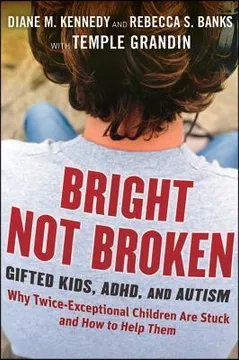
Reviews of Bright Not Broken are mixed, averaging 3.54/5. Many readers appreciate the first half's clear explanations of twice-exceptional (2e) children, covering the overlap between giftedness, ADHD, and autism. However, frequent criticism targets the authors' extensive discrediting of the DSM and questioning of ADHD's validity, which many found extreme or outside their expertise. Readers also note the book is outdated, published before DSM-V, and lacks practical guidance for parents. Temple Grandin's contribution is considered minimal despite prominent cover billing.
Glossary
Twice exceptional (2e)
Giftedness alongside disabilityA term for a person who has notable intellectual, creative, academic, physical, or other abilities alongside a learning or developmental disability. The two exceptionalities may mask one another, so a student can be overlooked as gifted, as needing disability-related support, or both.
Asynchronous development
Uneven rates of developmentA pattern in which abilities develop at markedly different rates. A child may show advanced reasoning while having significant difficulty with organization, motor coordination, emotional regulation, or social communication. In the book, this unevenness helps explain why gifted children may not match expectations based on their age or apparent intelligence.
Overexcitabilities
Heightened responses to experienceA framework associated with Kazimierz Dabrowski that describes heightened intensity in intellectual, psychomotor, sensual, emotional, and imaginational areas. The book uses it to explain why gifted children may show unusually persistent curiosity, energy, sensitivity, strong feelings, or vivid imagination, traits that can resemble symptoms of disability.
Whole child approach
Support strengths and difficultiesAn approach to understanding and educating a child that considers abilities and impairments together. Rather than focusing exclusively on a diagnosis or on talent, it aims to develop strengths while identifying and supporting specific challenges through assessment, instruction, accommodations, and appropriate therapies.
Response to Intervention (RtI)
Tiered school support frameworkA school framework that uses assessment and progress monitoring to identify students who are struggling, provide evidence-based instructional interventions, and adjust support according to response. The book warns that RtI may fail to identify twice-exceptional students when screening is tied to grade-level proficiency and does not examine both ability and disability.
Diagnostic Interview for Social and Communication Disorders (DISCO)
Developmental profile interviewA clinical interview described in the book as examining a person’s development, social communication, behavior, abilities, and difficulties over time. Its purpose is to create a broad profile rather than only determine whether a person meets a narrow diagnostic category. The authors present it as useful across a wide range of intellectual abilities.
Theory of mind
Understanding others’ mental statesThe capacity to recognize that other people have thoughts, beliefs, intentions, knowledge, and feelings that may differ from one’s own. The book uses the concept to explain some social communication difficulties associated with autism, including trouble interpreting social cues or anticipating how another person may understand an interaction.
Download PDF
Download EPUB
.epub digital book format is ideal for reading ebooks on phones, tablets, and e-readers.








