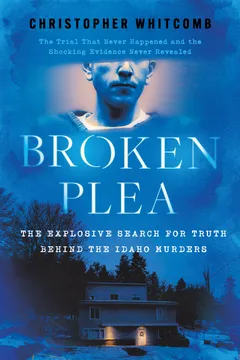


Key Takeaways
A guilty plea closed the case, but not the questions about evidence.
The legal ending. On July 2, 2025, Bryan Kohberger pleaded guilty to burglary and four murders, then received four life sentences without parole. The plea ended the planned trial, so jurors never heard competing examinations of the evidence. The murder weapon was never recovered, and no motive was presented in court beyond the state’s account of the crimes.
The book’s challenge. Christopher Whitcomb, a former FBI agent, says disclosure files and interviews reveal discrepancies in reports, evidence handling, timelines, and forensic interpretation. He argues that these deserve scrutiny, not that a reader can declare a different culprit. A plea is a legal resolution. It does not necessarily provide the public with a complete account of how the crime happened.
The distinction between legal closure and explanatory closure is the book’s most durable idea. A guilty plea establishes responsibility through a formal process, but it can also remove the public testing that a trial provides. That matters when the remaining questions concern the reliability or meaning of evidence. At the same time, unanswered questions are not evidence of innocence, and an untested alternative is not proof of another scenario. The useful standard is disciplined uncertainty: separate what the plea establishes from what the available record leaves unresolved.
Treat the first report as a hypothesis, not the crime scene itself.
Records shape investigations. Officer Mitch Nunes was the first responder and recorded the scene on body camera. Whitcomb compares that footage with Nunes’s written report and finds material differences: the report misidentified a victim, and its account of the surviving roommate’s statements did not match the recording in several respects. Other officers’ reports and later summaries then relied on early accounts.
Small errors can spread. The book invokes the butterfly effect, a term associated with mathematician Edward Lorenz, to describe how small changes in a complex system can produce larger, unpredictable consequences. Whitcomb applies the metaphor to investigation: an early mistake, once copied into later reports, can harden into accepted fact. The comparison is a warning about recordkeeping, not proof that one error determined the case.
The strongest point is not that any particular officer’s mistake explains the outcome. It is that records become infrastructure: later analysts often inherit the first account rather than rechecking its source. Video can correct memory and paperwork, but it does not interpret itself. A careful review should preserve both versions, mark exactly where they differ, and ask what later decisions depended on each. The butterfly analogy makes this chain memorable, though complex investigations also contain safeguards and corrections, so early errors do not automatically dictate the final result.
When evidence changes hands, its history matters as much as its DNA.
Provenance is evidence. The prosecution’s case prominently featured DNA reported on a knife sheath. Whitcomb highlights an apparent discrepancy: a handwritten inventory by investigator Jeffory Talbott lists the sheath on the floor beside a victim, while a later report and the prosecution’s account place it in the bed. He also describes gaps and inconsistencies in documents tracking the item’s handling.
Follow the sample. Chain of custody is the documented record of where evidence was found, who handled it, how it was stored, and what tests were performed. Whitcomb also recounts testimony that the sheath sample went to Idaho’s lab, then to private lab Othram for genetic genealogy, before the FBI took over. He argues that the paperwork and sequence could have been challenged at trial. The plea meant those challenges were not tested before a jury.
Forensic results are only as trustworthy as the path connecting a tested sample to the object found at a scene. This is not a technicality: provenance is what lets a court distinguish a genuine trace from contamination, substitution, or undocumented handling. Still, a discrepancy in a form does not by itself establish tampering or make every result invalid. The essential questions are concrete: which records are missing, whether the gap can be reconciled, and whether the proposed explanation survives independent review.
Treat a forensic pattern as a question to test, not a verdict.
The second-floor puzzle. Whitcomb focuses on reported bloodstains in the home’s common areas. State expert Paulette Sutton described several as diluted blood or cast-off, meaning blood released from a moving bloodied object. Some stains were associated with victims who, according to the state’s account, had been attacked elsewhere. One stain was reportedly beneath a box of White Claw cans, and a beer-pong table stood in a narrow passage through the living room.
Experts disagree. Sutton and defense expert Brent Turvey interpreted the scene differently. Whitcomb argues that diluted stains, their locations, and the table’s position raise questions about movement, cleanup, and the sequence of events. The book does not present a trial-tested resolution. Its central point is that photographs and lab labels need to be examined alongside the experts’ reasoning, not treated as self-explanatory proof.
A stain can be a physical observation, while the story attached to it is an inference. Keeping those layers separate helps prevent technical language from disguising uncertainty. The table and diluted stains are compelling precisely because they invite testable questions about trajectories, cleaning, and movement. But photographs alone can leave scale, timing, and material conditions unclear. The fairest reading holds both experts’ interpretations provisionally and asks what additional measurements or experiments would discriminate between them.
Reconstruct the rooms before trusting a tidy one-person timeline.
One account, many constraints. The prosecution described one killer entering the home, attacking four students, and leaving in minutes. Whitcomb contrasts that account with scene details and expert interpretations: Kaylee Goncalves and Madison Mogen were found together in a bed; Xana Kernodle was found in another room; and Ethan Chapin was found in bed nearby. The book emphasizes severe injuries, blood patterns, and questions about how people moved through the house without disturbing objects or leaving obvious traces.
A competing reconstruction. Turvey argues that the violence, scene patterns, and apparent cleanup are more consistent with at least two offenders. He also calls the bodies’ arrangement posing, the intentional placement of a scene for effect, and describes the sheath as possible staging, an attempt to misdirect investigators by altering or planting evidence. These are expert opinions advanced by the defense, not findings established at trial.
Physical reconstruction is valuable because it forces a narrative to obey space, time, and human movement. A route that works on a diagram may become implausible when doorways, furniture, injuries, and distances are considered. Yet reconstruction is sensitive to assumptions: estimates of duration, sequence, and what a person could hear or do can change the model. A second-offender theory should face the same scrutiny as the prosecution’s lone-offender theory, including whether each explains the evidence without adding unsupported steps.
Test witness uncertainty carefully, without turning confusion into guilt.
Accounts shifted. Surviving roommate Dylan Mortensen described hearing a commotion and seeing a masked person, but her later recollections included uncertainty about timing, what she heard, what she saw, and whether some details might have been dreams. The book compares her statements with body-camera footage, police summaries, and later interviews. It also notes that she and Bethany Funke were drinking and tired, and that they waited hours before calling 911.
Uncertainty cuts both ways. Whitcomb argues that investigators should have clarified the differences rather than simply accepting a polished summary. But neither survivor was charged or implicated in the murders. Trauma, intoxication, darkness, and time can make memory incomplete; inconsistency alone does not show deception. The accounts matter because they affect the timeline and the prosecution’s reconstruction, not because they establish wrongdoing by either witness.
Witness memory is not a recording. Under stress, people can retain vivid fragments while losing sequence, context, or confidence about what they perceived. That makes careful interviewing and comparison of contemporaneous records especially important. It also cautions against a common true-crime trap: treating uncertainty as a clue to hidden culpability. The responsible question is what each account can reliably establish, and what remains indeterminate. The book is right to demand clarification, while its skepticism must not become a presumption against the survivors.
Car footage and cell towers narrow possibilities, but do not identify a driver.
The phone gap. The case included surveillance of a white sedan and historical cell-site records for Kohberger’s phone. According to the records discussed in the book, the phone stopped reporting to the network at about 2:47 a.m. and reappeared around 4:48 a.m. The prosecution argued that the gap was consistent with the phone being switched off during the crime. Whitcomb stresses that the phone itself was not located near the house during that interval.
Location is approximate. Cell tower analysis estimates where a device may have been based on its network connections; it does not provide a precise dot on a map. The FBI’s Cellular Analysis Survey Team, or CAST, prepared an analysis that the defense expert Sy Ray challenged. Likewise, cameras showed a white sedan, but the book questions how conclusively footage identified its model and driver.
Digital traces are powerful because they can connect events that witnesses never saw, but their apparent precision can outrun what the underlying measurement supports. A tower connection establishes network contact with infrastructure, not necessarily a person’s exact location. A vehicle image may support a make or model range without identifying who was driving. The strongest assessment treats each data stream as a constraint, then asks whether independent evidence converges on the same explanation. The book’s cautions are useful, provided they are not mistaken for proof that the data are worthless.
Do not confuse a suspect’s biography with a motive for murder.
Context is not causation. Investigators built victimologies, profiles of the victims’ relationships, habits, and social circles, while also examining Kohberger’s education, routines, online activity, and past. Whitcomb notes that the records described no established connection between Kohberger and the victims and disclosed no clear motive. The prosecution’s public account emphasized a knife purchase, phone activity, a car, and DNA, but the plea hearing did not explain why the victims were selected.
Beware the character collage. Awkwardness, unusual habits, academic interest in crime, or a disturbing appearance may shape a reader’s impression, but they do not demonstrate why someone committed a specific crime. Victimology can generate leads, yet rumors about relationships, substances, or behavior can also become noise. The book asks readers to distinguish verified links from conjecture and personality descriptions from evidence of motive.
Humans naturally build coherent stories from biographical details, especially when the crime itself seems senseless. That narrative impulse can help investigators generate hypotheses, but it can also turn ordinary eccentricity into retrospective evidence. Motive is not required to establish every crime, and its absence does not negate a conviction. Still, when explaining a targeted, violent act, the difference between a demonstrated relationship and a suggestive character portrait matters. The book is most persuasive when it labels that gap rather than filling it with speculation.
Remember the four students as people, not merely forensic evidence.
Lives beyond the case file. The book recounts the students’ friendships, plans, work, and everyday rituals. Kaylee was preparing to move to Austin; Maddie was a close friend and mentor to Bethany; Xana was remembered as funny and generous; Ethan was known for his warmth and devotion to Xana. These details resist the flattening effect of autopsy reports and crime-scene photographs.
The survivor’s account. At Kohberger’s sentencing, Bethany described the house as a home filled with meals, jokes, movies, and shared routines. She also spoke about grief, fear, guilt, and the cruelty of public speculation. Her testimony gives the reader a human counterweight to the book’s forensic investigation. The central loss is not an unsolved puzzle. It is four young lives and the people whose lives were changed by their deaths.
True crime can make victims memorable for the manner of their deaths while erasing the texture of their lives. Everyday details restore proportion: these were friends, siblings, students, and partners, not just positions on a scene diagram. Bethany’s testimony also shows that public scrutiny has consequences for people already living with grief. Curiosity about unanswered facts can be legitimate, but it should not require turning survivors into characters in a theory. Remembering the victims is an ethical discipline as much as an act of empathy.
Analysis
Broken Plea is a true-crime argument built around a paradox: the defendant’s guilty plea resolves the legal question while, in Whitcomb’s view, leaving the factual narrative unusually exposed. The book’s engine is documentary comparison. Police reports are set beside body-camera recordings, handwritten evidence inventories, photographs, lab interpretations, witness interviews, and the plea hearing. The effect is cumulative. A possible error in one record becomes significant when later accounts appear to depend on it; a forensic claim becomes less conclusive when its provenance or interpretation is disputed.
That method gives the book its force, but also defines its limits. Kohberger’s plea and sentence are established outcomes. Claims that the sheath was planted, that multiple offenders acted, that survivors’ accounts conceal more than confusion, or that a cleanup occurred are not equivalent facts. They are interpretations offered by Whitcomb and defense experts, and the trial that might have tested them never happened. The prosecution’s competing interpretation also did not receive adversarial examination in open court. Readers therefore encounter an archive filtered through the author’s choices and a narrative strongly oriented toward doubt.
A sound reading separates observation from inference. The inventory’s location for an item is an observation; the conclusion that someone deliberately moved it is an inference. A phone’s missing network activity is an observation; the conclusion that its owner switched it off to conceal a crime is another inference. Neither should be accepted simply because it fits a compelling story. Each needs comparison with alternative explanations, source reliability, and the limits of the measurement.
The book’s broader contribution is its insistence that procedural confidence should not substitute for transparent explanation. Its most responsible takeaway is not that the conviction is false, but that justice can be legally final while parts of the public record remain difficult to evaluate. The reader’s task is to preserve that distinction, resisting both automatic deference to authority and the seductive certainty of an alternative theory.
Review Summary
Broken Plea receives mixed reviews, averaging 3.85/5. Supporters praise Whitcomb's forensic examination of evidence, highlighting chain of custody issues with the knife sheath, inconsistencies in survivor testimony, crime scene anomalies, and questions about whether one person could have committed the murders alone. Many five-star reviewers appreciate the evidence-based approach and find it raises legitimate doubts. Critics argue the book spreads misinformation, contains factual errors about the victims, makes unfair assumptions, and inappropriately scrutinizes surviving roommates. Several note it raises questions without providing answers.
Glossary
Butterfly effect
Small changes, large consequencesA concept associated with mathematician Edward Lorenz, describing how small differences in the starting conditions of a complex system can lead to very different outcomes. Whitcomb uses it as an analogy for investigation: an early reporting error may be repeated, influence later decisions, and become harder to correct. The analogy describes possible error propagation, not proof that a particular mistake changed the case.
Chain of custody
Evidence handling recordThe documented history of an item of evidence from discovery through storage, transfer, testing, and presentation. It identifies who handled the item, when and where custody changed, and what procedures may have altered it. In this book, the sheath’s location and handling records are central because the prosecution relied on DNA reportedly found on that object.
Investigative genetic genealogy
DNA-based family-tree leadAn investigative method that uses genetic data and genealogy research to identify possible relatives of an unknown DNA contributor. A familial association generates a lead, not by itself a confirmed identification of the contributor. Whitcomb describes disagreement about how the sheath sample moved between laboratories and how genealogy results were used in identifying Kohberger.
Victimology
Study of victims’ livesAn investigative approach that examines a victim’s relationships, routines, social environment, vulnerabilities, and recent experiences to develop context and possible leads. It can help investigators understand who had access to a victim or might have had a motive. Because it often relies on interviews and secondhand accounts, its findings can include rumor and should not be confused with proof.
Modus Operandi
Method used to commit a crimeA term used by investigators for the choices and behaviors involved in carrying out and concealing a crime. In the book, defense criminologist Brent Turvey uses it to discuss planning, precautions, the number of offenders, and possible cleanup. These behavioral interpretations are expert opinions about the evidence, not facts established through a trial.
Crime Scene Staging
Scene alteration to misdirectAn intentional alteration, fabrication, or placement of evidence meant to confuse or misdirect an investigation. Turvey argues that the knife sheath’s reported position could indicate staging. The claim is disputed and was not tested before a jury, so the term describes a proposed interpretation rather than an established finding in this case.
Franks hearing
Challenge to a warrant affidavitA court hearing in which a defendant may challenge allegedly false or misleading statements in a search warrant affidavit. A defendant must make a substantial preliminary showing to obtain the hearing. If the challenge succeeds, evidence obtained through the warrant may be suppressed. Kohberger’s defense used such a hearing to question aspects of the DNA investigation.
Cellular Analysis Survey Team
FBI cell-site analysis teamThe FBI team identified in the book as CAST, which analyzes historical cellular-site records and may provide expert testimony about device location. Such records show connections between a phone and network resources; they do not automatically establish a phone’s exact position. The defense challenged how the analysis in this case supported the prosecution’s account.
Brady disclosure
Prosecution disclosure of favorable evidenceA legal disclosure obligation stemming from Brady v. Maryland. Prosecutors must provide the defense with material evidence favorable to the accused, including evidence relevant to guilt or punishment. Whitcomb discusses a large collection of investigative files disclosed to the defense and argues that the volume, organization, and timing made meaningful review difficult.
Download PDF
Download EPUB
.epub digital book format is ideal for reading ebooks on phones, tablets, and e-readers.








