

Key Takeaways
Read humanity's broken ideals as clues to creation's unfinished healing.
A recurring human test. Wright calls justice, love, spirituality, beauty, freedom, truth, and power signposts: ideals people use to judge whether life and society are going well. They recur in public disputes, family life, art, and politics, yet no society fully delivers them. Their brokenness matters as much as their appeal. Each points toward a good people recognize but cannot secure by themselves.
John's larger answer. The Gospel of John reads this tension through creation and new creation. Its story presents Jesus' execution as apparent defeat, then his resurrection as God's beginning of a repaired world. The signposts are not invitations to abandon earthly life. They become a vocation: people shaped by Jesus and the Spirit work toward justice, love, and the other goods in the present.
What's distinctive is the move from frustration to responsibility. An ideal's repeated failure need not prove it is meaningless; it can expose the gap between what a society values and what its institutions actually do. This resembles the way democratic systems use rights as standards for criticizing their own practice. Still, the list is a theological interpretation, not a neutral inventory of universal human values. Cultures can disagree sharply about what justice or freedom requires. The framework is most useful when it invites careful comparison, rather than assuming that shared words mean shared conclusions.
Demand justice that repairs harm without letting the powerful escape accountability.
The hunger for resolution. Crime stories satisfy readers by identifying the offender and restoring moral order. Real life rarely offers that neat ending. Unaddressed wrongs linger in families and communities, and old grievances can feed larger conflicts. People know injustice should be corrected, yet attempts to do so can create fresh injuries or protect those with influence.
Justice in John's story. The Gospel presents Jesus as both judge and victim: he exposes wrongdoing, yet is condemned by authorities acting unjustly. Wright reads the cross as God's confrontation with evil, not as permission for human revenge. Resurrection signals that injustice does not have the final word. Jesus' followers are called to participate in repair, bearing witness to a justice that restores people and communities rather than merely punishing a culprit.
The distinction between retribution and restoration matters in current debates about courts and public safety. Restorative approaches ask what happened, who was harmed, and what repair is possible, questions that can bring victims and communities into a process often reduced to sentencing. But repair must not become a polite substitute for accountability, especially when power differences make reconciliation unsafe or coerced. The chapter's strongest implication is that justice needs both truth about harm and a future beyond it. Without the first, healing becomes denial. Without the second, punishment can reproduce the injury it claims to answer.
Make love concrete through costly care, not sentiment or possession.
Love takes a body. John portrays Jesus' love through actions: welcoming outsiders, raising Lazarus, caring for his friends, and washing their feet. The foot washing is both practical service and a preview of Jesus' self-giving death. In this account, love is not simply a warm feeling. It is a durable commitment that keeps acting when betrayal, grief, and danger arrive.
Love has a larger source. Wright connects Jesus' life to God's covenant love for Israel, a faithful relationship that persists despite Israel's failure. He also explains the Trinity as a way Christians speak of God as relational love, not merely a solitary being who occasionally loves. Jesus' followers are to make that love visible through how they treat one another and the wider world.
This account aligns with care ethics, a field of moral philosophy that treats attentiveness, dependence, and caregiving as central rather than secondary to abstract rules. The foot washing gives that claim a memorable form: status is measured by service, not by who gets served. Yet the language of sacrifice needs guardrails. In abusive relationships, demands for self-denial can be used to keep victims compliant. The chapter's emphasis on freely given care and opposition to evil supports a necessary distinction: love may bear costs, but it should not sanctify another person's domination.
Seek spirituality as God's presence in embodied life, not escape from it.
A place for presence. In the Jewish world Wright describes, the Temple represented God's presence among the people, while Torah shaped ordinary life around devotion to God. John presents Jesus as the true Temple, the place where God's presence arrives in human form. The image does not make the physical world disposable. It points toward God dwelling within creation and renewing it.
A life within people. Jesus promises the Spirit to his followers, who become places of God's presence themselves. His conversations with Nicodemus and a Samaritan woman describe a new beginning and a new kind of worship, no longer confined to a particular site. Wright contrasts this with spirituality reduced to discovering a private inner self. In John's vision, spiritual life is received as a gift and expressed in relationships and action.
The contrast between inward searching and embodied practice is relevant to contemporary wellness culture, where spirituality can become a consumer project focused on personal calm or self-discovery. John's Temple imagery instead links inner transformation to community, place, and responsibility. This connection is powerful because it resists treating the body and material world as obstacles to spiritual life. The account should not flatten all non-Christian spirituality into narcissism, however. Traditions differ, and many cultivate service and communal belonging. The useful question is whether a spiritual practice deepens engagement with other people and the world, or merely offers an escape from them.
Let beauty point beyond itself without pretending grief has disappeared.
Beauty is temporary. Wright begins with a moonlit sky, bright planets, and geese crossing the morning. The scene is beautiful partly because it passes, leaving both gratitude and sadness. He argues that human responsiveness to beauty can function as a signpost toward the Creator, even though the world is also marked by ugliness, violence, and death.
Beauty enters the story. Israel's wilderness Tabernacle, built with vivid materials and careful craft, offered beauty in a barren setting. John then presents Jesus as God's presence in the world, and the raising of Lazarus places new life inside a scene framed by death and grief. The resurrection does not erase suffering. It gives beauty a future beyond the corruption that threatens it.
Aesthetics often gives people a way to register value before they can explain it. A landscape, a piece of music, or a carefully made object can make attention feel morally important. This helps explain why beauty can console without solving the conditions that cause grief. The book's theological reading is an invitation to interpret that experience, not a demonstration that beauty proves God exists. Its most persuasive point is less like a proof and more like a claim about fit: the hope of renewal makes sense of why beauty feels both precious and painfully vulnerable.
Choose freedom from the powers that turn good desires into masters.
The Exodus shapes freedom. Passover recalled Israel's escape from slavery in Egypt and kept alive hope for liberation from later oppression. John marks Jesus' story with three Passovers, connecting his work to that history. Yet Jesus also describes an inward captivity: sin can become a power that weakens resistance and makes people serve what harms them.
Good things can become idols. Wright uses idolatry for giving ultimate loyalty to something other than God. A desire for national independence, status, pleasure, or technology can become destructive when it demands sacrifices from other commitments and relationships. Removing a dictator does not automatically create a free society, just as rejecting one constraint does not guarantee personal freedom. In John's account, Jesus offers a new identity and a way out of both external oppression and inner captivity.
The account usefully distinguishes freedom from mere permission. Addiction research and behavioral science both show how repeated rewards can narrow choice, even when a person initially welcomes the behavior. That connection helps explain the book's image of a good desire becoming a master. Still, addiction should not be reduced to personal sin or weak character. Biology, trauma, poverty, and social conditions can constrain agency. A serious account of freedom therefore needs both personal transformation and changes to environments that make exploitation easier.
Tell truth as a practice of repair, not a weapon of certainty.
Facts need interpretation. A courtroom witness can tell the truth without describing every event of the day. Someone must decide which facts matter, and memory and perspective can distort even sincere testimony. This does not mean reality is invented or that every account is equally accurate. It means truth requires careful listening, evidence, and correction.
Truth faces power. In John's account, Pilate questions Jesus about kingship while representing an empire that enforces its order through violence. Jesus identifies truth with God's renewed creation, not with whatever authorities declare useful. The Spirit empowers his followers to bear witness to Jesus and to speak truth in public. For Wright, truth is not detached information alone; it is a reality that exposes lies and makes a more just life possible.
This balances two familiar mistakes: imagining that observation is perfectly neutral, and concluding that perspective makes truth impossible. Historians and journalists face the same problem: evidence is real, but its significance depends on context and comparison among accounts. The chapter's emphasis on witness encourages scrutiny of power, including the witness's own interests. Its theological claim that truth centers on Jesus will not persuade every reader, and should not be smuggled in as a universal premise. The broader discipline remains valuable: distinguish incomplete knowledge from fabricated reality, and make claims answerable to evidence.
Exercise power by serving people, not securing control.
Power is a human task. In Genesis and the Psalms, humans receive authority to care for the world, and rulers are judged by whether they protect the poor and vulnerable. Power is necessary for shared life, but it can become tyranny when it serves the ruler, or chaos when no one accepts responsibility. John brings this tension to a head in Jesus' encounter with Pilate, whose authority is real but limited and accountable.
The model is service. Jesus rejects rule secured by fighting and demonstrates authority by washing his followers' feet and giving himself for them. The resurrection, in Wright's reading, shows that coercion and death do not have the last word. The Spirit sends Jesus' followers to lead through care, truth, and witness. Their power is not an escape from public life, but a different way of acting within it.
The model challenges the assumption that leadership is either domination or passivity. Organizations need authority to coordinate action, yet authority without accountability invites abuse. Service-oriented leadership can redirect attention toward the people affected by decisions, but good intentions alone cannot prevent coercion. Institutions still need transparent rules, shared oversight, and ways to challenge leaders. The chapter's Christian claim is that power should resemble Jesus' self-giving service. In civic terms, its durable contribution is a test for authority: does it enable others to flourish, especially those with the least leverage?
Analysis
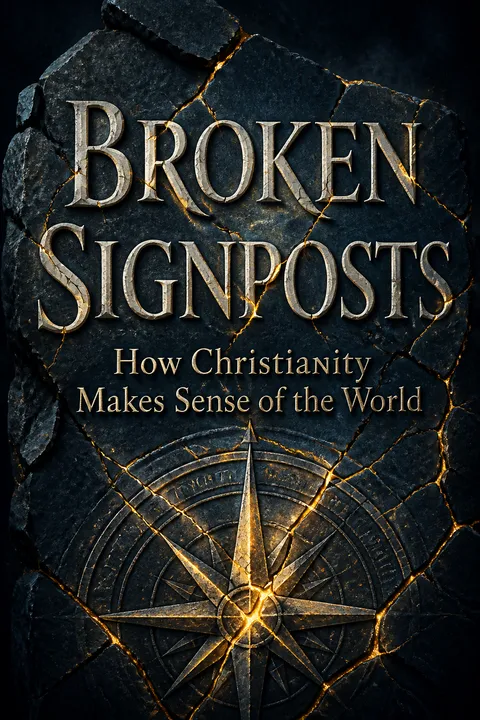
Broken Signposts is a work of Christian theology built around a simple but demanding interpretive claim: recurring human ideals both disclose what people believe a good world should be and reveal that the present world falls short. Its seven themes are not treated as independent virtues. Justice without love can become cold procedure; love without freedom can become possession; truth without humility can become domination. The book's coherence comes from reading them together through John's Gospel, where creation, Israel's history, Jesus' death, and resurrection form one narrative.
The narrative method is the book's chief strength. Rather than offering seven abstract definitions, Wright returns to scenes: the woman threatened with stoning, Lazarus emerging from the tomb, Jesus washing his followers' feet, and Pilate confronting a prisoner he can execute. These episodes make the argument memorable because they dramatize the gap between ideals and institutions. The cross becomes the point where the signposts converge: Jesus undergoes injustice, betrayal, humiliation, and violence, while the resurrection is presented as the beginning of a world in which those forces do not rule forever.
The framework is persuasive as an account of Christian meaning, but its reach should be judged carefully. The existence of shared aspirations does not establish that every culture organizes them in the same way, nor does their frustration prove a divine source. Readers outside Christianity may accept the diagnosis while rejecting the theological explanation. That distinction does not diminish the book's practical challenge. It asks whether religious belief produces visible work for justice, beauty, truth, and humane uses of power, rather than retreat from public life. Its deepest test is therefore ethical as well as doctrinal: the story makes sense of the world only if its followers help mend it.
Review Summary
Glossary
Broken signposts
Ideals that point beyond themselvesWright's name for seven widely valued human realities: justice, love, spirituality, beauty, freedom, truth, and power. They act as signposts because they suggest what human life and society are meant to be. They are broken because people and institutions repeatedly fail to realize them, leaving the ideals both meaningful and frustrating.
New creation
Renewed life for the worldThe Christian hope that God will renew creation rather than simply remove people from it. In Wright's reading of John, Jesus' resurrection begins this renewal within history. The new creation overcomes the corruption and death that damage the present world, and it gives Jesus' followers a present task of participating in its healing.
Covenant love
Faithful love within a promiseThe Bible's account of God's committed relationship with Israel, rooted in the covenant with Abraham and expressed in rescue, loyalty, and continuing care. Wright uses this idea to distinguish divine love from general benevolence. Israel's unfaithfulness does not end God's commitment; in John, Jesus embodies this love and extends its purpose toward the world.
Temple
Place of divine presenceIn Israel's scriptures, the Temple is the central place associated with God's presence among the people. Wright emphasizes that it also points toward God's intention to dwell within creation. John presents Jesus as the true Temple, and describes the Spirit's presence among believers as extending that reality into their lives and communities.
Spirit of truth
Spirit guiding truthful witnessIn John's Gospel, this is the Spirit Jesus promises to his followers. The Spirit enables them to understand and bear witness to Jesus, and to speak the truth about God's work in the world. Wright connects this role to the church's vocation: truthful testimony should expose destructive powers and contribute to the life of new creation.
Download PDF
Download EPUB
.epub digital book format is ideal for reading ebooks on phones, tablets, and e-readers.








