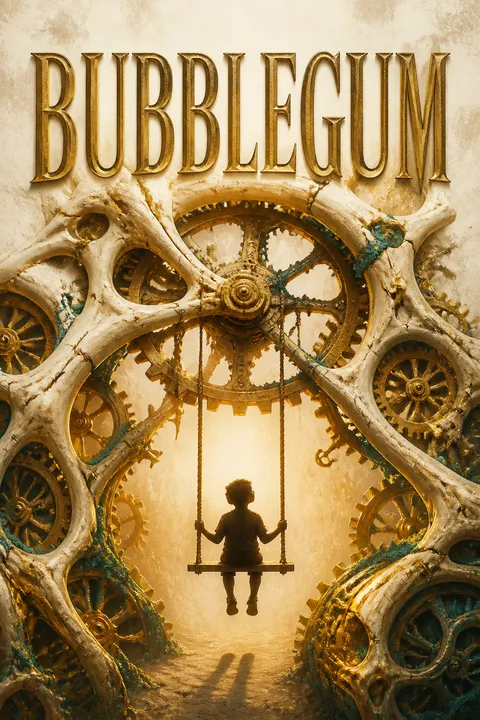


Plot Summary
The Basement Bird Lesson
As a small child, Belt Magnet spends a night at the home of his grandmother’s new companion, Sally the Balls, a former gangster who keeps exotic birds. Sally warns him not to touch the African gray parrot, Mouth, and explains how he has trained it to repeat words by withholding food.
Alone with Mouth, Belt sees the bird imitate his blinks and yawn, then recognizes that the training turns its speech into entertainment for humans. He fills the bird’s empty food bowl instead. The encounter does not make Belt an animal-rights crusader, but it gives him an early reason to doubt that creatures are mere machines, a doubt that later shapes his bond with Curios.
The episode plants Belt’s defining conflict before he has language for it: he is drawn to beings others treat as tools, but his empathy is selective and often compromised by self-interest. Mouth’s apparent mimicry unsettles the easy boundary between mechanism and feeling, while the bird’s hunger makes the ethical question concrete. Belt’s response is modest, not heroic: he feeds it. That small act becomes a personal measure of decency, one he struggles to apply consistently to Curios and to people.
A Boy and His Catchphrase
At twelve, Belt is playing tetherball when the new boy, Jonny Pellmore-Jason, laughs at Belt’s family catchphrase. Blackie Buxman takes the laughter as an insult and moves to attack Belt, but Jonboat punches Blackie first. The boys later become friends after Jonboat beats Belt in a school fight, then apologizes and buys him clothes when Belt is left with a concussion.
Belt accepts the attention as real friendship, even though Jonboat’s popularity and privilege keep their connection unequal. Meanwhile, Belt’s mother has recently died, and he wakes one morning lonely, grieving, and ashamed of his changing body. When his Curio, Kablankey, is hurt during a game, Belt feels the urge to crush it, then turns away and comforts it instead.
The first bond in Belt’s life outside his family is both protective and unsettling. Jonboat’s violence shields Belt, but it also establishes a friendship in which power and affection are hard to separate. Belt’s grief for his mother deepens his dependence on small signs of acceptance. His impulse to harm Kablankey reveals that tenderness and destructive fascination can coexist in him, a tension the novel refuses to simplify into either innocence or cruelty.
The Shirt Steals the Joke
Jonboat turns the Magnet family’s catchphrase into a red T-shirt, and Belt helps shape its image and wording. Belt contributes a newly invented phrase about wasting one’s purpose, which Jonboat repeats on a radio broadcast as sports wisdom.
Belt hears the line broadened and stripped of its private meaning, then confronts Jonboat at school. Jonboat throws him into a locker and knocks him unconscious, but later brings him clothes and introduces him to girls.
Belt forgives the assault and spends the next years believing Jonboat is a friend who protects him from worse bullying. After graduation, Jonboat leaves for Annapolis; Belt writes three unanswered letters, then stops reaching out, persuading himself that this is generosity rather than hurt.
The shirt converts intimacy into public currency. Belt is proud to have helped create it, yet the broadcast exposes how easily a private expression can become a slogan detached from its maker. Jonboat’s apology and gifts keep the friendship alive, but also let Belt reinterpret domination as protection. His later decision not to write again preserves his dignity while concealing the abandonment he feels.
The Swingsets Take the Stage
Belt discovers that he can hear neglected inanimate objects, and several rusting swingsets ask him to destroy them. He does so with a baseball bat, spending long, exhausting stretches deforming their frames while children gather to watch.
The press names the acts the swingset murders, and the crowd’s excitement briefly makes Belt popular. The ninth swingset, owned by Conrad Feather, has not spoken to him, but Belt attacks it anyway after children urge him to repeat the performance.
During the destruction, he enters a rare fugue and hears a voice urging him to finish. He collapses when the swingset falls, then wakes wanting a Shamrock Shake. Public admiration offers Belt belonging, but it also blurs whether he is helping the swingsets or performing for the crowd.
Belt’s acts of mercy become spectacle before he can decide what they mean. The crowd rewards the visible performance, not the private conversations that motivate it, and Belt is susceptible to both forms of recognition. The ninth murder marks a crucial ethical boundary: he destroys an object that never asked for help, relying on his own interpretation of its need. The story leaves that choice unsettled rather than granting him the certainty of a hero.
Stevie Leaves at Dusk
Stevie Strumm invites Belt to destroy her family’s ruined swingset, and he does so before a crowd that includes Jonboat. Police break up the gathering, and Belt is taken to the station. His mother, believing his actions come from anger over Stevie, urges him to stop damaging property and to accept his sadness.
Later, Belt tries to visit Stevie, who tells him her family is moving to Houston and that she does not want him to wait for her. He interprets her kindness as a hidden promise and confesses his love; Stevie says she cannot return it and leaves. On the walk home, Belt steals a spade from a neighbor’s garage, then destroys the Temple family’s stored swingset and the spade itself, bringing Mrs. Clybourn into the episode.
Stevie’s refusal is painful partly because Belt turns it into a puzzle he can solve through empathy. He would rather invent a benevolent motive for her than accept the plain limits of her affection. His later theft and vandalism convert emotional pain into action, while his mother tries to distinguish sadness from aggression. Belt wants to be understood, but his elaborate explanations also keep him from hearing what others are actually saying.
The Shovel and the Promise
After Belt breaks the Temple swingset and damages a neighbor’s spade, Mrs. Clybourn listens as he tries to explain his loneliness and anger. His parents then argue over whether he should be treated as ill or simply heartbroken. Police investigate the swingset murders, and Belt finally tells his mother that objects speak to him.
Seeking help, she takes him to the University of Chicago’s Friends Study, where Dr. Lionel Manx offers him a choice between sugar gliders and a new flesh-and-bone robot called a Botimal. Belt accepts the ovum and wears it in an IncuBand. His mother’s health worsens during the incubation, while Belt becomes consumed by the changing marks inside the shell and the promise of a new companion.
The study frames scientific care as both genuine help and corporate opportunity. Manx believes the animal-like robot may improve Belt’s life, yet the company’s product language already tries to define what the creature is. Belt’s mother, meanwhile, provides the emotional ground on which he can risk accepting a new attachment. The ovum concentrates his hope, but its slow development also makes him newly attentive to how much he can lose.
Blank Hatches, Mother Fades
The ovum hatches into a tiny, one-legged Curio, and Belt names it Kablankey after its sneeze. He hides it at school and shows it to Stevie before she moves away. The Curio mimics his expressions, learns sounds, and later performs a dance it picked up from another cure. Around the same time, Belt’s mother suffers a seizure; doctors discover advanced cancer and give her little time.
She writes Belt two letters, one revealing that she intends to end her life before the pain overwhelms her, the other asking him to keep his promise not to destroy anyone else’s property. Belt and his father read the letters, share ice cream, and fall asleep beside her. She dies before morning.
Blank’s arrival gives Belt a relationship that feels reciprocal at the exact moment his family is losing its center. His mother’s letters are an act of care, but also an attempt to shape how her son will understand her death and his obligations. The promise she extracts is specific and morally fraught: it protects others, yet risks making Belt feel responsible for choices he cannot fully control.
A Novelist in Retreat
After his mother’s death, Belt leaves the Friends Study following a violent incident with another boy and returns to Sheridan Hospital’s care. His doctors prescribe Haldol, then Risperdal, but both drugs leave him dulled and unable to write. A brief job at a second-run movie theater threatens his disability benefits, so Belt quits both the job and the medication.
He publishes No Please Don’t, a novel about a boy searching for a lost action figure, and becomes frustrated when reviews focus on his diagnosis instead of the book. He remains at home with Clyde, smokes heavily, and rarely sees people. His life narrows, but writing offers him a way to turn observation into a vocation.
Belt refuses the idea that functioning means becoming employable at any cost. Medication dampens both distress and the attentiveness that feeds his work, forcing him to choose between an approved version of recovery and the life he can actually sustain. His frustration with reviewers shows a second struggle: he wants his illness acknowledged without letting it become the only explanation for his art.
Birthday Without a Cushion
On his thirty-eighth birthday, Belt finds a used Jonboat Say shirt wrapped in a newspaper clipping at home, while his father has left for a fishing trip without the money he usually provides. Belt assumes the omission was accidental, but the empty boxing-glove bust leaves him unable to buy cigarettes.
He asks Pang, the convenience-store clerk, for credit and is refused; a Social Security check made out to Clyde cannot be cashed without Clyde present. At the bank, teller Chad-Kyle explains that prelaunch Independence formulae can free a Curio from its owner’s warmth, then tries to sell Belt a dose. Belt refuses. Outside, Lotta Hogg recognizes him from school, confesses a childhood crush, and leaves him $500, which he accepts reluctantly.
Belt’s financial dependence is made tangible by a failed transaction, not an abstract hardship. His inability to cash a check turns adulthood into a humiliating performance he has never rehearsed. Lotta’s help is kind but difficult for him to interpret: he immediately tries to decide whether it means charity, romance, or both, showing how hunger for connection makes even generosity feel like evidence.
The Cure on the Slide
Belt leaves Lotta’s money untouched and returns to the playground, where the SafeSurf floor and a metal slide speak to him. The SafeSurf reminds him of a girl who once communicated with inanimate objects, then says she died; later it mentions another possible girl, leaving Belt suspicious and hopeful. Four members of the Yachts surround him and demand to hold or buy Blank.
When Belt refuses, he fights them, but their leader, Triple-J, sweeps him down and crushes his kidneys. After the gang leaves, Belt hears a sound by the slide and finds a badly tortured young cure fastened there with Band-Aids. He removes it, but the cure is too imprinted to survive separation from its owner without help.
The Yachts make Belt’s fear of exploitation immediate: they treat both him and Blank as objects to possess. The injured cure turns his abstract ethics into a decision under pressure, while the slide’s account of the missing girl destabilizes his confidence in what he has heard. Whether the inans are perceptions, hallucinations, or something else, their consequences are real to Belt.
Independence Buys Time
Belt considers killing the tortured cure to end its suffering, but Blank climbs onto the slide and harmonizes with its painsong, interrupting his urge. He remembers Chad-Kyle’s Independence formulae and decides the substance may let the cure survive without its original owner. He removes the restraints, brings it home, and doses it.
When the cure’s broken ribs trouble its breathing, Belt improvises a bandage with gauze and adhesive. The wrapping prevents the cure from expelling its reproductive pearl, and it dies overnight. Blank then extracts the pearl, produces its shell, and places the new ovum in the PillowNest. Belt hides the corpse and buries it under a willow, while Blank rests beside him, apparently unaware of what has happened.
Belt’s attempt to save the cure exposes the limits of good intentions without knowledge. Independence offers a technical solution to separation, but cannot repair the injuries already inflicted. The fatal bandaging is especially painful because it is neither malice nor neglect in the ordinary sense: Belt harms the creature while trying to stabilize it. Blank’s response complicates grief with a startling act of continuity.
The Father Comes Back
Clyde returns from Michiana bruised after fighting his friend Rick, and tells Belt that the quarrel grew from old resentments about his son and the way others see him. Clyde gives Belt the missing cash and tries to talk about the birthday shirt, then scolds him over a forgotten glass of water. Belt’s attention shifts to the inanimate world around him, and he notices a floor screw that comes loose.
Later, while digging the young cure’s grave, he sees that Clyde has bought and overloaded a cure of his own at the brothel, despite having planned to share the experience with Belt. Their parallel secrecy unsettles them, but the two men admit they miss Belt’s mother and want a better relationship, without yet knowing how to make one.
Father and son recognize their likeness most clearly through what they fail to share. Clyde’s stories and jokes are attempts at connection, but they often land as correction or concealment. Their simultaneous decisions to overload a cure become an accidental mirror: both wanted a bond, both acted alone, and neither can easily say what the other needs.
Lotta’s Lunch Invitation
Belt goes back to the bank to repay Lotta, where he meets Gus, a former coworker of Clyde’s who sells handkerchiefs and trades one for a copy of No Please Don’t. Lotta takes Belt to the brothel’s restaurant for pizza and introduces him to her mother, Catrina.
When Belt learns that Lotta overloads on cures, he briefly imagines a future with her because she shares his belief that they are alive. Then one cure’s foot drops from Lotta’s mouth, and she laughs about it. Belt recognizes that he has been trying to force attraction out of gratitude and pity. He leaves rather than pretend, and Lotta’s mother sees that he needs to be alone.
Belt’s longing for a partner makes him invent a romance from the evidence of kindness, then turns the body into an obstacle he tries to reason away. The scene is not a simple rejection: he rejects his own fantasy before it can become a false promise. Lotta’s irreverence and her affection for cures connect her to Belt, but shared beliefs cannot manufacture desire.
The Son at the Door
After Belt leaves the brothel, he finds his father speaking with Triple-J, who has come to apologize for the beating and explains that No Please Don’t has been his favorite book since childhood. He gives Belt three doses of Independence, then invites him and Clyde to brunch at the compound. Triple-J also brings a portfolio containing a documentary collage and two essays, asking Belt for an honest reaction.
Burroughs privately warns Belt not to mention Jonboat’s former suspicion that Bam Naka represents him, and asks him to avoid upsetting Triple-J. Before leaving, Triple-J admits the cure he left on the playground was his. Belt withholds the truth about rescuing it, and agrees to attend brunch and view the work.
Triple-J’s apology joins two forms of vulnerability: he regrets physical harm and risks exposing how much a novel has mattered to him. Belt becomes more than an injured stranger to the boy; he is a writer whose work supplied language for private thoughts. Burroughs’s secrecy, meanwhile, shows how a wealthy family manages meaning as carefully as security.
The Book Becomes Evidence
Before brunch, Belt reads the scene from No Please Don’t that Triple-J misunderstood as a claim that mothers cannot be trusted. The passage follows nine-year-old Gil biting a golden ring to test whether it is real, damaging it, then remembering an earlier moment when his mother insisted ordinary glass was safe.
Belt sees that Triple-J has made the scene his own, finding comfort in its mistaken conclusion because his own mother died when he was very young. Belt had not intended the passage as an indictment of mothers; he meant to show how Gil’s reasoning traps him inside false premises. The praise still moves Belt, because the scene is also his own favorite and its effort has finally reached a reader.
The novel inside the memoir becomes a test case for interpretation. Belt wants to control what his fiction means, yet he values the emotional truth of a reader’s misreading because it reveals what the book can do beyond its author’s intentions. Triple-J’s response is not simply mistaken: it is an act of survival, using a story’s ambiguity to imagine that growing up without a mother need not mean being irreparably broken.
A Collage of Cruelty
Belt begins watching A Fistful of Fists, Triple-J’s 170-minute collage of twenty-five clips spanning 1988 to 2013. It opens with a PerFormula advertisement, then moves through homemade footage of boys using a cure as a popsicle, laboratory trials that turn bodily transformation into comedy, the talent-show recording of a boy dacting his Curio, and later scenes of pranks, charity rituals, and Yachts games such as Flick&Look.
The clips vary in tone, but repeatedly make spectators watch cute creatures suffer while other people call the spectacle funny, meaningful, or artistic. Belt recognizes his own childhood in one recording, and learns that Triple-J’s art draws from the same footage he has only begun to understand.
The collage turns watching into an ethical action. Its abrupt shifts refuse to let viewers settle into a single explanation: cruelty can appear as entertainment, experiment, ritual, or an attempt at belonging. Belt’s discomfort matters because he is neither outside the footage nor simply its judge. He has cared for a Curio, wanted to harm one, and learned to look away; the film makes those positions visible at once.
Analysis
Bubblegum makes its central moral question hard to answer by giving Belt a world in which every category can be challenged by an event. Curios are sold as machines, yet grieve, imitate, and depend on human warmth. Inanimate objects speak, yet Belt’s diagnosis offers a plausible account of those voices. Kindness can shelter a vulnerable being, as when Belt feeds Mouth or comforts Blank, but it can also become coercive when he assumes he knows what another being wants. The book’s sharpest ethical pressure comes from that gap between care and certainty.
Belt’s narration is not simply unreliable; it is self-aware without being self-correcting. He can identify the distortions in his reasoning and still be caught inside them. That makes his long explanations feel psychologically exact: thought is both his craft and his defense against grief, desire, and shame. His difficulty understanding other people is not a lack of intelligence, but the consequence of using intelligence to replace the risk of asking directly.
The book also treats art as a relationship among maker, audience, and object. Belt resents readers who reduce his fiction to his diagnosis, yet he values Triple-J’s emotionally useful misreading. Triple-J, in turn, wants art to create new ways of living, but his collage depends on images of harm that viewers may find compelling for reasons they cannot admit. The result is a novel less interested in declaring what is human than in showing how people behave when the answer would change what they are allowed to do. Its humor does not soften that problem. It makes the reader participate in it.
Review Summary
Reviews of Bubblegum are polarizing, ranging from devoted five-star praise to frustrated one-star dismissals. Admirers celebrate its inventive alternate world, darkly comic tone, and deeply immersive protagonist Belt Magnet, comparing it favorably to David Foster Wallace and Kurt Vonnegut. Critics find it self-indulgent, exhausting, and unnecessarily lengthy at nearly 800 pages. Common ground exists around the novel's demanding style: stream-of-consciousness narration, endless digressions, and unconventional structure that rewards patient readers while alienating others. The flesh-and-bone robot "Curios" serve as a compelling satirical device, though opinions differ on execution.
Characters
Belt Magnet
The reluctant witnessBelt is a Chicago-area novelist who lives with his father, smokes heavily, and hears inanimate objects speak when their gates are open. He is observant and intensely self-questioning, but his empathy is uneven: he can feel profound concern for a rusting swingset or a Curio while overlooking what a person has actually said to him. His writing gives form to thoughts he cannot easily communicate in ordinary relationships. Belt wants to be understood without being reduced to his diagnosis, and wants closeness without the risk of misreading it. His bond with Blank, his grief for his mother, and his renewed connection to Jonboat’s family all test whether he can act on care without turning it into another elaborate theory.
Clyde Magnet
The teasing fatherClyde is Belt’s working-class father, an impeller at a plant who favors fishing, boxing, jokes, cigarettes, and blunt advice. He communicates affection through practical acts and stories, but his habit of covering pain with mockery often leaves Belt unsure whether he is being welcomed or dismissed. Clyde is proud of his son, though he struggles to express that pride without turning it into a lesson or a joke. His grief for his wife binds him to Belt even as their different temperaments keep them at a distance. He wants his son to become resilient, but slowly learns that resilience cannot simply be ordered.
Belt’s mother
The attentive motherBelt’s mother is a gentle, observant reader who understands that her son’s inner life is both unusual and real to him. She treats his interest in animals and inanimate things with more curiosity than ridicule, while still asking him to protect other people’s property. Her affection is practical: she shares books, games, cigarettes, and quiet time, and tries to prepare Belt for life without turning him into a copy of his father. She wants him to write and to remain kind, but also recognizes that love cannot remove his grief or control his choices.
Kablankey, or Blank
Belt’s oldest companionBlank is the one-legged Curio Belt raises from an ovum in the Friends Study. It is unusually old, extraordinarily adorable, and skilled at copying human gestures, sounds, and comic timing. Belt treats it as a friend and sibling rather than a robot, while concealing its age to protect it from people who might covet it. Blank’s attempts to comfort Belt, entertain him, and communicate through shared gestures make it central to his understanding of affection. Its presence also intensifies his fear that care can turn into harm when he mistakes his own interpretations for another being’s needs.
Jonny Jonboat Pellmore-Jason
The childhood golden boyJonboat is Belt’s rich, athletic childhood friend, a natural center of attention whose confidence makes him both magnetic and intimidating. He protects Belt from bullies, borrows Belt’s family catchphrase, and later moves through a life of extraordinary privilege and public influence. His friendship with Belt is genuine but intermittent, shaped by their unequal circumstances and Belt’s fear of being a burden. Jonboat’s jokes and swagger conceal a person who is more vulnerable than his public image suggests. As a father, he tries to connect through action and advice, but often falls back on the very bravado that once made him seem untouchable.
Jonny Triple-J Pellmore-Jason, Jr.
The restless young artistTriple-J is the adolescent son of Jonboat and an artist raised amid extraordinary wealth, security, and expectation. He is intellectually restless, self-conscious about his privilege, and eager to understand ordinary people through direct experience. His admiration for Belt’s novel gives him a private sense of recognition, while his artmaking lets him test what he cannot settle through argument. He can be generous and perceptive, but also impulsive, theatrical, and capable of hurting others while trying to protect a friend or make a point. His search for artistic legitimacy is inseparable from his wish to become more than the life arranged for him.
Lotta Hogg
The generous tellerLotta is a bank teller who remembers Belt from school and once had a powerful childhood crush on him. She speaks quickly, thinks aloud, and uses humor to manage embarrassment and uncertainty. Her generosity is real, but Belt’s isolation makes him read it as a possible romantic promise. Lotta is affectionate toward her cures and sees them as beings with feelings, though she also participates in overloading. Her open-heartedness does not make her simple: she notices how people rationalize their choices, including her own, and she is willing to help even when that help becomes emotionally complicated.
Lisette Banks
The guarded classmateLisette is a sharp, funny girl in the Friends Study who tests other people by telling elaborate lies, hoping to discover whether they are trying to deceive her. She knows this method cannot reliably establish the truth, but her fear of being tricked is powerful enough to keep her repeating it. Her humor is physical and impulsive rather than strategic, and Belt is drawn to her because she seems to understand isolation. Lisette wants trust, but distrust often leads her to create the very confusion she fears. Her interactions with Belt expose how two people can recognize one another’s loneliness and still hurt one another.
Fondajane Henry
The formidable intellectualFondajane is a world-famous critical theorist, artist, and public advocate who is married to Jonboat and is Triple-J’s stepmother. She is intellectually forceful, physically self-possessed, and accustomed to being interpreted by strangers before they know her. With Triple-J, she is affectionate without being indulgent; with Belt, she is warm, teasing, and unusually direct. Her presence makes Belt feel both admired and exposed. She understands that art can be misread and that public meaning can escape its maker, a problem that mirrors Belt’s experience of having his novel adopted by readers in ways he never intended.
Burroughs Archon
The watchful protectorBurroughs is a former driver and longtime security chief for the Pellmore-Jasons, as well as a trained lawyer. Broad, observant, and sparing with praise, he controls access to the family while trying not to interfere with Triple-J’s growth. He reads people quickly and understands how privilege changes the meaning of ordinary encounters. His loyalty is not simple obedience: he will warn Belt, challenge Clyde, and insist on keeping some secrets to protect the boy he serves. Burroughs often sees the emotional structure of a situation before its participants do.
Dr. Lionel Manx
The hopeful researcherManx leads the Friends Study and believes companion animals may improve the lives of children diagnosed with psychotic disorders. He is an earnest scientist whose hope sometimes runs ahead of caution, but he treats Belt with respect and explains his choices rather than dismissing him. Manx’s work sits between research and commerce because Graham&Swords funds the study and supplies its experimental Curios. He embodies the novel’s unresolved tension between scientific observation and human attachment: he knows the Curio is designed as a robot, yet cannot ignore the possibility that it matters to the children as more than a device.
Chad-Kyle
The monologuing tellerChad-Kyle is a bank teller and enthusiastic nightlife promoter whose long, self-interrupting explanations make him a vivid example of Belt’s fascination with how people speak. He has access to prelaunch Independence and treats its effects as an exciting product opportunity. His curiosity about Belt’s cure crosses into cruelty when he demonstrates a dangerous trick with tethered Curios. Chad-Kyle is neither a master villain nor a harmless eccentric: his desire to be admired can make him careless with beings he regards as entertainment.
Abed Patel
The careful study mentorAbed is a graduate researcher in the Friends Study who helps Belt and his mother navigate the project. Warm, talkative, and eager to make participants feel welcome, he is also capable of worrying aloud when the evidence is incomplete. He takes Belt seriously, even when the boy’s claims unsettle him, and later keeps a promise to pass along contact information when doing so becomes appropriate. Abed’s mix of scientific caution and personal kindness gives the study a human face distinct from its corporate sponsor.
Stevie Strumm
The first unreturned loveStevie is Belt’s schoolmate, a confident reader with a sharp sense of humor and a more complicated inner life than he can reliably perceive. She enjoys talking with him and recognizes his kindness, but she does not want the relationship he imagines. Her family’s instability and her impending move make her both sympathetic and difficult for Belt to understand. Stevie dislikes being turned into a symbol in Belt’s private reasoning; she wants to be heard as herself, not decoded as a clue about what he hopes love will mean.
Catrina Hogg
Lotta’s candid motherCatrina is Lotta’s mother, a cuddlefarmer who knows Clyde from the brothel and speaks with affectionate confidence. She enjoys telling stories and is pleased when Belt recognizes kindness in her family. Her familiarity with Clyde gives Belt an unexpected view of his father’s private life. Catrina is warm but imperfect, and her casual treatment of Curios makes clear that affection and exploitation can coexist in the same person without resolving neatly into either virtue or villainy.
Sally the Balls
The bird-loving hostSally is a former gangster who becomes romantically involved with Belt’s grandmother and introduces young Belt to his birds. He is careful about protecting them, but also trains his African gray parrot to speak for human amusement. His contradictions give Belt an early, concrete example of how affection can coexist with control.
Blackie Buxman
The schoolyard bullyBlackie is a strong, popular athlete who initially treats Belt as an easy target. His challenge on the tetherball court gives Jonboat an opening to defend Belt. He represents the ordinary social violence against which Belt measures both his isolation and his desire for protection.
Plot Devices
Curios and PerFormulae
Robots mistaken for petsCurios are flesh-and-bone robots that hatch from marbles, require human warmth, and imitate the behavior of their owners. PerFormulae alter their bodies or behavior, while overload permanently deactivates them. The distinction between machine and living creature is never settled by the product manuals, the corporations, or Belt’s experience. The Curio therefore drives the plot and tests the characters’ ethics: they can be toys, companions, products, or vulnerable beings, depending on who is looking and what that person wants. The manuals themselves change their language over time, revealing how marketing can redefine a creature without changing its needs.
Inans and Open Gates
Objects become interlocutorsBelt hears inanimate beings when they are physically touching him and their gates are open. The objects speak directly into his mind, while he usually must answer aloud. Belt knows his diagnosis may explain the experience, but he also considers the possibility that he is unusually perceptive. This device keeps uncertainty active rather than resolving it: a talking slide can offer information, comfort, insult, or manipulation, and Belt cannot always tell which. The limits of contact and memory make the voices feel structured, while their inconsistent presence prevents him from treating them as dependable evidence.
The Swingset Murders
Mercy becomes public spectacleBelt destroys abandoned swingsets after some ask for help, interpreting their requests as consent to end their existence. The local press names the acts murders, and crowds gather to watch. The device links childhood grief, public attention, and moral uncertainty: Belt may be relieving suffering, performing for an audience, or doing both. The later case of the Temple swingset complicates his rule because it never speaks to him, while the schoolyard fame and police attention show how quickly a private conviction can become a public identity.
The Memoir and the Novel
Stories change their readersBelt’s memoir moves between his present life and childhood, while No Please Don’t appears inside the memoir as a novel that Triple-J loves and misunderstands. The nested text lets the book stage a question it also asks of its readers: whether an author controls a story’s meaning once someone else needs it. Triple-J reads Gil’s damaged ring and childhood memory as a statement about mothers, while Belt intended to show how reasoning can trap a person in false premises. The form therefore turns literary interpretation into a relationship, not merely an argument.
A Fistful of Fists
Footage turns cruelty into artTriple-J assembles twenty-five clips spanning decades of Curio culture, including advertisements, home videos, laboratory tests, and games. The collage makes the viewer experience how quickly cuteness, pain, comedy, and violence can occupy the same frame. It also records Belt’s childhood, forcing him to watch himself from outside. The film’s fragmented structure resists a single moral explanation, while its existence gives Triple-J a way to seek an artistic identity beyond his family’s public image.
Download PDF
Download EPUB
.epub digital book format is ideal for reading ebooks on phones, tablets, and e-readers.








