

Key Takeaways
Treat Buddhism as a method to test, practice, and reshape your mind
A path, not a creed. Chodron presents Buddhism as a practical route from unsatisfactory experience to lasting freedom. The Four Noble Truths identify suffering, its causes, the possibility of ending it, and a path toward that end. The Three Higher Trainings are ethical discipline, meditative stability, and wisdom. In sequence, they help people reduce harm, steady the mind, and understand reality more clearly.
Practice remains personal work. The Buddha can explain the route, but cannot remove another person’s anger or confusion for them. The Three Jewels, Buddha, Dharma, and Sangha, are compared to a doctor, medicine, and nurses: guidance helps, but the practitioner must take the medicine. Chodron encourages questioning and testing teachings rather than accepting them on authority alone.
The book’s strongest opening move is to make spiritual commitment compatible with scrutiny. That turns faith from a demand for assent into confidence built through observation and practice. The medical analogy also clarifies the limits of religious authority: advice can be valuable without replacing personal responsibility. One useful caution is that inner experience can be difficult to interpret, so questioning should include discussion with knowledgeable teachers, not only private judgment.
Measure progress by reduced harm and wider compassion, not spiritual display
Character is the evidence. Chodron places kindness, ethical conduct, and wisdom above claims of supernatural ability. The Buddha’s example is not a promise to rescue followers by force; it is evidence that a mind can be transformed. He taught a path, and people must work through it themselves. Even unusual powers, the book says, are distractions when pursued for fame or status rather than the benefit of others.
Humility protects practice. A practitioner who still lashes out at people has more immediate work than one who dreams of clairvoyance. The book treats love as wishing others happiness and compassion as wishing them freedom from suffering. These are not merely pleasant feelings. They should show up in speech and action, including in ordinary encounters with people outside one’s spiritual community.
This standard resists a familiar error in religious life: confusing spectacle with transformation. It also gives outsiders a more observable way to assess a teacher, through conduct rather than charisma or extraordinary claims. The standard is demanding, but it should not become a reason to dismiss anyone who struggles. The book’s own emphasis on gradual training suggests a better measure: whether harmful patterns are being acknowledged and worked on.
Meditate to rehearse wiser responses before emotions take the wheel
Training the mind. The Tibetan term for meditation, gom, means becoming familiar with something. Meditation is therefore not simply relaxation or sitting still. It is practice in making constructive attitudes and realistic views more familiar. Stabilizing meditation develops concentration, such as staying with the sensations of breathing. Analytical meditation examines an idea, such as impermanence or compassion, until understanding becomes clearer.
Build the habit gradually. Chodron recommends learning reliable methods from a qualified teacher, reflecting on what has been taught, and then practicing regularly. The aim is not to perform an impressive ritual posture. It is to make it easier to notice anger, attachment, or jealousy and apply an antidote. Even a short daily session, ideally in a quiet place, can create time to examine motives and prepare for the day.
The definition of meditation as familiarization makes the practice less mysterious and more behavioral. Repeated attention can make a chosen response easier to access when emotion narrows perspective. The distinction between concentration and analysis is useful because calmness alone does not guarantee insight. The emphasis on teachers also matters: a method can be meaningful within a tradition yet poorly suited to someone who adopts it without context or guidance.
Love people without turning affection into a contract
Care without clinging. Chodron distinguishes love from attachment. Love wishes others well because their happiness matters. Attachment exaggerates someone’s good qualities, clings to them, and expects them to behave in ways that secure one’s own happiness. When they fail to meet those expectations, hurt and anger follow. Non-attachment does not mean coldness or withdrawal. It means relating without possessiveness, unrealistic demands, or the belief that another person must keep us happy.
Keep care practical. Impartial love does not require treating a child, colleague, or stranger identically. It means their welfare matters, while conduct responds to the actual relationship and situation. Chodron also distinguishes compassion from pity: compassion does not place the helper above the person receiving help. Healthy self-care matters too. The goal is not self-neglect, but less self-obsession and a wider concern for others.
This distinction is especially useful because it separates emotional warmth from the control often smuggled into the word love. It supports closeness while making room for boundaries and changing relationships. The challenge is that attachment and ordinary dependence can be hard to tell apart in practice. The book’s test is not whether someone needs others, but whether care has become possessive, conditional, or organized around a demand for emotional payment.
Use impermanence to love fully without demanding permanence
Reality includes change. Buddhist discussions of suffering often use the word dukkha, meaning unsatisfactory experience, not only acute pain. Even enjoyable circumstances change, and expecting them to remain fixed makes loss and disappointment harder. Chodron uses familiar examples: a relationship changes, a car loses its shine, and a body ages. Reflecting on impermanence is not meant to make people gloomy. It is meant to reduce clinging to what cannot stay as it is.
Let mortality clarify priorities. Remembering death can help people stop treating status, criticism, possessions, or appearance as ultimate. Chodron notes that people often regret having harmed others or neglected spiritual practice, not having worked fewer hours. Accepting that life changes does not mean giving up on improvement. It means acting in the present without insisting that the present become permanent.
Impermanence becomes useful when it changes attention, not when it becomes a slogan repeated over grief. The idea can sharpen appreciation by revealing that people and experiences are not possessions guaranteed to last. It also helps distinguish acceptance from resignation: acknowledging a changing situation can make action more realistic. Still, contemplation of death may feel destabilizing for some readers, so its value depends on approaching it gradually and with support.
See emptiness as dependence, not a claim that nothing exists
No independent essence. Emptiness, also called selflessness, means that people and things do not exist as fixed, self-contained entities. They depend on causes, parts, and the mind that identifies and names them. They still exist; they simply do not exist in the independent way they may seem to. Chodron compares mistaken perception to watching a film and reacting as though the figures on the screen were independent, solid people. Understanding the projection changes the reaction without making the film disappear.
Investigate the solid self. A four-step analysis asks whether an independent self is identical to the body or mind, separate from both, or findable elsewhere. If no such self can be found, the conclusion is not that the person does not exist. It is that the person exists dependently. The book warns against confusing this philosophical emptiness with feeling empty or without purpose.
The important balance is between rejecting an imagined fixed essence and preserving ordinary consequences. A person can be dependent and changing while still being a real participant in relationships and decisions. That makes emptiness a challenge to rigid identity, not an excuse to evade responsibility. The concept is abstract, and the film analogy makes it accessible, but analogies cannot settle the argument by themselves. Careful study and reflection remain central to the book’s approach.
Treat karma as responsibility, never as a reason to abandon people
Actions leave tendencies. Karma means intentional physical, verbal, and mental action. In Chodron’s account, actions leave imprints on the mindstream, which can shape later experience when conditions support them. Karma is not a reward system administered by a judge, nor does it make the future fixed. The book describes results as conditional and says ordinary people cannot reliably identify the past action behind a particular person’s situation.
Repair rather than despair. The four opponent powers are regret, a resolve to avoid repeating the action, refuge and an altruistic attitude, and a remedial positive act. These are presented as ways to counter harmful imprints and ease guilt. Most importantly, karma never justifies withholding help from someone in pain. Chodron explicitly rejects using it to excuse apathy toward poverty or oppression. Compassion is still required, whatever causes someone’s hardship.
This is a strong ethical safeguard within a worldview that can otherwise be misused to explain another person’s suffering as deserved. The distinction between causal responsibility and moral blame is crucial: a theory of consequences should increase care, not reduce it. The framework’s metaphysical claims about future lives are not demonstrated by the practical guidance itself. Readers can still use its emphasis on intention, patterns, and repair without treating every misfortune as proof of a hidden cause.
Make compassion material through service, while keeping motives clean
Care needs public form. Chodron supports work such as schools, hospitals, hospices, food programs, and environmental protection as expressions of compassion. But good aims do not guarantee helpful action. Activism driven by contempt for opponents can recreate the same division it seeks to overcome. The example of loggers asks advocates to recognize workers’ need to support their families while seeking alternatives to environmental harm.
Balance effort with practice. Meditation can help people act with greater patience and clarity; service reveals where their understanding still fails under pressure. The book rejects both retreat from social problems and the fantasy that one campaign can end every source of suffering. It also applies compassion to animals and the environment, connecting human well-being to the conditions shared with other living beings.
The section makes a valuable distinction between moral urgency and moral superiority. A campaign can pursue a just goal while still dehumanizing the people it needs to persuade or protect. Attention to livelihoods encourages solutions that address causes, not only visible symptoms. The balancing act is real: contemplation can become an alibi for passivity, while activism can become a substitute for self-examination. Chodron’s standard requires both inner motive and outward effect.
Turn ordinary routines into deliberate practice, not spiritual theater
Practice where life happens. Chodron recommends beginning the day with an intention not to harm and to help, then pausing during busy moments to notice the mind before responding. At night, a brief review can identify harmful actions, acknowledge positive ones, and set a direction for the next day. These practices bring meditation into work, errands, and conversations rather than reserving it for retreat.
Let relationships teach. Families can practice through simple shared routines, such as offering food, making a shrine tidy, or discussing how different actions affect others. Children learn especially through example, and the book cautions practitioners against neglecting family in the name of helping distant beings. Monastic life is not required for Dharma practice; laypeople can study, meditate, keep ethical commitments, and contribute to the tradition.
Rituals and routines can work as prompts that make abstract values available at moments of choice. Their worth depends on whether they alter attention and conduct, not on how traditional or elaborate they appear. The family emphasis prevents spirituality from becoming a polished identity that coexists with neglect at home. It also leaves room for different lives: a shared ethical direction need not require everyone to adopt the same schedule or religious form.
Prepare for death by resolving practical worries and calming the mind
Reduce avoidable burdens. For someone nearing death, Chodron recommends settling practical affairs, addressing unresolved resentment, and reassuring the person that family responsibilities will be handled. She advises creating a calm environment rather than demanding that the dying person comfort grieving relatives. Support should follow the person’s own faith and wishes, not impose someone else’s beliefs. The book describes Buddhist prayers and positive reflection as ways to encourage a peaceful state of mind.
Treat uncertainty with care. Tibetan Buddhism describes an intermediate state, or bardo, between death and rebirth, which it says can last up to forty-nine days. Chodron recommends practices for the deceased during this period, while emphasizing that care and generosity matter during life too. On euthanasia and life support, she offers no universal answer. Decisions require attention to the person’s wishes, condition, awareness, and the effects on those involved.
The practical advice is valuable even for readers who do not share the book’s account of rebirth. Reassurance, reconciliation, and a calm setting are forms of care that address the living person rather than the family’s discomfort. The metaphysical details of the intermediate state belong to Buddhist belief and should not be confused with settled medical knowledge. The book’s insistence on case-by-case ethical judgment is therefore especially important in end-of-life decisions.
Choose teachers and traditions by substance, not titles or spectacle
Plural paths, shared aims. Buddhism includes traditions such as Theravada, Pure Land, Zen, and Vajrayana, with different methods and emphases. Chodron encourages respect across traditions while warning against combining techniques casually without understanding them. A spiritual teacher should be assessed through ethical behavior, learning, practice, compassion, and motivation, not an impressive title. Respect does not require surrendering common sense or personal responsibility.
Take commitments seriously. Vajrayana uses visualization and symbolic practices to cultivate qualities associated with Buddhahood. An empowerment prepares a student for a particular practice and may involve vows or daily commitments; it is not merely attendance at a ceremony. The book also notes that women’s abilities are not the issue when institutions restrict their opportunities. It urges Buddhist communities to address cultural barriers to women’s education, ordination, and leadership.
This guidance combines openness with discernment: pluralism need not mean treating every method as interchangeable, and respect need not mean deference to authority. The attention to teacher misconduct is especially important because spiritual settings can make ordinary boundaries feel negotiable. The discussion of women also distinguishes a tradition’s ideals from its institutions. That distinction invites communities to preserve serious practice while examining inherited inequalities rather than presenting them as inevitable.
Analysis
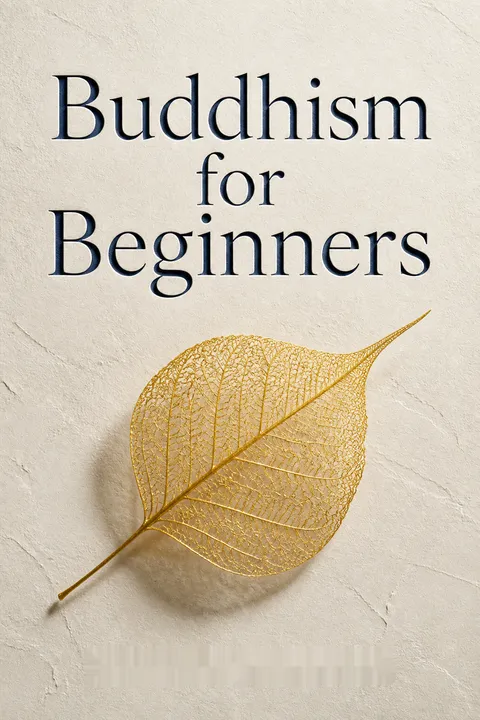
Buddhism for Beginners is organized as a question-and-answer guide, but its deeper structure is a progression from conduct to mental training to insight. It repeatedly corrects translation errors and popular misunderstandings: suffering is broader than pain, detachment is not emotional coldness, emptiness is not nonexistence, and karma is not divine punishment. Those clarifications make the book particularly effective for readers encountering Buddhism through fragments, stereotypes, or ritual without context.
Its most accessible contribution is psychological and ethical. Anger, clinging, jealousy, and pride are treated as habits that can be recognized and countered, while love and compassion are defined as intentions that must shape behavior. The insistence that a person’s spiritual development is their responsibility also limits the role of gurus and rituals. The book’s practical advice is strongest where it links reflection to observable action: how a person speaks, responds to family, helps a dying relative, or treats an opponent in a social conflict.
The account also asks readers to accept a substantial metaphysical picture, including rebirth, karma across lifetimes, and subtle consciousness continuing beyond death. Chodron advocates examination rather than blind faith, but some claims are presented as Buddhist teachings rather than established empirical findings. A careful reader can distinguish the ethical and contemplative practices from the truth claims about cosmic continuity. That distinction neither dismisses the tradition nor requires uncritical acceptance.
The book is notable for connecting inward practice to public responsibility. It rejects the use of karma to excuse poverty or oppression, supports social service, and recognizes gender inequality within Buddhist institutions. Its approach to activism is intentionally demanding: compassion must extend to opponents, while realistic limits protect practitioners from burnout. This prevents practice from shrinking into private serenity, though it also risks putting heavy demands on individuals without fully analyzing structural power. Overall, the book is most persuasive as an invitation to disciplined inquiry: test teachings through conduct, remain humble about what is not known, and let compassion guide both personal choices and collective life.
Review Summary
Buddhism for Beginners receives mixed reviews, with an average rating of 3.81/5. Many readers find it a helpful introduction to Buddhist concepts, praising its clear explanations and Q&A format. Some appreciate its insights into daily life applications and its non-judgmental approach. However, critics note that it assumes some prior knowledge, making it less suitable for complete beginners. A few readers disagree with certain interpretations or find the book too simplistic. Overall, it's considered a good starting point for those interested in Buddhism, though not comprehensive.
People Also Read




Glossary
Four Noble Truths
A map of suffering and releaseA foundational Buddhist teaching that describes unsatisfactory experience, its causes, the possibility of ending those causes, and a path leading to that end. In Chodron’s presentation, the truths shift attention from blaming circumstances alone toward examining the mental attitudes and actions that contribute to suffering.
Three Higher Trainings
Ethics, concentration, and wisdomThe three interrelated areas of Buddhist training: ethical discipline, meditative stabilization, and wisdom. Ethical conduct supports a calmer mind, concentration steadies attention, and wisdom understands reality in a way that can uproot ignorance. Chodron presents them as a path whose parts support one another rather than as isolated techniques.
Three Jewels
Buddha, Dharma, and SanghaThe Buddha, the Dharma, and the Sangha are the three sources of guidance in Buddhist practice. The Buddha shows the path, the Dharma is both the teachings and the realizations that protect against suffering, and the Sangha, in its deepest sense, refers to beings who directly understand reality. Taking refuge means relying on this guidance while actively practicing.
Bodhicitta
The wish to awaken for allThe altruistic intention to attain full enlightenment in order to benefit all sentient beings as effectively as possible. In Chodron’s account, it grows from love and compassion and is paired with wisdom. It is not simply kindness or a wish to help; it is a sustained commitment to develop the capacities believed necessary to guide others toward freedom from suffering.
Emptiness
Absence of independent existenceThe lack of inherent or self-contained existence in people and phenomena. Things still exist, but depend on causes and conditions, their parts, and the mind that identifies them. Realizing emptiness means seeing through the mistaken appearance of independence, not claiming that nothing exists or that ordinary actions have no consequences.
Karma
Intentional action and its imprintsIntentional physical, verbal, and mental actions that leave imprints on a mindstream. In this Buddhist account, those imprints can influence future experience when supporting conditions arise. Karma is not a system of reward and punishment imposed by an outside authority, nor does it make outcomes fixed. The book stresses that it must never be used to justify withholding help.
Four opponent powers
A practice for countering harmful imprintsA four-part method for purifying negative actions: regret for the harm, a resolve to avoid repeating it, taking refuge and generating an altruistic attitude, and performing a remedial positive action. Chodron distinguishes regret from self-hatred. The method is intended to acknowledge harm, redirect conduct, and weaken the influence of destructive actions.
Cyclic existence
Repeated rebirth shaped by afflictionsAlso called samsara, cyclic existence is the repeated experience of birth and death under the influence of ignorance, disturbing attitudes, and karmic actions. It is not merely the ordinary world or a particular place. In Chodron’s account, liberation means ending the causes that perpetuate this cycle and the unsatisfactory experiences associated with it.
Buddha nature
Potential for full awakeningThe potential all sentient beings have to become fully enlightened. Chodron compares it to a clear sky obscured by clouds: disturbing attitudes and negative actions conceal the potential but are not its permanent nature. Through following the path, practitioners can remove those obscurations and develop wisdom, compassion, and other beneficial qualities.
Vajrayana
A tantric Mahayana traditionA form of Mahayana Buddhism that uses methods such as deity visualization, mantra, and symbolic ritual to cultivate the qualities of enlightenment. Chodron describes it as requiring a foundation in compassion, the wish for liberation, and understanding of emptiness. Some practices require empowerment and instruction from a qualified teacher, along with specific commitments.
Positive potential
Imprints from constructive actionsThe beneficial imprints left by constructive actions, which may contribute to happiness when the appropriate conditions arise. The term is often translated as merit, but Chodron warns against treating it like spiritual currency or a reward. Positive potential can be dedicated toward the well-being and enlightenment of all beings without losing its benefit to the person who created it.
Download PDF
Download EPUB
.epub digital book format is ideal for reading ebooks on phones, tablets, and e-readers.








