

Key Takeaways
Make tech leaders defend the public values they once advertised.
The ideals were tested. In December 2016, Silicon Valley executives went to meet President-elect Donald Trump, despite having criticized his attacks on immigrants and other groups. Swisher urged them to make a public statement defending science, diversity, and democratic principles. They went without conditions, while Trump’s team publicized the meeting on its own terms. The spectacle marked a turning point in her view of an industry that had claimed it would improve the world.
Access had a price. Executives had practical interests in visas, government contracts, and avoiding regulation. That helps explain their decision, but does not make it principled. Swisher had warned Elon Musk not to attend; two years later, he acknowledged she had been right.
The episode shows how access can quietly replace accountability. A private meeting with a new administration may be necessary for business, but public silence can make participation look like endorsement. This is a familiar collective-action problem: each executive may hope to protect employees or win influence, while the group’s combined gesture legitimizes the very policies it once opposed. The strongest defense of the leaders is that engagement can sometimes change policy. The weakness is that, without visible commitments or follow-up, the public cannot distinguish influence from accommodation.
Treat digitization as a business-model upheaval, not a website upgrade.
The medium changes everything. Swisher’s Internet enthusiasm began when she downloaded a collection of Calvin and Hobbes cartoons at Duke University. The act showed her that a book, song, or film could move into a new form and reach people differently. She concluded that digitization would spread far beyond computers and software into the larger economy.
Old channels were vulnerable. She warned newspaper executives that online classifieds could undercut their business. Craigslist, which began as an email list of local events and offers, grew into a web service that competed with newspaper classifieds. Swisher argued that legacy companies needed to invest in digital products and habits, not simply reproduce print online. Her focus was on how the audience and business would change, not the machinery underneath.
This distinction is central to organizational change. A new distribution channel can preserve old assumptions, while a new medium alters discovery, cost, speed, and the relationship between producer and audience. The shift resembles the move from physical retail to online marketplaces: the product may remain familiar, but search and distribution reshape who captures value. Still, digitization does not dictate one inevitable winner. Leadership, public policy, and customer needs influence how disruption unfolds, and incumbents can adapt when they treat digital as a redesign rather than a side project.
Measure a tech bet by durable economics, not a soaring stock chart.
Hype hid weak math. During the dot-com boom, companies attracted investment and high valuations before proving that their business models could work. Swisher questioned Webvan’s costs and economics even as it expanded to thousands of employees. Kozmo.com raised $250 million, then reported $3.5 million in revenue and $26.3 million in losses for 1999. Nearly 800 Internet companies failed between 2000 and 2002.
Useful systems survived. Amazon also operated at a loss for years, but it built a distinct advantage in logistics, data, selection, and convenience. That made its ambition more than a stock-market story. The AOL and Time Warner combination, valued at $182 billion, instead paired companies with incompatible assumptions and suffered a sharp decline in value. Growth matters, but only when it can become a resilient business.
The contrast is not simply that one company was wise and others foolish. Early markets often fund uncertain infrastructure before revenue catches up, so insisting on immediate profit can also miss genuine innovation. The better question is whether growth builds capabilities that customers value and competitors cannot cheaply copy. That test separates an expensive experiment from a durable advantage. It also guards against a common cognitive trap: treating rising share prices as independent proof, when the price may merely reflect the same optimism being used to justify the investment.
Design for consequences, because a platform's harms scale with its reach.
The risks were visible. Swisher argues that digital platforms helped spread propaganda, harassment, and misinformation, even when their founders did not intend those outcomes. Journalist Maria Ressa warned Facebook in 2016 that people in the Philippines were facing graphic abuse after criticizing President Duterte’s drug war. Facebook did not remove the pages at issue until two years later.
Intent is not enough. Platforms can amplify users’ behavior across enormous networks, while companies often describe damage as an unintended side effect. Swisher connects this pattern to political polarization and the events surrounding the 2016 election and January 6. She also acknowledges that the extent of any one platform’s causal role is difficult to measure. Her point is that foreseeable risks deserve safeguards before harm becomes widespread.
This is an argument about externalities: a company earns revenue from a service while some costs land on people who never agreed to bear them. Scale makes the problem unusual, because the same design choice can affect millions before regulators or users can respond. A useful distinction is between intention and responsibility. Lack of malicious intent may matter morally, but it does not erase the duty to monitor foreseeable outcomes. At the same time, measuring influence on elections or mental health is difficult, so credible accountability requires transparent evidence, not merely confident accusation.
Judge moguls by both what they build and what they break.
Achievement does not cancel harm. Swisher uses the Prick to Productivity Ratio, a deliberately subjective way to compare a leader’s damaging behavior with the value of their work. She rates Steve Jobs as difficult but extraordinarily productive, while describing Elon Musk’s later conduct as overwhelming the credit he earned through ambitious companies. The framework is less a scientific score than a reminder to resist both hagiography and reflexive dismissal.
Power distorts feedback. Swisher observes that extreme wealth attracts people who flatter powerful founders, making their opinions feel like reality. Some then interpret criticism as persecution. The issue is not that successful people make mistakes. It is that insulated leaders can lose the ordinary feedback that helps them recognize and correct those mistakes.
The ratio is memorable because it refuses to let charisma or output settle the moral account. It resembles a performance review that considers both results and conduct, rather than treating one as a substitute for the other. Its weakness is equally instructive: a single score cannot capture who bears the cost of a leader’s behavior, and judgments of productivity are themselves contested. The framework works best as a prompt for specific questions: What value was created, who benefited, who was harmed, and did the leader accept responsibility?
Protect product quality and user trust from growth-at-any-cost thinking.
Craft can be a strategy. Swisher contrasts the growth-first culture of many platforms with Steve Jobs’s insistence on making products that worked well and felt coherent. The iPhone joined a touchscreen, a usable browser, and mobile software in a device that changed how people used digital services. Jobs also treated privacy as a design question, arguing that users should be told plainly when an app sought their location.
Excellence still needs scrutiny. Jobs could mislead reporters and had serious personal and professional flaws. Yet Swisher recalls that he could acknowledge a product misstep, such as Apple’s unsuccessful social network Ping. His example suggests that product focus and privacy can be competitive strengths, not obstacles to innovation. It does not mean a beautiful interface automatically makes a company ethical.
Product craft is a form of respect: it takes seriously the time, attention, and expectations of the person using the thing. In design, small defaults often carry large ethical consequences, because most users accept them without negotiation. Jobs’s privacy standard anticipates the principle of informed consent, which matters beyond technology, from medicine to research. But excellent design is not a complete moral defense. A useful product can still concentrate power or create dependency, so trust depends on governance and business incentives as much as on polish.
Treat representation as a safety input, not a hiring slogan.
Who builds matters. Swisher argues that leaders who have rarely felt unsafe can overlook risks that other people encounter immediately. She points to Uber employee Susan Fowler’s account of sexual harassment and internal dysfunction, and to the broader absence of women in leadership and investment roles. At the time of the Ellen Pao trial, Swisher cites women as making up only 4 percent of top venture capitalists.
Blind spots become policy. When the people making decisions share the same backgrounds, they can mistake familiar experience for universal experience. That affects workplace rules, product choices, and whose reports of harm are believed. Swisher notes that women who display aggression can be punished for traits celebrated in male leaders. Representation alone cannot guarantee fair decisions, but exclusion reliably limits what decision-makers are likely to notice.
Diversity has an epistemic value: people with different experiences can identify assumptions that a homogeneous group treats as neutral. In safety-critical fields, varied perspectives can expose failure modes before they reach users. Yet representation is not a substitute for authority. A company can hire diverse employees and still ignore them if decision rights, promotion systems, and incentives remain unchanged. The deeper test is whether people who raise uncomfortable risks can influence the product and workplace, rather than merely appear in a photograph or a recruiting campaign.
Ask the uncomfortable question, then verify the answer twice.
Curiosity needs discipline. Swisher’s reporting combines direct questions, broad source networks, and repeated checks. In 2013, a tip told her Yahoo planned a purchase worth about a billion dollars. She reasoned that Tumblr fit the likely size and appeal, tested that theory with investors, then confirmed details with Yahoo before publishing. The scoop was later confirmed by the company.
Fairness is part of accuracy. She also gave subjects a chance to respond, rejected an anonymous insult about Katie Couric, and avoided personal details when they had no bearing on business. Her approach is not to flatter executives into talking, then surprise them in print. It is to be clear about what is being reported, distinguish evidence from rumor, and correct the record when wrong.
The method resembles hypothesis testing: develop a plausible explanation, seek evidence that could disprove it, and check the account against sources with different incentives. That is stronger than either blind trust or reflexive suspicion. Access journalism can create conflicts, however, because close relationships may soften scrutiny even without an explicit bargain. Swisher’s emphasis on transparency and verification is therefore important, but readers should also ask how a reporter’s access shapes what becomes visible and whose perspective remains missing.
Build a newsroom's business model around independence, not prestige.
A new format created room. Frustrated with the pace and limits of legacy publishing, Swisher and journalist Walt Mossberg developed All Things Digital inside the Wall Street Journal. They started with live events, which required fewer resources than a full digital newsroom, then built a publication around lively interviews and reporting. Their rules included no payment or travel expenses for speakers, no advance questions, and no sponsor control over the stage.
Revenue supported experimentation. The first conference earned about $1 million in profit, though management initially resisted sharing the proceeds. Swisher and Mossberg eventually won a one-third share. After leaving Dow Jones, they launched Recode with outside investment and later sold it to Vox Media. Swisher’s lesson is that journalists can build businesses while protecting editorial independence, if incentives and ownership are designed carefully.
This is a practical response to a structural problem: journalism needs revenue, but revenue sources can shape coverage. Events and podcasts can diversify income beyond advertising, while direct audience relationships reduce dependence on a single institution. Neither model is automatically independent. Sponsors may still exert pressure, and a personality-led outlet can become too reliant on its founder. The value of Swisher and Mossberg’s rules is that they make boundaries explicit, giving staff and audiences a way to assess whether commercial success is compromising editorial judgment.
Govern AI around human choices, not science-fiction panic.
The future is a decision. Swisher sees generative AI as capable of helping with health, education, and climate problems, while also enabling deception and other harms. She is less worried about machines spontaneously turning against humanity than about people using powerful systems irresponsibly. The question is who builds the tools, who controls them, and what safeguards exist before they become widely embedded.
Face risks without surrendering. The book draws on Tristan Harris’s term post-tragic: acknowledging genuine harms without retreating into either naïve optimism or helpless despair. Swisher calls for discussion among developers, governments, and affected communities as AI changes. That stance resists both the promise that technology will solve everything and the claim that danger makes action pointless.
The framing shifts attention from cinematic scenarios to governance, incentives, and human institutions. That is useful because near-term harms often arise from familiar pressures, such as competition, secrecy, and the rush to deploy, rather than from a machine possessing independent motives. The harder challenge is that precaution can become a slogan unless it is translated into testing, auditability, and clear responsibility. A balanced approach should protect experimentation while requiring stronger evidence and oversight as a system’s reach and potential for harm increase.
Let finite time force change, not resignation.
Loss sharpened her choices. Swisher’s father died when she was five, and she repeatedly returns to how suddenly a life can change. In 2011, she suffered a stroke while in Hong Kong for a conference. The experience made her examine how she wanted to spend her time. Her answer was not simply to slow down: she loved reporting, interviewing, and building new projects, and did not want to abandon work that mattered to her.
Change can preserve the point. Swisher moved from newspaper reporting to technology coverage, from a corporate newsroom to entrepreneurial media, and later toward public argument about technology’s consequences. The forms changed, but her central commitments to curiosity and candor remained. Her closing appeal is practical: people should not let convenience or constant screen use replace attention to the lives happening around them.
Mortality can clarify priorities without dictating a single lifestyle. For some people it argues for ambition; for others, for rest, care, or a different balance. Swisher’s account is persuasive because she treats her own answer as personal rather than universal. It also connects individual time to public responsibility: choices made now shape the digital conditions younger people inherit. The challenge is to distinguish meaningful persistence from overwork. Passion can guide a life, but it still needs boundaries that protect health, relationships, and the capacity to keep choosing.
Analysis
Burn Book is a memoir of a journalist’s changing relationship with the industry she covered, but its deeper subject is the governance gap between technological scale and human accountability. Swisher’s career gives the argument unusual texture: she saw the Internet as a communications revolution before many newsrooms did, watched the dot-com collapse, and then tracked the rise of platforms whose social effects exceeded their founders’ early ambitions. Her central tension is productive. Digitization is powerful and often beneficial, yet claims of inevitability can obscure the choices embedded in products, business models, and corporate structures.
The book is strongest when it links a vivid encounter to an institutional pattern. The Trump Tower meeting illustrates how corporate access can dilute public commitments. Facebook’s handling of abuse and misinformation shows how delay can turn a known risk into a large-scale one. The accounts of Uber and technology’s gender imbalance connect leadership composition to what an organization can perceive. Across these examples, Swisher challenges the comforting idea that good intentions or technical brilliance are adequate substitutes for oversight.
Her proximity to powerful figures is both the memoir’s method and its limitation. Decades of interviews and saved communications offer detail unavailable to distant observers, while the author’s judgments can sometimes reduce complex people to memorable types. She acknowledges her subjectivity through devices such as the Prick to Productivity Ratio, but that device is a provocation, not a neutral measure. The book also rests largely on her own reporting and recollections, which makes its claims compellingly situated rather than a comprehensive history.
The broadest implication is that innovation and restraint are not opposites. A product can advance quickly while its makers test foreseeable harms, disclose conflicts, and create mechanisms for correction. The book asks readers to evaluate technology not only by what it enables, but by who controls it, who bears its costs, and whether the people affected can meaningfully challenge those decisions.
Review Summary
Burn Book by Kara Swisher receives mixed reviews. Many praise Swisher's sharp wit and insider knowledge of Silicon Valley, appreciating her candid critiques of tech moguls. However, some readers find the book lacks depth, offering little new information for those familiar with Swisher's work. Critics argue it's more about Swisher's self-promotion than insightful analysis. The audiobook, narrated by Swisher herself, is particularly enjoyed by fans. While some find her tone arrogant, others applaud her fearless approach to challenging powerful figures in tech.
Glossary
Everything that can be digitized will be digitized
Digitization's expansive directionSwisher's recurring idea that books, music, film, commerce, and other analog activities can be converted into digital forms. It began with her realization that a computer network could distribute a whole book and grew into a lens for anticipating changes across media and business. It describes a powerful trend, not a guarantee that every digital venture will succeed.
database of human intentions
Searches reveal human needsSwisher's description of search data as more than an index of web pages. Queries reveal what people are trying to learn, find, or do. The phrase captures both search's usefulness and its sensitivity: a search engine gathers traces of people’s interests at enormous scale, creating value as well as questions about privacy and control.
Prick to Productivity Ratio
Conduct weighed against achievementSwisher's deliberately subjective measure for weighing a powerful person's unpleasant or harmful behavior against the value of their work. It is not a formal assessment or a universal ethical score. Its purpose is to resist both automatic admiration of successful founders and automatic dismissal of their accomplishments, while making the trade-off explicit.
mirrortocracy
Power reproduces its own imageSwisher's term for a technology industry that presents itself as a meritocracy while repeatedly elevating people who resemble those already in power. The pattern narrows whose experience shapes products and workplace decisions. It can preserve blind spots while allowing leaders to mistake familiarity and financial success for proof that the system is fair.
grievance industrial complex
A system that rewards grievanceSwisher's label for the expanding tendency of powerful technology leaders to portray criticism as persecution and themselves as victims. The idea includes the enablers and audiences that reinforce those narratives. It matters because a leader who treats scrutiny as an attack may resist responsibility for harms caused by their company or platform.
reported analysis
Interpretation grounded in reportingSwisher's description of journalism that combines verified reporting with the reporter's own analysis. Rather than relying on a source to state an obvious conclusion or padding every argument with ritual counterclaims, it makes the reasoning explicit and accountable to evidence. It still requires accuracy, context, and a fair opportunity for subjects to respond.
skunkworks
A small team outside bureaucracyA small, experimental group allowed to work apart from a larger organization's slower routines. Swisher and Walt Mossberg used the idea for launching a digital journalism project within Dow Jones. The team sought faster decisions, new formats, and editorial autonomy while relying on the parent company for resources and support.
reportrepreneur
A journalist who builds businessesSwisher's term for combining reporting with entrepreneurship. A reportrepreneur does not only produce journalism inside an existing institution, but also creates publications, events, podcasts, or other ventures that can sustain that work. The concept emphasizes control over format and business decisions while carrying the responsibility to protect editorial credibility.
post-tragic
Acceptance followed by actionA term Swisher uses from Tristan Harris's work to describe facing genuine technological harms without denying them or becoming paralyzed by them. A post-tragic response acknowledges loss and uncertainty, then asks what practical action could reduce damage. It contrasts with naïve optimism and with despair that treats improvement as impossible.
FAQ
What’s Burn Book: A Tech Love Story about?
- Personal Journey in Tech: The book chronicles Kara Swisher's three-decade career in the tech industry, highlighting her interactions with influential figures like Steve Jobs, Elon Musk, and Mark Zuckerberg.
- Cultural Commentary: It explores the evolution of Silicon Valley and the impact of technology on society, critiquing the often hypocritical nature of tech moguls.
- Intersection of Media and Tech: Swisher discusses the merging of traditional media with tech, focusing on the challenges and failures in adapting to the digital age.
Why should I read Burn Book: A Tech Love Story?
- Insightful Perspectives: Swisher offers a unique insider's view of the tech industry, sharing anecdotes and insights that reveal the personalities behind the products.
- Candid Critique: The book critiques the tech industry's shortcomings, including privacy issues, ethics, and the consequences of unchecked power.
- Engaging Storytelling: Swisher's writing is both humorous and poignant, making complex topics accessible and engaging for readers interested in technology and media.
What are the key takeaways of Burn Book: A Tech Love Story?
- Tech's Dual Nature: Technology can be both a force for good and a source of harm, as seen in the rise of misinformation and privacy violations.
- Importance of Accountability: Swisher argues that tech leaders must be held accountable for their actions and the societal impacts of their innovations.
- Evolving Landscape: The narrative illustrates the constantly changing tech landscape, highlighting the need for adaptability.
What are the best quotes from Burn Book: A Tech Love Story and what do they mean?
- “You shouldn’t go, Trump’s going to screw you.”: This reflects Swisher's warning to Elon Musk about the ethical dilemmas of aligning with Trump.
- “When you invent the ship, you also invent the shipwreck.”: This underscores that every technological advancement comes with risks and potential negative consequences.
- “If you can imagine your invention in an episode of Black Mirror, then don’t make it.”: A warning against creating products that could lead to dystopian outcomes.
How does Burn Book: A Tech Love Story address the issue of privacy in tech?
- Critique of Practices: Swisher discusses how companies like Facebook and Google have mishandled user data, prioritizing growth over privacy.
- Call for Transparency: The book advocates for clearer communication from tech companies regarding data usage and privacy policies.
- Consequences of Neglect: Swisher warns that neglecting privacy can lead to significant societal harm, including misinformation and erosion of trust.
What role does media play in Burn Book: A Tech Love Story?
- Media's Evolution: Swisher examines how traditional media has struggled to adapt to the digital age, often failing to keep pace with tech innovations.
- Impact on Journalism: The book highlights the challenges journalists face in covering tech, including the need for transparency and accountability.
- Personal Reflections: Swisher shares her own experiences in media, illustrating the intersection of journalism and technology in her career.
How does Kara Swisher portray the tech industry’s culture in Burn Book: A Tech Love Story?
- Hyper-Competitive Environment: The book describes a culture where ambition and innovation are celebrated, often at the expense of ethics.
- Male-Dominated Landscape: Swisher discusses gender disparities in tech, sharing her experiences as a woman in a predominantly male industry.
- Evolving Attitudes: The narrative reflects on how attitudes in tech have shifted, with some leaders becoming more aware of their societal responsibilities.
What are some of the challenges faced by tech leaders according to Burn Book: A Tech Love Story?
- Balancing Innovation and Ethics: Swisher discusses the difficulty tech leaders face in pushing boundaries while considering ethical implications.
- Public Scrutiny: Tech leaders are increasingly under public scrutiny, facing backlash for their decisions and societal impacts.
- Navigating Change: Swisher emphasizes the need for adaptability in a rapidly changing tech landscape, with new challenges and competitors emerging.
How does Burn Book: A Tech Love Story reflect on the future of technology?
- Uncertain Trajectory: Swisher suggests that while technology has immense potential, its future is fraught with challenges requiring responsible leadership.
- Need for Accountability: The book calls for greater accountability from tech leaders, urging them to consider the broader implications of their innovations.
- Hope for Progress: Despite challenges, Swisher maintains optimism about technology's potential to improve lives if guided by ethical principles.
How does Burn Book: A Tech Love Story address the issue of diversity in tech?
- Highlighting Homogeneity: Swisher points out the tech industry's lack of diverse perspectives, which can lead to poor outcomes.
- Advocating for Inclusion: The book emphasizes the importance of including women and people of color in leadership roles for better innovation.
- Personal Stories: Swisher shares her experiences and observations about the challenges faced by women and minorities in tech.
What personal experiences does Kara Swisher share in Burn Book: A Tech Love Story?
- Family and Relationships: Swisher discusses her journey as a mother and partner, reflecting on balancing personal and professional life.
- Health Challenges: She shares experiences with health issues, including a stroke, prompting her to reevaluate her life and career.
- Career Evolution: Swisher recounts her career trajectory, illustrating her passion for the industry and commitment to accountability.
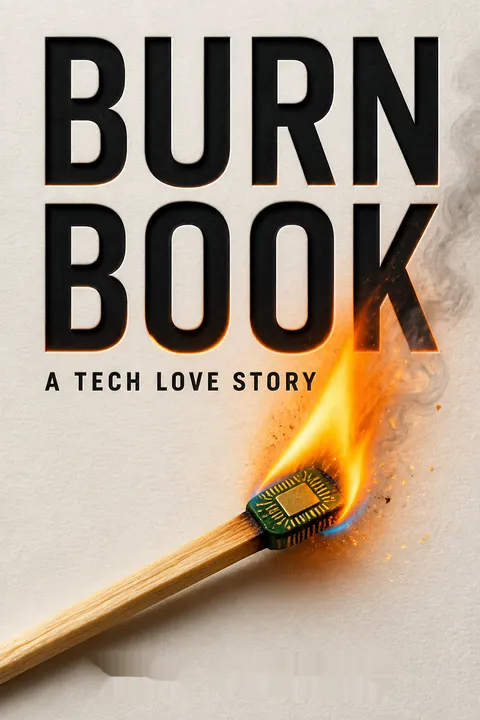
What is the significance of the title Burn Book: A Tech Love Story?
- Cultural Reference: The title references a "burn book," suggesting the book will expose truths about the tech industry and its leaders.
- Critique of Tech Leaders: It signals Swisher's intention to hold powerful figures accountable for their actions.
- Personal Reflection: The title reflects Swisher's personal journey, serving as a metaphor for lessons learned and stories shared.
Download PDF
Download EPUB
.epub digital book format is ideal for reading ebooks on phones, tablets, and e-readers.








