

Key Takeaways
Claim both identities before others cast them as opposing teams.
A public identity trial. During a book event in Omaha, a man demanded that Ranya apologize for 9/11 and rejected her insistence that she was American. The exchange exposed a painful assumption: Muslim and American cannot belong together. Polls cited in the book found widespread suspicion of Muslim Americans’ loyalty and religious freedom, making the challenge larger than one hostile encounter.
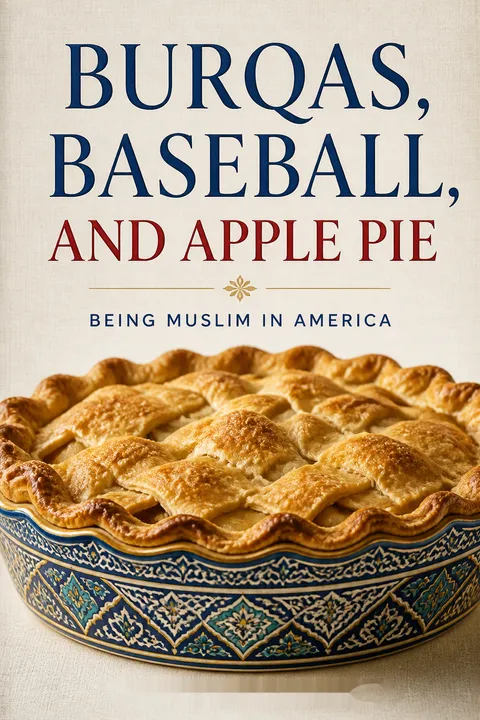
Ordinary life, contested belonging. Ranya’s family carries Palestinian and Syrian roots, celebrates American traditions, and identifies as Muslim. The book’s title brings together familiar pleasures such as baseball and apple pie with the image of the burqa to show that Muslim American life is not an exception to American life. Its central claim is a refusal to surrender either identity to people who demand a choice.
The account treats identity as both personal and political: a person can feel securely American at home and still be asked to prove it in public. That tension resembles the broader experience of minority groups whose membership is conditionally accepted, especially during moments of national crisis. The story’s strength is its concrete scale, a single exchange that reveals a larger civic boundary. Its limitation is also important: one family’s experience cannot stand for every Muslim American, whose religious practice, ancestry, and sense of belonging differ widely.
Let inherited faith become a choice made through honest questions.
A child’s blunt question. When Ranya’s son learned that Muhammad Ali had converted to Islam, he asked why anyone would choose to become Muslim. The question unsettled her because she had treated Islam as an inherited identity more than a consciously examined belief. She had grown up with prayer, Ramadan, Eid, and a loving image of God, but had not needed to defend her faith until after 9/11.
From inheritance to commitment. Motherhood changed the stakes. Ranya wanted her children to understand Islam rather than remain Muslim only out of family loyalty or abandon it to escape stigma. She describes herself at first as an accidental Muslim, meaning someone born into the faith without having deliberately chosen or explored it. Inquiry became a way to make faith more honest and to give her children answers without demanding their eventual choice.
The shift from inherited identity to examined commitment connects religious formation with a broader developmental principle: beliefs become more durable when people can question them without fearing expulsion. Research on autonomy and internal motivation similarly distinguishes chosen commitments from compliance maintained by pressure. That does not mean every person needs a crisis to examine a tradition, nor that questioning guarantees continued belief. The useful point is narrower: children are better equipped to decide when adults offer knowledge and permission to ask, rather than treating doubt as disloyalty.
Use interfaith friendship to learn, not merely to agree.
A living study group. After 9/11, Ranya began reading about Islam and found a source of connection in the shared Abrahamic heritage of Muslims, Christians, and Jews. She started meeting regularly with Suzanne, a Christian mother, and Priscilla, a Jewish mother. Their group, the Faith Club, was a sustained conversation among the three women about their traditions, questions, and disagreements, not a ceremony of easy consensus.
Disagreement made trust. Their discussions included difficult questions and conflict, but the women kept meeting and grew closer to their own traditions as well as one another. Ranya found in Islam a reverence for earlier prophets and scriptures, including Moses and Jesus. The friendship also helped her explain Muslim beliefs to her daughter’s classmates, answering questions about headscarves and the word Allah without treating difference as a threat.
This is more than a feel-good case for dialogue. Structured contact works best when participants have enough continuity and trust to move past polished introductions, which is exactly what weekly meetings allowed. Interfaith friendship can also correct a common asymmetry: people often expect minorities to explain themselves, while majority traditions remain unexamined. Still, dialogue is not a substitute for institutional change, and no individual Muslim should be made responsible for reassuring every anxious audience. The group’s value lies in mutual inquiry, not in turning its members into permanent public representatives.
Interpret scripture in context, guided by justice rather than literalism alone.
Interpretation has consequences. Ranya’s faith crisis sharpened when she heard about Aisha, a thirteen-year-old raped and then stoned to death after seeking help from a Somali religious court. She could no longer treat severe punishments as distant anomalies. She began looking for Muslim thinkers who argued that scripture must be understood within its historical setting and judged by its broader moral commitments.
A contested verse. The Quranic passage often read as permitting a husband to strike his wife has been interpreted literally, softened with restrictions, or reinterpreted by reform-minded scholars. Ranya discusses translator Laleh Bakhtiar’s alternative reading and the view that the verse cannot override the Quran’s wider demand for justice. She also describes Abdolkarim Soroush and the Mu’tazilites, a historic theological school that emphasized reason and held that the Quran was created rather than identical with God. Their history challenges claims that reinterpretation is automatically foreign to Islam.
The key insight is that interpretation is never merely academic when a text is invoked to govern bodies, families, or punishments. Historical context and ethical principles give readers tools to distinguish a tradition’s enduring commitments from rules shaped by a particular society. Yet interpretation itself is contested, and declaring one reading morally superior does not settle who has authority to enforce it. The book’s strongest contribution is not a final ruling on every verse, but its insistence that believers may reason, debate, and hold religious claims accountable to human consequences.
Refuse gatekeepers who mistake one culture for all Islam.
No single Muslim authority. Ranya argues that Islam has no central leader equivalent to a pope who can speak for every believer. Sunni Muslims, who make up most Muslims, have no single clergy serving as a universal intermediary between people and God. That diversity makes it impossible to identify one person or institution as the voice of Islam, even though public debate often demands exactly that.
Culture can masquerade as doctrine. She criticizes Wahhabism, a puritanical movement rooted in Saudi Arabia that rejects many later theological traditions and has gained influence through Saudi state power and funding. Its practices and assumptions can be presented as universal Islam, even when they reflect a particular national history. The book also describes Sharia as the evolving human effort to understand Islamic guidance, rather than a single fixed code imposed identically across places and eras.
Religious decentralization protects personal conscience, but it creates a communication problem: no representative can settle disputes for everyone, and loud or well-funded voices may appear more authoritative than they are. This resembles other decentralized movements in which visibility is mistaken for consensus. The answer is not necessarily a single religious authority, which could suppress legitimate difference. It is stronger religious literacy, transparent institutions, and a habit of asking whose interpretation is being presented, what tradition supports it, and whose interests it serves.
Challenge harmful Muslim authority without turning Muslims into collective suspects.
Words can intimidate. A fatwa is a religious legal opinion issued by an Islamic scholar, though it does not automatically carry the force of state law. Ranya traces public fear of fatwas to the death threat against Salman Rushdie and describes later rulings that were absurd, coercive, or violent. With no universally accepted process for deciding who may issue one, a ruling can travel widely online and make fringe authority seem representative.
Condemn conduct precisely. The author rejects the idea that such rulings are harmless opinions when they threaten people or encourage violence. At the same time, she challenges anti-Muslim campaigns that use extreme examples to portray all Muslims as dangerous. The same principle applies in both directions: criticize a specific act, doctrine, or speaker clearly, without assigning guilt to an entire faith community.
The distinction between criticism and collective blame is essential to democratic debate. Speech can be legally protected and still produce real social consequences, particularly when influential figures attach threats or suspicion to a whole group. The book is persuasive in asking readers to judge claims by their effects as well as their formal status. A further challenge is to avoid treating every unpopular religious opinion as equally dangerous. Precision matters: direct incitement, doctrinal disagreement, and offensive expression raise different ethical and legal questions.
Read political violence through history, not as proof of religious essence.
A faith is not a terrorist profile. When Ranya’s young son asked whether all terrorists were Muslim, she faced a question fed by headlines, classroom stereotypes, and violence committed in Islam’s name. The book rejects both the claim that Islam is inherently violent and the reflexive answer that religion has nothing to do with violence. It argues that Muslims must confront real abuses while refusing to let violent actors define the whole faith.
Context can clarify without excusing. Ranya distinguishes jihad, a term for striving that includes personal moral struggle and, in some interpretations, armed defense, from attacks on civilians. She points to political oppression, conflict, weak institutions, and alienation as conditions that can make violent movements more persuasive. Those conditions help explain recruitment and mobilization; they do not erase the agency of perpetrators or the harm they cause.
This approach avoids two familiar traps: treating scripture as a mechanical cause of violence, or treating religious language as irrelevant whenever violence occurs. Political sociology helps explain how grievance, group identity, and institutional failure can make radical movements attractive, while theology can supply the vocabulary used to justify action. Explanation is not absolution. The argument is strongest when it keeps both levels visible and resists simple comparisons among religions, since movements arise from distinct histories and cannot be ranked by isolated examples.
Defend women’s agency without prescribing one correct Muslim appearance.
A veil has different meanings. Ranya distinguishes forms of covering and the circumstances in which women wear them. A hijab is a headscarf; a niqab covers the face. In her account, veiling can be imposed by law or social pressure, chosen as an expression of faith, or used as a public statement of identity. The same garment can therefore mean constraint to one woman and a source of dignity or access to another.
Reform can come from within. Muslim feminists challenge restrictions on women by interpreting scripture and law through equality and justice. Ranya points to activists working against child marriage and polygamy, and to scholars who argue for women’s leadership in prayer. Their approach matters because many believers do not want to abandon Islam to claim women’s rights. The book’s standard is agency: women should be able to veil, refuse, or reinterpret without being told that fabric alone measures their faith.
The focus on agency resists both religious coercion and the assumption that visible religious practice must be false consciousness. Feminist scholarship has long warned that outsiders can reproduce control while claiming to liberate women, especially when they treat women’s own explanations as irrelevant. At the same time, personal choice cannot be assessed apart from laws, family pressure, and material constraints. The book’s varied examples make the point, but any general account of veiling should leave room for women whose experiences do not fit a neat division between free choice and coercion.
Hear both Palestinian and Israeli stories before demanding peace.
Memory is part of the conflict. Ranya’s children inherit Palestinian family memories of homes left behind and relatives separated by displacement. Her father returned to the house where he grew up in Tiberias, then used as a government building, and wept as he recalled his mother and childhood. The scene makes Palestinian loss personal, not an abstract political claim.
Recognition is not surrender. The author argues that Israelis and Palestinians each carry real histories of fear, loss, and suffering. Acknowledging one side’s pain does not cancel the other’s, and assigning all blame to one people makes compromise harder. She sees the conflict as more than a question of borders: it also concerns dignity, movement, security, and the right of each community to have its history heard.
The emphasis on recognition aligns with conflict-resolution approaches that treat acknowledgment as a precondition for trust, rather than a reward granted after agreement. Personal testimony can make a disputed history emotionally legible, especially to readers who know only the dominant public narrative. Still, symmetry in human dignity should not be confused with symmetry in power, responsibility, or circumstance. Acknowledging two narratives is a starting point for negotiation, not a complete account of the conflict or a substitute for examining specific policies and harms.
Treat American pluralism as the ground where Muslim belonging can flourish.
Citizenship is not a religious test. Ranya’s family relies on the American promise of constitutional protection and freedom of worship, even as school teasing and political rhetoric make their belonging feel conditional. Her son’s crescent-and-star banner hangs alongside classmates’ crosses and Stars of David. The image captures a practical version of pluralism: difference is visible without making one child less American.
Patriotism can include critique. Ranya loves the country’s ideals while recognizing its history of exclusion and its recurring waves of suspicion toward minorities. She argues that American Muslims should not have to hide their faith to demonstrate loyalty. Her family’s Muslim identity also includes joy, prayer, food, and traditions, not only responses to prejudice. The book ends by treating equal Muslim citizenship as a test of whether America can live up to its own promise.
The closing argument links secular government with religious freedom: separating state authority from religious authority protects believers and nonbelievers alike. That principle is especially powerful for minorities who depend on neutral law rather than the goodwill of a majority. The book also offers a useful corrective to a purely defensive identity, reminding readers that belonging includes ordinary pleasures and family rituals. Its optimism is aspirational, not a description of settled reality; constitutional principles matter precisely because social acceptance remains uneven.
Analysis
This memoir turns a family’s coming-of-age story into an argument about who gets to define both Islam and America. Its narrative movement is deliberate: an inherited, mostly private faith becomes publicly scrutinized after 9/11; that scrutiny prompts study, interfaith friendship, and an increasingly demanding engagement with Muslim institutions. Domestic scenes carry the argument. A child’s question, a school assignment, a meal, or a family memory makes abstract disputes about scripture and citizenship immediate without pretending that one household represents every Muslim.
The book’s strongest contribution is its refusal of a false choice. It rejects both anti-Muslim claims that Islam is inherently incompatible with democracy and Muslim apologetics that excuse cruelty as beyond criticism. It instead places interpretation, political context, gender, and civic belonging in conversation. The result is a model of religious loyalty that includes dissent: Ranya remains attached to Islam partly because she believes it must be challenged and renewed from within.
That stance is also the book’s limit. Its preferred Islam is progressive, pluralist, and grounded in justice, but those standards are argued for rather than settled by the memoir. Readers from more orthodox traditions may dispute its readings of scripture, while readers seeking a broad survey of Muslim communities will find a personal and American-centered account instead. The book sometimes presents complex geopolitical or theological debates through a strong moral lens, which can illuminate stakes but compress disagreement.
Its civic argument remains sharp: a democracy cannot claim religious liberty while requiring a minority to prove its patriotism more than others. Its personal answer is neither assimilation through disappearance nor identity through grievance. It is the difficult work of belonging, questioning, and insisting that the country’s ideals apply to the people whose presence tests them.
Review Summary
Burqas, Baseball, and Apple Pie offers an insider's perspective on being Muslim in America. Reviewers found the book informative but repetitive, praising Idliby's exploration of Muslim identity and her efforts to reconcile Islamic faith with American values. Many appreciated her candid discussion of challenges faced by Muslims post-9/11. However, some criticized her writing style and perceived bias. The book sparked discussions on religious interpretation, assimilation, and the diversity within Islam. Overall, readers found it a thought-provoking, if imperfect, contribution to understanding Muslim-American experiences.
Glossary
Accidental Muslim
Inherited, unexamined Muslim identityRanya’s description of being born into a Muslim family and identifying with the faith before examining what it meant to her personally. The term does not imply that the person is not Muslim. It marks the difference between inherited affiliation and a commitment reached through study, reflection, or deliberate choice.
Faith Club
Three-faith dialogue groupThe name Ranya, Christian mother Suzanne Oliver, and Jewish mother Priscilla Warner gave their regular discussions of faith. The women asked difficult questions, disagreed, and continued meeting rather than limiting conversation to shared beliefs. Their group became a source of friendship, religious learning, and support for explaining their traditions to their children.
Wahhabism
Puritanical Islamic movementA religious movement named for the eighteenth-century reformer Muhammad ibn Abd al-Wahhab. In the book, it is described as rejecting many later theological and mystical traditions in favor of a strict return to early Islam. Ranya emphasizes its connection to Saudi state power and its influence in promoting one particular interpretation as though it represented all Muslims.
Sharia
Islamic path of guidanceThe body of Islamic guidance and law through which Muslims seek to understand how to live in accordance with their faith. Ranya stresses that its human interpretation has changed across historical settings and should not be reduced to punishments imposed by governments or religious authorities. She also explains the word’s association with a path to water, a metaphor for life and sustenance.
fatwa
Islamic legal opinionA religious legal opinion addressing a question of Islamic practice or law, traditionally given by a qualified scholar. A fatwa is not automatically a binding statute, and its authority varies by issuer and setting. The book highlights how unregulated or widely circulated rulings can become confusing or dangerous, especially when they threaten people or encourage violence.
jihad
Striving in faithAn Arabic term meaning striving or struggle. The book distinguishes an inward struggle to act ethically and resist wrongdoing from armed struggle, which it presents as limited to particular interpretations and circumstances. Ranya rejects the use of jihad to justify attacks on civilians, conquest, or revenge, and argues that the term should not be treated as a synonym for terrorism.
Mu’tazalites
Rationalist Muslim theological schoolA historic school of Islamic theology associated with reasoned inquiry and the belief that the Quran was created rather than eternally identical with God. Ranya invokes the Mu’tazalites to show that debate about revelation and the use of human reason have deep roots in Muslim intellectual history, rather than being exclusively modern or imported challenges.
People of the Book
Earlier scriptural communitiesAn Islamic term for communities understood to have received earlier divine scriptures, especially Jews and Christians. Ranya uses it to emphasize Islam’s connections to earlier Abrahamic traditions and its reverence for figures such as Moses and Jesus. The term signals a shared religious lineage, although it does not mean that the traditions hold identical beliefs.
Download PDF
Download EPUB
.epub digital book format is ideal for reading ebooks on phones, tablets, and e-readers.








