

Key Takeaways
Treat etiquette as daily respect, not a performance for important rooms
Respect is the real rule. Meier defines business etiquette not as fancy rituals, but as showing consideration to colleagues, clients, and everyone supporting the work. She cites a study attributed to Harvard and Stanford claiming workplace success depends 85 percent on social skills and less than 15 percent on technical ability. That precise split should be read cautiously, but it underscores her point: expertise alone does not guarantee that others will trust or want to work with someone.
Small moments reveal character. One hiring manager took finalists to lunch and watched how they treated restaurant staff. The meal was a preview of how candidates might treat future colleagues. Courtesy, reliability, honesty, and composure are not decorative extras in this view. They are observable evidence of how a person handles relationships.
What's useful here is the shift from etiquette as status display to etiquette as a prediction about cooperation. Organizational psychology distinguishes task performance, the work itself, from contextual performance, the behavior that helps a team function. Courtesy belongs to the second category. The lunch test is memorable because it observes behavior when candidates are not delivering a rehearsed answer. Still, manners are an imperfect proxy for competence: accent, disability, cultural norms, or unfamiliarity with formal dining can shape impressions. The strongest lesson is to judge respect by how people treat others, not by whether they know every ritual.
Build a first impression from signals that agree with one another
People read the whole scene. Meier calls her framework the 7-in-7 Theory: a first impression is shaped by a cluster of cues, including how someone enters, facial expression, grooming, posture, voice, body language, and the feeling they create in others. Her point is not that everyone gets exactly seven seconds, but that these signals begin working quickly. She cites research by Janine Willis and Alexander Todorov suggesting that judgments from faces can form in a fraction of a second.
Consistency builds credibility. A polished outfit cannot compensate for a voice that sounds uncertain or body language that appears disengaged. Prepare the practical details: arrive ready, keep materials in good condition, stand and sit attentively, and make eye contact that feels natural. The goal is not to perform a character, but to avoid sending conflicting messages.
First impressions are a form of rapid social inference: people use visible cues to estimate trustworthiness, competence, and intent before they have much evidence. That makes coherence valuable. It also makes first impressions vulnerable to bias, since appearance and manner are filtered through expectations about class, gender, age, and culture. The framework is most useful as a self-audit, not as a license to judge others quickly. A thoughtful professional can control preparation and attentiveness, but cannot fully control what another person reads into them.
Practice confidence until your delivery matches your actual competence
Presence can be trained. Meier separates confidence, which can be expressed in a particular situation, from deeper self-esteem, which may take longer to develop. Her advice is to prepare, organize, build rapport, observe effective role models, and rehearse a more assured way of speaking and moving. This is practice, not a claim that expertise can be replaced by swagger.
Delivery changes the room. In one hiring presentation, Candidate B offered the more strategic plan, but Candidate A won the panel with a warm opening, clear authority, and engaging delivery. Candidate A had other offers and declined. Rather than hire the second candidate, the company kept searching for someone with comparable presence. The story shows how communication affects whether an audience can recognize and respond to good ideas.
The case illustrates a familiar gap between having a strong idea and making it legible to other people. Performance psychology often treats rehearsal as a way to reduce uncertainty, freeing attention for the audience rather than for self-monitoring. That is a more durable model than simply acting confident. Yet charisma can distort selection: a compelling presenter may be mistaken for the strongest thinker, while quieter candidates are underestimated. Presence is valuable when it helps substance travel. It becomes dangerous when it substitutes for testing the substance.
Make your communication clear, calm, and easy to answer
Listen before reacting. Meier recommends noticing facial expression, tone, and body language, then adjusting rather than pushing through a conversation unchanged. She cites Albert Mehrabian's model assigning substantial influence to vocal and nonverbal cues, though the percentages should not be treated as a universal formula for every message. When disagreement appears, address it before resentment builds, offer a possible solution, and avoid sending an angry message while emotions are high.
Control the channel. In person, speak clearly, avoid interrupting, and keep your voice steady when someone else is upset. For public speaking, prepare the material, learn the audience, test the equipment, and use slow breathing to settle nerves. Her 5 x 5 exercise uses a five-second inhale and five-second exhale for a few minutes before a stressful moment.
Communication is not merely transmitting information; it is managing the conditions under which another person can receive it. Calm pacing and a well-timed question lower the social cost of responding honestly. The advice to pause before sending an angry message also recognizes that written communication strips away facial and vocal context. Mehrabian's percentages are often overgeneralized beyond the narrow settings from which they arose, so the sounder principle is simpler: when words and delivery conflict, listeners notice the conflict. Clarity and emotional regulation make that mismatch less likely.
Assume your digital footprint may reach the next hiring decision
Online conduct travels. A 2018 CareerBuilder survey cited in the book found that 70 percent of employers used social media to screen candidates, and 57 percent of those employers had found material that made them decide not to hire someone. Meier also notes that employers may review current employees' public profiles. Her practical advice is to search your name and images, review tagged posts, and consider setting an alert for new mentions.
Write for the reader. Business email should be brief, accurate, and easy to act on. Use a clear subject, check names and spelling, label attachments professionally, and avoid forwarding another person's message without permission. Reply within about a day when possible, and check whether a reply-all is actually needed. Social profiles should present accurate experience rather than inflated titles or accomplishments.
The chapter treats online identity as part of professional reputation, a sensible response to the persistence and searchability of digital material. The same logic appears in risk management: reduce preventable exposure, and make important information easy to verify. But a public post is not a complete account of someone's judgment or work, and screening practices can amplify bias or punish lawful personal expression. The practical standard is not to erase personality. It is to recognize that context collapses online, and to avoid sharing material that could mislead, harm others, or compromise confidential work.
Network by making people feel known, not by collecting contacts
Curiosity opens conversation. Meier's W-W-H-C method means using questions about what, why, and how, then offering a sincere compliment. Open questions invite fuller answers than yes-or-no prompts, while a specific compliment can ease an introduction. Her approach discourages treating an event as a contest to gather the most business cards. Arrive early, put the phone away, and look for a natural opening rather than forcing entry into a closed conversation.
Connections spread beyond job titles. Meier's business partner Anne once mentioned her publishing ambitions to her grandmother's piano teacher. The teacher knew someone whose daughter edited a major magazine and passed along Anne's name, leading to a conversation and résumé referral. The lesson is to maintain genuine relationships across generations and settings. Follow up, share useful information, and help without demanding an immediate return.
The emphasis on curiosity makes networking less transactional and more psychologically realistic: people are more likely to remember exchanges in which they felt heard. The story also shows how opportunity moves through weak ties, acquaintances who connect someone to a different circle than their closest friends do. That makes a broad network useful without making every relationship a calculated asset. The tension is worth keeping visible: strategic networking can become extractive if people are valued only for access. Generosity and sustained attention are not just tactics; they are the ethical limits that keep networking human.
Host clients as if every small convenience carries your reputation
The host owns the experience. Whether the meeting is in an office or restaurant, the person hosting should help guests feel expected and comfortable. Meier recommends greeting them warmly, guiding them rather than pointing, offering a drink, and keeping phones out of sight. At a meal, the host generally pays, checks that everyone has been served, and signals when the group can begin. These small actions make hospitality visible without turning it into a show.
Respect includes the people serving. The book repeatedly stresses considerate treatment of receptionists, servers, and other support staff. A client may forgive a restaurant mistake, but being ignored by a host absorbed in a phone sends a different message. When something goes wrong, stay courteous in front of guests and address the issue discreetly. Hospitality is a practical way to demonstrate that other people's time and comfort matter.
Hosting is a form of service design: the host anticipates friction and quietly removes it so guests can focus on the purpose of the meeting. That is why details such as directions, refreshments, and a clear start cue matter more than elaborate gestures. The emphasis on service workers also counters a common status error, treating courtesy as something owed only to powerful people. Hospitality can become performative if every movement is scripted, however. Its best measure is whether guests feel at ease and respected, not whether the host executes a flawless ritual.
Learn table manners so meals stop competing with the conversation
Reduce uncertainty at the table. Meier recommends the Continental style for business dining: keep the fork in the left hand and the knife in the right, and work through place settings from the outside toward the plate. Her Index, Wrap, and Twist technique is a way to position the fingers on cutlery. Wait until everyone has food before starting, and let the host signal the meal's beginning. These habits help diners focus on the people and discussion rather than guessing what to do next.
Small courtesies do real work. Hold stemmed glasses by the stem, keep phones off the table, and treat servers patiently. In American business meals, the host typically pays and a tip of 15 to 20 percent is customary. Dining customs vary by country, so local practice takes precedence over any single universal rule.
Procedural fluency reduces cognitive load. When someone no longer has to consciously decode every fork or pause, more attention is available for listening and conversation. That is the practical value of learning conventions before a high-stakes meal. Yet conventions are not moral truths, and unfamiliarity should not be mistaken for disrespect. The book's own reminder to adapt across cultures is essential: etiquette is a coordination system, and its rules depend on the people sharing the table. Competence includes knowing when a rule is locally helpful and when it is simply unfamiliar to the group.
Negotiate with evidence, timing, and a prepared alternative
Make the case before naming a price. Meier advises researching the market rate for a role and preparing the evidence that supports a salary or raise request. For a current job, that evidence might include goals met, leadership, client relationships, and work beyond the role's original scope. Ask before budgets are settled, choose a moment when urgent work is not dominating, and state a clear figure. Personal expenses are less persuasive than the value delivered.
Listen for what can move. If the answer is no, ask whether the obstacle is the amount, timing, or budget. Compensation may include a bonus, added leave, flexibility, a title change, or a scheduled review. Interviews require similar preparation: learn the organization, bring relevant examples, arrive a few minutes early, and ask about next steps. After a meeting, a short, specific handwritten note can make appreciation memorable.
The approach combines anchoring, preparation, and perspective-taking. Naming a researched figure can shape the bargaining range, while listening reveals whether the real constraint is money, timing, or role design. This is more effective than treating negotiation as a contest in which one side must defeat the other. The advice to ask for the higher end of a range should still be calibrated to evidence and market context; an unsupported high opening can damage credibility. The strongest preparation is therefore not just a number, but a defensible account of contribution and a clear sense of acceptable alternatives.
Represent your employer consistently, including after the meeting ends
Professional boundaries travel. Meier frames employees as both individuals and representatives of their organizations. That responsibility extends to social media, business trips, networking events, and office parties, not only formal meetings. Her advice is to avoid gossip, oversharing, and excessive drinking, and to follow company policies on travel expenses and dress. A work event remains connected to work even when it happens after hours or away from the office.
Adapt without surrendering judgment. Her Elevator Rules of Business Etiquette replace gender-based courtesies with attention to seniority and hosting: the person offering respect opens the door, guides a guest, or handles the bill. When traveling internationally, research local greetings and customs rather than assuming Western habits apply. These rules are tools for showing consideration, not proof that every workplace or culture should look the same.
The idea of being a company representative captures how reputation can cross settings: a careless action in a public or social context may shape how clients and colleagues perceive an organization. It also explains why explicit boundaries matter on trips and at parties, where the setting feels relaxed but professional relationships remain. At the same time, organizations should not use the language of representation to demand unlimited personal conformity. Clear policies and proportionate expectations protect both employees and employers. Adaptability is strongest when it combines awareness of context with room for individual difference.
Analysis
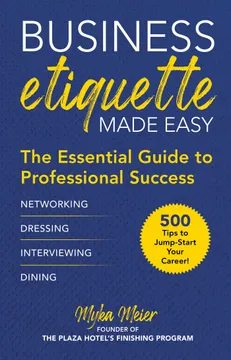
Business Etiquette Made Easy is best understood as a field guide to reducing uncertainty in professional encounters. Its subject ranges from greetings and posture to email, networking, meals, interviews, and salary discussions. The governing idea is consistent: people make judgments from small behaviors, so deliberate courtesy can make competence easier to trust. The book's many scenarios give the reader practical scripts for moments that otherwise feel awkward, from remembering a name to responding to a lower salary offer.
The book's strongest contribution is its insistence that manners apply to everyone, not just senior leaders or high-status clients. Treating service staff well, giving guests clear directions, and protecting colleagues' time are concrete forms of respect. Its advice on preparation also has wide reach: organized materials, researched salary ranges, and practiced presentations reduce avoidable anxiety and improve communication.
Its main limitation is that it sometimes treats social conventions as more universal and predictive than they are. The cited 85 percent social-skills claim and Mehrabian's communication percentages are presented with more certainty than their context warrants. Likewise, a firm handshake, a polished appearance, or a particular dining style can become a biased proxy for capability. The author's reminders to follow local customs and avoid gendered assumptions help, but etiquette must remain adaptable rather than become a new test of cultural fluency.
The most durable way to use the book is as a toolkit, not a scorecard. Learn the practices that prevent confusion and signal consideration, then adjust them to the person, culture, and situation. A precise email, a calm response, or a well-hosted meal succeeds not because it follows a ritual for its own sake, but because it makes cooperation easier. In that sense, etiquette is not decoration around professional work. It is part of the infrastructure that lets people work together with less friction and more trust.
Glossary
7-in-7 Theory
Seven first-impression signalsMeier's framework for the elements she believes shape an in-person first impression: entering a space, facial expression, personal presentation, posture, voice, body language, and the positive feeling a person creates. The name connects these seven elements to the popular idea that impressions form within about seven seconds. The framework is a reminder to make professional signals coherent, not a guarantee of how quickly any individual forms a judgment.
HACH (Handshake, Air kiss, Cheek kiss, Hug) System of Greeting
Four greeting optionsMeier's system groups four common Western greetings by formality: handshake, air kiss, cheek kiss, and hug. She recommends the handshake as the dependable business default, with a different greeting generally appropriate only when the other person initiates it or the context clearly calls for it. The system also emphasizes that local and cultural customs should guide greetings outside familiar settings.
Meier Method Formula for Confidence
Practices for projecting confidenceA set of practices intended to help someone convey confidence in professional situations. Meier emphasizes polished preparation, controlled use of the voice, rapport, organization, identifying situations that trigger insecurity, observing people whose confidence is effective, and regular rehearsal. The formula treats situational confidence as a skill that can be practiced, while distinguishing it from the longer process of building self-esteem.
W-W-H-C (What, Why, How, Compliment)
Conversation prompts for connectionA networking conversation method built around open questions beginning with what, why, or how, followed by a sincere compliment. The open questions tend to invite fuller answers than yes-or-no questions, giving a conversation more room to develop. A compliment can help establish warmth, but Meier advises making it specific and avoiding intrusive questions about an item's price or personal appearance.
Index, Wrap, and Twist (IWT)
Formal cutlery gripMeier's method for holding a fork and knife in formal Western dining. The index fingers rest along the handles, the remaining fingers curl around them, and the wrists turn toward the plate. The method supports the Continental style, in which the fork remains in the left hand and the knife in the right. It is a technique for formal meals, not a rule for every dining culture.
Elevator Rules of Business Etiquette
Rank-based courtesy rulesMeier's modern, gender-neutral approach to gestures such as opening doors, ordering, paying, and entering an elevator. Rather than assigning these actions by gender, the rules consider who is hosting and who is senior in rank. The person who wants to show respect takes the practical role, such as opening a door or guiding a client, while the guest is made comfortable.
The Tango
A tactful way to create spaceA nonverbal technique Meier describes for responding to someone who stands too close. The person plants one foot and places the other a step behind, widening the stance and subtly creating more distance without abruptly turning away. The method is intended to preserve a listening posture while establishing a boundary, particularly in tense or crowded interactions.
5 x 5 breathing exercise
Five-second breathing rhythmA breathing practice Meier recommends before public speaking or other stressful situations. The person sits or stands upright, inhales slowly through the nose for five seconds, then exhales through the mouth for five seconds, repeating the cycle for two to three minutes. Its purpose is to redirect attention toward steady breathing and support a calmer physical state.
Past-Present-Future
A short-toast structureA format for a concise celebratory toast. The speaker briefly recognizes something from the past, acknowledges the present occasion, and offers a hopeful thought about what lies ahead. Meier presents it as a way to organize an impromptu toast without turning it into a long speech. It can be used for an individual, a team, or a business partner.
Mehrabian, Albert
Communication researcher citedAlbert Mehrabian is cited in the book for a model assigning different proportions of message impact to words, vocal cues, and nonverbal behavior. Meier uses it to stress that tone and body language influence communication. The percentages are often applied too broadly; they should not be treated as a universal measurement of how all messages are understood.
Willis and Todorov first-impression study
Rapid face-based judgmentsA study by psychologists Janine Willis and Alexander Todorov, cited by Meier, examined how quickly people make judgments from faces. The book uses the research to emphasize how rapidly facial impressions can form. The finding concerns judgments from facial images under particular conditions, and does not establish that such judgments are accurate assessments of a person's character or ability.
Download PDF
Download EPUB
.epub digital book format is ideal for reading ebooks on phones, tablets, and e-readers.








