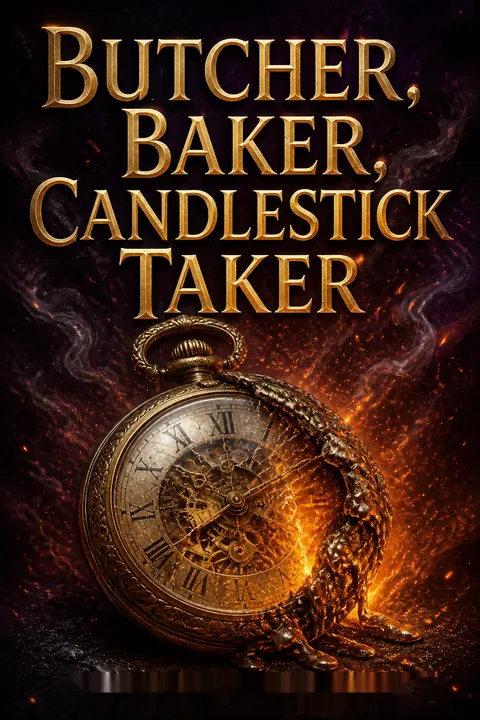


Plot Summary
Prologue
The book opens with an unseen presence dwelling on fire: its hungry movement, its heat on flesh, and what remains after a body is consumed. The description sounds almost like an invitation to watch destruction, while its final question turns the reader toward a hidden victim.
Fire is introduced before Spokane’s people or its crime, making the image a warning that the story’s most disturbing secret will involve both murder and a furnace.
The prologue makes fire more than atmosphere. It joins domestic heat, bodily vulnerability, and the deliberate concealment of evidence before the plot has supplied a name or motive. Its teasing invitation creates unease because the reader is positioned as a witness who cannot yet identify what is burning. That delay mirrors the investigation: visible traces will mislead, while the decisive violence has been hidden inside a familiar working space. The opening also establishes a tension between spectacle and knowledge. A blaze can fascinate the observer even as it destroys the person who should be seen.
The Red Rogue’s Haul
During the night before the investigation begins, the Red Rogue slips into Gladys Mitchell’s mansion through a concealed firewood passage. The thief gathers gold candlesticks, sapphire jewelry, a butterfly box, and a theatrical mask, but leaves Archie Prescot’s experimental mantel clock when its unexpected chimes threaten to expose the burglary.
The clock’s melody distracts the intruder long enough to make the theft precarious, yet the Red Rogue escapes into the surrounding woods. By morning, housemaid Eleanor Sigmund finds the Japanese art collection disturbed and the hidden drawer empty.
Mitchell has lost valuable objects, but the missing pieces are not the only danger now inside her house: the police will soon be called, and the inventor whose clock failed to stop the thief will be drawn into the case.
The burglary establishes the novel’s central uncertainty through a concrete failure: Archie’s invention makes noise, but it does not capture anyone. The thief’s skill and the clock’s unintended effect create a comic surface over a serious breach of trust. The stolen pieces also matter because they make the mansion look like a conventional theft scene, encouraging investigators to assume that the burglary and the coming murder belong to the same criminal. The concealed passage introduces the house as a mechanism with secret routes, much like the clock itself. Both promise order, yet both can be used in ways their designers did not anticipate.
Three Strangers Converge
Detective Bernard Carew, newly promoted and insecure among his veteran colleagues, wakes worrying that routine theft cases will cost him his badge. Across town, clockmaker Archie Prescot arrives from Connecticut to design the Great Northern Depot tower clock.
Marian Kenyon, newly returned from Seattle after her grandmother’s death, finally leaves her darkened home and encounters Cecil Sigmund, a chauffeur whose charm unsettles her. In Montrose Park she meets Archie, who demonstrates a pocket watch that plays a distinct chime for each hour. Their shared curiosity about sound gives Marian a welcome interruption from grief.
Meanwhile, Eleanor recognizes the missing objects at Mitchell’s home and opens the secret mantel drawer, confirming the burglary. Mitchell summons Archie to examine his faulty clock before anyone knows that Marian and the inventor have already become acquainted.
These parallel introductions place the mystery inside several different forms of displacement. Bernard has earned his position but not the respect he wants; Archie has traveled far for work and hopes his ideas will matter; Marian has returned to a home that no longer contains the person who made it safe. Their first connections are practical rather than fated: a clock, a walk, a burglary. That grounding makes later revelations more affecting, because each character enters the case with a private need for recognition or shelter. Eleanor’s discovery converts Mitchell’s carefully maintained display into evidence and begins the chain that draws all four lives together.
The Workshop’s Deadly Hour
At Mitchell’s mansion, Archie finds his clock stopped just before midnight. He explains its mechanism: movement triggers delayed chimes intended to lull an intruder, but the Red Rogue had escaped before they could help.
Mitchell responds by offering to support Archie’s inventions and asks him to meet her other patronized researcher, Hayate Matsumoto, a blind Japanese blacksmith. At their afternoon meeting, Matsumoto shows Archie how clicks and reflected sound help him navigate, then shares his attempt to direct sound waves through a gunlike instrument.
Archie sees a possible link to his own experiments. Mitchell does not attend their discussion. Later, Matsumoto returns to his workshop and finds her beheaded beside the forge. Bernard and his twin, patrolman Thomas, arrive to investigate, turning Archie’s promising new partnership into a murder inquiry.
The meeting binds the technical and criminal plots without making invention a mere decorative backdrop. Archie and Matsumoto recognize in each other a rare intellectual counterpart, while Mitchell’s absence from their conversation leaves a gap that becomes suspicious only afterward. Their methods also challenge the idea that knowledge belongs solely to what can be seen: Matsumoto navigates by sound, and Archie builds mechanisms that translate vibration into action. The body’s location complicates that collaboration immediately. A workshop built for making things has become a place where the investigators must determine what was destroyed, what was staged, and whose work has been taken.
The Second Cause of Death
Bernard studies the workshop and notices that Mitchell’s body is arranged too calmly for a sudden struggle. A clean hatchet with a trace of blood lies beside the woodpile, while the surrounding forge is messy and the tools elsewhere are orderly.
Matsumoto says he heard someone in a coat running from the workshop toward the house after his meeting with Archie, but he cannot identify the person. At the morgue, Coroner Nathan Baker gives Bernard the crucial correction: Mitchell was strangled before her head was removed.
Thomas gathers staff schedules, revealing a long window in which several people could have left their duties. Chauffeur Cecil Sigmund is missing, and his wife Eleanor is distressed. The case now involves not only a killing, but a deliberate attempt to disguise how it happened.
The autopsy changes the murder from an apparent frenzy into an action with stages. Strangulation implies proximity and control; decapitation then obscures that intimacy and invites the police to focus on the wrong weapon. Bernard’s attention to bodily arrangement and the cleaned hatchet shows his preference for inference over force, even while his inexperience makes each conclusion provisional. Thomas’s timeline supplies a different kind of evidence, turning household routine into a map of opportunity. Their competing strengths begin to function as a genuine investigative partnership: Bernard reads physical traces, while Thomas notices absences and inconsistencies that a more solitary detective might overlook.
A Coat Goes Missing
Bernard and Thomas question Mitchell’s staff and search the mansion. Jennings, the polished butler, resists questions about the household and keeps Mitchell’s private study locked; Mrs. Sigmund alone holds the keys. Thomas learns that Eleanor’s husband has a history of gambling and disappears on unexplained errands.
Eleanor suspects he was involved with Mitchell, pointing to a strand of her employer’s hair on his clothing. The detectives also discover that Jennings’s glowing references came from people who died the previous year, and he vanishes before they can confront him.
In the basement, Bernard finds burgundy cloth caught in the wood chute, suggesting a burglar used the hidden route. Then Eleanor identifies Mitchell’s coat back in the hall closet, though she last saw her employer wearing it. The returning coat narrows suspicion to someone who knew the house.
The house’s labor arrangements become a system of concealed dependencies. Eleanor cleans and tends the grounds while her husband’s status as chauffeur gives him mobility; Jennings controls access to private rooms; Matsumoto depends on a patroness who controls his material circumstances. The clues do not immediately resolve into guilt because each character has a plausible secret. The burgundy cloth supports the burglar theory, while the coat’s return points inward, and Eleanor’s bruises suggest that the household’s violence predates the murder. This section makes social position evidentiary: who is permitted to move, enter, or remain unquestioned matters as much as what any person says.
The Patroness’s Stolen Ideas
Mitchell’s patent lawyer tells Bernard that she had mailed a new will on the day she died, leaving her estate to Matsumoto. The letter accompanying it admits that she had claimed inventions that were not hers and expresses a wish to make matters right.
Her patents cover a sound funnel and a device that alters a tuning fork’s resonance, both developed by Matsumoto. Thomas checks Mitchell’s ledgers against the Sigmunds’ bank records and finds extra monthly payments to Cecil, disguised in her accounts as payments to C.S. The detectives conclude that Cecil had been blackmailing Mitchell over her theft of inventions, not necessarily having an affair with her.
The discovery makes Matsumoto a possible beneficiary with motive, while Cecil becomes both blackmailer and missing suspect. Archie learns the patronage he had just welcomed was built on stolen work.
The patent revelation revises the moral landscape without making Mitchell’s final act of restitution erase her earlier exploitation. She had converted another person’s research into wealth, then tried to redirect her estate when guilt or pressure made the arrangement untenable. The will makes property a form of delayed recognition: Matsumoto may inherit what his ideas should have earned, but only after years of dependence. Cecil’s payments likewise turn intimacy into an unstable inference. Eleanor reads a strand of hair as proof of an affair, while the ledger reveals a different transaction. The section’s central psychological tension is how easily evidence acquires meaning from the observer’s wound.
Archie Knows the Thief
After seeing a red-coated figure escape from the balcony outside his room, Archie recognizes the quiet squeak of Marian’s gutta-percha boots when she meets him in the park. He realizes she is the Red Rogue who entered Mitchell’s mansion.
Marian admits she began stealing small valuables while struggling to support herself in Seattle, then used photography assignments in wealthy homes to identify later targets. She insists she avoids the poor and sometimes leaves money for people in need, but does not pretend the thefts are lawful.
Archie is shaken, especially after learning that Mitchell had stolen inventions from Matsumoto, yet he promises not to expose Marian. Their friendship deepens through the disclosure, though he still withholds her identity from Bernard and Thomas. Marian now has a personal reason to solve the murder: she must separate her burglary from the killer’s violence.
Marian’s confession forces Archie to distinguish affection from approval. He does not discover a spotless heroine, but a person who has built a self-image around cleverness and selective fairness while avoiding the harm her choices cause. Her photographic work makes looking itself morally ambiguous: she studies rich interiors by day, then treats their abundance as permission at night. Archie’s promise protects her, but it also places him in conflict with the detective he boards with. Their intimacy grows through truth, yet truth is not automatically liberating when it creates obligations to conceal. Marian’s new motive is therefore double: loyalty to Eleanor and self-preservation.
Blood Beneath the Forge
As Bernard and Thomas continue inspecting the workshop, Thomas questions why a body already dead from strangulation would leave so much blood beneath it. He proposes that the pool and splatter belong to a second victim.
The brothers examine the forge and find that coal has been used, a poker has been moved, and a leather glove and small bone fragments are buried in the ash. A tooth confirms that the remains are human, not the bird Matsumoto once lost in the fire.
They infer that someone cut up a second victim, used the forge to destroy the body, and attempted to hide the evidence before staging Mitchell’s death over the blood. The coat returned to the hall may have concealed bloody clothing. Yet no suspect has been connected to the bones, and the missing ash bucket may hold the answer.
Thomas’s inference begins with an excess: the blood seems too abundant to belong to the body the police can see. This is a useful counterweight to Bernard’s focus on the visible corpse, because it treats discrepancy as evidence rather than noise. The forge transforms the investigation from a question of who wielded a hatchet into one of what happened before the scene was arranged. Fire has not erased the crime completely; it has changed the scale and form of its remains. The missing bucket becomes an important practical detail, reminding the detectives that concealment depends on ordinary tools and routines, not on a flawless criminal design.
Bones Become Chicken Feed
Marian approaches Roslyn Carew about work as a companion and suggests her old friend Eleanor might serve as a maid, giving the women a possible future beyond Mitchell’s household. Later, Archie accidentally tells Marian that the police are searching the forge for bones.
Remembering Eleanor’s farm experience, Marian visits the kitchen with him and learns that chicken bones are ground into grit and larger bones are taken to the potting shed. At the shed, she finds Eleanor operating the bone-cutter beside a bucket of soot-darkened human bones.
Marian takes the bucket before Eleanor can continue grinding and carries it straight to the workshop, where Bernard and Thomas have already recovered fragments and a tooth. Eleanor follows them. The missing husband is no longer merely an absent suspect; his remains have led the investigators to the woman who handled them.
The discovery depends on knowledge that the police do not possess: Marian remembers Eleanor’s working skills, while the cook explains the household’s disposal practices. Domestic competence, usually treated as invisible labor, becomes the key investigative instrument. The bone-cutter is not sinister in itself; it is ordinary farm equipment repurposed within a chain of concealment. Marian’s decision to carry the bucket to the detectives marks a change in her priorities. She risks exposing herself to protect Eleanor and clear her own name, choosing the difficult form of loyalty that requires bringing evidence into the open rather than keeping a friend’s secret.
Eleanor’s Double Confession
Facing the detectives, Eleanor explains that she found Cecil strangling Mitchell in the workshop. Years of his violence against her had taught her how dangerous he was; she struck him with the forge poker before he could see her.
She then butchered his body, cooked it in stages, hid unfinished pieces in the coal, and later ground many bones into chicken feed. But she did not stop at defending herself. She placed Mitchell’s body over Cecil’s blood, used the hatchet to remove her head, burned her bloodied clothing and gloves, and wore Mitchell’s coat back to the house.
The scene was designed to hide Cecil’s death and make Mitchell appear to be the sole victim. Eleanor had mistaken the confrontation for an affair, but Cecil was blackmailing Mitchell over her stolen patents.
Eleanor’s confession separates the act that stopped immediate violence from the later decisions that made her a deliberate concealer of evidence. Her first blow may have been self-protection; the butchering, staged beheading, and disposal of remains required time, skill, and repeated choices. The mistaken belief that Cecil and Mitchell were lovers gives her revenge a personal logic, but not factual certainty. Her cleaning practices, previously associated with order and coping, become a method of transforming the household’s evidence. The revelation does not offer a clean moral category. Eleanor is both an abused person who intervened and the architect of an elaborate cover-up.
Innocence Has Edges
When Bernard corrects Eleanor’s belief that Cecil was Mitchell’s lover, explaining that Cecil had been blackmailing her instead, Eleanor falters. The truth does not undo the violence she suffered or the fact that she stopped Cecil from killing Mitchell, but it unsettles the story she used to justify everything that followed.
Marian catches her as she begins to collapse and faces the friend she had hoped to protect. The detectives have the confession and the remains, though the novel does not report a trial or sentence.
Marian answers Eleanor’s plea for moral reassurance by recognizing that innocence depends on how one weighs the circumstances, not by absolving her. The women’s hoped-for employment with Roslyn remains only a possibility, while Archie and Marian are left with a bond built on secrets now exposed.
The ending refuses to make factual clarity equivalent to moral closure. Bernard can correct the mistaken affair theory, and the recovered bones can establish what Eleanor did, but neither discovery can settle what the act means to the people who survived it. Marian’s response is compassionate without becoming acquittal. That distinction matters because she, too, has defended her own theft through a private code of fairness. The two women are not morally identical, but both must confront the distance between intention and consequence. The unresolved employment prospect and absent legal outcome preserve the story’s central discomfort: recognition can begin change, but it cannot restore what violence has taken.
Analysis
The novel turns a classic country-house mystery into an inquiry about who gets believed, who owns ideas, and what kinds of labor remain invisible. The mansion is not simply a stage for suspects. Its hidden passage, locked study, servant stairs, and elaborate household routines distribute power unevenly. Mitchell can finance research and control access to rooms; Matsumoto can create valuable work while depending on her support; Eleanor sustains the estate through labor that others barely notice. The investigation advances when Bernard and Thomas learn to read these structures as carefully as they read physical evidence.
The book also distinguishes explanation from exoneration. Eleanor’s violence begins in a moment when Cecil is killing Mitchell and Eleanor fears for her own life. Yet her later acts require planning: she burns, conceals, stages, and disposes of remains. Her history of abuse makes her motives intelligible without making every choice innocent. Marian’s response matters because she, too, has built a private moral code to excuse theft. The case forces her to consider whether a good intention can erase the harm attached to an action.
Technology carries the same ambiguity. Archie’s clock and Matsumoto’s sound experiments promise new forms of knowledge, but invention cannot protect its maker from exploitation. Mitchell’s patents show how progress may enrich the person who controls a claim rather than the person who made the discovery. Sound, meanwhile, becomes an alternative to visual certainty: Matsumoto navigates by echoes, Archie recognizes a thief by a boot’s squeak, and Thomas hears an inconsistency in the amount of blood. The story’s deepest lesson is not that careful observation guarantees justice. It is that evidence becomes useful only when investigators question their assumptions, especially the assumptions produced by class, gender, disability, and personal grief.
Review Summary
Readers praise Butcher, Baker, Candlestick Taker for its engaging historical mystery set in 1901 Spokane. They commend the well-developed characters, intricate plot, and accurate historical details. Many appreciate the humor, food descriptions, and unexpected twists. The book is described as a cozy mystery with Agatha Christie vibes, featuring a compelling storyline and vivid setting. Reviewers note the author's attention to historical accuracy and her skillful portrayal of diverse characters. Overall, readers find it an enjoyable, immersive experience that keeps them guessing until the end.
Characters
Marian Kenyon
The returning photographerMarian is a young photographer who returns to Spokane after five years away and the death of her beloved grandmother. Independent and observant, she resists being defined by grief or by the expectations of a small, watchful city. Her camera-trained attention makes her alert to details in buildings, clothing, and people’s habits, while her loyalty to Eleanor draws her into a mystery she might otherwise avoid. Marian is also imaginative and quick to act, sometimes trusting her own moral judgment more than the law. Her central tension is between the freedom she sought in leaving home and the responsibilities she discovers when she comes back.
Bernard Carew
The methodical detectiveBernard is a newly promoted Spokane detective, broad in build and earnest in temperament. Raised in a police family, he wants to replace intimidation with careful observation and reason, an ambition shaped by his admiration for fictional detectives. The older detectives’ pranks leave him unsure whether he belongs, so the Mitchell case becomes both a murder inquiry and a test of his professional worth. Bernard tends to hold himself responsible for finding the right answer, which can make him rigid, but he listens to evidence and learns to rely on Thomas. His affection for his wife and respect for his brother temper his stern investigative manner.
Thomas Carew
The irreverent twinThomas is Bernard’s twin brother and a patrolman whose quick humor can disguise a sharp instinct for people and irregularities. He needles Bernard, enjoys good food, and resents being left with desk work while his brother investigates. Yet Thomas is organized when it matters and often spots the discrepancy that advances the case. His less formal manner helps him question witnesses who might stiffen under Bernard’s authority. The brothers’ rivalry is affectionate but real: Thomas wants to be recognized as capable, while Bernard is learning that leadership does not require solving every problem alone.
Archie Prescot
The sound-minded clockmakerArchie is a Connecticut clockmaker sent to Spokane to design the Great Northern Depot tower clock. Large-bodied, near-sighted, and prone to malapropisms, he is more comfortable with delicate mechanisms than with social suspicion. His fascination with sound drives both his inventive work and his openness to collaboration with Matsumoto. Archie wants his ideas to matter beyond the clock shop, but past disappointments make him wary of sharing them. His kindness is genuine, though his desire to trust can outrun his judgment. His growing connection with Marian tests whether affection can coexist with knowledge of another person’s wrongdoing.
Eleanor Sigmund
The vigilant housemaidEleanor is a capable housemaid whose life is shaped by hard physical work, strict routines, and a long history of having to manage without much protection. She values cleanliness not as decoration but as a way to impose order on a world that often feels unsafe. Quiet around authority, she can become forceful when she believes someone is being treated unjustly. Her old friendship with Marian gives her a rare space to be seen as a person rather than a servant. Eleanor’s care for the household and its animals reflects a practical, sustaining generosity, even when she struggles to imagine a future beyond work.
Hayate Matsumoto
The blind inventorMatsumoto is a Japanese blacksmith and inventor who uses sound and tongue clicks to understand the space around him. Blind since birth, he learned his family’s metalworking craft and applies the same discipline to experiments with sound waves. His controlled manner can seem inscrutable to people who assume blindness means helplessness, but he is perceptive, technically ambitious, and attentive to the work of others. His relationship with Mitchell is that of a dependent researcher and patroness, while his early collaboration with Archie offers the possibility of shared discovery.
Gladys Mitchell
The ambitious patronessMitchell is a wealthy Spokane patron of inventors who fills her mansion with Japanese art and supports unconventional research. Stylish, intellectually curious, and accustomed to directing a large household, she takes an active interest in new technology and the people who create it. Her authority gives her unusual room to shape other people’s opportunities, though her relationships with staff and inventors are marked by distance and unequal power. To those around her she can appear both generous and difficult to know, a public benefactor whose private motives remain uncertain.
Cecil Sigmund
The charming chauffeurCecil is Eleanor’s husband and Mitchell’s chauffeur and groundskeeper. His red curls and smooth manners make a memorable impression, but people who work beside him find him unreliable and difficult to read. He is ambitious about improving his position and moves between household duties and the city’s less respectable entertainments. His marriage to Eleanor is strained by his absences and her guardedness. Cecil’s outward charm makes it difficult for others to know how much of his conduct is performance and how much reflects the man underneath.
Reginald Jennings
The guarded butlerJennings is Mitchell’s formal butler, trained to manage a large home with precision and to keep personal opinions out of sight. He is protective of the household’s dignity and sharply class-conscious, particularly when he believes the staff are being judged unfairly. His feelings for Eleanor complicate his professional reserve, though he seldom makes himself easy to understand. Jennings’s confidence and carefully controlled manners lead the detectives to wonder what history he is withholding.
Mrs. Curry
The household cookMrs. Curry is Mitchell’s experienced cook, a warm and practical presence among the household staff. She takes pride in her food and in the rhythms of a working kitchen, where care is measured in meals prepared and people fed. Her long experience makes her a steady listener, though she does not always recognize how much Eleanor carries alone. Mrs. Curry’s memories of the Great Fire connect the household’s present fears to Spokane’s older wounds.
Roslyn Carew
The pragmatic wifeRoslyn is Bernard’s wife, a wheelchair user who runs her household with confidence and expects to be treated as capable. She understands her husband’s insecurity even when he cannot name it, and encourages him without pretending his work matters more than their marriage. Her search for a companion creates a practical possibility for Marian and Eleanor after the case, while her scientific reading and direct questions reveal an intellectually curious woman.
Nathan Baker
The precise coronerDr. Nathan Baker is Spokane’s coroner, a small, precise physician whose medical findings give Bernard a firmer basis for investigating Mitchell’s death. He is direct and unsentimental, distinguishing what the body can prove from what remains the detective’s problem.
Plot Devices
The alarm mantel clock
A failed thief catcherArchie’s experimental clock is designed to react when moved, then play a delayed sequence of chimes meant to lull an intruder into sleep. In Mitchell’s mansion, the unexpected chimes distract the Red Rogue but do not prevent the theft. The device gives Archie a reason to visit Mitchell and meet Matsumoto, while its failure establishes a recurring distinction between an ingenious design and a reliable result. It also makes sound a practical force in the story, not simply a signal of passing time.
Sound as perception
A route to hidden knowledgeMatsumoto navigates by clicking his tongue and interpreting the returning sound, while Archie builds clocks that convey time through distinct melodies. Their shared research into resonance and vibration leads to a collaboration that broadens both men’s ambitions. Sound also supplies a clue when Archie identifies Marian by the particular squeak of her boots. The device links scientific discovery to everyday attention: what characters hear can reveal what they cannot see, but it still requires patience and interpretation.
The Red Rogue’s disguise
Cover for the hidden thiefThe burgundy overcoat, altered with hidden pockets, lets the Red Rogue carry stolen objects and move through the night without immediately revealing the thief’s identity. The red cloth Bernard finds in the wood chute connects the burglar to Mitchell’s house, while Archie later identifies Marian through the squeak of her boots rather than the coat. The disguise separates the public image of Marian from her secret work and creates suspicion that the burglar may also be the murderer. Its function is therefore both practical and misleading.
The forge and bone-cutter
A trail through destructionThe forge appears at first to be merely Matsumoto’s workshop, but its heat, coal, poker, ash, and slack tub become a map of concealed violence. Bernard notices the excessive blood, Thomas questions the remains, and a bone and tooth establish that another body was burned there. The missing ash bucket leads Marian to the potting shed, where Eleanor uses a bone-cutter for chicken grit. Ordinary work equipment thus preserves evidence even as it helps conceal it. The clues turn household routine into forensic testimony.
The patent and revised will
A motive disguised as generosityMitchell’s patents and final will expose the economic structure beneath her patronage. She had claimed inventions developed by Matsumoto, while Cecil extracted money by threatening to reveal the theft. Her revised will redirects her estate to Matsumoto, suggesting an attempt at restitution and making him appear to have a motive. The documents also correct Eleanor’s assumption that Mitchell and Cecil were lovers. Paper records therefore do more than identify property: they reveal how money, power, guilt, and blackmail shaped relationships the household had misunderstood.
Download PDF
Download EPUB
.epub digital book format is ideal for reading ebooks on phones, tablets, and e-readers.








