

Key Takeaways
Treat economies as interacting organisms, not predictable machines.
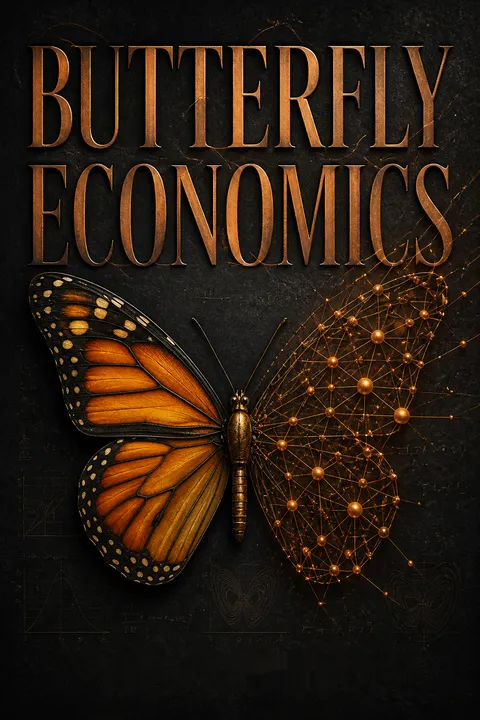
The colony changes the rules. Ormerod’s central argument is that people and firms influence one another directly, so an economy cannot be understood simply by adding up isolated individual choices. Ants make the idea concrete: when an ant finds food, chemical trails can draw others to the same source. But each ant can also repeat its previous choice or switch independently. The result is a group whose behavior changes through interaction, not through a central plan.
Feedback creates surprises. Positive feedback means an initial shift reinforces itself, while negative feedback dampens change. In the ant experiments, the colony often favored one food source for a time, then shifted dramatically to the other. Short-term outcomes were hard to predict, but the proportions observed over long periods followed recognizable patterns. Ormerod uses this contrast to frame his alternative, which he calls Butterfly Economics.
The ants are a memorable model because they show how order can emerge without a manager and how a small local event can shape a group. Similar logic appears in traffic, online recommendations, and the spread of ideas: individual actions alter the environment that guides the next person. The analogy is useful, but it is not proof that people behave like ants. Human networks have institutions, unequal influence, and deliberate strategies. Those differences matter when translating a clean model into an explanation of society.
Expect popularity to reshape demand when buyers discover their tastes together.
Success attracts its audience. When people cannot know in advance whether they will like a new film, product, or restaurant, they use other people’s choices and opinions as evidence. Praise spreads through conversation and reviews, much like trails between an ant nest and food. The resulting feedback can make an already popular choice more attractive, even when the original difference between options was small.
Film revenue shows the scale. In the nine-month period examined by economists Arthur De Vany and W. David Wallis, the top four films earned more than one-fifth of box-office revenue. The highest-grossing film took about $49 million, while the film in the middle earned roughly $300,000. A large budget or famous cast could not guarantee success. The audience’s response, and the news that response generated, helped decide which films became hits.
This account anticipates what is now commonly called social proof: under uncertainty, other people’s choices become information. It also explains why a market can produce extremely unequal outcomes without an equally large difference in quality. The same mechanism makes early attention valuable for artists and new businesses. Yet popularity is not the only force at work. Advertising, distribution, access, and price can determine who gets a chance to become popular in the first place, so feedback should not be mistaken for a neutral vote on merit.
A technology can win through early adoption, even when a rival works better.
Adoption can lock in. The theory of QWERTY describes how early choices can shape later choices when users benefit from joining the largest group. VHS defeated Betamax despite Betamax’s technical advantages. Once more people owned VHS machines, retailers had reason to stock VHS tapes, and new buyers had reason to choose the system with wider support. A small early lead could become self-reinforcing, while switching costs helped preserve it.
The same logic scales up. QWERTY keyboards remained dominant despite repeated attempts to market more efficient layouts. Businesses can also cluster in places such as Silicon Valley because firms benefit from access to workers and suppliers already there. These outcomes are path-dependent: the route taken early can influence the options available later. Ormerod argues that this can justify carefully targeted support for promising new technologies, not blanket intervention in every industry.
The argument connects to network effects, where a product becomes more useful as more people adopt it, and to path dependence, where history narrows future choices. These concepts help explain why markets do not always select the technically best option. They also make policy questions harder: an early subsidy can help a useful technology reach critical scale, but it can also entrench a poor bet. The important distinction is between correcting a real coordination problem and simply backing a favored company.
Read financial booms as shifts in trader behavior, not just changing fundamentals.
Two kinds of judgment compete. Fundamentalists assess an asset against its underlying value. Chartists use recent price movements to form expectations about where it will go next. Traders can keep their current approach, change it independently, or adopt another approach after observing others. If chartists become dominant, past price movements can help drive new buying; if fundamentalists take over, attention may return to underlying value.
Prices can overshoot. In the early 1980s, traders repeatedly described the US dollar as overvalued, yet continued buying it for much of two years before its sharp 1985 decline. Ormerod uses interacting traders to explain how that behavior can persist and why financial prices can swing much more than dividends or other fundamentals. The account does not make future prices predictable. It explains volatility while preserving uncertainty about the next move.
The useful insight is that disagreement among traders can be part of market structure, rather than evidence that one side must be irrational. Similar models appear in behavioral finance, where investors may follow valuation signals, trends, or other people’s actions. The framework makes volatility easier to understand, but it does not establish that social feedback explains every price movement. Interest rates, earnings, regulation, and sudden news still matter. A strong explanation should test how these forces interact, not replace one single-cause story with another.
Treat crime as a social tipping process, not a simple poverty equation.
Crime can reinforce itself. Ormerod sketches a population divided into three groups: people not susceptible to crime, people who might offend, and active criminals. The chance of moving between groups depends partly on social and economic conditions, punishment, and the behavior of others. If more people offend, others may be more likely to follow, while the influence of law-abiding neighbors may weaken. The model can therefore produce abrupt shifts between low-crime and high-crime states.
Similar conditions can diverge. In the model, small changes near a critical point can produce a large change in crime, while larger changes elsewhere may have little effect. This helps explain why the relationship between deprivation and crime can appear inconsistent across times and places. Ormerod also notes that US imprisonment rose from just under 200,000 people in 1970 to about one million in the 1990s, while crime remained high by comparison with the 1950s and 1960s.
Thinking in terms of tipping points helps explain why neighborhood conditions may change sharply rather than gradually. It also directs attention to social ties, informal norms, and prevention, alongside formal punishment. But a model that can generate a pattern is not, by itself, evidence that the pattern caused any particular crime wave. Crime is diverse, and the relative importance of opportunity, enforcement, social networks, and economic conditions can vary by offense and place. The framework is strongest as a reason to investigate interactions, not as a substitute for careful local evidence.
Explain family change through shifting norms as well as changing incentives.
Economics tells only part. Gary Becker’s economic theory treats a couple as a unit dividing time between paid work and household work. It predicts that rising employment and earnings for women can make independent living more feasible and change the economic costs of marriage and children. In the European Union, women’s employment rose from about 22 percent in 1960 to roughly 45 percent by the book’s publication.
Social patterns also spread. The economic account does not explain why countries with similar prosperity have different family structures. In the mid-1990s, divorce rates in Denmark, Finland, and the United Kingdom were substantially above those in France and Germany, and more than twice Italy’s. Ormerod argues that attitudes and social emulation help explain such variation. The same economic change may have different effects depending on the prevailing norms and the family patterns people observe around them.
This is a useful correction to explanations that reduce intimate decisions to income and incentives. Social norms can change what people regard as possible, acceptable, or desirable, and those shifts can spread through families and communities. The account also needs a careful boundary: rising employment may correlate with changes in marriage without being their sole cause. Law, contraception, education, and personal preferences may matter too. A richer explanation treats economic independence and changing norms as interacting influences, rather than competing answers.
Use economic forecasts as uncertain scenarios, not precise steering instructions.
Forecast errors are substantial. Ormerod argues that short-term economic forecasting faces a structural problem: many agents interact, and small changes can sometimes have large consequences. In the United Kingdom, the Treasury’s average one-year-ahead error for GDP growth was about 1.5 percentage points, against average growth of roughly 2 percent. In 1997, the International Monetary Fund repeatedly revised its forecasts for several East Asian economies as the crisis unfolded.
A lucky call proves little. One correct forecast may be chance; a useful method must perform reliably across many predictions. Ormerod’s analysis of economic time series finds little consistent structure for accurate forecasts, especially outside the United States, where he sees somewhat more. He warns that governments cannot safely assume they know exactly when a downturn will arrive or precisely how a tax or interest-rate change will affect it.
The distinction between uncertainty and ignorance is important. Forecasts can be poor at naming the next quarter’s outcome while still helping institutions compare scenarios and prepare for risks. The book is persuasive against treating point estimates as reliable commands. Its broader dismissal of forecasting is less secure: accuracy varies by variable, horizon, and period, and a forecast can inform contingency planning without promising control. The practical lesson is not to stop measuring, but to attach uncertainty to estimates and avoid policies that depend on one precise prediction.
Explain business cycles through firms copying sentiment, not only outside shocks.
Confidence becomes a business input. Ormerod’s business-cycle model places firms at its center. Each company adjusts production using its recent growth and its view of overall business sentiment. Firms interpret the same news differently because they have different circumstances and attitudes to risk. Their decisions affect aggregate output, which in turn influences expectations. This feedback can produce booms and recessions without requiring a new external shock each time.
The simulation matches key patterns. Ormerod reports that repeated simulations reproduce important features of postwar US output data, including short-run correlations and cycles lasting roughly two to seven years. He contrasts this with real business cycle models, which he argues fail to match those features. The model’s point is not that companies know the future. They use simple rules, watch other firms, and make decisions under uncertainty, producing aggregate fluctuations that no single firm intends.
This approach gives micro-level behavior a genuine role in explaining macroeconomic outcomes, while rejecting the idea that the whole can be reduced to one representative decision-maker. It also offers a disciplined alternative to blaming every downturn on an external disturbance. The evidence remains model-dependent: simulations can reproduce data patterns without uniquely identifying the real mechanism. Still, the emphasis on heterogeneous firms and shared expectations provides testable questions about how sentiment travels and how production decisions amplify it.
Expect economic growth to concentrate rather than automatically close rich-poor gaps.
The standard model predicts catch-up. Robert Solow’s influential growth model links output to labor, capital, and technological progress. It predicts that poorer countries can grow faster because additional capital should yield larger gains where capital is scarce. But technology is effectively assumed to arrive from outside the model, and historical experience does not show the expected worldwide convergence.
Starting position matters. Angus Maddison’s historical estimates show that France and Germany produced about 80 percent of US output per person in 1870, and remained at roughly that relative level in the mid-1990s. Other world regions lost ground relative to Western Europe over the longer period examined. Ormerod’s alternative model builds growth from firms connected by relationships that can help or harm them. Increasing returns and mergers can magnify differences, producing both concentrated firm sizes and groups of countries that grow at different rates.
The challenge to automatic convergence remains consequential: access to technology does not guarantee that countries can use it equally well, and accumulated advantages can compound. The firm-network model makes that possibility visible without assuming every economy follows one smooth path. Yet historical comparisons across centuries depend on difficult national-income estimates, and a model’s fit does not settle why particular countries prosper. Institutions, education, trade, and political choices still require explanation. The strongest lesson is to treat catch-up as a possibility, not a law.
Let governments shape durable conditions instead of micromanaging each quarter.
Rules outlast interventions. If short-term outcomes are hard to predict, governments should be cautious about trying to fine-tune each movement in growth, inflation, or exchange rates. Ormerod instead emphasizes the broader conditions under which people and firms act. The Marshall Plan illustrates this kind of intervention: aid supported postwar recovery, while recipients also moved away from wartime planning toward market economies and reduced trade barriers.
Protect against lasting damage. The book does not argue that governments are powerless. It argues that their effects depend on the system’s starting point and can have unintended consequences. During a deep recession, Ormerod proposes temporary measures to limit mass job losses, since unemployment can move onto a persistently higher path. In business, he similarly favors strategic thinking about competitors and long-term position over frantic reactions to every short-lived fluctuation.
The distinction between shaping rules and controlling outcomes is a valuable guide for policy design. Governments can influence institutions, infrastructure, and the distribution of risk even when they cannot forecast the precise path of the economy. The Marshall Plan example also shows that a focused intervention can change the setting in which many later decisions occur. Still, restraint should not become a blanket case for inaction. Public policy needs evaluation, especially where harms fall unevenly. Complexity argues for humility and feedback-aware design, not for abandoning responsibility.
Analysis
Butterfly Economics makes a substantial move from a machine metaphor to a living-systems metaphor. Its most useful claim is not simply that people imitate one another, but that interaction changes the probabilities of future choices. This creates path dependence, uneven outcomes, and tipping behavior. The same conceptual machinery is applied to product adoption, asset markets, crime, family patterns, business cycles, and long-run growth. The range gives the book explanatory reach, while the ants provide a clear, recurring image for the underlying mechanism.
The strongest contribution is methodological. Ormerod rejects the representative individual as a universal foundation and insists that aggregate patterns can depend on diversity and interaction. His business-cycle simulations show how simple rules at the firm level can generate complex fluctuations without a sequence of external shocks. This is a productive middle ground between purely verbal explanations and models that assume away social influence.
The main limitation is identification. A model that can reproduce a pattern does not establish that its proposed mechanism generated that pattern. Different interaction networks, incentives, or institutions may produce similar outcomes. The ant analogy also shifts across the book: sometimes agents interact locally, sometimes they respond to an aggregate signal. Those are distinct social structures and deserve separate evidence. Moreover, the argument against short-term prediction is strongest as a warning against false precision, not as proof that all forecasts are useless.
The practical conclusion is therefore measured rather than fatalistic. Complex systems are difficult to control precisely, but policy still changes incentives, institutions, and exposure to harm. The book’s enduring challenge is to ask not only what individuals choose, but how their choices alter the environment in which everyone else decides. That question enriches economics, provided it is paired with transparent testing and attention to who benefits when feedback becomes self-reinforcing.
Review Summary
Butterfly Economics receives mixed reviews, with an average rating of 3.69/5. Readers appreciate Ormerod's innovative approach, combining economics with psychology to explain human behavior and its impact on markets. The ant experiment analogy is frequently mentioned as intriguing, though some find it overused. Many readers find the book insightful and thought-provoking, particularly in challenging traditional economic theories. However, some criticize the later chapters as dry and academic, with a few readers struggling to maintain interest throughout.
Glossary
Butterfly Economics
interaction-based social economicsOrmerod’s name for an approach to economics and society that treats people and firms as interacting agents rather than isolated decision-makers. Their behavior can change in response to what others do, producing collective patterns that are difficult to predict precisely. The approach draws on biological and complex-systems models to study both social behavior and economic outcomes.
interacting agents
mutually influencing decision-makersIndividuals, firms, or other units whose choices affect one another directly. In Ormerod’s account, an agent may continue its previous behavior, switch independently, or change after observing other agents. The group outcome therefore cannot always be inferred from a single representative individual or from adding up choices made in isolation.
positive feedback
self-reinforcing changeA process in which an initial change increases the likelihood or impact of further changes in the same direction. For example, early adoption of a product can encourage others to choose it, attracting more suppliers and users. Positive feedback can magnify small initial differences, produce abrupt shifts, and help explain why outcomes become concentrated or persistent.
theory of QWERTY
path-dependent technology adoptionOrmerod’s label for the theory associated with Brian Arthur’s work on competing technologies and increasing returns. When adopters learn from earlier adopters, each choice can raise the odds that later buyers choose the same option. An early lead may then become self-reinforcing, allowing one technology to dominate even if it was not initially superior.
fundamentalists
value-focused market tradersIn the book’s financial-market model, fundamentalists judge an asset by its underlying value, such as a company’s expected future dividends. Their approach differs from traders who infer future price movements from past price patterns. The proportions of these trader types can change as agents respond to news and to one another’s behavior.
chartists
trend-focused market tradersIn Ormerod’s account of financial markets, chartists use the history of an asset’s price to form expectations about its future movement. Their methods range from simple pattern reading to advanced mathematical techniques. When chartists become influential, recent price movements can reinforce further buying or selling, contributing to market volatility.
satisficing
seeking a satisfactory choiceHerbert Simon’s term, used by Ormerod, for choosing an option that is good enough rather than calculating the single best possible outcome. The idea reflects limits on information and computation, especially when the future is uncertain. Firms and individuals can use practical rules of thumb without having to solve an impossible optimization problem.
real business cycle theory
cycles driven by external shocksA school of economic modeling that explains fluctuations in output through external shocks, often technological, and the choices of a representative consumer. In the version criticized by Ormerod, individuals respond rationally to changes in productivity by adjusting work and leisure. He argues that its simulations do not reproduce important patterns in postwar US output data.
growth clubs
countries sharing growth pathsGroups of countries whose economies begin from similar conditions and tend to follow related long-run growth patterns. The concept allows income differences between groups to persist or widen, even if countries within a group move more similarly. It contrasts with the prediction that poorer countries will automatically catch up with richer ones.
About the Author
Other books by Paul Ormerod
Download PDF
Download EPUB
.epub digital book format is ideal for reading ebooks on phones, tablets, and e-readers.








