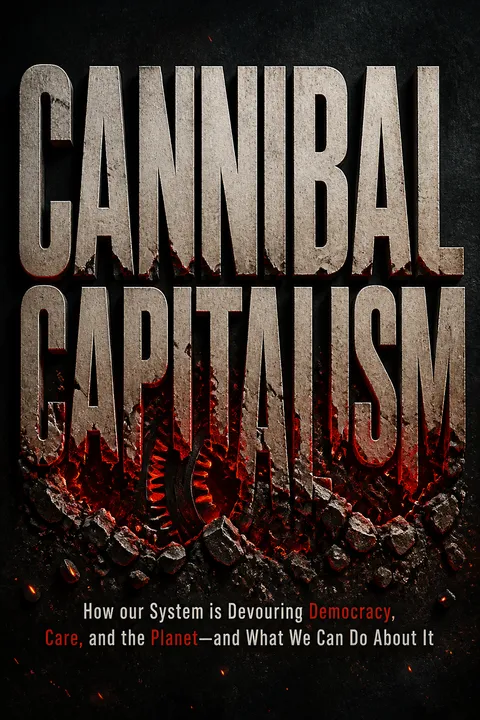


Key Takeaways
Treat capitalism as a whole society, not merely an economy
Look beyond markets. Capitalism is usually described as private ownership, wage labor, and production for profit. Fraser argues that this misses the society that makes those arrangements possible. Profitable production also depends on care that raises and sustains workers, nature that supplies materials and absorbs waste, public institutions that enforce property and contracts, and wealth seized from politically vulnerable populations. These supports are not accidental surroundings. They are part of how the system works.
The hidden cost. Capital treats these supports as cheap or limitless, while its demand for endless expansion wears them down. The result is not only economic instability, but also crises of care, ecology, racial justice, and democracy. The book calls this broader arrangement cannibal capitalism: a system that feeds on the conditions it needs to survive.
The expanded definition changes the central question from whether markets work efficiently to who sustains them, and at whose expense. It also offers a useful test for policy: does a reform change the social arrangements that generate harm, or merely soften one visible symptom? The framework is powerful because it connects problems often assigned to separate disciplines. Its reach creates a challenge, though: if every major social harm is traced to capitalism, the analysis must still specify which institutions and decisions produce each outcome rather than treating the system as a single actor.
Follow profits into the care, nature, and public power they consume
Trace the supports. Marx’s familiar account locates profit in wage labor: workers produce more value than they receive in wages. Fraser retains that insight but follows the production process further back. Capital also benefits from unpaid or underpaid care, low-cost natural resources, public services and infrastructure, and wealth taken from subordinated populations. Markets allocate major inputs and determine how society invests its surplus, but they do not account for all the work and resources that make accumulation possible.
A built-in tension. Fraser’s 4-D logic describes how the economy depends on these other realms, separates them from the economy, disavows their costs, and thereby destabilizes them. For example, firms rely on educated, healthy workers while resisting the public spending and care arrangements that help produce them. The apparent efficiency of the market can conceal a bill shifted to families, communities, and future generations.
This way of tracing costs resembles a more complete balance sheet: it asks what an institution consumes even when those costs do not appear in its accounts. The approach is especially useful for comparing policies that look profitable in the short term but shift burdens elsewhere. It also clarifies why counting paid employment alone gives an incomplete picture of economic contribution. Yet the metaphor of a single system can flatten differences among firms, states, and sectors. The analysis becomes most actionable when it identifies which actors benefit, which costs they shift, and what rules permit that transfer.
Track racism through who is protected from seizure and who is not
Two forms of accumulation. Exploitation occurs when workers formally sell their labor for wages, while capital keeps the surplus their work generates. Expropriation is the seizure of labor, land, resources, or other wealth with little or no compensation. Fraser argues that the two are linked: cheap or confiscated inputs help make waged labor more profitable. Political institutions also distinguish those treated as protected workers and citizens from populations rendered vulnerable to dispossession and coercion.
A changing boundary. This division has taken different forms, from slavery and colonial rule to Jim Crow and contemporary debt, foreclosure, incarceration, and precarious work. In financialized capitalism, exploitation and expropriation increasingly overlap, but racial inequality persists. Black and brown borrowers, for example, were disproportionately targeted by subprime lending and its foreclosures. The boundary may blur, Fraser argues, without erasing the racialized patterns of vulnerability it helped establish.
The account connects racial hierarchy to material processes and political status, not only to individual prejudice. That makes it possible to ask how law, credit, labor markets, and policing distribute protection and exposure. It also helps explain why formally universal rules can produce unequal outcomes when groups begin from unequal positions. A further question is how much of present racial inequality depends on this specific accumulation pattern, and how much is sustained through institutions with independent histories. The framework is strongest when it treats those forces as mutually reinforcing without assuming that one explanation exhausts the others.
Count care as essential infrastructure, even when no wage records it
Work behind work. Social reproduction means the activities that sustain people and social bonds: raising children, caring for the sick and elderly, maintaining households, and building communities. Paid production depends on this labor, yet capitalist societies have often treated it as private, feminine, and less valuable. That arrangement both supports the workforce and weakens the status of those doing the work.
The care crunch. The organization of care has shifted across capitalist eras. Mid-century welfare systems offered some public support while reinforcing the male-breadwinner family model. Financialized capitalism promotes two-earner households, cuts public provision, and pushes care back onto families and low-paid workers. Global care chains extend the strain: a migrant caregiver may leave her own family’s care to another, less-resourced worker. Fraser also points to workplace perks such as egg freezing and breast pumps as signs of a system adapting women to work demands rather than reorganizing work around human needs.
Calling care infrastructure makes its social function visible without reducing intimate relationships to economic inputs. The framing also exposes a familiar accounting problem: unpaid work can be indispensable and still disappear from measures centered on wages and output. That insight invites a practical question about who gets time, security, and support to care. There is a tension to preserve, however. Public provision can ease burdens, but care cannot be fully standardized or delivered as a technical service. A durable response must protect both the material conditions of care and the relationships through which people give and receive it.
Make climate politics challenge the profit system, not just its emissions
Nature is not a free input. Capital depends on the natural world for materials, energy, food, and places to dispose of waste, while treating these resources as if they could replenish themselves without limit. Fraser distinguishes three ways to understand nature: biophysical processes studied by science, nature as capital’s supposedly limitless resource, and historical landscapes shaped through human and nonhuman interaction. The conflict among them helps explain why profit-driven extraction can destabilize living systems.
A history of displaced costs. Coal powered industrial growth, while colonial extraction supplied cheap cotton, sugar, and fertilizer. Later, oil underpinned mass car use and social provision in wealthy countries, while environmental burdens were often pushed elsewhere. Today, carbon permits and offsets can turn nature into tradable units without necessarily reducing the need for large-scale change. Fraser argues for trans-environmental politics: climate action linked to labor, care, racial justice, and democratic control.
The historical examples challenge the comforting idea that cleaner consumption in one place necessarily means less environmental damage overall. The key question is where extraction, emissions, and waste move when a policy changes the accounting rather than the production system. The framework also resists treating climate as a trump card that makes other injustices secondary. Its political reach is a strength, but coordination is difficult: groups facing immediate job loss, land dispossession, or climate danger may disagree about priorities. A shared project needs to make those tradeoffs explicit rather than assuming that naming a common system resolves them.
Democratize decisions now hidden behind the market boundary
Markets require public power. States establish property rights, enforce contracts, maintain money, build infrastructure, and use force to protect the conditions of accumulation. Yet capitalism separates political authority from economic power, leaving firms and investors to make consequential choices outside democratic control. The public sphere is then expected to manage the damage without necessarily controlling the decisions that caused it.
Debt narrows the choices. In financialized capitalism, creditors and global institutions can pressure governments to cut services and impose austerity. Fraser describes this as a crisis of democracy, not simply a failure of political manners or institutions. The COVID-19 pandemic made the dependence on public capacity unusually visible: testing, hospitals, vaccine development, income support, and coordinated care required collective action. But restoring public authority alone may not suffice if private actors retain control over production and investment.
The argument distinguishes the right to vote from the power to decide what falls within democratic reach. That distinction is valuable because a society can retain elections while removing major choices about work, investment, and public resources from collective debate. The pandemic example makes the issue concrete: public systems are asked to respond to dangers whose essential resources may be privately controlled. Still, public institutions are not automatically democratic or competent. Expanding their authority requires safeguards for participation and accountability, not simply a transfer of power from markets to the state.
Expect capitalism to redraw its boundaries when crises threaten it
Four changing arrangements. Fraser traces capitalism through mercantile, liberal-colonial, state-managed, and financialized phases. Each organizes production, care, political authority, and nature differently. The mid-century welfare settlement, for instance, expanded public support and working-class security in parts of the wealthy world, while relying on gender hierarchy, racial exclusion, and extraction from poorer regions. The current financialized phase instead gives creditors greater influence and shifts care and risk onto households.
Conflict shapes the system. These changes are driven in part by boundary struggles: conflicts over what should be treated as economic, political, private, or public. Such struggles can produce real gains, but capitalism has repeatedly adapted by reorganizing its institutions and preserving accumulation. Crisis alone does not guarantee transformation. A new arrangement can address one blockage while carrying old inequalities forward or creating new ones.
The historical model avoids two simple stories: that capitalism never changes, and that each crisis naturally brings progress. It treats reform as consequential but contested, with gains and exclusions often arriving together. This invites a more precise reading of political victories: which boundaries have shifted, which groups gained security, and where costs were displaced? The account also cautions against assuming that a crisis will discredit the existing order by itself. People need an organized interpretation of events and a credible alternative, or adaptation may outpace transformation.
Build a common political project from struggles that capitalism divides
Many fronts, connected causes. Fraser expands anti-capitalist struggle beyond disputes between employers and wage workers. Conflicts over care, racism, imperialism, ecology, and public power also contest the institutional boundaries that support accumulation. These struggles can draw on values such as solidarity, stewardship, and democratic self-rule, but none comes from a wholly separate world outside capitalism. Care, community, and nature can also be absorbed into market strategies or used to justify exclusion.
From overlap to alliance. Fraser argues that movements need a counterhegemonic project: a broadly shared account of the crisis and a political force capable of changing the arrangements behind it. Environmental justice movements, labor, feminist groups, and anti-racist and indigenous movements each identify part of the problem. Their insights do not automatically combine. A durable alliance must recognize real differences, including who has borne the costs of past compromises, while creating a common direction for change.
The emphasis on coalition-building is more demanding than a call for unity. It asks movements to understand how their separate aims are connected without pretending they are identical. That matters because appeals to a universal public interest can conceal whose needs have historically been neglected. A shared analysis can help identify common adversaries, but it cannot substitute for negotiation over priorities and representation. Fraser’s warning against romanticizing capitalism’s supposed outside is also useful: practices that appear local or communal may offer resources for change without being automatically emancipatory.
Make socialism replenish what production uses and democratize the surplus
Change more than ownership. Fraser’s socialism would transform the relation between production and care, society and nature, and private economic power and public decision-making. It would make democratic debate determine how society uses its surplus: the resources and capacities left after necessary needs are met. Growth would no longer be an automatic requirement of the system. Decisions about what should expand, what should shrink, and what counts as necessary would become political choices.
No free ride. A socialist society should replenish or repair the human, ecological, and public conditions it uses. Fraser calls this a pay-as-you-go principle. She proposes no markets at the top, where society allocates its surplus, and none at the bottom, where basic needs should be guaranteed as rights. Between those levels, markets could coexist with cooperatives, commons, and self-managed projects. The design and reach of social institutions should themselves be decided democratically, a process she calls redomaining.
This proposal makes socialism a project of institutional design, not simply a change in who owns firms. Its strongest test is whether it can make decisions about production answerable to care, ecological limits, and democratic priorities at once. The distinction between basic guarantees and discretionary exchange gives that discussion a practical shape. Yet democratic planning raises difficult questions about scale, expertise, and disagreement. The framework names who should decide and what principles should guide them, but leaves many design problems open. That openness is not a flaw by itself; it marks where political practice must supply detail.
Read COVID as a stress test of capitalism's hidden dependencies
One shock, several failures. Fraser presents COVID-19 as a point where ecological damage, weakened public capacity, care shortages, and racialized inequality converged. Habitat disruption can increase contact among species and create conditions for pathogen spillover. Meanwhile, years of cuts to public health systems left many governments with fewer resources for testing, treatment, and coordination. The crisis also moved schooling and care into homes, adding pressure to families and especially to women.
Who was essential? Many frontline workers in food, delivery, warehouses, hospitals, and care were low-paid and disproportionately women and people of color. Their work was indispensable, yet often precarious and poorly protected. Fraser argues that the pandemic exposed how markets undervalue work and how existing inequalities shape exposure to illness and access to treatment. It does not prove that every failure had one cause, but it makes the connections among public capacity, care, ecology, and class difficult to ignore.
The pandemic works here as a systems test: a shock reveals dependencies that routine operation keeps out of view. The contrast between essential work and low pay exposes a gap between social necessity and market reward. The account also keeps unequal exposure in the frame instead of treating risk as evenly shared. A careful reading should distinguish this diagnosis from a claim that capitalism alone explains every feature of a pandemic. Its force lies in showing how institutions can amplify a biological emergency, distribute its burdens unequally, and limit collective responses.
Analysis
Fraser’s central achievement is not simply adding race, gender, ecology, and democracy to a conventional account of class. It changes the unit of analysis. Capitalism becomes an institutional order whose market economy depends on, and systematically devalues, the social and natural conditions outside its official accounts. This creates a coherent explanation for why economic growth can coincide with exhausted caregivers, degraded ecosystems, racialized dispossession, and weakened democratic authority.
The framework is most persuasive as a map of connected pressures. Its historical sequence shows that capitalism can absorb crisis through institutional redesign, so neither collapse nor progress is automatic. Its account of boundary struggles also avoids treating care, community, or nature as pure alternatives untouched by market society. These ideas help explain why movements need both a shared diagnosis and bargaining across genuine differences.
The main analytic risk is breadth. When the same system is said to generate many kinds of harm, the argument needs clear causal pathways to distinguish structural dependence from direct causation. Capitalism is not a person with one intention: states, firms, creditors, households, and movements have different powers and conflicts. The book often identifies these mechanisms, but the political program remains less specified than the diagnosis. Questions of institutional design, international coordination, and democratic planning are recognized rather than settled.
That incompleteness is also an invitation. The book supplies a strong diagnostic question for public debate: what hidden labor, resource, or authority makes this apparently private economic activity possible, and who pays when it is depleted? Turning that question into specific institutions is the harder next task. The argument’s value lies in making separate crises legible as related without pretending that one slogan or policy can resolve them all.
Review Summary
Glossary
Cannibal capitalism
Capitalism consuming its supportsFraser’s term for capitalism understood as a societal order, not only an economic system. Its profit-driven economy relies on care, nature, public power, and wealth taken from subordinated populations, while treating these supports as cheap or limitless. By wearing down the conditions it depends on, the system generates crises that threaten its own stability and human well-being.
Expropriation
Confiscation feeding accumulationA process through which capital commandeers labor, land, resources, or other capacities without adequate compensation and incorporates them into profit-making activity. Unlike wage exploitation, expropriation does not operate through a formally free labor contract. Fraser treats it as an ongoing condition of accumulation, closely linked to political subjection and racialized vulnerability.
Exploitation
Surplus taken from wage laborThe capitalist relation in which workers who lack independent access to the means of production sell their labor power for wages, while owners appropriate the surplus their labor generates. Workers are formally free to contract, though their need for income constrains their choices. Fraser argues that exploitation is intertwined with expropriation, which supplies cheap inputs and lowers the costs of labor.
Social reproduction
Work sustaining people and bondsThe activities that maintain human beings and social relationships, including caregiving, child-rearing, household work, education, and community support. These activities replenish workers and sustain social cooperation, making economic production possible. Much social reproduction is unpaid or underpaid, often performed by women, and treated as separate from the officially valued economy.
Boundary struggles
Conflicts over social divisionsPolitical conflicts over where societies draw and redraw divisions such as economy and polity, production and reproduction, human society and nature, or exploitation and expropriation. These boundaries determine which activities are treated as private, public, paid, or politically controllable. Fraser considers such struggles as fundamental to capitalist change as conflicts over wages and workplace control.
Financialized capitalism
Accumulation organized through financeThe contemporary regime of capitalism in which finance and debt play a central role in directing accumulation and disciplining households, firms, and governments. Fraser links it to austerity, precarious work, weakened public services, and global institutions that can constrain democratic choices. It also expands the overlap between wage exploitation and uncompensated or undercompensated extraction.
Trans-environmental
Ecology linked to other strugglesAn approach to environmental politics that connects ecological damage with labor conditions, care, racism, imperialism, migration, and democracy. It rejects the idea that climate change can be addressed as an isolated issue. For Fraser, effective ecological politics must identify the common social arrangements behind these connected harms and build alliances across affected movements.
Redomaining
Democratically redrawing social boundariesFraser’s term for making the design and scope of social institutions a democratic question. Redomaining means collectively deciding which matters belong in public decision-making, which should be organized in other ways, and how social domains relate. It aims to bring choices that capitalism assigns to private economic power into inclusive, accountable political deliberation.
Nature I, Nature II, and Nature III
Three views of human-nature relationsFraser distinguishes three meanings of nature. Nature I is the biophysical world studied by science, whose processes operate whether or not people recognize them. Nature II is nature conceived by capitalism as a cheap, seemingly limitless resource and waste sink. Nature III refers to historically changing landscapes shaped through interactions between human societies and nonhuman life. The distinctions clarify different levels of analysis rather than competing claims.
Counterhegemony
A shared alternative political directionA political project that challenges the prevailing common sense and builds support for a different organization of society. In Fraser’s account, it requires more than agreement that conditions are bad: movements must connect ecological, economic, racial, care, and democratic crises, develop a common diagnosis, and organize the political force needed to pursue institutional transformation.
About the Author
Other books by Nancy Fraser

Download PDF
Download EPUB
.epub digital book format is ideal for reading ebooks on phones, tablets, and e-readers.








