

Key Takeaways
Treat a slow start as a clue, not a verdict on your capacity.
A label is temporary. At seven and a half, Chip Gaines still struggled with his ABCs. His school sent him to a gym with the other children in the lowest reading group, nicknamed the Penguins. He remembers feeling pleased to have gym time, not ashamed of the label. The image became a useful reminder: penguins cannot fly, but they can swim. A limitation in one setting does not settle what a person can do elsewhere.
Look for the fit. Gaines celebrates stories of people who were underestimated, and urges readers to question harsh judgments from others and themselves. The point is not that every setback secretly predicts fame. It is that a category, especially one assigned early, should not be mistaken for a complete account of someone’s abilities.
What's valuable here is the shift from asking whether someone meets a standard to asking where their strengths can work. That reframing can protect a child or adult from turning one difficulty into a fixed identity. It also needs a practical companion: a reading struggle, for instance, may call for focused support, not simply a more positive attitude. Optimism is most useful when it expands the search for a good fit without denying the need for help.
When one dream ends, reuse its discipline to build another.
Practice can travel. Gaines built his teenage and college life around baseball. He cites a roughly 6 percent chance that a high-school player would play college ball, followed by an 8 percent chance of being drafted, making the professional route less than half a percent. He still made a college team, then was cut during his sophomore year. The loss left him depressed and without a sense of direction.
A new field appeared. After watching a landscaper work outside a business class, Gaines asked for a job, learned the trade, and eventually started his own landscaping company. He says baseball had trained his persistence and work habits. The sport did not become his career, but the effort invested in it became useful preparation for entrepreneurship.
The deeper insight is that a failed ambition need not make its years of effort worthless. Skills, habits, and relationships can outlast the role that first gave them meaning. The risk is allowing one passion to become an entire identity, leaving no sense of self when it disappears. A broader account of identity makes transitions less like erasure: the player may stop competing, while the discipline and capacity to learn remain available.
Count the cost before adventure makes your team carry it.
Good intentions are not enough. In his twenties, Gaines left for a three-month Spanish immersion program in Mexico while Joanna, then his girlfriend, was expected to manage his three businesses alongside her own full-time job. He had not prepared her for the work or kept reliable books. With little money in reserve, missed rent payments led to bounced checks and unpaid contractors. Joanna and Gaines’s parents had to step in to keep the crew paid.
Responsibility caught up. The trip also involved a failing radiator, a stranded truck, and a frightening encounter with a bull. Gaines eventually reached Mexico, but Joanna demanded he return, and he came home after only a few weeks. The experience forced him to see that launching businesses was not the same as building dependable ones.
This story usefully separates boldness from the romance of being impulsive. A decision is not purely personal when employees, partners, or family members absorb its risks. The book’s strongest lesson is not to avoid adventure, but to make responsibility part of the plan: prepare a capable substitute, understand the finances, and tell affected people what they are taking on. Courage without those steps can transfer the cost of one person’s freedom to others.
Let a partner's opposite instincts cover your blind spots.
Difference can be an asset. Gaines describes himself as quick to act and comfortable with risk; Joanna is more cautious, attentive to detail, and alert to possible consequences. Their strengths complemented each other as they bought and renovated properties. Her careful financial thinking made room for his appetite for action, while his big-picture energy encouraged her to pursue creative ideas.
Boundaries make teamwork work. Their first house-flipping project produced a major argument: Joanna tried to direct details, while Chip rejected advice from a first-time partner. They learned to give each other space, stay in their respective strengths, and remember that they were trying to solve the same problem. They also had to make deliberate time for marriage and family, rather than letting every conversation become a business meeting.
Complementarity is more than pairing a risk taker with a cautious person. It requires enough trust for disagreement to be heard, plus clarity about who owns which decisions. Without that structure, one partner’s strengths can become the other’s additional labor, or caution can be mistaken for obstruction. The Gaineses’ example is most persuasive when read as a practice of mutual correction, not as proof that every couple should work together.
Reserve your courage for meaningful risks, not avoidable danger.
Risk has different purposes. Soon after his first son was born, Gaines drove a new ATV off a steep embankment and fell face-first onto the ground. He needed stitches and still carries a prominent scar. Seeing his wife and baby afterward changed how he understood thrill seeking: the rush was no longer worth treating survival as a private concern. He began to distinguish calculated risks from stunts that could leave his family without him.
Fear need not decide. Gaines argues that uncertainty cannot be removed from life, so fear should not automatically veto a worthwhile choice. Joanna, for example, had moved to New York to pursue broadcast journalism, then returned with ideas that helped inspire her home-decor business. Small acts of courage can open doors, but bravery does not require courting needless harm.
The distinction between courage and recklessness is central to this story. Taking a risk for a meaningful goal can expand a person’s life; taking a risk merely to prove fearlessness may offer little beyond a temporary thrill. The scar makes the cost concrete, while the family context changes the decision’s moral scale. Fear can also carry useful information, so the aim is not to silence it, but to judge what it is warning about.
Trust intuition, but let changing seasons change the plan.
A dream can change shape. When Joanna was pregnant with their second child, she decided to close her home-decor shop because she could not give both the business and her young family the attention she wanted. Rather than force a part-time arrangement, she sold the inventory and hosted occasional sales at home. Later, her design skills became central to the couple’s renovation work. As the housing market weakened, they also shifted from flipping houses toward remodeling existing homes.
Return is not retreat. Years after closing the shop, Joanna felt ready to reopen it. Magnolia Market returned in its original building, with a clearer sense of what she wanted to make. Across these changes, instinct was paired with practical adjustments: reduce the workload, find new revenue, learn new skills, and reconsider the decision when circumstances changed.
The story treats intuition as a source of direction, not a substitute for planning. Joanna’s decisions mattered because they were followed by concrete changes in time, money, and work. That makes the example more useful than a simple instruction to follow a feeling. A strong gut sense can still be mistaken; the sensible response is to test it against obligations and observable conditions, then remain willing to revise the plan.
Make beginners capable by letting them solve real problems.
Scrappy means resourceful. Gaines uses the word for grit, persistence, and the willingness to make a reasonable attempt without having every answer. At Magnolia, employees were expected to tackle unfamiliar tasks and help wherever needed. When project manager Kristen had to obtain her first construction permit, Gaines gave her a few starting points but did not walk her through each step.
Mistakes can teach. Kristen found the right city office and secured the permit, but she did not know an electrical inspection had to happen before the wall was closed. The crew had to reopen it. The costly error taught her the process and helped her earn confidence with contractors and officials. Magnolia’s early staff also packed orders, cleaned, and filled gaps across departments rather than staying inside narrow job descriptions.
The strongest version of learning by doing gives a novice a real task, room to think, and a tolerable cost for mistakes. That is different from withholding information simply to test someone. The reopened wall made learning memorable, but repeated preventable errors can become waste or unsafe practice. Good leaders must judge which mistakes are educational, which require advance instruction, and when a learner needs support before the stakes rise.
Measure setbacks across the whole season, not one play.
A bad stretch is not the final score. Gaines uses the New England Patriots’ comeback from a 25-point deficit in the 2017 Super Bowl to illustrate perseverance across a whole game. He applies the same idea to Magnolia’s decision to buy and renovate a group of abandoned downtown buildings, including two large grain silos. The work was projected to cost millions, far more than the couple had previously risked on a single project.
Betting on yourself is uncertain. Joanna saw a destination for the store, offices, and community space, while Chip hesitated over the financial exposure. They proceeded, and the Silos became popular, though the renovation took longer and cost more than expected. Gaines argues that a setback can still teach or redirect a person, but the decision itself remains a gamble, not a guaranteed win.
The long-view frame helps prevent one failure from becoming a verdict on a person’s ability. It is especially compelling when a team keeps adapting rather than surrendering to an early score. Yet successful comebacks can make risk look wiser in retrospect than it was at the time. The useful question is not only whether someone persevered, but whether the downside was understood, the people affected were protected, and new evidence changed the strategy.
Restore overlooked places by investing where others see only liabilities.
Place can be part of the work. Gaines writes that Waco was often dismissed as an undesirable or uneventful town. He and Joanna chose to build their businesses there, including in areas other investors might have avoided. Their first shop was in a location without much nearby retail; later they bought the neglected downtown silo property and made it the home of Magnolia Market.
Attention can spread. The Fixer Upper television show featured Waco’s buildings, landscapes, and local businesses alongside the renovations. The Gaineses describe the result as a boost in visitors and renewed interest in the city. Their story casts restoration as more than improving a building: it can invite people to notice a place, support other local efforts, and imagine a different future for it.
This account makes a valuable case for seeing assets where conventional reputation says there are none. Its focus on a particular town also shows how a business can be tied to civic identity rather than treated as interchangeable with any location. The harder question is what restoration means to residents who are not visitors or business owners. A thriving destination is a beginning, not by itself proof that gains are broadly shared.
Build trust across difference through shared work before debate.
Start with a common task. Gaines imagines two people with sharply different backgrounds digging a ditch together. Shared effort gives them time to learn how each thinks, and the other person’s approach may improve the work. Afterward, a meal creates room for stories and more honest conversation. The aim is not to force agreement, but to encounter a person before reducing them to a position or label.
Make room for disagreement. Gaines connects this idea to Abraham Lincoln’s Cabinet, which included political rivals, and to Magnolia Table, the restaurant the couple planned in a historic Waco building. They chose a new name to signal welcome rather than preserve a slogan they felt divided people into insiders and outsiders. Listening is presented as a civic practice, not merely a courtesy.
The approach is strongest when it makes contact more than a performance: people do something together, listen, and allow the other person to complicate their assumptions. It also recognizes that friendship does not require agreement. Still, conversation alone cannot resolve every conflict, especially when people have unequal power or face material harms. Listening can establish the trust needed for change, but it should not become a reason to postpone change.
When success dilutes your priorities, stop before it spends your family.
Momentum can hide neglect. While filming Fixer Upper, running Magnolia, and raising four children, Gaines and Joanna believed they could keep doing all three at full strength. One night, a customer tweeted that an online order had not arrived. The complaint kept Gaines awake; the next morning, he recognized that the warehouse’s shipping problems needed his attention, even as he was scheduled to film.
Choose what deserves your best. The couple concluded that their family, their business, and the television show had become too much to manage well at once. Although Fixer Upper was successful and helped Magnolia grow, they decided to leave after the fifth season. Their reasoning was not that the show had failed, but that continuing would take time and energy from commitments they valued more.
This is a useful corrective to the assumption that every successful opportunity should be extended. Public attention and commercial growth can disguise the costs of divided attention, especially when the people closest to the work are also the ones carrying the home responsibilities. The story does not make leaving an easy universal answer. It does show the value of naming nonnegotiable commitments before momentum quietly assigns them whatever time remains.
Turn the work you love into a launchpad for someone else.
A runway gives others room. Gaines uses the image of a runway for people who help someone else build confidence and take off. He traces that idea to his father, grandfather, and father-in-law, who modeled hard work, support, and belief. A century-old pecan grove near the Gaines farmhouse offers another image: someone planted and tended trees whose fullest harvest would belong to later generations.
Let the work travel. Gaines describes starting businesses that new owners expanded beyond what he had imagined, and says he wants Magnolia employees to pursue ambitions of their own, even if those ambitions eventually lead them elsewhere. The book closes by asking readers to identify what energizes them and take a practical first step. A worthwhile life is measured not only by personal achievement, but by what others can build with the opportunity it creates.
The runway idea turns legacy away from self-display and toward enabling other people’s agency. Its pecan-tree image makes the time horizon tangible: useful work may be planted long before its planter sees the full result. The standard is demanding but grounded. Rather than predicting a grand future, a person can ask whether present choices give family, colleagues, or successors more room to grow. That question makes legacy an everyday practice.
Analysis
Capital Gaines is a memoir structured as a sequence of formative mistakes, business experiments, and changing commitments. Its argument is less a formal system than a repeated pattern: act, discover what the action costs, learn from the consequences, and keep moving with a wider view of what matters. The narrative gains credibility when Gaines admits that his optimism and appetite for risk harmed people around him, as in the Mexico trip, or endangered himself, as in the ATV crash. These episodes make clear that courage is not automatically virtue; its value depends partly on who bears the downside.
The book also offers a practical account of entrepreneurship that is unusually social. Business growth depends on Joanna’s complementary judgment, employees willing to handle unglamorous work, and family members who sometimes rescue an underprepared operation. That makes the success story more collective than the lone-founder mythology it might initially resemble. The strongest management lesson is not simply to improvise, but to build trust and responsibility while improvising. The weakest version of the book’s advice appears when learning by failure is treated as inherently superior to instruction. A novice can learn from a mistake, but a leader still has a duty to distinguish a recoverable lesson from avoidable harm.
Its optimism is both its engine and its limitation. Gaines repeatedly interprets setbacks as preparation, and that stance can preserve agency when plans collapse. Yet successful outcomes can make risk look retrospectively inevitable or wise. The book is most persuasive when it adds concrete constraints, such as a household’s needs, business cash flow, employee livelihoods, or finite attention. Its final emphasis on family, meaningful work, and empowering others gives the entrepreneurial story a more human measure of success than growth alone. Readers need not share the author’s Christian faith to recognize the larger claim: opportunities have seasons, and good judgment includes knowing when to pursue one, when to reshape it, and when to let it go.
Review Summary
Capital Gaines receives mixed reviews from readers. Many praise Chip's authenticity, humor, and inspirational messages about taking risks and pursuing dreams. However, some find the writing style juvenile and the advice cliché. Readers appreciate Chip's faith and work ethic but criticize his lack of acknowledgment for financial support. The book is seen as entertaining but lacking in substance by some. Fans of the TV show generally enjoy the behind-the-scenes stories, while others find it repetitive of previous books. Overall, opinions are divided on the book's value and impact.
People Also Read



Glossary
Scrappy
Persistent, resourceful problem-solvingGaines uses scrappy to mean gritty, persistent, and willing to try a solution without having every detail in advance. At Magnolia, it describes employees who tackle unfamiliar problems, fill gaps, and do whatever work is needed. The term is not meant to endorse cutting corners or hurting others to get ahead.
Underdoggers
People who root for underdogsGaines’s playful label for people drawn to the less favored side, whether in sports, business, or civic life. He uses it for people who find potential in places and projects others dismiss. In the book, the outlook helps explain why he and Joanna chose to invest in Waco and in properties other people might overlook.
Seven Rs of Global Domination
Magnolia's varied business areasA joking name Gaines gives to the range of Magnolia-related ventures: retail, renovation, rentals, real estate, ranching, restaurant, and reality show. The phrase captures the company’s variety and the fact that its founders often had to learn unfamiliar industries while working. It is humorous shorthand, not a formal business framework.
Runway
Support that helps others launchGaines’s metaphor for a person, family, or organization that gives someone else confidence, opportunity, and room to pursue a goal. A runway does not determine where another person must go; it provides a foundation for taking off. He applies the idea to mentors, parents, employees, and the next generation.
Job and work
Paid task versus purposeful effortGaines distinguishes a job, which is a task performed for an agreed price, from work, which is effort directed toward a goal or calling that matters to the person doing it. The distinction does not mean paid employment lacks meaning. It asks readers to notice whether their daily labor connects to something they value.
FAQ
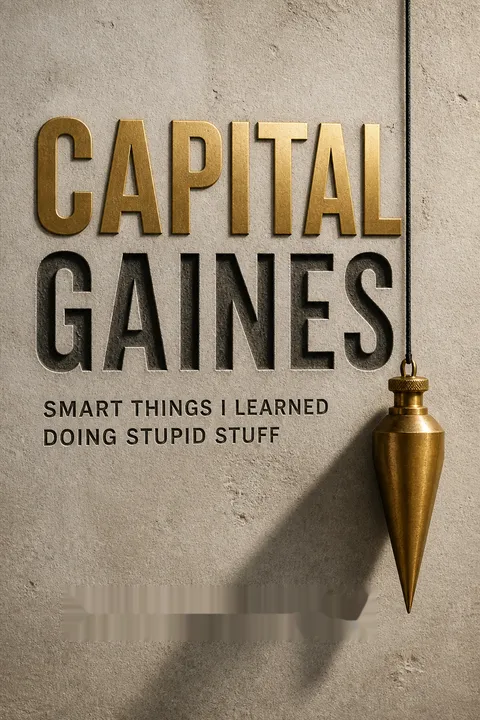
What's "Capital Gaines: Smart Things I Learned Doing Stupid Stuff" about?
- Author's Journey: The book is a memoir by Chip Gaines, detailing his life experiences and the lessons he learned from them. It covers his journey from childhood to becoming a successful entrepreneur and TV personality.
- Life Lessons: Chip shares insights from his personal and professional life, emphasizing the importance of taking risks, learning from failures, and trusting one's instincts.
- Entrepreneurial Spirit: The book highlights Chip's entrepreneurial ventures, including his work with Magnolia and his experiences on the HGTV show "Fixer Upper."
- Personal Growth: It also delves into Chip's personal growth, his relationship with his wife Joanna, and their shared journey in building a family and a business.
Why should I read "Capital Gaines: Smart Things I Learned Doing Stupid Stuff"?
- Inspiration: The book offers inspiration for those looking to pursue their dreams, emphasizing the value of hard work and perseverance.
- Relatable Stories: Chip's candid storytelling and humorous anecdotes make the book relatable and engaging for readers.
- Practical Advice: It provides practical advice on entrepreneurship, leadership, and personal development, making it useful for aspiring business owners.
- Unique Perspective: Readers gain insight into the life of a successful entrepreneur who values authenticity and family above all.
What are the key takeaways of "Capital Gaines: Smart Things I Learned Doing Stupid Stuff"?
- Embrace Failure: Chip emphasizes that failure is a crucial part of success and should be viewed as a learning opportunity rather than a setback.
- Trust Your Instincts: He advocates for trusting one's gut feelings and making decisions based on intuition and personal values.
- Value Relationships: The importance of building strong relationships, both personally and professionally, is a recurring theme throughout the book.
- Pursue Passion: Chip encourages readers to find work that aligns with their passions and to never settle for a life that lacks fulfillment.
What are the best quotes from "Capital Gaines" and what do they mean?
- "You were uniquely created for a purpose." This quote emphasizes the belief that everyone has a unique role to play in the world and should strive to fulfill it.
- "Life isn’t safe, remember." Chip reminds readers that taking risks is essential for growth and that living in fear limits potential.
- "Never quit your day dream." This encourages readers to pursue their dreams relentlessly, regardless of obstacles or societal expectations.
- "Gaineses never quit." A personal mantra that underscores the importance of perseverance and resilience in achieving success.
How does Chip Gaines define success in "Capital Gaines"?
- Personal Fulfillment: Success is not just about financial gain but also about finding personal fulfillment and happiness in one's work and life.
- Impact on Others: Chip believes success involves positively impacting others and leaving a lasting legacy.
- Balance: Achieving a balance between work, family, and personal growth is a key component of success for Chip.
- Authenticity: Staying true to oneself and maintaining integrity in all endeavors is crucial to being truly successful.
What lessons does Chip Gaines share about entrepreneurship in "Capital Gaines"?
- Take Risks: Chip stresses the importance of taking calculated risks and being willing to fail in order to succeed.
- Learn Continuously: He highlights the need for continuous learning and adaptation in the ever-changing business landscape.
- Build a Strong Team: The value of surrounding oneself with a supportive and capable team is emphasized as essential for business growth.
- Stay Passionate: Maintaining passion and enthusiasm for one's work is vital for long-term success and satisfaction.
How does Chip Gaines describe his relationship with Joanna in "Capital Gaines"?
- Partnership: Chip and Joanna's relationship is portrayed as a strong partnership, both in marriage and business.
- Complementary Strengths: They leverage their complementary strengths, with Joanna focusing on design and Chip on construction and entrepreneurship.
- Support and Trust: Mutual support and trust are highlighted as foundational elements of their relationship.
- Shared Vision: They share a common vision for their family and business, which guides their decisions and actions.
What role does faith play in "Capital Gaines"?
- Guiding Principle: Faith is a guiding principle in Chip's life, influencing his decisions and providing a sense of purpose.
- Trust in God: Chip often references trusting in God's plan and timing, even when faced with uncertainty or challenges.
- Moral Compass: Faith serves as a moral compass, helping Chip navigate personal and professional dilemmas.
- Source of Strength: It is portrayed as a source of strength and resilience, especially during difficult times.
How does Chip Gaines address failure in "Capital Gaines"?
- Learning Opportunity: Failure is seen as a valuable learning opportunity that can lead to growth and improvement.
- Part of Success: Chip views failure as an integral part of the journey to success, not something to be feared or avoided.
- Resilience: He emphasizes the importance of resilience and the ability to bounce back from setbacks.
- Perspective Shift: Encourages readers to shift their perspective on failure, seeing it as a stepping stone rather than a roadblock.
What is Chip Gaines' approach to leadership in "Capital Gaines"?
- Lead by Example: Chip believes in leading by example, demonstrating hard work and integrity in all his actions.
- Empower Others: He focuses on empowering others, encouraging them to take initiative and develop their own strengths.
- Open Communication: Maintaining open and honest communication with team members is crucial for effective leadership.
- Adaptability: Being adaptable and willing to change course when necessary is a key aspect of his leadership style.
How does "Capital Gaines" address work-life balance?
- Prioritize Family: Chip emphasizes the importance of prioritizing family and ensuring that work does not overshadow personal relationships.
- Set Boundaries: Setting clear boundaries between work and personal life is essential for maintaining balance.
- Quality Time: He advocates for spending quality time with loved ones and being present in the moment.
- Self-Care: Recognizes the need for self-care and taking breaks to recharge and maintain overall well-being.
What advice does Chip Gaines give for pursuing dreams in "Capital Gaines"?
- Start Small: Begin with small steps and gradually work towards larger goals, building momentum along the way.
- Stay Persistent: Persistence and determination are key to overcoming obstacles and achieving dreams.
- Embrace Uncertainty: Be willing to embrace uncertainty and take risks in pursuit of one's passions.
- Seek Support: Surround yourself with supportive people who believe in your vision and can offer guidance and encouragement.

Download PDF
Download EPUB
.epub digital book format is ideal for reading ebooks on phones, tablets, and e-readers.








