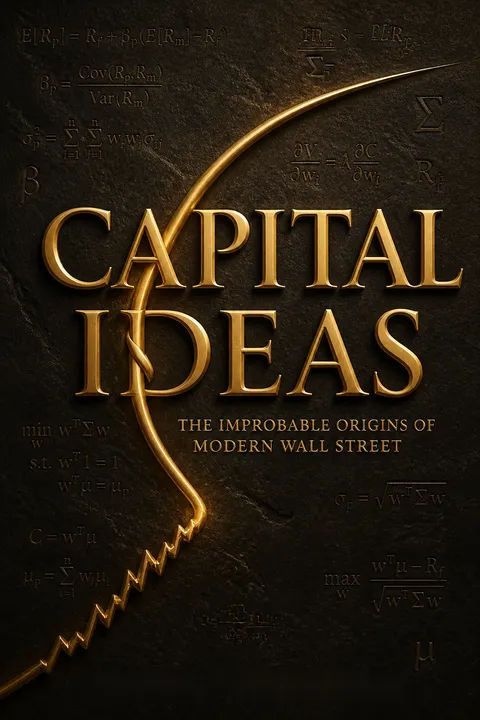


Key Takeaways
Assume stock forecasts are hard to monetize, even when they sound persuasive
A century-old puzzle. In 1900, mathematician Louis Bachelier argued that market prices respond to expectations so quickly that past movements offer little dependable guidance about the next move. A random walk is a sequence of price changes with no reliable pattern that an investor can exploit. Bachelier also found that the range of possible movement expands with the square root of time, not in direct proportion to it.
Evidence beats confidence. In 1933, Alfred Cowles assessed thousands of recommendations and found that advisory services, insurers, and market forecasters generally failed to outperform the market reliably. Later studies by Maurice Kendall and others found price patterns too weak to support dependable trading rules. This does not mean stocks have no long-term return. It means consistent returns above the market are unusually difficult to earn.
What's striking is how the book turns forecasting from a confidence contest into a measurement problem. The same discipline applies beyond finance: predictions should be judged against a clear benchmark and tested on data not used to invent the rule. Yet poor average performance does not prove that every analyst lacks skill. It does shift the burden of proof onto anyone charging for forecasts, especially when transaction costs and taxes can erase a small apparent advantage.
Diversify across different risks, not merely across more ticker symbols
The whole changes the parts. Harry Markowitz's 1952 insight was that a portfolio's risk depends not just on how volatile each holding is, but on how holdings move in relation to one another. Mean-Variance Analysis compares a portfolio's expected return, or mean, with its variability, or variance. The Efficient Frontier is the set of portfolios offering the highest expected return for each risk level, or the lowest risk for each expected return.
Count less, compare more. Fifteen randomly selected stocks, the book notes, can produce volatility only about 5 percent higher than a portfolio of one hundred. But sixty railway stocks would not diversify as well as a mix of railways, utilities, mining, and manufacturing, since companies in one industry can fall together. Trustees who sold an overvalued glamour stock only to buy other Favorite Fifty growth stocks learned that many holdings can still amount to one concentrated bet.
The key advance is relational: risk belongs to the portfolio, not simply to its ingredients. That idea resembles risk pooling in insurance, where many independent losses are easier to absorb than one shared catastrophe. Diversification cannot eliminate broad market declines, and historical correlations can change under stress. Still, it corrects a common mistake: owning many names is not the same as owning many distinct sources of risk.
Choose your risk exposure separately from the assets that carry it
Two decisions, not one. James Tobin's Separation Theorem divides portfolio choice into two tasks. First, select an efficient combination of risky assets. Then decide how much of total wealth to place in that portfolio rather than in cash or other low-risk assets. Tobin showed that, under the model's assumptions, investors can share the same risky portfolio while adjusting their overall exposure to suit their circumstances.
Match exposure to need. A retired person seeking stability can hold more cash or government obligations alongside the risky portfolio. An investor seeking greater exposure can borrow to hold more of it. This differs from tailoring the stock list itself to each person, as if conservative clients should own only supposedly safe stocks and ambitious clients only fast-growing ones. Those narrow lists may be poorly diversified, even when each stock seems to fit the client's personality.
This separation is useful because it distinguishes a preference about risk from a forecast about which company will win. It also clarifies what advice should address: not only a client's temperament, but income, obligations, time horizon, and capacity to absorb losses. The clean result depends on simplified assumptions, including access to borrowing and low transaction costs. In practice, those constraints make the separation a planning principle, not a universal recipe.
Interpret random prices as the market processing news, not as proof of perfection
Competition erases easy clues. Paul Samuelson argued that prices can move unpredictably precisely because investors compete to anticipate future events. When credible news arrives, buyers and sellers act on it, often moving prices before the information becomes obvious to everyone else. Eugene Fama organized tests of market efficiency into weak-form tests of past price patterns, semi-strong tests of public information, and strong-form tests of private advantages.
Efficient is not infallible. The efficient market idea says that available information is reflected in prices enough to make persistent outperformance difficult. It does not say the price is a perfect measure of value, or that every investor is rational. Fischer Black's account of noise trading explains why rumor, hunches, and mistaken interpretations also generate trading. Such activity can push prices away from estimates of value, yet it supplies buyers and sellers and helps keep markets active.
The subtle point is that randomness can be an outcome of intense information processing, not evidence that information is irrelevant. This is close to the idea of a competitive equilibrium: prices coordinate many dispersed judgments without requiring any one participant to know everything. But an efficient market is a conditional claim, not a moral endorsement. Bubbles, unequal information, and noisy judgment remain possible, particularly when trading is costly or investors cannot readily act on what they know.
Value a share through cash it may deliver, not hoped-for resale
A share is a claim on cash. John Burr Williams's Dividend Discount Model values a stock by estimating its future payments to owners and discounting them to present value. Discounting reduces the value of distant payments because they arrive later and are uncertain. The same logic applies to other investments that produce future cash flows. The model is conceptually powerful, but projecting dividends far into the future is difficult, and small changes in assumptions can alter the estimate sharply.
Growth magnifies uncertainty. David Durand used the Petersburg Paradox, a coin-tossing game with theoretically unlimited winnings, to show how implausible it is to value growth as if it continued without limit. Benjamin Graham instead emphasized assets, earnings, dividends, and financial strength, seeking a margin between estimated value and market price. Neither approach removes judgment. One requires forecasts; the other depends on accounting measures that may miss a company's future earning power.
The cash-flow approach disciplines investors by asking what ownership ultimately provides, rather than relying entirely on finding a later buyer. Its weakness is also its strength: explicit assumptions make uncertainty visible, but can create false precision when forecasts are fragile. Graham's emphasis on balance sheets offers a useful counterweight, especially when survival matters more than distant growth. The two methods frame different questions, rather than supplying one infallible valuation.
Demand compensation for market risk, not risks diversification can erase
One risk is unavoidable. The Capital Asset Pricing Model, developed independently by William Sharpe, Jack Treynor, John Lintner, and others, connects expected return to market risk. Beta measures how strongly an asset tends to move with the market. Investors demand a premium over a relatively risk-free return for bearing market-wide fluctuations, and a stock's beta indicates how much market exposure it contributes.
Not every danger earns a premium. Unsystematic risk comes from company-specific or industry-specific events and can be reduced by holding a broad portfolio. The model therefore predicts compensation for systematic risk, not for every risk attached to a single stock. It helped explain why a stock's volatility alone does not determine its expected return, and why a broad market portfolio can be a strong benchmark. The model assumes competitive markets and other ideal conditions, so its estimates are guides, not guarantees.
The distinction resembles the difference between a hazard one person can avoid and a shock shared across an entire system. A diversified investor can dilute the first, but cannot diversify away a market-wide downturn. This provides a useful test for active bets: is the investor being paid for a risk the portfolio must bear, or merely accepting avoidable concentration? Beta is an elegant summary, though any single statistic can hide changing business conditions and correlations.
Treat debt and dividends as claims on value, not value itself
Financing rearranges claims. Franco Modigliani and Merton Miller argued that, in idealized markets, a company's total value depends on its earning power and risk, not on whether it is financed with debt or stock. If two otherwise similar firms are valued differently, arbitrageurs can sell the expensive one and buy the cheaper one, sometimes borrowing personally to reproduce the leverage of the firm. Their trading pushes the discrepancy toward equality.
The assumptions matter. In the model, changing debt or dividends reallocates claims on a firm's income rather than creating new productive value. Debt can increase risk for shareholders because interest must be paid first, but it does not automatically make the underlying business more valuable. Taxes, bankruptcy costs, information gaps, and market frictions can change the result. The theory is useful partly because it identifies those real-world complications that make financing choices matter.
The Modigliani-Miller result is best read as a benchmark: financial packaging alone cannot manufacture operating value in a frictionless market. That benchmark helps separate genuine productivity gains from accounting rearrangements. Real firms face taxes, distress risk, and conflicts between managers, creditors, and shareholders, so capital structure is not irrelevant in practice. The important discipline is to ask which friction a financing choice addresses, rather than assuming that more debt or a different dividend automatically creates wealth.
Use options to reshape risk, but price volatility and liquidity honestly
A right has a price. An option gives its owner the right, but not the obligation, to buy or sell an asset at an agreed price within a set period. Aristotle's story of Thales describes an early call option: he reserved the right to use olive presses, then profited when the harvest created a shortage. In 1973, Fischer Black and Myron Scholes published a formula for valuing options, with Robert Merton helping develop its theory and applications.
Volatility drives the value. The formula uses the underlying asset's price, the exercise price, time remaining, interest rates, and expected volatility. It showed how a carefully balanced position in a stock and an option could produce a nearly risk-free payoff, allowing arbitrage to constrain prices. Contingent Claims Analysis applies option logic to corporate liabilities, treating shareholders' residual claim as a call-like right on company assets. These models make risk tradable, but their results depend on estimates and market conditions.
Options are powerful because they separate a right from an obligation, creating an asymmetric payoff: the buyer can limit a loss while retaining some upside. The same flexibility has a cost, and volatility is central to that price. Replication and arbitrage provide a remarkable bridge from abstract probability to market practice. Yet a formula does not make uncertainty disappear. It can only price uncertainty under specified assumptions, including the ability to trade and hedge when needed.
Turn financial theory into systems, data, and disciplined execution
Institutions made theory usable. At Wells Fargo in the 1960s and 1970s, John McQuown, James Vertin, and William Fouse built computer-based methods around portfolio theory, risk measurement, and performance evaluation. The first index fund began in 1971 with $6 million from Samsonite's pension plan. A later fund tracked the S&P 500. By 1990, indexing had grown into a substantial part of institutional investing, and Wells Fargo had become a model for applying financial research.
Implementation is part of the idea. The team had to measure results fairly, account for transaction costs, and persuade colleagues whose expertise and status were tied to traditional stock picking. Barr Rosenberg's firm, BARRA, developed tools that helped managers estimate risk and combine different managers in a portfolio. The lesson is not that computers automatically improve decisions. Better data, usable models, organizational support, and careful execution had to work together.
The history shows why an elegant theory can sit unread for years: organizations need data, tools, incentives, and people who can translate between mathematical language and daily decisions. That is a lesson in implementation science as much as finance. Indexing also makes performance comparison harder to evade, which changes institutional accountability. Quantification can sharpen discipline, but it can also encourage overconfidence if users mistake a model's precision for certainty about its inputs.
Portfolio insurance worked until the market stopped supplying buyers
Protection depended on trading. In the 1970s, Hayne Leland devised portfolio insurance, a strategy that shifted assets between stocks and cash to protect a portfolio below a chosen floor while retaining some upside. Futures contracts later made those shifts cheaper than trading hundreds of stocks individually. The strategy was a synthetic put option: it aimed to imitate protection without requiring a conventional option contract.
Liquidity was the hidden condition. On October 19, 1987, the Dow fell 23 percent and 604 million shares traded. Many investors sought to sell at once, buyers retreated, and prices in stock and futures markets diverged. Insurance strategies added selling pressure, but panic, stop-loss orders, and market infrastructure also mattered. The promised protection was difficult to deliver at modeled prices when there were too few willing buyers. The episode exposed an execution risk, not simply a flaw in the mathematics.
Portfolio insurance illustrates a broad problem in risk management: a strategy that assumes assets can be sold at a given price may fail precisely when everyone wants to sell. This is a form of model risk, where the map omits how behavior changes under stress. The episode also cautions against assigning a single cause to a market crash. A mechanism can amplify a decline without creating all the conditions that made the decline possible.
Protect liquid markets because they make dispersed investment and ownership possible
Markets connect savings to production. A stock exchange lets investors buy small pieces of many companies and sell them without negotiating an entire business sale. That liquidity makes diversification practical, helps investors compare companies, and gives businesses a way to raise capital. The book argues that markets therefore affect more than traders: prices influence corporate decisions and help direct resources toward or away from enterprises.
Use the machinery with judgment. The financial revolution expanded investment choices, risk-management tools, and access to global markets. Those changes also brought speculation, excessive leverage, unequal information, and episodes of disorder. The book's defense of markets is not that they are fair or always right, but that alternatives such as centralized allocation have their own costs. Its story of new stock exchanges opening in former socialist economies underscores how closely market institutions are tied to the transition toward private investment and ownership.
The book's strongest social claim is that liquidity and diversification enable ordinary savings to support enterprises without requiring each saver to own or manage a whole company. That is a powerful account of markets as infrastructure, not just a casino. But prices are signals, not verdicts on social worth. The argument for functioning markets is strongest when paired with safeguards against fraud, manipulation, and systemic fragility, rather than treated as a case for leaving every outcome untouched.
Analysis
Capital Ideas is an intellectual history with a practical destination. Its central drama is not a contest between academics and Wall Street, but the slow conversion of abstract concepts into institutions capable of using them. Bachelier's mathematics, Markowitz's portfolio logic, Tobin's separation of risk exposure from asset choice, and Sharpe's pricing of systematic risk initially seemed detached from practice. The 1970s crisis supplied a reason to listen; computers, institutional investors, and translators such as the Wells Fargo team supplied the means.
The book's most durable insight is that risk cannot be evaluated one security at a time. A holding matters through its interaction with the rest of a portfolio, while an investor's appropriate risk level depends on circumstances beyond a stock list. This reframes investment management from a search for heroic stock pickers into a problem of portfolio construction, measurement, and execution. It also explains why theory could influence corporate finance, derivatives, and pension management, not merely security selection.
The narrative is persuasive because it gives ideas human origins: Markowitz finds a research problem in a library; Sharpe unsettles Bernstein over whether managers beat the market; Leland invents portfolio insurance after a sleepless night. These scenes make technical shifts memorable without pretending that a theorem instantly changes behavior. The book also usefully distinguishes a model's insight from its assumptions. Modigliani-Miller clarifies what financing cannot do by itself; the 1987 crash shows what a hedging strategy cannot guarantee when liquidity disappears.
Its optimism about competitive markets needs careful reading. Evidence that informed investors make persistent outperformance difficult does not mean prices are socially optimal, nor that market access is equal. A price can coordinate decisions while reflecting short horizons, noise, or unpriced social costs. The book is best treated as a guide to how modern finance reasons, not as proof that every innovation improves welfare. Its deeper achievement is methodological: quantify risk, test performance, expose assumptions, and distinguish a good model from a good outcome.
Review Summary
Capital Ideas is widely regarded as a comprehensive history of modern finance theories. Readers appreciate Bernstein's accessible explanations of complex concepts and biographical details of key figures. The book covers efficient markets, portfolio theory, and other fundamental ideas that shaped Wall Street. While some find it dated or overly supportive of market fundamentalism, many consider it essential reading for understanding financial theory development. Critics note it could be more concise and critically examine potential drawbacks of these theories.
Glossary
Random walk
unpredictable price changesA model in which successive price changes contain no dependable pattern that can be used to forecast the next change. The idea does not mean prices stay still, or that investors earn no return over time. It means that past movements alone provide little reliable basis for consistently beating the market.
Mean-Variance Analysis
return-risk comparisonA method for comparing portfolios by their expected return, or mean, and their variability, or variance. Developed by Harry Markowitz, it treats risk and expected gain as joint considerations and emphasizes how assets move in relation to one another. The goal is to identify portfolios that offer the best available return for a chosen level of risk.
Efficient Frontier
best risk-return portfoliosThe set of portfolios that are not dominated by another available portfolio. Each point offers either the highest expected return for its level of risk or the lowest risk for its expected return. Investors can choose among these combinations according to their circumstances and willingness to bear uncertainty.
Separation Theorem
separates risk decisionsJames Tobin's result that, under the model's assumptions, investors can separate the choice of an efficient portfolio of risky assets from the choice of how much wealth to place in risky assets rather than cash or another risk-free asset. Different investors can therefore share the same risky portfolio while choosing different overall exposures.
Efficient market
prices absorb informationA market in which available information is reflected in prices quickly enough that trading strategies based on that information do not reliably earn excess returns. The concept does not require perfect rationality or guarantee that prices equal an unknowable true value. It describes the difficulty of consistently outperforming other informed participants.
Capital Asset Pricing Model
prices systematic riskA theory linking an asset's expected return to its exposure to market-wide risk. That exposure is measured by beta, the asset's tendency to move with the market. The model predicts that investors should receive compensation for systematic risk that cannot be diversified away, rather than for risks unique to a company that a broad portfolio can reduce.
MM theory
financing does not create valueThe Modigliani-Miller propositions hold that, under idealized market conditions, a company's total value depends on its underlying earning power and risk, not on how its financing is divided between debt and equity. Taxes, transaction costs, bankruptcy risk, and information gaps can alter the result. The theory's value is partly in clarifying how such real-world frictions matter.
Black-Scholes formula
estimates option valueA mathematical method for valuing an option using the underlying asset price, exercise price, time to expiration, interest rate, and expected volatility. Developed by Fischer Black and Myron Scholes, with Robert Merton's related work, it relies on the ability to construct and adjust a hedge. In practice, it is also used to infer the volatility implied by an option's market price.
Portfolio insurance
dynamic downside protectionA strategy designed to protect a portfolio below a chosen minimum value by shifting between risky assets and cash as market prices change. It aims to reproduce the payoff of a put option through repeated trading rather than a single contract. Its effectiveness depends on being able to trade in sufficient volume at prices close to those assumed by the strategy.
Contingent Claims Analysis
values conditional financial claimsAn approach that uses option theory to value financial claims whose payoff depends on future conditions. In corporate finance, it treats shareholders' residual claim on company assets as similar to a call option, since creditors have prior claims and shareholders receive what remains. The framework helps analyze how debt, risk, and asset values shape security prices.
FAQ
1. What is Capital Ideas: The Improbable Origins of Modern Wall Street by Peter L. Bernstein about?
- Comprehensive history of finance: The book traces the intellectual revolution that transformed Wall Street, focusing on how academic theories about risk, return, and market behavior became the foundation of modern investing.
- Key figures and ideas: Bernstein profiles pioneers like Markowitz, Sharpe, Fama, Samuelson, Modigliani, and Miller, showing how their work shaped portfolio theory, asset pricing, and market efficiency.
- Theory meets practice: The narrative explains how abstract financial models were adopted by practitioners, leading to innovations like index funds, options, and portfolio insurance.
- Impact on markets: The book explores how these ideas changed investment management, corporate finance, and the behavior of financial markets worldwide.
2. Why should I read Capital Ideas by Peter L. Bernstein?
- Understand modern finance: The book provides essential background on the theories and tools that underpin today’s investment strategies and financial markets.
- Meet the innovators: Readers gain insight into the personal stories and intellectual battles of the academics who revolutionized Wall Street.
- Bridge theory and practice: Bernstein explains how complex models became practical tools, demystifying concepts like diversification, risk measurement, and market efficiency.
- Practical relevance: The book helps investors, finance professionals, and students appreciate both the power and limitations of financial innovation.
3. What are the key takeaways from Capital Ideas by Peter L. Bernstein?
- Revolution in finance: Modern financial theory, especially around risk and diversification, fundamentally changed how investments are managed.
- Role of academic research: The transition from intuition-based investing to systematic, quantitative approaches was driven by academic breakthroughs.
- Practical transformation: Innovations like index funds, option pricing, and risk measurement tools emerged directly from these theories.
- Ongoing challenges: The book also highlights the resistance, controversies, and limitations faced in applying these models to real-world markets.
4. What are the most important concepts introduced in Capital Ideas by Peter L. Bernstein?
- Portfolio theory and diversification: Markowitz’s mean-variance analysis and the efficient frontier guide optimal portfolio construction.
- Capital Asset Pricing Model (CAPM): Sharpe’s model links expected returns to market risk (beta), shaping asset pricing and performance evaluation.
- Efficient Market Hypothesis (EMH): Fama’s theory asserts that markets quickly incorporate all available information, challenging active management.
- Option pricing and risk management: The Black-Scholes formula and portfolio insurance strategies revolutionized derivatives and risk control.
5. How did Harry Markowitz’s portfolio selection theory change investing, according to Capital Ideas?
- Risk-return trade-off: Markowitz introduced the idea that investors should balance expected return against risk, measured as variance.
- Formal diversification: He mathematically demonstrated that combining assets with low covariance reduces overall portfolio risk.
- Efficient frontier: Markowitz’s efficient frontier concept helps investors select portfolios that maximize return for a given level of risk.
- Lasting impact: Initially overlooked, his work became the foundation of modern portfolio management and earned him a Nobel Prize.
6. What is the Capital Asset Pricing Model (CAPM) and why is it significant in Capital Ideas by Peter L. Bernstein?
- Risk and return relationship: CAPM predicts that an asset’s expected return depends on its sensitivity (beta) to market movements, not on its unique risks.
- Market portfolio as benchmark: The model asserts that the market portfolio is the optimal risky portfolio for all investors.
- Practical applications: CAPM underpins asset pricing, portfolio construction, and performance measurement in both academia and industry.
- Influence on finance: Its simplicity and explanatory power made CAPM a cornerstone of modern financial theory and practice.
7. How does Capital Ideas by Peter L. Bernstein explain the Efficient Market Hypothesis (EMH)?
- Definition and forms: EMH, developed by Eugene Fama, posits that stock prices fully reflect all available information, making it impossible to consistently outperform the market.
- Empirical evidence: Studies show that past prices, public news, and even insider information are quickly incorporated into prices.
- Implications for investors: EMH supports passive investing and questions the value of active management and technical analysis.
- Acknowledged limitations: The book discusses market anomalies and exceptions but maintains that markets are generally efficient.
8. What is the "Interior Decorator Fallacy" and how does it relate to investment advice in Capital Ideas by Peter L. Bernstein?
- Fallacy definition: The "Interior Decorator Fallacy" is the mistaken belief that each investor’s portfolio must be uniquely tailored, leading to unnecessary complexity.
- Tobin’s Separation Theorem: James Tobin showed that all investors should hold the same mix of risky assets (the market portfolio) and adjust risk by varying allocations to risk-free assets.
- Practical implications: This insight simplifies portfolio construction and challenges the need for radically different portfolios for each client.
- Relevance for advisors: Recognizing this fallacy helps focus on asset allocation rather than on creating unique stock lists for every investor.
9. How did Modigliani and Miller’s theories on capital structure and dividends influence finance, as described in Capital Ideas by Peter L. Bernstein?
- Capital structure irrelevance: Modigliani and Miller (MM) showed that, under perfect markets, a firm’s value is independent of its mix of debt and equity.
- Arbitrage logic: Their use of arbitrage arguments and the Law of One Price made their theory robust and influential.
- Dividend irrelevance: MM also argued that dividend policy does not affect firm value, focusing attention on total earnings and risk.
- Practical adjustments: Later work incorporated taxes, showing that real-world factors like interest deductibility can make capital structure relevant.
10. How did the Black-Scholes option pricing model revolutionize derivatives, according to Capital Ideas by Peter L. Bernstein?
- Solving the option valuation problem: Black and Scholes applied CAPM concepts to derive a formula for pricing options, showing that risk and expected return cancel out in the calculation.
- Closed-form solution: Their model provided a practical, systematic way to value options, making options trading more accessible and transparent.
- Industry impact: The formula became a standard tool for traders, risk managers, and corporate finance professionals.
- Further developments: Robert Merton extended the theory, and the model’s adoption coincided with the growth of options markets.
11. What role did Wells Fargo play in bringing academic finance theories into real-world investing, as described in Capital Ideas by Peter L. Bernstein?
- Early adoption of theory: Wells Fargo’s trust department embraced modern portfolio theory and quantitative methods in the 1960s and 1970s.
- Collaboration with academics: The bank worked with scholars like Black, Scholes, and Rosenberg to integrate cutting-edge research into investment processes.
- Innovation in index funds: Wells Fargo pioneered index funds and systematic portfolio management, influencing the broader investment industry.
- Market impact: Their efforts transformed institutional investing and demonstrated the practical value of academic finance.
12. What were the main challenges and controversies in adopting modern financial theories, according to Capital Ideas by Peter L. Bernstein?
- Resistance from practitioners: Traditional managers and analysts were skeptical of quantitative methods, fearing loss of expertise and control.
- Model limitations: Theories like CAPM and Black-Scholes rely on assumptions (e.g., perfect markets, no taxes) that don’t always hold in reality.
- Market events: Crises like the 1987 crash exposed vulnerabilities in models such as portfolio insurance and highlighted the importance of market liquidity.
- Ongoing debates: Despite widespread adoption, debates continue over the applicability and realism of financial models in complex, real-world markets.
About the Author
Other books by Peter L. Bernstein


Download PDF
Download EPUB
.epub digital book format is ideal for reading ebooks on phones, tablets, and e-readers.








