

Key Takeaways
Defend individual rights as capitalism's premise, not a side benefit
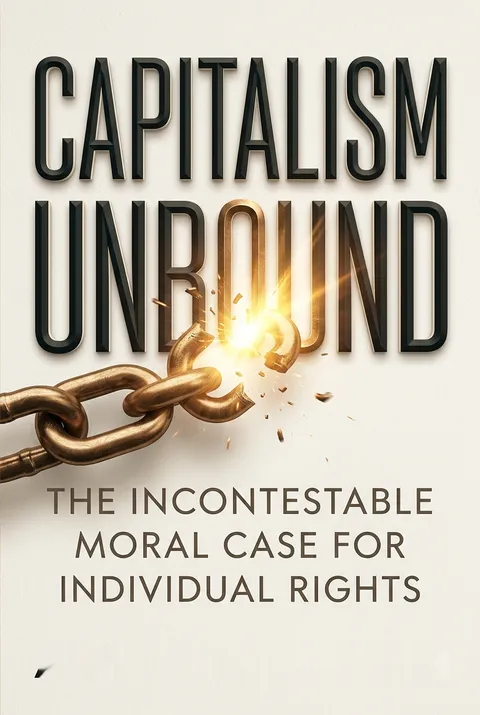
Rights come first. Bernstein defines capitalism not simply as private business, but as a system that protects each person's right to life, liberty, property, and peaceful choice. He traces this ideal to the American Revolution and the Constitution, whose checks and balances were designed to restrain government power. He assigns government a narrow role: protect people from force and fraud through criminal justice, civil courts, and national defense.
The founding was incomplete. The book acknowledges that American institutions tolerated slavery and later expanded government intervention. Its argument is that these are violations of the rights principle, not evidence against it. For Bernstein, freedom means being protected from coercion by private individuals and by the state.
The book's strongest move is to make rights the standard by which economic arrangements are judged, rather than treating prosperity as the only measure. That brings questions of consent and power into economic debate. Yet rights require institutions capable of defining and enforcing them, including courts and public authority. The difficult question is not whether government can coerce, but which uses of coercion protect equal freedom and which undermine it. Bernstein offers a clear boundary, but readers still need to consider how that boundary handles harms that are indirect, cumulative, or difficult to attribute.
Measure industrialization against the poverty it inherited, not today's comfort
The baseline was brutal. Bernstein challenges accounts of preindustrial life as a lost era of worker independence and comfort. He describes recurring famine, unsafe water, epidemic disease, and life expectancy in Britain of about 34 years in 1761. The book cites estimates that between 1781 and 1851, real wages rose by more than 60 percent for farm workers, 86 percent for blue-collar workers, and 140 percent across workers overall. British life expectancy reached about 41 years by 1871.
Mass production changed access. Mechanized textile production sharply expanded clothing supply. Bernstein cites cotton cloth prices in the early 1860s at less than one percent of their 1784 level. His point is that early factory conditions must be compared with the poverty that preceded them, not with later standards of comfort.
The comparison forces a useful historical question: better than what? Industrialization expanded access to goods that had once been scarce, and real-wage measures help make that change visible. But averages cannot capture every worker's experience, and rising output does not erase hazardous workplaces, crowding, or unequal gains. The author's numbers support a strong claim about long-run material improvement, not a claim that every transition was humane or that markets alone produced every improvement. Keeping those conclusions distinct makes the historical argument more persuasive.
Free minds turn invention into affordable goods at mass scale
Ideas became machinery. Bernstein presents the Scottish Enlightenment and the Lunar Society of Birmingham as a chain linking science, engineering, and business. James Watt improved the steam engine, while Matthew Boulton helped manufacture and sell it. Their engine powered textile production, contributing to a dramatic rise in output. Elsewhere, John McCormick's reaper and George Stephenson's locomotives helped increase agricultural output and speed transport.
America extended the pattern. Bernstein calls the late nineteenth century the Inventive Period. He describes Edison, Bell, Carnegie, Rockefeller, and the Wright brothers as innovators who turned technical knowledge into products and infrastructure. His central claim is that legal freedom to think, experiment, invest, and compete lets inventions spread beyond the workshop and become goods ordinary people can afford.
The examples make innovation look less like a lone flash of genius and more like a connected system: research, skilled labor, investment, manufacturing, and customers all matter. That is a valuable corrective to accounts that credit either inventors alone or impersonal economic forces. The book sometimes gives political freedom nearly all the causal credit. Education, scientific institutions, transport networks, and accumulated knowledge also shaped these breakthroughs. Freedom may enable invention, but the route from an idea to widespread benefit depends on many supporting conditions.
Pursue your values without making other people pay their price
Self-interest is not predation. Drawing on Ayn Rand, Bernstein uses egoism to mean pursuing one's considered values, not exploiting others. Values are the people, activities, and goals a person judges worth acting to gain or keep. A student working toward a career, or a person exercising to preserve health, gives up some immediate pleasures but is not necessarily making a sacrifice: the effort serves something valued more highly.
Sacrifice has a narrower meaning. In the book, sacrifice means surrendering a greater value for a lesser one. A parent spending money on a child's needs instead of a new car is not sacrificing if the child's well-being matters more. Bernstein argues that human needs make values objective in an important sense: choices can support or damage the conditions of human life.
This distinction helps separate self-respect from selfish caricature. It also explains why short-term discomfort can serve a person's deeper interests without becoming self-denial. The harder question is how to judge values when people disagree or when a person's choices harm themselves over time. Bernstein appeals to human life as the standard, but applying that standard requires interpretation, not just assertion. His account is most compelling when it rejects coercive sacrifice while leaving room for people to choose demanding commitments, including care for others, as central values.
Make kindness voluntary, so care strengthens rather than corrodes relationships
Help can benefit both. Bernstein argues that benevolence need not require self-erasure. A doctor may find meaning and income in treating patients; a business can earn profit while providing useful products and employment. In these cases, the giver's success and another person's benefit can coexist. He contends that voluntary help is more genuine when the helper chooses it because the recipient matters to them.
Charity has a historical example. The book cites private philanthropy in the United States at 1.67 percent of GDP in 2005, more than twice the share reported for the next country, Great Britain. Bernstein sees this as evidence that a society built around individual choice can also support generosity. His objection is not to helping people, but to making self-sacrifice an enforced moral duty.
The distinction between chosen care and compelled giving is morally useful: affection can become strained when help is demanded as proof of virtue. The account also captures how cooperation can create mutual gains, a theme shared with research on reciprocal relationships and prosocial behavior. Still, not all valuable care is easily reciprocal, and people may have ethical duties to strangers even without personal affection or immediate benefit. The book makes a forceful case against coercion, but its argument does not by itself settle how communities should respond when voluntary support falls short.
Use prices and local judgment where central planners lack lived knowledge
Planning needs information. Bernstein argues that economic planning happens throughout society whenever workers, firms, and customers decide what to make, buy, save, or invest. A central plan excludes most people from those decisions and cannot know their changing preferences in detail. In a market, prices convey information about scarcity and demand, helping producers decide what to supply.
The Soviet example tests the theory. The book describes persistent shortages in the former Soviet Union, including rationed meat and sugar in 1989 and limited access to hot running water. Bernstein argues that without private ownership and meaningful prices, planners could not coordinate production well. In his view, the more decisions are centralized, the less knowledge and initiative are available to solve practical problems.
This is a powerful version of the knowledge problem: no office can collect every local fact or changing preference in real time. Prices compress some of that information into signals that businesses and consumers can respond to. But markets do not automatically account for every cost, such as pollution, or provide every public good. Those gaps invite debate about collective action, not a blank cheque for central control. Bernstein's critique is strongest against comprehensive planning, and less conclusive as a rejection of every limited public intervention.
Ask whether government created the monopoly it claims to cure
Legal privilege can block rivals. Bernstein's example is California's Central Pacific Railroad, whose political connections helped secure legal barriers against competing lines. He argues that those barriers, rather than open competition, enabled high rates and abusive practices. By contrast, he describes Edward Harriman's renovation of the Union Pacific, which lacked the same protected position, as an example of efficiency accompanied by lower freight rates.
The argument extends to labor. Bernstein supports workers' freedom to organize, but also employers' freedom to hire nonunion workers and negotiate individually. He argues that government-backed limits on hiring and bargaining can exclude workers and reduce jobs. His proposed test is whether a law protects people from force and fraud or gives one group power to prevent peaceful competitors from entering.
Regulatory capture is a genuine institutional risk: firms may seek rules that protect them from competitors, even when those rules are presented as public protection. Bernstein's railroad case makes that danger concrete. Yet competition is not always fair or effective, and workers can face employers with much greater bargaining power. The key distinction is between voluntary collective action and coercive exclusion, but real labor law often tries to balance both. The book usefully asks who benefits from regulation, though its account gives less attention to why workers organize in the first place.
Trace economic crises through policy choices, not slogans about markets
Rules can amplify risk. Bernstein attributes the Great Depression's depth and duration to policies including the Smoot-Hawley tariff, restrictions on bank branching, Federal Reserve decisions, and New Deal controls. He also treats the housing collapse as a policy failure: land-use restrictions limited construction in some areas, while federal pressure to broaden mortgage access and government-backed mortgage firms helped spread risky lending.
Incentives matter. The book's general claim is that policy can distort prices, encourage decisions that would not survive ordinary risk, and distribute losses beyond those who made the choices. Bernstein argues that blaming markets alone misses those mechanisms. His account treats the housing crisis and depression as failures of a mixed economy, not as evidence that unregulated capitalism failed.
Following incentives is more useful than assigning blame by label. Tariffs, lending rules, monetary policy, and land restrictions can all shape behavior, sometimes in unintended ways. But Bernstein's explanations are unusually one-sided: economic historians debate the relative weight of monetary contraction, financial fragility, private risk-taking, and policy errors in the Depression and housing crisis. Showing that government affected outcomes does not establish that it was the sole or primary cause. The strongest lesson is to examine specific mechanisms and evidence before using a crisis to vindicate an entire system.
Let migration test which system people choose when exit is real
Freedom as an experiment. Bernstein proposes a global comparison: let each country choose its economic system, remove barriers to peaceful emigration, and study where people move and how their lives fare. His prediction is that migration, skilled workers, and measures of happiness would favor the freest society. The proposal is meant to shift the argument from abstract promises to observable choices.
The experiment has limits. The book presents this as a thought experiment, not a policy likely to be adopted. It also expects migration to reveal a strong preference for freedom and prosperity. Its larger point is that people should be able to choose the political environment in which they live, rather than being treated as instruments of a national economic plan.
The proposal gives individual choice a vivid empirical role: migration can reveal what people value when they have options. It also recognizes that political systems should be judged by the lives people can build within them. Yet migration would not cleanly isolate the effects of one system. People move for family, safety, language, and opportunity, while those able to leave are not a random sample of the population. The thought experiment is therefore better as a moral test of exit rights than as a controlled economic study.
Analysis
Bernstein builds a moral argument through economic history. His central move is definitional as well as political: capitalism means a system of individual rights, not merely an economy containing private firms. That lets him interpret industrialization, innovation, and personal choice as consequences of a single principle. The narrative of Watt, Boulton, and the American inventors gives the thesis memorable human scale, while the contrast with preindustrial poverty stresses that mass production altered the material possibilities of ordinary life.
The book's strongest insights are the importance of incentives, the knowledge limits of central planning, and the danger that regulation can be captured by established interests. Its distinction between self-interest and exploitation also clarifies that voluntary cooperation can serve both parties. These arguments are most persuasive when they identify mechanisms rather than treating political labels as explanations.
The main weakness is the tendency to make the empirical record confirm a tightly closed moral framework. If capitalism is defined as a system that never initiates coercion, then coercive business privileges count as noncapitalist by definition. That is conceptually consistent, but it makes historical comparison harder: real economies mix markets, public institutions, and unequal power. The book also attributes broad crises primarily to government, while giving less room to private misjudgment, systemic risk, or cases where collective rules address harms markets do not price.
Its moral case and its economic case should therefore be evaluated separately. The claim that people deserve substantial freedom is a normative argument; statistics on wages, prices, or crises cannot prove it by themselves. Conversely, the value of individual rights does not establish that every market outcome is efficient or fair. A careful reader can retain the book's insistence on consent, innovation, and scrutiny of state power while testing its causal claims against competing evidence. That distinction preserves the force of its thesis without mistaking conviction for proof.
Review Summary
Capitalism Unbound receives mostly positive reviews, with readers praising its concise arguments for capitalism and individual rights. Some appreciate its moral stance and historical examples. Critics find it overly strident and unconvincing, comparing it to Ayn Rand's style. Readers value its defense of capitalism but note copyediting issues. The book is seen as important and timely, inspiring further exploration of capitalist ideas. Overall, it's viewed as a condensed, passionate argument for laissez-faire capitalism, despite some reservations about its approach.
Glossary
Individual rights
Protected personal freedomsFor Bernstein, individual rights are moral claims belonging to each person, including rights to life, liberty, property, and peaceful pursuit of personal goals. They are protections against force and fraud by other individuals and by government. The author treats this principle as capitalism's foundation and argues that legitimate government exists to protect, not override, these rights.
Capitalism
Private ownership with rightsBernstein uses capitalism to mean a political and economic system in which property is privately owned and individual rights are protected, including the right to produce and trade voluntarily. This is a stricter definition than simply describing an economy with businesses and markets. He distinguishes his ideal of laissez-faire capitalism from mixed economies that combine private enterprise with government controls.
Statism
Individual subordination to stateStatism is the principle that individuals are subordinate to the state and may be compelled to serve collective purposes. Bernstein uses the term broadly for political systems that permit government to initiate force against peaceful people. He treats feudalism, totalitarian regimes, and welfare-state policies as differing forms or degrees of this rejection of individual rights.
Egoism
Pursuit of one's valuesEgoism, in Bernstein's use of Ayn Rand's ethics, means pursuing one's considered, life-supporting values through one's own choices and effort. It does not mean exploiting others for immediate gain. The individual is responsible for choosing goals and acting to achieve them, while respecting other people's equal right to pursue their own values.
Altruism
Duty of self-sacrificeBernstein uses altruism to describe a moral code that treats self-sacrifice and service to others as central virtues. He argues that when this code is applied politically, it supports the claim that individuals owe unchosen service to society and that government may compel it. He distinguishes this doctrine from voluntary generosity, which he considers compatible with egoism.
Values
Chosen life-supporting aimsValues are the people, objects, relationships, and goals a person considers important enough to act to gain or keep. Bernstein, following Rand, connects value to life: a value supports the conditions of human survival or flourishing. He distinguishes values from mere wishes and argues that people must choose and pursue them through rational action.
Mixed economy
Markets combined with controlsA mixed economy combines private ownership and market exchange with government intervention in economic life. Bernstein sees it as an unstable mixture of freedom and coercion: market activity can create wealth, while controls may restrict rights, distort incentives, or protect favored groups. He classifies modern Western economies, including the United States, as mixed rather than fully capitalist.
Great Disconnect
Economic success, moral rejectionThe Great Disconnect is Bernstein's name for the gap between capitalism's material achievements and the negative moral judgment it often receives from intellectuals and moralists. He attributes the gap to an altruistic ethic that regards self-interest with suspicion. As a result, he argues, critics may overlook capitalism's role in innovation, rising living standards, and voluntary cooperation.
Coercive monopoly
Government-protected market exclusionA coercive monopoly is a business or organization able to exclude competitors through government privilege, regulation, subsidy, or franchise rather than by winning customers in open competition. Bernstein argues that legal barriers to entry allow such organizations to impose terms that a market exposed to competition would constrain. He applies the concept to both businesses and labor unions.
Inventive Period
Late nineteenth-century innovationThe Inventive Period is Bernstein's name for the late nineteenth-century United States, especially the years after the Civil War and before the rise of stronger Progressive regulation. He presents it as a particularly free era marked by inventions, industrial expansion, and rising living standards. The label is meant to replace the more critical description of the period as the Gilded Age.
Productive Geniuses
Creators of material wealthBernstein uses Productive Geniuses for inventors, entrepreneurs, and industrialists whose knowledge and judgment create useful goods and services. He argues that people such as Carnegie and Rockefeller should be understood not simply as accumulators of wealth, but as creators of wealth that benefits consumers and workers. The term recasts productive achievement as a moral and intellectual contribution.
Download PDF
Download EPUB
.epub digital book format is ideal for reading ebooks on phones, tablets, and e-readers.








