

Plot Summary
The Tower at Tim's Door
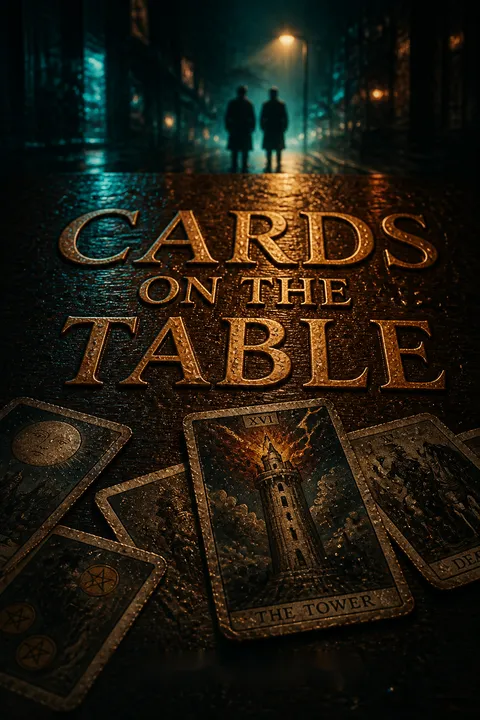
Tim North, a former reporter writing a book about Eva Aldrich, finds a Tarot card tucked beneath the number on his apartment door. The Tower shows a falling couple and a structure struck by lightning, but Tim cannot tell whether it is a threat, a clue, or a prank.
Eva, a young actress, was stabbed at a Hollywood party in 1957; The Lovers card was left on her body, and her killer was never identified. Tim takes the new card to Jack Brady, his neighbor, a homicide detective, and a man with whom he once had a brief affair. Jack agrees to check the cold case and keep the card, giving Tim a reason to reopen contact he has tried to avoid.
The card makes Tim’s work suddenly personal, but its meaning remains unstable: warning and invitation occupy the same small rectangle. That uncertainty suits a mystery built on public versions of a private past. Tim has already chosen to investigate Eva, yet he still hopes research will remain orderly, something he can manage at a desk. His return to Jack exposes another kind of unfinished business. He seeks professional protection, but the request carries the emotional risk of approaching someone who once withdrew. The case begins by collapsing the distance between Tim’s work, his safety, and his desire for connection.
A Warning in the Laundry
In the apartment laundry room, a man shuts Tim inside the dark and shoves him down the stairs after warning him to stop investigating Eva. Tim escapes with bruises but no useful description of his attacker, so the police can do little. Jack visits, advises him to change his routines, and admits he has found an earlier parallel: crime reporter Raymond Irvine was researching Eva in 1963 when someone forced his car off Mulholland Drive.
No link was proved, but Irvine’s death changes the stakes. Tim now has reason to believe that the danger did not begin with his book. He keeps investigating, then disregards Jack’s warning and takes a shortcut home, where Jack tells him that a detective kept a private file on Eva’s case.
The assault converts an old murder from material for Tim’s book into an active threat, while Irvine’s fate suggests that the danger may recur whenever someone tries to make the story legible. Tim’s response is not simply bravery. He is also stubborn about preserving control over his work and routines, even when that control is partly an illusion. Jack’s advice reveals how carefully he has observed Tim’s habits, blending police vigilance with a lingering personal attentiveness. Yet the two men do not communicate easily: Jack offers practical protection, while Tim hears the distance between them as rejection. The investigation advances through a threat and a relationship wound at once.
Hollywood's Witnesses Remember
Eva’s former friend, actress Gloria Rayner, tells Tim that Eva wanted to see her costar Stephen Ball on the night she died, despite having recently ended her engagement to gangster Tony Fumagalli.
Gloria still believes Eva’s ex-husband, William Burack, was responsible, but her evasions leave Tim unsure what she is withholding. At the mansion of astrologer Roman Mayfield, who knew Eva closely, Tim challenges him about the card on his door.
Mayfield acknowledges leaving it, denies that Burack could have killed Eva, and describes Eva with affection rather than the flat glamour of old publicity. Before Tim can press further, an epileptic seizure drops him to the floor. Mayfield stays with him, helps him recover, and sends him home in his limousine.
Gloria and Mayfield offer contrasting forms of memory. Gloria performs her old Hollywood persona, turning difficult questions into jokes and charm; Mayfield treats the past as emotionally charged, even when he filters it through astrology. Neither gives Tim a clean statement of fact, so he must read what each witness avoids as carefully as what each remembers. His seizure interrupts the interview and makes his body, usually concealed behind professional curiosity, impossible to ignore. Mayfield’s patient care unsettles Tim’s assumptions about him, but kindness is not evidence of innocence. The section asks the reader to separate a person’s apparent gentleness from the truth of what that person may know.
Perkins's Private Evidence
After waking from his seizure, Tim confronts Jack about their failed romance and his epilepsy; Jack admits he resented being kept in the dark, but tells him that detective Bud Perkins maintained a private file on Eva.
Tim heads upstairs to see it and is attacked by the same hulking man who pushed him in the laundry room. This time Tim fights back, and Jack tackles the assailant, who draws a gun before escaping. Jack identifies him as professional muscle and later brings out Perkins’s file.
Its notes place Eva’s body inside Ball’s villa, identify a kitchen knife as the weapon, and leave both Ball and Gloria unaccounted for at key moments. The file gives Tim his first substantial new evidence and turns his suspicion toward the people closest to Eva.
Perkins’s unofficial file matters because it preserves uncertainty rather than resolving it. Its gaps, especially the missing witnesses and Ball’s unexplained movements, direct Tim toward new questions; the archive becomes an engine for inquiry, not a verdict. The attack sharpens that distinction. Tim’s punch shows he can resist, but the gun makes clear that courage cannot neutralize hired violence. Jack’s intervention saves him, while their argument over the seizure exposes a more intimate danger: Tim experiences disclosure as surrendering control, and Jack experiences concealment as a breach of trust. Both are partly right, which makes their connection more difficult than a simple reconciliation.
The Lovers Reversed
Police records connect Tim’s attacker to Clyde Wells, an enforcer employed by Frankie Fumagalli, Tony’s son. Tim still cannot prove why the Fumagalli family wants him to stop. Stephen Ball finally agrees to an interview and confirms that he gave Eva a key to his villa, where he found her dead.
He insists that Burack killed her, then names Gloria as his alternative suspect. Ball’s account leaves Tim with a practical puzzle: how did The Lovers card from Mayfield’s deck reach Eva?
After Tim presses him by phone, Ball admits that he stole the card during a reading and slipped it to Eva while they danced. He remembers it lying upside down on her body. Tim recognizes that the reversed card may carry a meaning the original investigation overlooked.
The reversed card is the first clue that changes the shape of the problem rather than merely adding another suspect. Ball’s confession explains the card’s route to Eva, but it also narrows the circle of people who could have known its significance. His polished certainty about Burack and Gloria is less persuasive than the details he reluctantly supplies about his own conduct. Meanwhile, Clyde’s identification gives the intimidation a concrete connection to the Fumagalli organization without proving who ordered it or why. Tim’s method is increasingly interpretive: he joins evidence from a detective’s file, a witness’s memory, and a symbol whose orientation was ignored. The case rewards attention to what earlier investigators treated as decoration.
A Morning on the Grass
After Ball’s interview, Jack seeks Tim out, and they resume their physical relationship. Jack explains that Tim’s secrecy about epilepsy had seemed part of a larger pattern of guardedness, though he still finds him funny, capable, and attractive. The next morning, after they swim together, Tim suffers a seizure beside the pool.
Jack pulls him clear of the water and stays with him while he recovers, then checks on him before leaving for work. Tim assumes the seizure will end whatever has begun between them, but Jack’s presence complicates that fear. Later, Ball returns Tim’s call and confirms the card was upside down. Tim now has a promising new lead, but the episode makes the cost of his daily risks impossible for Jack to ignore.
The pool seizure makes the romance’s central conflict physical rather than theoretical. Tim’s independence is real, but swimming alone carries a risk he cannot control once a seizure begins; Jack’s fear is therefore grounded in what he has just had to do. At the same time, Tim interprets care through the memory of being rejected after his first seizure with Jack. The same act of help can feel like tenderness to one man and a prelude to abandonment to the other. Ball’s call supplies a fresh investigative clue amid this emotional exposure, but the two developments are linked: Tim’s effort to keep moving forward requires him to acknowledge vulnerability without letting it define his worth.
Frankie's Closed Door
Gloria finally explains why Eva broke her engagement to Tony: Eva discovered him wearing women’s clothing and reacted with disgust. Gloria doubts Tony would have killed her to keep the secret quiet, especially after three days had passed.
Soon afterward, Clyde brings Tim to Frankie Fumagalli in a limousine. Frankie denies that his father killed Eva, but demands that Tim abandon the book because the revelation could humiliate his still-living mother.
He insists he cannot control Clyde, leaving the threats unresolved while making the family’s fear plain. On the ride home, Tim studies a 1957 Life photograph of the party and recognizes Mayfield in the pool behind Eva. The image suggests how someone could have washed away the murder weapon’s blood.
The Fumagalli secret supplies a plausible motive for someone to suppress the book, but Gloria’s distinction between motive and timing prevents an easy solution. Frankie’s concern for his mother humanizes the pressure without making his methods acceptable; his denial does not erase the threat, and Tim cannot know whether it is complete. The photograph offers a different kind of evidence, one that has been visible all along but required Tim to ask the right question. Mayfield’s presence near the pool connects a remembered setting to the concealed mechanics of the crime. In this section, family reputation, celebrity image, and forensic absence converge: what people want hidden is not always the same as what they did.
The Last Reading
Tim confronts Mayfield with the photograph and the reversed card. Mayfield admits that he loved Eva, who had just learned Tony’s secret, and that he followed her to Ball’s villa after she mistook his feelings for another kind of betrayal.
During their argument, he stabbed her with a fruit knife, placed his own Tarot card on her body, then returned to the pool and washed the knife before letting it sink into the drain. Now seriously ill, he wants Tim to uncover the truth and leaves the decision to report him to the police in Tim’s hands.
Tim then visits Jack, expecting another rejection. Instead, Jack admits he may be falling in love with him and explains that the pool seizure made him fear Tim would drown. Tim agrees to take his safety seriously, and Jack raises the possibility of a lasting commitment.
Mayfield’s confession does not make the past morally tidy. The man who cared for Tim after a seizure also committed a brutal murder and spent decades withholding the truth. His illness and charity do not cancel his responsibility, and his request that Tim decide what happens next transfers a burden rather than settling it. The title’s card becomes an especially sharp emblem here: a token of love is left reversed, transformed by resentment and violence. Jack and Tim’s resolution answers the novel’s other unanswered question. Love is not proven by rescuing someone once, but by negotiating the habits that make care possible. Tim’s promise to protect himself is an act of agency, not submission.
Analysis
The mystery turns on the difference between a story people repeat and a sequence they can prove. Eva’s ex-husband is an attractive suspect because jealousy is legible, the police once considered him, and later witnesses keep returning to that explanation. Tim’s progress comes from resisting the comfort of a familiar narrative. A private detective’s file, Ball’s recollection of the card, and a party photograph each revise the case without immediately solving it. The Tarot cards sharpen this process: their imagery appears theatrical, but orientation and ownership become evidence. Their symbolic charge also reflects how witnesses make private motives seem fated after the fact.
The novel’s treatment of intimacy runs alongside its investigation. Tim and Jack are drawn together, but neither can simply convert attraction into trust. Tim’s silence about epilepsy protects him from pity and rejection; Jack’s bluntness protects him from emotional uncertainty, though it can wound Tim. The pool seizure exposes the limit of both strategies. Tim cannot guarantee his safety through willpower, and Jack cannot make love meaningful by taking control. Their eventual agreement depends on Tim accepting reasonable precautions while remaining an agent in his own life.
Mayfield’s confession resists a reassuring division between the gentle and the monstrous. He has shown Tim compassion, yet he committed a violent act and concealed it for decades. The confession restores Eva’s death to a human chain of desire, humiliation, anger, and choice, but explanation does not absolve him. Likewise, Frankie’s wish to protect his mother gives his pressure a recognizable motive without excusing the threats. Across both plotlines, the book asks what truth costs when it disrupts the identities people have built around silence. Tim’s answer is not to abandon intimacy or investigation, but to accept that both require risk, discernment, and responsibility.
Review Summary
Cards on the Table is a well-received mystery novella with a 4.03 average rating. Readers praised the engaging plot, classic Hollywood atmosphere, and the romance between Tim and Jack. Many found the characters relatable and the writing stylish. Some criticized the rushed romance and underdeveloped characters, while others felt it was a perfect blend of mystery and love story. Lanyon's trademark style of flawed characters and witty dialogue was appreciated. Overall, fans of the author found it a satisfying, quick read with a compelling cold case mystery.
People Also Read

Characters
Tim North
The guarded investigatorTim is a former reporter whose book about Eva Aldrich draws him into a fifty-year-old murder and a present-day campaign of intimidation. He is observant, dryly funny, and persistent, but his independence can become a refusal to let others see what he needs. A serious accident has left him living with epilepsy, and strained family ties have narrowed his support network. His connection to Jack makes him want closeness even as he protects himself from another rejection. Tim’s investigative strength lies in noticing details that seem incidental, then testing them against what witnesses remember. He is not a fearless hero so much as a man trying to keep doing meaningful work while learning when self-reliance becomes self-endangerment.
Jack Brady
The watchful detectiveJack is a Glendale homicide detective, Tim’s neighbor, and the man with whom Tim once shared a brief relationship. Controlled and practical, he notices patterns in people’s routines and approaches danger through preparation rather than bravado. His professional habits shape his personal life: he is attentive, but can sound judgmental when he is afraid or uncertain. Jack wants to protect Tim without treating him as helpless, a balance complicated by Tim’s health and his own reluctance to enter a serious relationship. His attraction is clear, yet he needs honesty and mutual responsibility before he can trust intimacy. Jack’s steadiness gives Tim a counterweight, though it does not spare either man from difficult conversations.
Roman Mayfield
The celebrity astrologerRoman Mayfield is an aging astrologer known in Hollywood as the Seer to the Stars. He was close to Eva and remains invested in the memory of the people and parties that shaped his youth. His grand surroundings and mystical vocabulary can make him seem theatrical, but he also shows genuine patience and tenderness when Tim becomes ill during an interview. Roman approaches the past through astrology and Tarot, systems that give him a language for emotion and fate. His evasiveness leaves Tim unsure how much is performance and how much is conviction. He is both a keeper of old Hollywood stories and a reminder that witnesses can be affectionate, eccentric, and difficult to read.
Gloria Rayner
Eva's glamorous confidanteGloria Rayner, once a blonde bombshell in Hollywood films, was Eva’s closest friend. Now elderly and surrounded by the luxurious remnants of her former life, she keeps her wit, appetite for attention, and talent for steering a conversation away from discomfort. Gloria remembers Eva with affection, but her loyalty does not make her an uncomplicated witness. She can be candid about the glamour and rivalries of the period while withholding the intimate facts Tim most needs. Her jokes act as both social weapon and shelter, allowing her to control the pace of a conversation. Gloria’s memories are valuable precisely because they are personal, partial, and shaped by the long afterlife of celebrity.
Eva Aldrich
The vanished starletEva Aldrich was a young actress whose death at a Hollywood party left behind a famous unsolved case. In photographs and films she appears beautiful and composed, but the people who knew her describe a more forceful woman: funny, socially magnetic, superstitious, and unwilling to let others choose her attachments. Her short career and early death have made her easy to turn into an image, whether a glamour portrait or a crime-scene victim. Tim’s investigation tries to recover the person beneath those competing stories. Eva matters not only because of what happened to her, but because her relationships with Gloria, Stephen Ball, Tony Fumagalli, and Roman Mayfield reveal how differently people understood her.
Stephen Ball
Eva's former costarStephen Ball is a retired actor who once costarred with Eva in an adventure film and was among the people closest to the night of her death. Tall, wealthy, and accustomed to public attention, he remains protective of his version of the past. He believes Eva’s ex-husband was responsible, yet his own history with her complicates his claims. Ball is proud and guarded, and he dislikes having an old personal tragedy revived for a book. His memories eventually give Tim an important detail about the Tarot card, but they arrive wrapped in defensiveness and self-interest.
Frankie Fumagalli
The guarded heirFrankie Fumagalli inherited his father’s organization and presents himself as a tired, polished businessman rather than a traditional mob boss. He is protective of his mother and acutely aware that family reputation can become a form of power or vulnerability. When Tim’s book threatens to expose a private humiliation, Frankie tries to control what will be published. His manner is restrained until his anger breaks through, suggesting a man who prefers pressure and negotiation but is willing to intimidate. His denials do not make him trustworthy, yet his concern for his mother gives his motives a personal dimension.
Tony Fumagalli
Eva's former fiancéTony Fumagalli was a powerful gangster known to the press as a gentlemanly figure and was once engaged to Eva. His public image and his private life do not neatly align, making him a source of rumor as well as a possible suspect. By the time Tim investigates, Tony is elderly and living with Alzheimer’s disease, beyond the reach of ordinary questioning. His son Frankie remains protective of him, while Gloria remembers the relationship from close range. Tony’s presence in the story shows how a powerful man’s reputation can outlast his ability to speak for himself.
Clyde Wells
The hired enforcerClyde Wells is a large, capable enforcer employed by Frankie Fumagalli. He uses physical intimidation to pressure Tim away from the Aldrich investigation, first attacking him in the apartment complex and later confronting him with a gun. Clyde is not a source of explanation; he is the force that makes the investigation dangerous in practical, immediate ways. His professional confidence contrasts with Tim’s improvised resistance and Jack’s police training. Clyde’s presence also raises a crucial uncertainty: being connected to the Fumagalli organization does not by itself establish who directed each threat.
Callie North
Tim's twin sisterCallie is Tim’s twin sister and the family member most attuned to his moods. She senses when he is struggling, asks after the book and his health, and hopes he might visit their parents. Her concern reflects an emotional bond that survived the family’s conflict over Tim’s sexuality, even as he remains wary of returning home. Callie does not drive the investigation, but her calls remind Tim that he has relationships beyond Jack and the case. She offers a possible route back toward family without pretending that reconciliation will be simple.
William Burack
Eva's ex-husbandWilliam Burack was Eva’s wealthy ex-husband, a businessman whose jealousy and anger made him the popular suspect in her murder. He died years before Tim began investigating, leaving behind an alibi that the police could not disprove and a public reputation that encouraged easy conclusions. Burack’s role in the story is largely mediated through old reports and the memories of others, so the distinction between evidence and inherited suspicion remains important.
Bud Perkins
The cold-case detectiveBud Perkins was one of the original investigators on Eva Aldrich’s case. After the official investigation stalled, he kept a private collection of clippings, photographs, and notes. His file reveals where his suspicions lay and preserves leads that were not prominent in the public record. Perkins never appears in Tim’s present-day investigation, but his habit of keeping unofficial records gives Tim a way to see the case through a detective’s unfinished attention.
Raymond Irvine
The lost reporterRaymond Irvine was a crime reporter who began researching Eva’s murder in 1963 and died after his car was forced off the road. No one proved a connection between his death and the case. His story gives Tim a precedent for danger and raises the possibility that someone has been protecting the old secret for decades.
Plot Devices
The Tarot Cards
Symbols that misdirectThe Tower card left at Tim’s apartment initially resembles a threat, while The Lovers card found with Eva’s body points toward the history of her relationships. The second card’s origin, placement, and reversed orientation become practical clues: Ball had taken it from Mayfield’s deck and given it to Eva, and its meaning changes when turned upside down. Tarot is not simply supernatural decoration. It gives the characters a vocabulary for interpreting desire and betrayal, while its visual details also help Tim reconstruct who handled the card and what happened at the crime scene.
Perkins’s Private File
An unofficial second recordDetective Bud Perkins kept a personal file after Eva’s case went cold. Its clippings, photographs, and handwritten notes preserve questions that did not make it into the public account, including uncertainty about Stephen Ball’s movements and Gloria Rayner’s whereabouts. Jack obtains the file through a retired colleague and Perkins’s widow, giving Tim access to evidence outside the official reports. The file does not name the killer or provide a complete solution. Instead, it redirects Tim toward gaps in the timeline and encourages him to verify old suspicions against living witnesses.
Tim’s Epilepsy
A risk that demands trustTim’s epilepsy shapes both his daily routines and his relationships. Stress, missed meals, and swimming alone can increase danger, while his seizures leave him exhausted and dependent on help afterward. He does not want his condition to define him, so he sometimes withholds information or minimizes risks. Jack, a detective accustomed to assessing danger, sees that secrecy as both a personal barrier and a threat to Tim’s safety. The condition is not merely an obstacle in the mystery: it makes care visible, forces difficult conversations about autonomy, and gives Tim a concrete reason to reconsider what independence should require.
The Life Magazine Photograph
A face inside the pastAn old photograph of the crowded Garden of Allah pool first serves as a record of Hollywood’s party culture. Tim studies it again after learning that the murder weapon was washed and left in the pool. He then notices Roman Mayfield among the swimmers, a face he had missed because Mayfield had hair in the picture. The photograph does not prove guilt by itself, but it links Mayfield to the location and gives Tim a concrete reason to confront him. A familiar archive image becomes evidence only after Tim understands what question to ask.
Download PDF
Download EPUB
.epub digital book format is ideal for reading ebooks on phones, tablets, and e-readers.








