

Key Takeaways
Create investable cash without turning your life into a budgeting contest
Start before investing. The book’s central argument is that many people need a practical way to free up money before they can decide how to invest it. The author traces the idea to a car wash: a friend pointed out that a loyalty program could cover it, prompting the author to look for other low-effort savings. A cheaper home alarm added another $25 a month, and small changes eventually became a repeatable method.
A household example. Eric and Keisha were saving only 2% of their income and disliked budgeting or giving up things they enjoyed. By changing bills and spending habits, they eventually freed up $1,800 a month in the book’s example. The aim is not austerity, but to redirect money that was leaking away.
What's distinctive is the book's focus on the gap between financial intention and available cash. It treats saving as a design problem: change recurring arrangements and defaults rather than demanding constant restraint. That approach can make financial progress feel less like punishment. It also has limits. Some households have little discretionary spending to trim, and lower bills cannot compensate for inadequate income or an unexpected crisis. The method is best understood as a useful layer of financial planning, not a universal fix.
Compare recurring bills instead of accepting each renewal by default
Start with repeat charges. In the book’s opening household story, Keisha compares car insurance after seeing a renewal increase and finds coverage that costs $200 less each month. The couple then applies the same scrutiny to other bills, including phone service, home insurance, entertainment, and memberships. Their additional changes add up to $547 a month, with more possible savings from energy use and property taxes.
Make the review concrete. List regular withdrawals, check whether each service is still needed, compare equivalent coverage, and ask the current provider for a better price. Switching is not automatically wise: check the new provider’s reputation, coverage, fees, and terms before cancelling the old arrangement. The book’s figures are examples, not guaranteed results.
Recurring costs are powerful targets because one decision can affect many future months. This resembles preventive maintenance: a short inspection can catch a leak that would otherwise keep draining resources. Comparing providers can also correct the inertia that keeps customers on outdated plans. The important discipline is to compare like with like. A cheaper insurance premium with weaker protection, or a low-cost service with hidden fees, may not be a real saving. Time spent reviewing bills should be weighed against the value of the change.
Give every dollar saved a job before it disappears into spending
Make the saving visible. The book calls the step of deliberately assigning freed-up money “Savour the Savings.” Its meaning is straightforward: when a bill falls or a payment ends, direct the difference toward a chosen purpose instead of letting it blend into everyday spending. The options include paying down debt, building an emergency fund, investing, or setting aside some money for enjoyment.
Automate the decision. Eric and Keisha put $500 of their new monthly savings toward investments and $47 toward an emergency fund. An automatic transfer makes the choice happen without requiring a fresh act of willpower each payday. The couple’s example also leaves room for fun. The principle is not that every saved dollar must be invested, but that its destination should be intentional.
This is a practical form of precommitment: deciding in advance how money will be used, before competing wants arrive. It also counters mental accounting, the tendency to treat money differently depending on where it seems to come from. A saved bill can feel like a windfall, even though it is simply income no longer being spent. Automation reduces the chance that the windfall is absorbed by routine purchases. However, automatic investing should not leave a household unable to meet near-term bills or emergencies.
Pay off 20% card debt before seeking uncertain investment gains
Compare the rates. Eric and Keisha carry about $6,000 on credit cards charging roughly 20% interest. The book estimates that this balance costs around $1,200 a year in interest. Paying it down avoids that expense, while investment returns are uncertain. The couple uses a $3,000 after-tax bonus to clear one card, then directs $400 a month toward the other until it is paid off.
Keep the sequence clear. Once the card balances are gone, they commit the freed-up $500 each month, including saved interest, to investing. The book presents debt repayment as a way to improve wealth, not as a rival to wealth-building. The right order depends on interest rates, repayment terms, taxes, and the need to keep cash available. High-rate consumer debt generally deserves attention before speculative returns.
The comparison is compelling because avoiding a high interest charge is more predictable than hoping an investment will outperform it. In that sense, debt repayment resembles earning a return equal to the interest avoided, subject to loan terms and fees. The broader lesson is to compare actual rates rather than treating all debt as identical. A low-rate mortgage and a high-rate credit card do not pose the same choice. A household also needs enough liquidity to handle urgent expenses, so eliminating every cash reserve to pay debt can create a costly cycle of borrowing again.
Track what you own minus what you owe, not just income
Measure the whole picture. A Wealth Tracker is the book’s spreadsheet for recording assets, debts, and the difference between them. Eric and Keisha list items such as their home, vehicles, investments, and business, then subtract their mortgage, car loans, and credit card balances. They estimate current values and project how those values and debts may change over time.
Use the number as feedback. Their tracker shows assets rising and debts falling, helping them see progress beyond their monthly paycheques. The book also argues that a negative starting figure is not a reason to stop tracking: paying down debt can improve the number even before savings grow. Estimates are imperfect, especially for homes and businesses, so consistency and direction matter more than pretending the spreadsheet is an exact measure of spendable cash.
A net-worth snapshot can make trade-offs more visible than income alone. A large salary may coexist with heavy debt, while a modest income can support steady asset-building. The tracker also creates feedback, a feature shared by useful monitoring systems in health and education: progress is easier to sustain when it can be observed. Yet the measure should not be mistaken for liquidity. A home’s estimated value cannot necessarily pay next month’s bills, and market values fluctuate. Net worth is a compass, not a bank balance.
Separate bill money from daily spending to prevent overdrafts
Separate the flows. Eric and Keisha repeatedly overdraft their joint chequing account because automatic payments and everyday purchases draw from the same pool. A phone purchase leaves too little for scheduled mortgage and phone bills. Their solution is to use one account for recurring bills and another for daily expenses.
Reduce surprises. They arrange a fixed monthly transfer into the bill account, large enough to cover scheduled payments, while leaving the remainder in the everyday account. This makes upcoming obligations easier to distinguish from money available for discretionary purchases. It also gives the couple a clearer list of recurring bills to review for savings. The system still requires a realistic transfer amount and occasional updates when bills or income change.
The account split functions like a simple envelope system without requiring a detailed monthly budget. It changes the information available at the moment of spending: the everyday account shows a more honest picture of what is available for flexible use. This kind of separation can reduce accidental overspending because it makes obligations harder to overlook. Its usefulness depends on dependable income and careful setup. If bill amounts vary substantially, a buffer may be needed, and extra accounts should not introduce fees or needless complexity.
Search the full household, not only groceries and coffee, for savings
Look beyond small treats. The book’s 60 recipes span housing, transportation, food, household costs, lifestyle, and financial services. Examples include comparing mortgages, lowering utility use, buying a smaller or used vehicle, reducing food waste, reviewing phone plans, using employer benefits, and shopping for lower-cost prescriptions. The range matters because a large bill can offer more leverage than repeatedly trimming a small purchase.
Treat the total cautiously. The author says the recipes together represent more than $13,000 in possible monthly savings, while noting that most readers will not be able to use every idea. The total combines different household situations and examples, so it is not a realistic forecast for one family. Use the recipes as a menu: identify costs that apply, estimate actual savings, and avoid counting overlapping changes twice.
The breadth is a strength: it shifts attention from moralizing about small luxuries to examining the structure of household costs. That is a more useful search strategy when housing, cars, or childcare dominate a family’s expenses. The approach also invites a portfolio mindset, where several modest changes contribute to one goal. The headline total needs restraint, since examples from different households cannot simply be added together. Local prices, access to alternatives, health needs, and family responsibilities shape what is feasible.
Change purchasing defaults instead of making every pleasure forbidden
Replace, do not merely resist. The book favors small changes that preserve the activity while reducing its cost: try generic products, plan grocery purchases, buy frozen foods that would otherwise spoil, pack some lunches, or share an appetizer instead of ordering one each. Its clothing section argues that people often buy items they rarely wear, while its food section cites substantial household waste. The point is to examine what is actually used and enjoyed.
Pause before buying. The book’s questions include whether an item is needed, borrowed, rented, bought used, or available at a better price. These prompts turn a vague intention to “spend less” into a decision process. They are not rules against spending. They help distinguish valued purchases from impulse purchases, forgotten subscriptions, and food or clothing that ends up unused.
Substitution is often more durable than prohibition because it protects the underlying reward. A person who likes meals out may keep the social ritual while changing the frequency or order; someone who enjoys fitness may use a lower-cost class rather than abandon exercise. This is a form of choice architecture, where the available options are adjusted to make a preferred action easier. The caution is that convenience, time, nutrition, and accessibility have real value. The cheapest option is not always the best use of a household’s resources.
Save part of every raise before your lifestyle absorbs it
Capture new cash early. The book’s approach to lifestyle inflation is to decide in advance what share of a raise, inheritance, bonus, or newly finished payment will go toward debt or savings. One example proposes saving 20% of new income while enjoying the rest. Eric and Keisha use part of a raise and bonus to eliminate credit card debt rather than immediately increasing their routine spending.
Look at benefits, too. The financial recipes also urge readers to inspect workplace programs, including employer-matched retirement contributions, stock purchase plans, and health or education benefits. Some benefits may be valuable, but details and tax treatment vary. A second income is another option the book explores, from tutoring to dog walking. The common idea is to notice new resources before they are silently absorbed into a more expensive routine.
A raise can feel like permission to upgrade everything, especially when recurring expenses are easy to expand and hard to reverse. Pre-committing a portion of the increase preserves the improvement in financial capacity while still allowing a reward. The same logic applies to an employer match, which can be overlooked if workers do not understand the plan. The percentage should remain flexible: a household catching up on essential needs may reasonably spend more of a raise, while another may prioritize debt or long-term saving.
Treat 7% growth projections as scenarios, not promises
Compounding changes scale. The book illustrates the potential of redirected monthly savings by projecting what they might grow into if invested over many years. For example, it estimates that investing $200 each month at an assumed 7% annual return for 25 years could produce about $166,400. The point is that a recurring saving is not merely a one-time discount; it can become a repeated contribution.
Respect the assumptions. The projection depends on the return, time horizon, fees, and consistency of contributions. Investment values can fall, and a 7% return is not guaranteed. The book also notes that debt repayment can be an alternative use of the money. Use projections to understand the effect of time and regular contributions, not as a promise about a future account balance.
Compound growth is mathematically persuasive because returns can themselves generate returns, but the path is not smooth. A projection compresses uncertainty into one assumed rate and may omit taxes, inflation, fees, and the timing of market losses. That does not make the illustration useless. It makes it a planning scenario rather than a forecast. The most robust insight is the importance of recurring contributions and time, while the appropriate investment, risk level, and debt priorities depend on each household’s circumstances.
Analysis
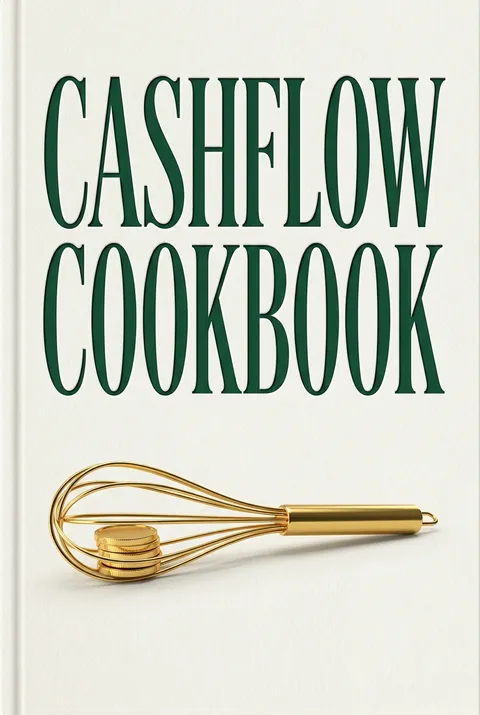
Cashflow Cookbook is a practical personal-finance guide organized around a simple bottleneck: before people can invest more or repay debt faster, they need money available to do so. Its answer is not a detailed budget or a call to renounce enjoyable spending. It asks readers to inspect recurring bills, household routines, and financial services for costs that can be reduced with limited effort. Eric and Keisha’s story gives the method a human arc: a small insurance saving becomes a reason to examine debt, banking, and daily spending, then a new way to picture their financial future.
The book’s strongest contribution is operational. It turns a broad goal, “save more,” into observable tasks: compare a bill, check a service, separate bill payments, or automate a transfer. The recipe format lowers the barrier to starting, while the Wealth Tracker supplies feedback. The approach also wisely looks beyond coffee and snacks to housing, vehicles, childcare, insurance, and workplace benefits, where a single change can matter more.
Its numerical examples are motivational, not forecasts. Many rely on a 7% return, long investment periods, and savings estimates that vary by household. The $13,000 monthly total combines opportunities from different cases and should not be read as a typical result. Some recommendations also depend on location, contracts, eligibility, health, and available time. Comparison shopping can save money, but coverage, reliability, and convenience have value too.
The book is most useful as a diagnostic menu rather than a universal prescription. Readers can choose applicable changes, verify their costs and risks, and direct the resulting cash toward the priority that fits their situation. Its central behavioral insight is durable: make financial improvement easier to repeat by changing the system around spending, not relying entirely on willpower.
Glossary
Broil a Bill
Lower a recurring billThe book’s label for reviewing and reducing a recurring expense. The process may involve checking whether a service is still needed, comparing providers, negotiating with the current provider, using less, or switching. The intended result is a continuing reduction in monthly costs, with appropriate attention to coverage, service quality, and contract terms.
Savour the Savings
Assign freed cash a purposeThe book’s term for deliberately directing money freed by a lower bill or reduced expense. Rather than allowing the amount to disappear into ordinary spending, a person assigns it to a priority such as debt repayment, investing, an emergency fund, charity, or discretionary enjoyment. The emphasis is on making the destination intentional and, where useful, automatic.
Wealth Tracker
Record assets and debtsA spreadsheet or similar record that lists what a household owns and owes, then calculates wealth as assets minus liabilities. The book suggests reviewing the figures over time to see whether assets are growing and debts are declining. Estimates, especially for property or a small business, are approximate and should not be confused with readily available cash.
Light Serving
Smaller household exampleThe book’s label for a lower-savings illustration, generally representing a single person or smaller household with fewer expenses and assets. It is presented alongside a Hearty Serving to show that a recipe may have different financial effects depending on household size and circumstances. These examples are guides for calculation, not expected or guaranteed savings.
Hearty Serving
Larger household exampleThe book’s label for a higher-savings illustration, generally representing a larger family or household with more vehicles, properties, dependants, or spending. It is paired with a Light Serving to demonstrate how the same cost-saving idea can produce different results. The figures are illustrative and may not match any particular reader’s situation.
Download PDF
Download EPUB
.epub digital book format is ideal for reading ebooks on phones, tablets, and e-readers.








