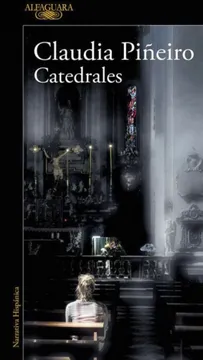


Plot Summary
A Faith Breaks at the Funeral
At nineteen, Lía1 refuses to pray beside her younger sister7 Ana’s7 closed coffin. The family and priest10 treat her sudden atheism as a grief-stricken outburst, but Lía1 knows the death has exposed how much of her faith rested on fear. Her older sister4 Carmen4 turns away from her, while her father6 asks her to reconsider.
Only Marcela,3 Ana’s closest friend,3 shares Lía’s1 stunned silence, clutching a turquoise ring Ana7 borrowed for luck. With nobody able to say who killed Ana7 or why, Lía1 leaves her family and Argentina for Santiago de Compostela, where Ana7 had once dreamed of walking. She and her father6 keep writing, but agree to avoid family news until Ana’s7 killer5 is found.
Lía’s refusal to pray is not a tidy conversion from belief to disbelief. It is an attempt to claim authority over her own mind at the moment when the family most expects obedience. The coffin contains a body made unspeakable by violence, and the family’s response makes Lía’s religious doubt another offense to manage. Her departure becomes both escape and a promise to her father: distance will not mean indifference, provided the unanswered crime remains the one permissible subject.
Ana’s Last Secret
Years earlier, Ana7 and Marcela3 became inseparable after Marcela3 entered a new school and Ana7 made room for her. At seventeen, Ana7 begins guarding the identity of a man she loves,5 then tells Marcela3 she is pregnant and intends to end the pregnancy. The man5 arranges an illegal procedure but stays away, afraid of being recognized.
Marcela3 walks with Ana7 to a shabby house and holds her hand while an unqualified practitioner performs the abortion. The next day, Ana7 is feverish and in pain. She refuses to involve her family, instead asking Marcela3 to take her to a church where she expects the man5 to meet her. He does not arrive. Ana7 dies on Marcela’s3 lap as Marcela3 waits with her, then runs for help.
The friendship becomes a practical form of care when the adults and institutions around Ana offer no safe route. Marcela cannot make the decision for her, but she refuses to leave her alone with its consequences. Ana’s lover describes his absence as necessity, while Ana bears the bodily danger and social exposure. Her request for a church meeting joins private crisis to the religious world that has taught her to feel shame, but cannot protect her from an unsafe procedure.
The Body Is Rewritten
As Marcela3 runs for help, a church statue falls on her and damages her ability to form new memories. Elsewhere in the church, Julián5 finds Ana7 dead and carries her body away in his family’s van. Carmen4 joins him, and when rain defeats their attempt to burn the corpse, she uses a ceramic kiln to incinerate its torso.
She cuts off Ana’s7 head and legs, then the pair return the remains to a vacant lot and report them anonymously. Investigators accept a sexual murder theory and close the case, while Marcela’s3 account is dismissed as delusion. A priest who knows more than he reveals10 urges discretion. Ana’s7 father, Alfredo,6 continues searching, but the official explanation leaves him with no answer and Lía1 with no reason to return.
Carmen’s concealment is at once an act of control and an attempt to control the meaning of a death. The remains are arranged to invite a familiar explanation, while the real circumstances are removed from view. The investigation assists this revision through haste and prejudice: Marcela’s damaged memory makes her testimony easy to discard, and the family’s respectable image receives more protection than the truth. Alfredo’s persistence resists that social convenience, though he cannot yet identify what has been hidden.
Letters Across Cathedrals
Carmen4 and Julián5 raise their only child,2 Mateo,2 in a strict Catholic household, while his grandfather6 Alfredo6 gives him books and space to question what his parents present as settled truth. Alfredo6 and Mateo2 plan a European route through cathedrals, drawing them together by tracing buildings on paper.
When Alfredo6 dies, Mateo2 receives three letters, including one intended for him and Lía1 to read together. He leaves Argentina, cuts off contact with his parents, and follows their planned route through Europe toward Santiago de Compostela.
His parents interpret his disappearance as a crisis to be corrected; Mateo2 sees it as his first chance to decide where his life goes. He finds Lía’s1 bookshop online, visits it, and watches from a distance before daring to approach her.
The route through cathedrals is less a pilgrimage than Alfredo’s careful attempt to make kinship possible across a rupture. Drawing lets grandfather and grandson share a practice without requiring them to agree about religion. Mateo’s departure is not simply youthful rebellion: he has been raised in a family that treats closeness as a claim to authority. His wish to find Lía suggests that independence may require a new relationship, not just distance from the old one.
A Sister Returns
Thirty years after their estrangement, Carmen4 arrives at Lía’s1 Santiago bookshop with her husband,5 Julián.5 Their son2 Mateo2 has stopped communicating during his European trip, and his recent card purchases show repeated visits to Lía’s1 store.
Lía1 knows nothing about him and refuses to pretend otherwise. Carmen4 and Julián5 ask her to check the shop’s records and contact them if Mateo2 appears. Only as they leave does Carmen4 reveal that their father,6 Alfredo,6 died two months earlier and has left Lía1 half his ashes.
The news lands harder than the request: Lía’s1 careful correspondence with her father6 had excluded illness and family updates, and his final letters reached her without warning that he was dying. She puts his ashes away, angry at Carmen’s4 timing and at herself for knowing so little.
Carmen’s visit turns Lía’s carefully managed separation into an obligation she did not choose. The missing son connects them, but the delayed news about Alfredo makes the encounter an emotional ambush. Lía’s correspondence had preserved affection by restricting information; that same restriction now magnifies her grief. Carmen’s composure and Lía’s hostility are both defenses, but they operate differently: Carmen controls what is disclosed, while Lía controls whether she will respond.
Ashes Beneath the Buganvillas
Lía1 rereads her father’s6 letters and notices that Alfredo6 once mentioned a young friend named Mateo2 who helped him research the names of flowers. Her partner, Luis,9 suspects the friend is Carmen’s4 son.2
At the shop, employee Ángela11 confirms that Mateo2 had visited often, buying books on atheism and Raymond Carver’s story about a cathedral; he had hidden when Carmen4 and Julián5 came in. Lía1 takes Alfredo’s6 ashes to the park’s buganvillas, plants her father6 had helped her remember across the distance.
As she hesitates over scattering them, Mateo2 approaches. He agrees to place his hand over hers as they release the ashes together. For Lía,1 meeting the nephew2 she had never known begins not with family explanations, but with a small shared ritual for the father6 they both miss.
The letters make memory material: a flower’s name, a book purchase, or a familiar detail can reconnect people when direct speech has failed. The meeting at the park matters because neither aunt nor nephew is asked to solve the whole family at once. Their joined hands repeat Alfredo’s way of teaching through drawing, turning inheritance into an act they perform together. Lía’s unbelief does not prevent ritual; it changes what ritual can mean.
Marcela’s Lost Testimony
Before his death, Alfredo6 revisits the old case and reads Marcela’s3 police statement with fresh attention. He seeks her out, listens as she recounts what she remembers from before the blow to her head, and records details she cannot reliably retain.
Marcela3 explains that Ana7 was already dead in the church before the body was later found in pieces, but she cannot reveal the private event she promised Ana7 to keep secret. Alfredo6 respects that limit while asking a criminalist, Elmer García Bellomo,8 to reopen the physical evidence.
Marcela3 works through decades of notebooks to reconstruct what happened and carries an old list of possible men in Ana’s7 life. This time, investigators have both her testimony and someone willing to test it against the evidence.
Marcela’s notebooks do more than compensate for memory loss; they expose how institutions decide whose account counts as knowledge. The police treated her condition as a reason to disregard everything she said, even though the injury affected what she could store after the incident, not what she had seen before it. Alfredo’s method is ethically significant: he listens without forcing her to break her promise, then looks for a way to test her account independently.
The Color of the Cause
Elmer8 reexamines the autopsy and notices that the burns on Ana’s7 body do not match the fire damage at the vacant lot. The torso had been exposed to far greater heat than her head and legs, suggesting someone tried to erase a cause of death rather than hide her identity. In Marcela’s3 account, Ana7 first looked unusually pale, then yellow, then blue as she weakened.
Elmer8 connects those stages to Mondor syndrome, a deadly infection that can follow an unsafe abortion. The diagnosis changes the case: Ana7 was not killed in a sexual assault, though someone later staged her remains to support that theory. As Elmer8 considers who might have been forbidden to love Ana,7 Alfredo6 recognizes the connection to Julián,5 the man who became Carmen’s4 husband.5
The forensic breakthrough depends on attending to differences that the first investigation flattened: where the body burned, how its parts were arranged, and how Ana’s skin changed before death. Elmer’s precision corrects not only a technical error but a cultural one. The original theory made sexual violence legible and convenient, while an illegal abortion remained difficult to name. The body was evidence, but only once someone stopped treating the official story as a conclusion.
A Priest Behind the Silence
Julián’s5 account reveals that he had been a seminarian5 when he began a secret sexual relationship with Ana,7 even as he loved Carmen4 and hoped to leave religious life for her. After Ana7 became pregnant, he helped arrange an abortion but avoided accompanying her, fearing discovery.
Carmen4 knew of his involvement and chose to marry him, treating their future family as something worth protecting from scandal. Their religious convictions and desire for respectability shaped what each could admit: Julián5 framed his choices as deference to Ana,7 while Carmen4 understood silence and concealment as protection.
Alfredo6 confronts Julián5 after learning enough to identify his role, but the family still cannot agree on what responsibility means. Their son Mateo’s2 estrangement makes the old bargain impossible to keep sealed.
Julián and Carmen do not share a single motive, though they build a life around a shared silence. He separates intention from consequence, using Ana’s supposed freedom to soften his own abandonment. Carmen’s need to preserve family and reputation lets her recast concealment as care. Their religious language supplies a moral structure, but it also offers escape routes from accountability. Mateo’s departure disrupts that structure by refusing the family’s inherited version of what can be forgiven.
Epilogue
In Alfredo’s6 final letter, intended for Lía1 and Mateo2 to read together, he admits that his own silence about abortion helped make Ana7 unable to seek his help. He does not excuse Julián5 or Carmen,4 and he refuses to let the law’s narrow definition of murder settle the question of responsibility.
He also confesses his love for Marcela,3 whose memory loss means she can meet his affection anew each day. Though he calls himself a believer, he imagines each family member building a private cathedral from what matters most to them. The letter asks the living to face the truth together, even if it cannot restore the dead.
Alfredo’s letter shifts the novel’s final judgment from identifying a single culprit to examining the conditions that made harm possible. He names his own failure as a father, refusing the comfort of blaming only the people who acted after Ana’s death. His love for Marcela offers intimacy without possession: he does not ask her to remember or reciprocate. The imagined cathedrals transform religion into chosen forms of meaning, built from books, questions, art, and affection rather than imposed doctrine.
Analysis
Catedrales treats truth not as a single answer waiting in a file, but as a conflict over who is allowed to describe what happened. Marcela3 remembers Ana’s7 final hours, yet her injury gives officials an excuse to dismiss her. Elmer8 can identify the medical pattern only after he joins physical evidence to her account. Alfredo’s6 years of investigation matter, but his final recognition is broader: the family’s silence about abortion helped make Ana’s7 danger unspeakable before it became a crime scene.
The novel’s religious characters do not all believe in the same way, and their faith does not produce one moral result. Lía1 and Mateo2 resist religious authority as an imposed system; Julián5 uses belief to frame his failures; Carmen4 turns faith into a structure for protecting family and reputation; Alfredo6 keeps a faith he can no longer hold without doubt. The book asks how doctrine becomes dangerous when it replaces judgment, especially when a young woman’s body and choices are treated as threats to collective respectability.
Its recurring acts of recording and drawing offer alternatives to that inherited certainty. Lía1 and Alfredo6 preserve closeness through letters, Mateo2 and Alfredo6 build cathedrals on paper, and Marcela3 writes down a life that otherwise vanishes from her memory. These practices do not erase injury or guarantee agreement. They make attention possible. The imagined cathedrals in Alfredo’s6 last letter therefore stand for chosen forms of belonging: structures built from books, questions, art, and love, rather than obedience alone.
Review Summary
Most readers praise Catedrales as a powerful, polyphonic novel told through seven distinct voices, emphasizing it transcends the crime genre to explore religious fanaticism, hypocrisy, family trauma, and social criticism in Argentina. Reviewers consistently highlight the masterful character construction, particularly the character Marcela, and the novel's intimate, emotional depth. While many note the plot is predictable, they argue this is irrelevant given the book's true focus. A minority of critics found it agenda-driven, repetitive, or lacking nuance.
Characters
Lía Sardá
The exiled, watchful booksellerLía is the middle Sardá sister, a bookseller in Santiago de Compostela who values independence and exact language. Her refusal to perform belief places her at odds with a family that treats Catholic identity as both moral standard and social bond. She is sharp, guarded, and quick to expose evasions, yet her long correspondence with her father6 shows a capacity for tenderness that she protects from intrusion. Books and remembered words give shape to a life built far from home. Her relationship with her nephew Mateo2 offers a chance to approach family without returning to the rules that once made her feel trapped.
Mateo
The searching, isolated grandsonMateo is Carmen4 and Julián’s5 only son, an intellectually curious young man raised within a tightly devout household. He is shy, observant, and prone to retreat when other people’s expectations become overwhelming. His grandfather Alfredo6 encourages his questions and gives him a model of affection that does not depend on obedience. Mateo’s interest in architecture and cathedrals sits beside skepticism about religious authority, making him both drawn to beauty and wary of the meanings others assign it. He wants connection, but not at the price of surrendering the right to choose his own beliefs or future.
Marcela Funes
Ana’s fiercely loyal friendMarcela becomes Ana’s7 closest friend after entering a new school as an outsider. She is attentive to other people’s moods and willing to stay beside someone in frightening circumstances, even when she does not know how to help. A brain injury leaves her unable to reliably form new memories, so she uses notebooks, photographs, and repeated routines to keep daily life coherent. Her account of the past is vivid, while the present repeatedly slips away. Marcela’s loyalty is not blind: she can preserve a promise and still struggle with what that promise costs the people who want the truth.
Carmen Sardá
The commanding eldest sisterCarmen is the eldest Sardá sister, a theologically educated woman whose public warmth contrasts with her controlling presence at home. She is ambitious, organized, and deeply invested in Catholic ideals of family, motherhood, and moral order. Her skill at reading social situations gives her influence, while her certainty can make other people’s needs feel like obstacles to a plan. Carmen’s faith is not merely private comfort; it shapes her ideas about respectability and who should bear responsibility. The gap between her polished public manner and her private authority defines much of her relationship with her sisters.
Julián
The conflicted former seminarianJulián is a former seminarian whose concern for others coexists with fear of exposure and a strong dependence on religious rules. He is gentle in manner, hesitant under pressure, and more comfortable seeking counsel than making decisions that might cost him his future. His desire for love conflicts with the celibacy he once considered a sacred calling, and that conflict shapes how he understands duty. Julián’s habit of dividing intention from consequence lets him think of himself as compassionate even when his choices leave another person exposed. He is a husband and father who remains strongly influenced by the moral world in which he was formed.
Alfredo Sardá
The father who keeps searchingAlfredo, father to Lía1, Carmen4, and Ana7, is a retired history professor with an expansive curiosity and a deep attachment to his daughters. He draws, reads widely, and prefers patient inquiry to easy conclusions. His affection for Lía1 survives years of distance through letters that share ordinary details rather than demands. The unresolved case makes him stubborn, but his persistence is rooted in grief and a belief that the truth matters even when it cannot undo loss. Alfredo listens closely to people others discount, and he tries to create bonds through shared acts rather than authority.
Ana Sardá
The gifted, guarded younger sisterAna is the youngest Sardá sister, an artistically gifted teenager with a warm, teasing bond with Lía1 and an especially close friendship with Marcela3. She is sociable and generous, but also capable of keeping parts of herself private as she grows beyond childhood. Ana’s romantic imagination and desire for a future of her own sit uneasily beside the strict expectations surrounding her. The turquoise ring she borrows from Lía1 becomes a small emblem of the sisters’ intimacy and of Ana’s hope that something can protect her.
Elmer García Bellomo
The stubborn forensic investigatorElmer is a trained criminalist who trusts physical evidence more than hierarchy or instinct. Talkative and self-assured, he can be difficult to redirect, but his persistence keeps him returning to details his colleagues dismiss. He distinguishes a crime scene from the place where events actually occurred and resists conclusions built on thin evidence. His professional rigor is sharpened by awareness that institutions can rush, mishandle, or distort investigations. Elmer’s task is not to make a suspect seem psychologically plausible, but to determine what the evidence can genuinely support.
Luis
Lía’s steady, perceptive partnerLuis is Lía’s1 long-term partner in Santiago, a university professor who respects her independence without mistaking silence for indifference. He offers practical support and notices connections she initially resists, especially the link between Alfredo’s6 letters and Mateo’s2 visits. His calm presence gives Lía1 a place to return to after memories unsettle her. Luis does not try to repair her estrangement by force; he helps her recognize when a new choice is possible.
Father Manuel
The parish’s influential priestFather Manuel is the parish priest connected to the Sardá family and to Julián’s5 religious formation. He is practiced at soothing conflict and interpreting distress through the language of faith. His influence reaches beyond pastoral care into the community’s response to tragedy. For the young people around him, he represents both the warmth of parish life and the authority of an institution whose decisions can determine which accounts are heard.
Ángela
The observant shop managerÁngela manages Lía’s1 bookshop and remembers the customers and purchases that Lía1 cannot identify. Sociable and perceptive, she notices when Mateo2 behaves strangely around Carmen4 and Julián5, then provides Lía1 with the concrete details that help connect him to Alfredo’s6 letters.
Dolores
The devout Sardá motherDolores is the Sardá sisters’ mother12, a devout Catholic whose concern for family reputation shapes the emotional climate at home. She is quick to interpret hardship through religious belief and less equipped to discuss subjects her faith marks as shameful. Her influence is felt in the daughters’ different responses to obedience, secrecy, and independence.
Susana
Alfredo’s trusted caregiverSusana cares for Alfredo6 and helps preserve the private arrangements he makes for Mateo2. She is practical, discreet, and attentive to the relationships inside the family, offering Mateo2 guidance without taking control of his choices.
Plot Devices
The three letters
A delayed family reckoningAlfredo6 leaves Mateo2 one letter, Lía1 another, and a third for them to read together if they choose. The private letters give each recipient a relationship with Alfredo6 beyond the family’s public version of events. The shared letter makes their meeting necessary before the most painful knowledge can be passed on. It also lets Alfredo6 speak after his death, not as an all-knowing judge, but as a father who must acknowledge his own omissions and the limits of what he learned.
The cathedrals
A language for connectionAlfredo6 and Mateo2 draw cathedrals together, while Lía1 and Alfredo6 exchange descriptions of Santiago’s cathedral and the flowers near it. Architecture becomes a shared subject across differences in age, belief, and distance. The act of drawing depends on one person guiding another’s hand, a model for how knowledge can be offered without being imposed. In Alfredo’s6 final letter, each family member’s imagined cathedral turns that shared practice into a private way of making meaning.
Marcela’s notebooks
Memory made externalAfter her injury, Marcela3 records names, events, and instructions in notebooks so she can recover information that her mind cannot retain. Photographs and marked pages help her link a face to a name or a present conversation to an earlier event. The notebooks preserve not only practical facts but also the testimony the police dismissed. They make memory visible as labor: Marcela3 must repeatedly rebuild a usable account of her life, while others decide whether to treat that account as credible.
Forensic color and heat
The body contradicts the caseElmer8 compares the pattern of burns on Ana’s7 remains with the damaged ground and finds that the two do not match. He then connects Marcela’s3 recollection of Ana’s7 changing complexion to the colors described in the autopsy. These physical and remembered details challenge the official sexual-assault theory and reveal that the body was altered to conceal another cause of death. The clues show how careful observation can recover a truth that hurried investigators and social prejudice have obscured.
The turquoise ring
A token across generationsAna7 borrows Lía’s1 ring as a symbol of luck, then entrusts it to Marcela3 with the hope it will return to its owner. Marcela3 preserves it, and Mateo2 later carries it toward Santiago as part of Alfredo’s6 plan to reconnect the sisters. The ring links the women through affection rather than explanation. Its passage also turns an object associated with protection into evidence of how much each person has carried for someone else.
Download PDF
Download EPUB
.epub digital book format is ideal for reading ebooks on phones, tablets, and e-readers.








