

Plot Summary
Prologue
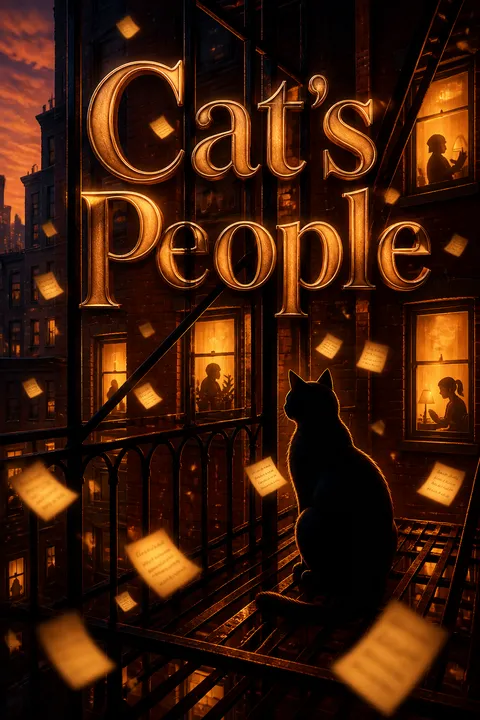
Cat survives by keeping to shadows. As a black stray, he has learned to distrust most people, but he recognizes a few kind regulars as his own. Rainbow Lady feeds him each morning, Cheery Mailman shares treats and walks, and Sad Bodega Man once had a wife who cared for him.
Cat prizes his freedom and believes people exist chiefly to serve cats. Yet his street map is already shaped by the small, repeated kindnesses that keep him alive, and by the people who need him as much as he needs them.
Cat’s rules make the novel’s central irony visible before its human characters do: he claims independence while depending on a network of care. His distrust is not a comic quirk alone. It is an adaptation to abuse, danger, and the instability of street life. By making the cat the first interpreter of the neighborhood, the story asks readers to notice acts that humans overlook: a plate left at the same hour, a familiar footstep, a door held open. Cat’s self-interest is real, but it does not prevent attachment. It gives attachment a cautious, unsentimental shape.
Charles Has Three Tails
Every morning, Núria feeds her three cats before she remembers to take care of herself. She has a barista job she still loves and a rescue route she never abandons, but lately she moves through both as if half asleep. Her mother keeps pressing her to date and have children, and Núria cannot bring herself to explain that she wants neither.
When her mother announces a newly single man as a possible match, anxiety makes Núria claim she already has a boyfriend. Looking down, she sees Churro playing with her shoelace and borrows his name, calling the imaginary man Charles. The lie buys her a moment of peace, but it also leaves her needing to produce a convincing partner.
Núria’s lie is a small act of self-protection, not a scheme for attention. She cannot yet set a direct boundary with her mother, so she invents a person who can absorb the pressure for her. Her care for the cats is steady and practical, while care for herself remains a postponed task. The contrast matters: devotion is a strength, but it also lets her avoid asking what she wants beyond being useful. The story begins when that avoidance becomes unsustainable, even though Núria does not know it yet.
Orange Notes Across the Hedge
Collin Thackeray, a bestselling novelist stalled on his next book, watches the woman feeding the black cat from his brownstone window. Her care catches his attention because he, too, keeps the world at a distance. He leaves an orange note on Cat’s empty plate asking whether the animal understands her. Núria finds it, then uses a borrowed pen to answer that of course he does.
The exchange gives Collin enough courage to visit the café where she works. Nervous and unsure what to order, he lets Núria choose an almond mocha; she decorates it with foam hearts. He notices her name and, back home, finally types the title page of a new manuscript. A few words are all he has, but they break his silence.
The notes offer intimacy without requiring either person to withstand immediate scrutiny. For Collin, writing is both his profession and his safest form of approach; the exchange turns that familiar tool toward a real person rather than an imagined story. Núria’s brief answer is equally revealing. She accepts contact while keeping control of its pace. Their first meeting in the café is awkward, but it converts distant observation into a concrete encounter. The manuscript’s first words show that connection does not simply distract Collin from work. It returns him to the capacity to begin.
Bong's Bodega Breaks Open
Omar, the neighborhood mail carrier, has earned Cat’s trust with patient company and treats. When Omar enters Bong’s bodega and finds the owner crying over a drink Conchita used to love, he starts to leave rather than intrude. Cat blocks the door. Omar turns back, sits beside Bong, and lets him admit that his wife’s death has left him lost.
The two men share the quiet instead of trying to cure it. Later, when Bong finds Cat outside the closed store, memories of Conchita’s kindness stop him from shooing the stray away. He brings Cat inside and feeds him. The cat who once belonged to Conchita becomes a living link between Bong and the people beginning to gather around him.
Cat’s intervention is modest but consequential: he does not solve grief; he prevents a grieving man from being left alone at the moment he finally lets it show. Omar’s response matters because he offers presence without demanding a polished explanation. Bong’s later welcome to Cat is a first movement from memory toward action. Conchita’s kindness continues not as a shrine-bound ideal but as a practice Bong can choose again. The bodega becomes a place where grief can be witnessed without being treated as a private failure.
Foodtown's Hidden Customer
After her father dies, Lily searches boxes in his basement and finds a children’s book inscribed to Núria, an old family photograph, returned letters, and a magazine profile of a Brooklyn barista. The girl in the photograph is her father’s other daughter. Lily travels from Georgia to find her, but cannot yet bring herself to introduce herself.
She gets a job at the Foodtown where Núria shops and watches her from the register. When Núria finally reaches Lily’s checkout lane, Lily recognizes her face and reads her name from the debit card. Their first exchange is only a routine purchase. Lily leaves the counter with proof that her sister is real, but no idea how to turn that discovery into a conversation.
Lily’s investigation begins in grief and becomes a search for belonging. The objects in the cookie tin are evidence, but they are also the remains of a relationship she did not know existed. Her decision to watch Núria rather than approach her reflects both longing and fear: she imagines a joyful reunion because she has little experience of the harder, less scripted forms of intimacy. The checkout encounter punctures that fantasy. Recognition does not automatically create trust, and the distance between the sisters will have to be crossed through imperfect choices.
Cardboard House, Open Door
After seeing Cat explore his tidy alley, Collin buys food, bowls, and a bed, then builds a cardboard shelter himself. Cat tests the food, claims the house with his scent, and spends the night on its soft cushion. Núria notices that the stray now eats with unusual calm and wonders who else is caring for him. Meanwhile, she and Omar turn her invented boyfriend into a running joke.
Omar invites her to dinner with his partner, Carl, and cooks vegan versions of family dishes. Over the meal, Núria admits she has always imagined a café filled with rescue cats, while Omar wonders whether cooking should become his career. The dinner gives both of them room to voice ambitions they usually keep private.
The shelter is a practical gift, but it also changes Collin’s relationship to the neighborhood: he acts before he can explain his motives. Cat’s cautious acceptance makes that effort visible without turning him into a tame symbol. The dinner extends the same logic among the humans. Omar and Núria listen to each other’s uncertainties without insisting on a ready-made plan. Their invented romance has created a harmless opening for genuine friendship. Across both strands, belonging begins not with a grand declaration but with making space, feeding someone, and allowing an unfinished desire to be spoken.
Lemonade Beside Conchita
At the cemetery, Lily meets Bong beside Conchita’s grave. He is grieving his wife; Lily is missing her father and struggling to feel at home in Brooklyn. They walk together for lemonade, and Lily admits she came to the city hoping to find a sister who does not know she exists. Bong listens without pushing her to act before she is ready.
When Lily later seeks him out after her difficult encounter with Núria, he reassures her and offers her a part-time job at the bodega. She accepts, needing the income as well as the companionship. The store gives Lily a steadier foothold in the neighborhood, while Bong finds relief in having someone to share the work.
Bong and Lily recognize a familiar loneliness in each other without pretending their losses are identical. His response is particularly useful because it combines emotional welcome with material help. A job cannot resolve Lily’s family history, but it eases the immediate threat of eviction and gives her a place where she is expected. Bong’s offer also restores a sense of usefulness he has lost in grief. Their friendship shows how care can be both tender and concrete: listening matters, and so does a paycheck.
Cat Crosses the Street
After too much wine and sangria, Núria stumbles through the night and falls face-first onto a subway grate. A man approaches and tries to take advantage of her while she is dazed. Cat sees him touch her and races across traffic, nearly struck by a car, then scratches and bites him until he lets go.
Lily, out walking because she cannot sleep, calls for help and frightens the man away. She helps Núria stand and walks her to her apartment, where she cleans the cuts on her forehead and knee. Núria knows Lily from the supermarket, but neither woman names the connection between them. Lily leaves having protected her sister without yet being able to tell her why she came.
The danger makes visible what the characters’ gentler exchanges have only implied: dependence is not weakness, and intervention can require risk. Cat’s loyalty overrides the caution that has kept him alive; his rescue is an act of attachment, not a sudden transformation into a fearless animal. Lily also moves from watching to doing. Yet the encounter does not resolve her secret. She can protect Núria’s body before she can risk exposing their shared past, a distinction that gives the scene both relief and unease.
Letters Beneath a Stone
Seeing Núria bruised after the attack, Collin writes a longer note admitting his fear of rejection and explaining why her warmth draws him. He leaves it with a colorful glass heart he once bought for his mother, and Cat guards the gift until Núria finds it. She reads the letter and invites its writer to identify himself by ordering a Guillermo at the café.
Collin has not yet answered in person, but the invitation changes the exchange from anonymous curiosity into a possible meeting. Nearby, Lily returns to Cat, who recognizes her kindness and lets her pet him. When she confides that Núria is her sister, Cat cannot understand the words, but he senses the loneliness beneath them.
The letter changes the balance between the two correspondents. Collin is no longer only observing Núria; he names his own defenses and risks being judged for them. The glass heart makes that vulnerability material, while the coded coffee order gives Núria a way to invite contact without surrendering her caution. In parallel, Cat’s brief acceptance of Lily’s touch marks another loosening of his boundaries. The scene links forms of recognition that are not yet mutual: Collin knows why he is drawn to Núria, and Lily knows who Núria is, but both still await a response.
Boston, a Hundred Thousand
Omar’s longtime neighbor Mrs. Lewis tells him she is moving to Boston to live with her daughter. Her departure sharpens the emptiness he already feels, especially as Carl keeps urging him toward culinary school and a restaurant career. Omar admits he lied about planning a school visit because he does not want that future.
Carl hears the lie as a breach of trust and leaves to stay with his brother. Before moving, Mrs. Lewis gives Omar a treasured tea set and a letter with a hundred-thousand-dollar check, thanking him for being family to her. The money gives him choices, but it cannot choose for him. He must decide what kind of work feels like his own.
Omar’s conflict is not simply between a safe job and a glamorous career. It is between a life he has not fully examined and a future Carl has imagined on his behalf. His lie delays the conflict, then makes it sharper by turning a difference in desire into a question of trust. Mrs. Lewis’s gift recognizes the care Omar has already given; it does not buy his next decision. Her move and Carl’s departure leave him with support and possibility, but also with the responsibility to define success for himself.
Two Daughters, One Photograph
Now working beside Bong, Lily sees Núria in the bodega and recognizes her chance to stop hiding. Later, at an ice cream shop, Núria spots a photograph of Lily with a man who looks like her own father. Lily explains that the two women share a father, who died in a car accident the year before.
Núria learns that he built another family in Georgia, while her mother had kept their new address and phone number from him. Shock and anger overwhelm her, and she leaves Lily behind. At home, Núria asks her mother directly; her mother confirms that she later learned of the other family but withheld the news to spare Núria renewed pain. The truth arrives with grief, but also with a sister.
The revelation destabilizes Núria’s most painful explanation of her father’s absence. She had lived with unanswered questions; now she must contend with the fact that he had another life and that her mother concealed it. Lily’s secrecy has its own cause, but understanding it does not erase the intrusion Núria feels. The scene refuses a clean assignment of blame. Protection, abandonment, and deception overlap, forcing Núria to hold anger alongside the possibility of connection. A new family bond cannot restore the lost years, but it gives the past a more complicated shape.
Kidney Failure Finds a Family
Cat grows weak, stops eating, and becomes dangerously dehydrated in his shelter. Collin finds him barely responsive and carries him through the neighborhood to the café, where he finally identifies himself by calling out the Guillermo order Núria requested.
She rushes Cat to a veterinary clinic. The veterinarian diagnoses stage-three kidney disease and explains that intensive fluids, medication, and a special diet could give him another year or two, but only with reliable care.
Núria cannot take a fourth cat; the others cannot house him either. Collin volunteers to bring Cat into his brownstone, and the others offer supplies and help. At the clinic, Omar handles the fluid demonstration with ease and recognizes a possible future in veterinary care.
Cat’s illness converts affection into a practical test. It is easy to love a stray at a distance; treatment requires time, money, routine, and a willingness to accept responsibility. Collin’s choice to take him in is also the moment his anonymous courtship becomes direct action. The group does not pretend that care guarantees recovery or a long life. Instead, they respond to uncertainty with shared labor. Omar’s recognition of his aptitude emerges through doing, not abstract career planning, offering a model of vocation grounded in the needs of a particular creature.
Cat Chooses the Upstairs
Before Cat leaves the clinic, Núria and Lily meet to repair their rupture. Lily brings their father’s book, the returned letters he kept sending, and the magazine profile that helped her find Núria. The evidence shows he had not forgotten his first daughter, though it cannot undo his absence. Núria chooses to know Lily rather than lose her too.
She and Collin go on a date, and Núria kisses him when his nerves keep him from making the first move. Four days later, they bring Cat to Collin’s brownstone, where the others help settle him in. Omar announces he will enroll in a veterinary technician program. Cat rests indoors, hearing the people who have become his own gather downstairs.
The ending does not repair every injury; it creates a livable future around them. The letters complicate Núria’s memory of her father without absolving him, and her choice to reconnect with Lily is an act of agency rather than instant forgiveness. Her kiss with Collin reverses the pattern of waiting for someone else to make the next move. Cat’s move indoors gathers the novel’s separate acts of care into a shared household. Home becomes less a private possession than a relationship maintained through attention, food, treatment, and presence.
Analysis
Cat’s People builds its plot through repeated acts of care rather than through a single dramatic quest. A plate of food, a paper note, a box of scones, a ride to Coney Island, and a borrowed workplace all become mechanisms by which people move from private distress into mutual obligation. These gestures matter because each character initially mistakes self-protection for independence. Núria gives to strays while denying her own desires. Collin watches rather than risks rejection. Bong buries grief in work. Lily observes her sister from a distance. Omar serves others while postponing his own vocational question.
Cat provides the book’s structural intelligence. His routine draws the characters into the same physical spaces, while his limited but attentive perspective makes trust legible as behavior: someone returns, leaves food, waits, or stays when escape would be easier. He does not erase the difference between human and animal needs. Instead, his illness makes those needs converge. Caring for him requires a group to coordinate, accept limits, and provide ongoing labor, transforming casual kindness into commitment.
The family plot resists a simple division between truth and betrayal. Núria’s father left, her mother withheld information, and Lily concealed her identity while trying to approach. Each choice was shaped by fear or a wish to protect, yet each caused harm. The sisters’ reconciliation depends not on declaring the past harmless but on making room for evidence, anger, and future contact at once. Similarly, Omar’s disagreement with Carl insists that affection cannot substitute for listening. A shared future must contain both partners’ ambitions.
The novel’s resolution is deliberately communal. Cat gains indoor safety, Núria accepts both romantic and sibling intimacy, Collin opens his home, and Omar finds a direction through direct caregiving. None of these outcomes abolishes grief, illness, or uncertainty. They show instead that belonging is maintained through concrete acts, repeated after the first emotional breakthrough has passed.
Review Summary
Characters
Cat
Streetwise strayA black cat who has survived on Brooklyn streets by reading danger and keeping people at a distance. He distrusts strangers for good reason, yet recognizes reliable kindness in routines, footsteps, and food left where he can safely reach it. His pride in his independence makes each small act of trust meaningful. Cat also observes human loneliness with an animal’s blunt attention: he cannot untangle their histories, but he notices when someone needs company. His point of view gives the neighborhood a map drawn from scent, sound, shelter, and the people who prove dependable.
Núria
Cat rescuer and baristaA dedicated community cat caretaker and skilled barista, Núria builds her days around feeding others while neglecting her own needs. She is funny, disorganized, and more comfortable with animals than with people, partly because her father’s unexplained departure taught her to expect loss. Her mother’s pressure to date and have children makes her avoid direct confrontation, but Núria is not passive: she keeps choosing the work and relationships that feel true to her. Her central struggle is learning that care can include boundaries, ambition, and the risk of letting people know her.
Collin Thackeray
Reclusive novelistA successful novelist whose stalled next book has become a measure of his fear that his best work is behind him. Collin is observant, conscientious, and socially anxious, but his solitude has hardened into a habit that keeps even welcome possibilities outside his door. He notices Núria through her care for Cat before he can imagine speaking to her, and writing notes gives him a cautious way to approach. His polished public success contrasts with a private uncertainty shaped by demanding parents and limited practice at emotional risk.
Omar
Neighborly mail carrierA warm, attentive mail carrier who remembers the people and animals along his route and makes small kindnesses part of his daily work. Omar has learned to be useful through steady service, but he is uncertain whether his dependable job is also his calling. His empathy draws him into other people’s grief, sometimes before he has addressed his own needs. He is playful and generous without being naïve, though he sometimes uses humor to postpone difficult truths. Omar’s relationships challenge him to distinguish a life that looks successful from one that feels chosen.
Bong
Grieving bodega ownerA Filipino immigrant who runs a neighborhood bodega and has built much of his life around work, family, and his late wife Conchita. Bong is practical and reserved, with a deep instinct for hospitality that grief has made harder to access. He prefers self-reliance partly because depending on others risks another loss, yet his kindness to customers and animals keeps drawing people close. His relationship with the neighborhood is made of repeated exchanges: food, help, conversation, and memory. He offers others comfort in the same humble, material forms through which he understands care.
Lily
Searching newcomerA young woman from Georgia who has left a life that felt too small, though she arrives in Brooklyn without a secure plan or much confidence in herself. Lily is observant, imaginative, and quick to invent stories about the people around her; fantasy helps her manage insecurity but can also keep her from acting. She wants family and belonging, yet fears that reaching for either will expose her to rejection. Her charm and Southern candor sit beside a sharp awareness of money, work, and the ways other people underestimate her.
Rocky
Núria’s blunt best friendNúria’s closest friend, Rocky is outgoing, affectionate, and unafraid to challenge her when she neglects herself. Her practical concern can sound like nagging, but it comes from genuine loyalty. Rocky gives Núria a model of friendship that is direct and durable, even when the two women disagree.
Carl
Omar’s ambitious partnerOmar’s longtime partner, Carl works in interior design and imagines a more ambitious professional future for them both. He is affectionate, stylish, and often funny, but his enthusiasm for planning can crowd out Omar’s stated preferences. His conflict with Omar grows from a real desire for shared progress and a failure to listen closely.
Mrs. Lewis
Omar’s elder confidanteA widowed neighbor whose home, antiques, tea, and stories make a welcoming refuge on Omar’s mail route. Mrs. Lewis is perceptive without being solemn, and she knows how to offer comfort without turning grief into someone’s only identity. She treats Omar as family and encourages him to take his own desires seriously.
Conchita
Bong’s beloved wifeBong’s wife, remembered through their shared rituals, teasing, faith, and years of running a bodega together. Conchita’s compassion for animals and openness to neighbors continue to shape how Bong sees the world. Her presence in the story is carried by specific objects and habits rather than by an idealized memory alone.
Núria’s mother
Protective, demanding parentA Spanish-speaking mother who loves Núria fiercely but measures security through conventional milestones such as marriage and children. Her persistent matchmaking can overwhelm her daughter, while her protectiveness leads her to make choices on Núria’s behalf. Beneath the pressure is a woman shaped by painful history and the belief that withholding difficult truths can spare someone she loves.
Caroline
Collin’s outspoken sisterCollin’s older sister and Bernie’s mother, Caroline is capable, direct, and willing to speak openly about the family’s emotional strain. She turns to Collin when she needs someone who understands their mother, and their sibling bond provides him with rare practice in listening and tenderness.
Bernie
Collin’s keen observerCaroline and Alesha’s seven-year-old daughter, Bernie keeps a research journal full of drawings and observations. Her sharp, humorous attention makes her a perceptive judge of adult behavior. She approaches Cat with curiosity and gives Collin an affectionate reason to step outside his usual solitude.
Anh
Café coworkerNúria’s coworker at Brooklyn Brew, Anh is quick-witted and socially perceptive. He notices the tension between Núria and Collin before she is willing to interpret it herself.
Dr. Vasquez
Cat’s veterinarianA veterinarian who explains Cat’s condition plainly and gives the group a realistic care plan. Her guidance turns their affection into informed, practical responsibility.
Rosalinda
Omar’s beloved abuelaOmar’s grandmother, whose example of service and generosity helped shape his instinct to care for neighbors. Her remembered advice remains an ethical compass when he faces hard choices.
Miel, Gazpacho, and Churro
Núria’s demanding catsNúria’s three indoor cats, each with a distinct temperament and favorite place in her small apartment. Their daily needs anchor her routines, provide comfort, and reveal how much tenderness she gives even when she has little energy left for herself.
Plot Devices
The orange note exchange
Courtship by correspondenceCollin begins with a brief question left on Cat’s feeding plate, and Núria answers using whatever paper and pen she can find. Their notes allow both characters to share fears and curiosity before they can manage a face-to-face conversation. The later Guillermo order gives Núria a way to invite Collin to identify himself. The device is not merely a romantic gimmick: it dramatizes how people with different forms of social anxiety can create a pace of intimacy they can tolerate.
Cat’s feeding route
A neighborhood meeting placeNúria’s rounds repeatedly bring her past the same hedges, bodega, brownstone, and neighbors. Cat’s food and shelter attract attention, but the routine also lets people notice one another without a formal invitation. Omar meets Núria through Cat, Collin first notices her while she feeds him, and Bong reconnects with the stray his wife once cared for. The route turns ordinary acts of animal rescue into a social structure that gradually links isolated people.
The family archive
Evidence of a buried pastA book, photograph, returned letters, and magazine profile preserved among Lily’s father’s belongings give her a path to Núria. The objects do not provide a complete explanation for the family’s separation, but each adds a piece that changes how the sisters understand their father and their mothers’ choices. Their delayed delivery makes the archive both a source of truth and a test of trust between people who have already formed painful assumptions.
The cardboard cat house
Shelter becomes commitmentCollin’s handmade shelter begins as a small attempt to improve a stray’s life. Cat’s decision to sleep there brings Collin closer to the animal and makes the alley a point of contact with Núria. Later, when Cat’s illness demands more than outdoor feeding can provide, the shelter’s temporary safety gives way to Collin’s commitment to bring him indoors. Its modest construction foreshadows the larger, shared work of caring for a vulnerable animal.
Cat’s point of view
A different social mapCat interprets human life through familiar sounds, smells, food, danger, and repeated behavior. His narration exposes both the literal risks of street survival and the emotional patterns people fail to recognize in themselves. He cannot understand every secret, but he often sees who is lonely, who returns, and who has earned trust. This perspective gives the novel a way to connect separate human stories without making Cat magically omniscient.
Download PDF
Download EPUB
.epub digital book format is ideal for reading ebooks on phones, tablets, and e-readers.








