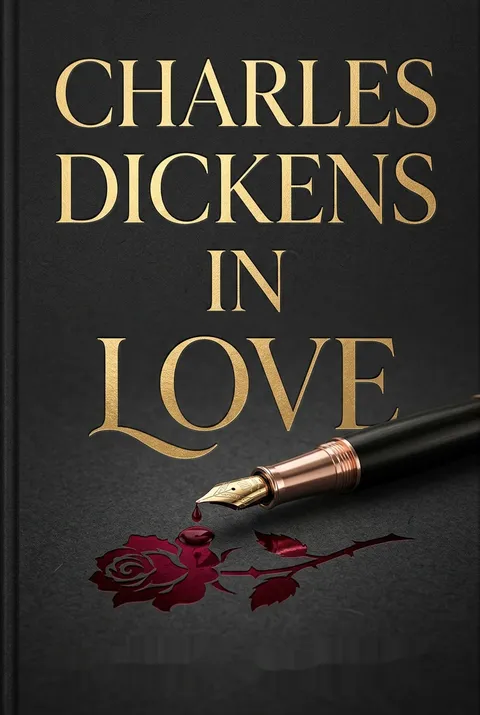


Key Takeaways
Dickens's three loves shaped the novels: one awakened desire, one worship, one embodied both.
Three distinct attachments. Robert Garnett reads Dickens’s career through Maria Beadnell, Mary Hogarth, and Ellen Ternan. Maria was the young woman he pursued and lost; Mary, his sister-in-law, died at seventeen and became a sacred memory; Ellen, a young actress, became his long-term companion. Each love marked a different stage of his life and stirred different forms of feeling and fiction.
A life inside the art. The book argues that Dickens’s novels repeatedly transform these experiences into characters and plots, rather than simply copying real people. At Niagara Falls, for example, his thoughts of Mary’s spirit mingled with plans to send Ellen a gift. The scene captures the competing idealism and desire that Garnett sees running through Dickens’s work.
The book’s strongest move is to treat biography as a lens on literary imagination, not as a key that unlocks every character. Its three-part structure gives readers a vivid way to track changing ideas of love, from yearning for the absent to devotion to the ideal and intimacy with a living person. The risk is making women seem chiefly valuable as stages in Dickens’s development. Their own motives are often less knowable than his, and the distinction matters.
Maria Beadnell's rejection redirected romantic intensity toward Dickens's first fiction.
A first consuming love. Dickens met Maria in 1830, when he was eighteen, and pursued her for roughly three years. She eventually rejected him, despite his repeated letters and attempts to keep their connection alive. He later remembered her as the great lost love of his youth, although his surviving evidence leaves her own feelings uncertain. When they reunited in 1855, the grown woman disappointed the idealized memory he had preserved.
Energy finds another outlet. After the breakup, during a summer when parliamentary work offered little income, Dickens began publishing sketches. Garnett argues that the timing matters: romantic longing and ambition were redirected into writing. The record cannot prove that Maria caused his literary career, but Dickens himself linked his drive to the years he spent trying to become worthy of her.
The persuasive point is not that heartbreak reliably produces art, but that Dickens converted a private defeat into a durable story about longing, effort, and loss. His later fiction gives that feeling structure, while his memories of Maria keep the younger version of himself alive. The causal claim deserves restraint: the summer recess and financial need also explain why he tried writing. The episode is strongest as a portrait of several motives converging, not a single muse creating a novelist.
Mary Hogarth's death supplied Dickens with a private religion and moral center.
Grief becomes devotion. In 1837, Mary Hogarth collapsed after an evening at the theater and died the next day in Dickens’s arms. He was twenty-five; she was seventeen. He later described dreaming of her for months, wore her ring, and returned to her grave. Her early death fixed her in his imagination as permanently young, gentle, and pure.
A sacred model for fiction. Garnett argues that Mary’s memory gave Dickens a personal focus for religious feeling that formal church life did not. In Oliver Twist, Rose Maylie resembles Mary in age, goodness, and idealized beauty. Agnes Wickfield in David Copperfield carries the same spiritual role. The ideal could inspire compassion and self-sacrifice, but it also made it difficult for Dickens to imagine virtuous women as sexual beings.
The transformation of grief into an ethical ideal helps explain why Dickens’s fiction can feel both tender and morally earnest. A remembered person becomes a standard against which cruelty and selfishness are judged. Yet idealization has a cost: the real Mary, whose surviving letters suggest a lively teenager, is nearly eclipsed by the flawless angel Dickens needed her to be. The pattern illuminates his art while also showing how mourning can preserve someone by simplifying her.
Read David Copperfield as Dickens's map from erotic longing to sacred devotion.
Two loves in one novel. Dickens called David Copperfield his favorite book, and Garnett reads it as a personal reckoning. Dora Spenlow, a pretty, immature young woman, draws David into an overwhelming youthful infatuation. Her character carries traces of Maria Beadnell, including a pampered manner and a beloved small dog. Agnes Wickfield, by contrast, is calm, self-denying, and morally guiding, echoing Mary Hogarth.
A chosen ending. David’s love for Dora awakens ambition and feeling, but the novel ultimately presents Agnes as his true partner and spiritual center. This is not simply a better marriage replacing a bad one. It stages a movement from sensual excitement toward stability and goodness, a resolution Dickens himself did not achieve in his marriage to Catherine.
The contrast makes the novel’s emotional architecture unusually legible: Dora represents the thrill of wanting, while Agnes represents the peace of being guided and accepted. The distinction also exposes a limitation in Dickens’s ideal of femininity. One woman gets to be vivid and desirable, another morally perfect, but neither is granted the full range of both qualities. Reading the novel this way enriches its autobiographical texture without reducing its characters to disguised portraits.
Before Ellen, Dickens was already writing women whose desire challenged his ideals.
New kinds of heroines. Dickens’s fiction began with idealized maidens, but by Dombey and Son, Edith Dombey had become a proud, angry, sexually charged woman who defies the men controlling her. In Bleak House, Lady Dedlock conceals a past love and an illegitimate daughter. Rather than simply repenting, she remains bound to her lost lover and dies trying to reach his grave.
Fiction outgrows its rules. These characters arrived before Dickens met Ellen Ternan. Garnett treats them as signs that Dickens’s imagination was already moving beyond the neat division between pure maiden and flirtatious coquette. The novelist could create women whose force and longing unsettled his own moral preferences, even while his public writing often favored tidy resolutions.
These characters show how fiction can test a writer’s beliefs before life forces a direct confrontation. Edith and Lady Dedlock are not easily contained by Dickens’s preference for cheerful reform or angelic goodness; their intensity makes the novels more psychologically unsettled. The biographical reading is suggestive, but it should not make the women mere forecasts of Ellen. Their power also comes from craft, genre, and the social constraints their plots expose.
Ellen Ternan's arrival shattered Dickens's marriage and his carefully managed public life.
A theatrical meeting. Dickens met the Ternan family in 1857 while staging The Frozen Deep, a play about an embittered man who sacrifices himself for a woman he cannot marry. During the company’s visit to Doncaster, his attention shifted to Ellen, then eighteen. Dickens was forty-five and still married to Catherine. Their growing attachment helped precipitate his 1858 separation, which divided the household and damaged friendships and business ties.
A private life takes shape. Dickens supported the Ternans, helped Ellen leave the stage, and arranged housing for her. He could not publicly marry her or openly acknowledge their relationship, so affection coexisted with concealment. Garnett presents the affair as more than a brief escape: Ellen became central to Dickens’s emotional life, though the power imbalance and harm to his family remain part of the story.
The affair unsettles the familiar image of Dickens as a benevolent public reformer. His private choices had consequences for a wife and children who had little control over them. At the same time, the long duration and practical care complicate the label of casual infidelity. A clear-eyed account must hold both facts together: genuine attachment does not erase unequal power, secrecy, or the pain imposed on others.
Treat Dickens's coded records as clues, not proof, of Ellen's pregnancy.
A missing paper trail. No letters Dickens wrote to Ellen are known to survive. His 1867 pocket diary instead uses the letter N for her and records frequent trips to Slough and Peckham, where she lived. He also used the pseudonym Mr. Tringham when dealing with rented houses. These fragments reveal a carefully maintained relationship, but they do not directly explain every absence or arrangement.
A major inference. Garnett interprets Dickens’s repeated trips to France in 1862, his anxious letters, and a long Paris stay as evidence that Ellen was pregnant and gave birth around January 1863. He suggests their infant may have died soon afterward. The account is plausible within the pattern of evidence, but no direct record confirms either birth or death. The distinction between documented fact and reconstruction is essential.
The archival puzzle is compelling because secrecy itself shaped what could be preserved: coded initials, indirect payments, and strategic silences are part of the evidence. But gaps are not self-interpreting. A repeated trip can support several explanations, and a diary code cannot establish a birth on its own. The strongest reading labels confidence carefully, allowing the reconstruction to illuminate the relationship without turning a persuasive hypothesis into settled fact.
Lizzie Hexam joins erotic desire and moral goodness in one heroine.
A different kind of goodness. In Our Mutual Friend, Lizzie Hexam is the daughter of a Thames scavenger who retrieves drowned bodies. She is modest and self-sacrificing, yet also a dark, sensuous young woman who falls in love with the idle Eugene Wrayburn. Her devotion helps transform him from a careless man into someone capable of generosity. After a rival attacks him, Lizzie saves him from the river.
The old divide collapses. Earlier, Dickens often separated the sexually attractive woman from the morally pure one. Lizzie combines both, which Garnett connects to Dickens’s mature love for Ellen and his continuing reverence for Mary. The river setting makes the change vivid: love emerges not from an ideal garden but from a world of mud, death, and bodily vulnerability.
Lizzie matters because she is not required to become less desirable in order to be virtuous. That combination makes her a more integrated figure than the earlier saintly heroines. Still, the plot measures her value partly by how she improves a man. The character opens a richer account of female desire, while the story’s structure keeps that desire in service of male redemption.
Ellen became a domestic partner, sustained through secrecy, distance, and relentless work.
A hidden household. After years of trips to France, Dickens arranged for Ellen to live in Slough and then in a house at Peckham, under the name Windsor Lodge. His diary shows him making frequent journeys to see her, often between work in London and family life at Gad’s Hill. Ellen’s mother was often present, giving the arrangement a family setting rather than the shape of a furtive, occasional liaison.
Affection under strain. The 1865 Staplehurst train crash nearly killed Dickens and the Ternans. Ellen was injured, and he sent food and attended to her recovery. He continued to seek her company even while touring and working, but the time together required planning, secrecy, and repeated travel. His devotion was real; so were the costs of maintaining two separate lives.
The domestic details change the emotional scale of the story. Repeated visits, shared routines, and attention during illness describe a relationship built through ordinary care, not only dramatic passion. Yet domesticity does not make the arrangement fair or transparent. The parallel households depended on other people’s labor and on keeping the truth from public view, so intimacy and concealment remain inseparable.
Dickens's funeral concealed the woman named first in his will.
A final uncertainty. Dickens died in 1870 with The Mystery of Edwin Drood unfinished. Its fierce heroine, Helena Landless, has been read by Garnett as a late expression of his mature ideal of a strong, embodied woman. Dickens’s will named Ellen first among its beneficiaries. He also demanded a private funeral, which gave her a way to attend without public notice.
Thirteen names, fourteen mourners. The Times reported fourteen mourners but listed only thirteen by name. Garnett argues that Ellen was the missing person, though the record cannot confirm it. After Dickens’s death, Ellen eventually married and raised a family. Maria and Ellen were later buried near each other in Southsea; Mary lies elsewhere, at Kensal Green. The ending gathers the three lives that had shaped Dickens’s private world.
The funeral arithmetic is a fittingly suspenseful ending, but its evidentiary status should remain visible: the unnamed mourner may have been Ellen, yet the newspaper account does not identify her. The scene captures the book’s larger tension between public commemoration and private attachment. Dickens’s novels survive openly, while the woman he loved most in later life appears chiefly through traces that cannot entirely dispel uncertainty.
Analysis
Charles Dickens in Love is a literary biography organized around emotional transformation. Garnett’s central claim is that three attachments shaped Dickens’s imagination in distinct ways: Maria Beadnell awakened romantic yearning and ambition; Mary Hogarth’s death turned feminine purity into a private sacred ideal; Ellen Ternan brought desire and devotion into a sustained, embodied relationship. The framework helps connect private life to characters and plots without treating Dickens’s novels as transparent memoir.
Its most illuminating readings show the fiction changing as Dickens’s emotional categories strain. David Copperfield separates Dora’s erotic appeal from Agnes’s spiritual guidance. Edith Dombey and Lady Dedlock complicate the earlier pattern with anger, secrecy, and enduring desire. Lizzie Hexam brings sensuality and moral virtue together. These comparisons make literary development feel personal without reducing it to simple cause and effect.
The book is also strongest when it acknowledges what cannot be known. Dickens’s letters to Ellen are absent, and many claims about her life rely on coded diaries, indirect remarks, or records edited after his death. The proposed pregnancy and infant loss, and the suggestion that Ellen attended the funeral as the unnamed fourteenth mourner, are consequential reconstructions, not confirmed facts. Readers should keep that distinction in view even when the evidence forms a persuasive pattern.
A further tension concerns power. Dickens’s devotion to Ellen appears enduring, but he was a famous, wealthy man nearly three decades older than the actress he supported. His separation from Catherine and the pain experienced by his children complicate any romantic account. The book resists turning Dickens into either a saint or a villain, though its lyrical language sometimes risks granting his own passion more attention than the women’s independent lives. Its deepest contribution is not a verdict on his character, but a portrait of an artist whose ideals and desires remained in conflict, and whose fiction gave those conflicts lasting form.
Review Summary
Charles Dickens in Love receives mixed reviews, with an average rating of 3.92/5. Readers appreciate Garnett's analysis of Dickens' relationships with Maria Beadnell, Mary Hogarth, and Ellen Ternan, and how they influenced his writing. Some praise the author's research and narrative style, while others criticize the book's length, speculation, and lack of focus on Dickens' wife. Critics note that much of the information is already well-known. Overall, the book is seen as an informative blend of biography and literary analysis, albeit with some shortcomings.
People Also Read

Glossary
the Virgin and Venus
Spiritual and embodied loveGarnett’s shorthand for contrasting ideals of feminine love in Dickens’s life and fiction. The Virgin represents spiritualized purity, self-denial, and devotion, associated especially with Mary Hogarth. Venus represents embodied desire and erotic love, most fully associated with Ellen Ternan. The contrast helps trace Dickens’s movement from treating sexuality and holiness as opposites toward imagining them together.
Mr. Tringham
Dickens’s rental pseudonymA false name Charles Dickens used when paying rates on houses connected to Ellen Ternan. Local records give variations of the name, including Charles, John, and Thomas Tringham, along with misspellings. Researchers used these records to connect Dickens with Ellen’s homes in Slough and Peckham, showing how ordinary administrative documents could reveal a relationship concealed in his correspondence.
N
Diary code for EllenThe initial Charles Dickens used in his 1867 pocket diary to refer to Ellen Ternan. The diary records visits, journeys, and appointments involving N, often alongside her mother. Deciphering the initial, together with coded place names and railway abbreviations, reveals how frequently Dickens traveled between his work, his family home, and Ellen’s residence.
the Patient
A coded name for EllenDickens’s indirect reference to Ellen Ternan in letters, particularly correspondence with his sub-editor W. H. Wills. The label appears after the 1865 Staplehurst train crash, when Ellen was recovering from injuries. Its casual use suggests that trusted associates understood whom Dickens meant, while preserving discretion in letters that might be read or archived.
Download PDF
Download EPUB
.epub digital book format is ideal for reading ebooks on phones, tablets, and e-readers.








