

Key Takeaways
Learn chess through a few positions that unlock many recurring situations
Choose high-value patterns. Alburt argues that improvement does not require absorbing every chess fact. It depends on remembering a smaller collection of positions that repeatedly illuminate real games. A stored position can work like a compressed file: when a similar situation appears, it expands into useful plans, tactical ideas, and likely outcomes. He says a developing tournament player can benefit more from the right King and Pawn examples than from volumes of unfocused instruction. His collection of 300 positions is meant to be a practical foundation, not an encyclopedia of every possible line.
The aim is transfer. The diagrams are deliberately mixed rather than grouped by tactic, so a student must recognize what matters without being told the theme in advance. A position may teach a mating pattern, an endgame rule, or how to defend a worse position. The point is to carry a useful idea from the study board into an unfamiliar game.
The collection treats chess improvement as a problem of selecting representative cases, not accumulating pages. That is a powerful response to information overload: a good example becomes a reusable mental model rather than a fact with no context. The tradeoff is that compact pattern collections can encourage overconfidence if learners mistake resemblance for identity. Two positions may look alike while a single pawn or tempo changes the result. The examples are most valuable when players learn both the pattern and the conditions that make it work.
Review patterns until they become available during your own games
Memory needs maintenance. Alburt distinguishes information that is merely familiar from knowledge that can be summoned at the board. He recommends revisiting important positions often, using a notebook, cards, a database, or diagrams placed somewhere visible. Review a small group frequently, then move it to a less frequent review cycle as it becomes secure. Forgetting is normal, so the goal is not to preserve every detail equally. It is to keep the most practical ideas accessible.
Build a personal archive. Save positions from your own games, especially moments when a decision went wrong. Record the better continuation and any mental error that contributed, such as overlooking a reply or calculating only one candidate. Organize examples by opening, middlegame, endgame, and recurring themes. Alburt calls this developing a personal theory: an evolving collection of positions that reflects what a player actually needs to understand.
This advice turns study into a feedback loop. General examples supply a vocabulary, while a player's own games reveal which parts of that vocabulary are missing under pressure. The combination is stronger than either source alone: model positions teach what to notice, and personal records show when the lesson failed to transfer. The archive also needs pruning. A large database can become another attic of neglected information, so usefulness depends on returning to positions and connecting them to decisions, not merely saving them.
Treat intuition as compressed experience, not mysterious talent
Pattern knowledge feeds intuition. Alburt presents intuition as the ability to judge a position or choose a promising plan without calculating every branch. It is not a supernatural gift. It grows as a player learns to recognize meaningful features and stores enough examples for those features to suggest a move. Visualization, by contrast, means holding positions and move sequences clearly in the mind so concrete variations can be calculated.
Train the two differently. For intuition practice, spend only one or two minutes on a position and record the move that feels right, including how confident the choice is. For analytical practice, spend roughly 20 minutes calculating lines and checking the final positions mentally. Then set up the board and play through the variations to test whether the visualization was accurate. The contrast helps identify whether a mistake came from poor judgment or faulty calculation.
The distinction resembles the difference between fast recognition and deliberate reasoning: fast judgment is useful when it draws on well-organized experience, while calculation tests whether that judgment survives concrete replies. Neither mode is sufficient by itself. Intuition can inherit a player's blind spots, and extended analysis can waste time exploring a line that was never a serious candidate. Separate practice makes the source of error easier to diagnose, which is a more useful goal than simply counting correct answers.
List candidate moves, calculate, and change lines when uncertainty appears
Search before committing. Alburt recommends identifying the candidate moves, meaning the plausible choices worth serious consideration, before calculating. Start with the most attractive option. Continue while the line produces a favorable, understandable result; if an opponent's reply makes the outcome unclear, note what has been learned and examine another candidate. This prevents a player from becoming trapped in one attractive variation.
Check the move order. When a combination seems close but does not work, try changing the sequence. In one example, a queen sacrifice first appears to be the key, but reversing the order reveals a forced mate. Alburt also urges a final verification before moving: replay the chosen move with a fresh eye, and check the position after the apparent final capture. A line that looks winning can contain an overlooked defensive resource.
This is a disciplined search procedure rather than a promise to calculate everything. Candidate generation reduces tunnel vision; abandoning a line when it becomes murky protects time for alternatives. The emphasis on checking the final position is especially important because people often stop calculating at the moment a combination appears to succeed. A useful habit is to ask not only what the move threatens, but what the opponent's most stubborn reply changes. The method remains flexible: not every position has a forcing solution, and a sound practical move can be correct without exhaustive proof.
Train quick judgment and deep calculation as separate skills
Practice under a clock. Alburt describes a Dvoretsky exercise in which a player has 20 minutes to solve four positions, one at a time. A correct solution permits moving on; a mistake costs as much as eight minutes, with the penalty adjusted to its seriousness. The exercise trains players to divide limited time between careful analysis and timely decisions, much as they must in a tournament.
Resist tunnel vision. Alburt's own exercise gives a player four positions but asks them to solve only one or two within 10 to 20 minutes. This encourages attention to multiple possibilities instead of forcing a solution to every diagram. He also recommends scoring intuition separately from analysis: quick choices test recognition, while longer sessions test calculation. The task is not simply to solve puzzles, but to make a good decision at a realistic pace.
The exercises model a real constraint often missing from puzzle study: time is part of the problem. A player who finds a brilliant line after an hour may still be unprepared to choose well over the board. The timed tasks make decision quality visible, while penalties discourage careless guessing. One useful caution is that practice clocks should match the training goal. A severe time limit can build decisiveness, but it can also reward habits that are too rushed if accuracy and reflection are not reviewed afterward.
Look beyond material: king safety, coordination, and forcing moves decide tactics
Tactics grow from relationships. The collection repeatedly shows that a piece's value depends on what it protects, blocks, or threatens. A deflection lures a defender away; interference interrupts coordination; a discovered attack reveals a second threat when one piece moves. In Bernstein versus Capablanca, Black exploits White's weak back rank by forcing an exchange that leaves the position exposed. In Reti's game against Bogolyubov, a quiet-looking piece move disrupts the defenders and makes the back-rank weakness decisive.
Start with forcing ideas. Checks, captures, and threats often narrow the opponent's choices, but they must be examined in the right order. Alburt's examples include sacrifices that open a file, clear an escape square, or draw the King into a mating net. Material can be given up profitably when the resulting coordination is decisive. Conversely, an attractive capture can fail if the opponent has an in-between check or a counterattack.
The tactical examples teach a relational way of seeing. Instead of asking whether a piece is defended in isolation, the player asks whether its defender has too many jobs, whether a line is blocked, or whether the King lacks an escape square. This connects calculation to structure: combinations often become possible because the position has already accumulated weaknesses. The caution is that labels such as deflection or interference are explanations after recognition, not substitutes for calculating the opponent's best reply.
Endgames reward exact squares, tempi, and correct move order
Small differences decide. In pawn endings, the King may matter more than the pawn count. Alburt's position 133 shows why capturing immediately can draw, while first fixing the enemy pawn and using waiting moves can win. The Rule of the Square provides a quick test of whether a King can catch a passed pawn. Opposition, the contest to make the other King yield a useful square, can determine whether a pawn promotes or the defender holds.
Learn the landmark positions. Philidor's Position shows a defensive method for drawing a Rook and Pawn against a Rook by restricting the opposing King and checking from the side at the right moment. Lucena's Position demonstrates the winning method for the stronger side, using the Rook to shield its King from checks while advancing the pawn. These are not decorative studies. Remembering the key setup can replace uncertain over-the-board improvisation.
Endgames reward exactness because there are fewer pieces to obscure the consequences of a tempo or square. This makes them unusually teachable: a small change in whose turn it is can reverse the result, so learners can isolate cause and effect. The named positions also offer durable reference points for practical play. Still, memorized landmarks should function as diagnostic anchors, not scripts. A pawn on a different file, a changed King location, or a different move can invalidate the familiar rule.
Win strategically by improving piece roles and creating a second front
Improve the position before forcing matters. Alburt's examples include controlling an open file, placing a Knight on a protected central square, and restricting the opponent's pieces. In a game between Winter and Capablanca, Black accepts a temporarily awkward Bishop in order to prevent White's central pawn advance, then attacks on the queenside, where his pieces are more active. The strategic point is that the apparently inferior piece or pawn structure may be outweighed by control and activity.
Make new weaknesses matter. Creating a second front forces defenders to divide their attention. A passed pawn on one wing can distract the King while another pawn advances elsewhere. In other positions, a pawn sacrifice opens a file or creates a durable outpost. The best plan may not win material immediately. It can instead improve the worst-placed piece, restrict counterplay, and make the opponent defend several problems at once.
These positions prevent the book's vivid combinations from turning into a false picture of chess as nonstop tactics. Strategic play often prepares the conditions for tactics by improving piece coordination and limiting the opponent's options. A second front is powerful because defense has finite capacity: a King cannot reach both wings instantly, and a piece cannot guard every weakness. Yet activity is not automatically compensation for material. The examples insist on concrete follow-through, so strategic claims remain accountable to what the pieces can actually achieve.
In a bad position, seek stalemate, perpetual check, or practical traps
Keep asking what can be saved. The book includes positions where the side to move is worse or lost, and the task is to make victory difficult. A defender may create perpetual check, force stalemate, or set a trap that exploits an opponent's impatience. In one example, a player down material finds a stalemate resource by allowing the opponent to capture the last useful piece. In another, Alburt advises making a tempting but faulty move available to an opponent who may overlook the refutation.
Resistance is a skill. The aim is not to pretend a bad position is equal. It is to identify the opponent's task, remove easy routes to victory, and create decisions that demand accuracy. A draw can be a successful result, and even a lost game can offer practical chances if the opponent must solve new problems under time pressure. Resignation should follow analysis, not replace it.
This is a valuable corrective to the habit of treating evaluation as destiny. A worse position still contains choices, and the defender can shape the difficulty of the opponent's task. That principle extends beyond chess: outcomes depend partly on how many errors a situation invites. There is a limit, of course. Traps are not a substitute for sound defense, and deliberately complicating a position can fail against an alert opponent. The strongest practical resistance combines realism about the evaluation with creativity about the remaining resources.
Analysis
Alburt's book is less a catalog of 300 answers than a proposal for how chess knowledge should be stored and used. Its central teaching unit is the position: compact enough to revisit, rich enough to evoke a family of related situations. The learner is asked to build a bridge from recognition to action, first identifying a pattern, then seeing it in another game, and finally creating or preventing it independently. That progression makes the collection more than a puzzle book.
Its strongest pedagogical choice is the mixture of positions. Because the student is not told whether the diagram demands a tactic, defense, or positional plan, the exercise resembles practical chess more closely than a themed workbook. The method also recognizes that calculation quality and time management are inseparable during play. Timed exercises, candidate moves, and post-analysis review turn mistakes into evidence about the player's process, not merely evidence of a wrong answer.
The book's scope is necessarily selective. Three hundred positions cannot represent every opening, strategic structure, or endgame, and a memorable motif can become a misleading shortcut when its conditions differ. Alburt partly addresses this by urging players to record their own games and construct a personal archive. That advice is essential: the collection supplies a shared foundation, while personal experience determines which examples require repeated attention.
The most useful interpretation is therefore not to memorize solutions mechanically, but to retain decision-relevant features. Where are the vulnerable squares? Which defender is overloaded? Does the King have an escape? What changes if the move order is reversed? These questions convert famous combinations and technical endings into tools. The book's practical promise rests on disciplined retrieval and verification, not on the number 300 alone.
Review Summary
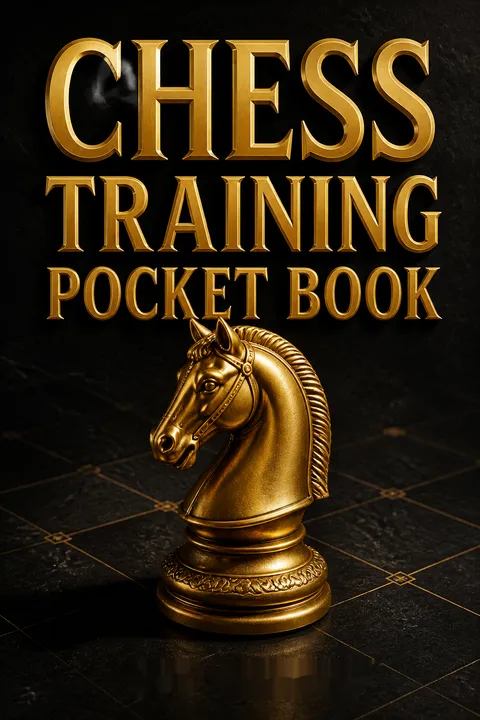
Chess Training Pocket Book is highly regarded by readers for its compilation of 300 essential chess positions and ideas. Many find it educational and helpful for pattern recognition, with varying difficulty levels suitable for intermediate players. The book's small size is praised for portability. Reviewers appreciate the format with diagrams and solutions on facing pages. Some readers have gone through the book multiple times, finding it improves their gameplay. A few mention it's challenging, while one criticizes the cover design. Overall, it's recommended for serious chess players looking to enhance their skills.
People Also Read





Glossary
personal theory
A player's own chess archiveA player's organized, evolving collection of positions that explain ideas in personally useful ways. It can include examples from books and the player's own games, arranged by opening, middlegame, endgame, or theme. The archive is meant to support recognition and original decision-making, and should be revised as some examples become redundant or less useful.
candidate moves
Plausible moves to examineThe moves that appear reasonable enough to deserve serious consideration in a position. Rather than committing immediately to the first attractive idea, the player lists alternatives, calculates the most promising one, and switches if the line becomes unclear or unfavorable. The method reduces tunnel vision and helps allocate analysis time among competing options.
support position
A position reached during calculationAn intermediate position created by a candidate line, which the player studies to decide what happens next. Holding this position clearly in mind helps reveal follow-up moves that are easy to miss while focused on the initial combination. Alburt uses it to encourage accurate visualization and continued analysis after an apparent sequence of exchanges.
Zugzwang
Having to move worsens your positionA situation in which a player would prefer to pass, because every legal move weakens the position. Zugzwang is especially important in endgames, where a King or piece may have no useful waiting move. Alburt uses positions in which one side can maneuver until the opponent must abandon a key square or allow material loss.
Philidor's Position
A drawing Rook ending setupA standard defensive position in a Rook and Pawn versus Rook ending. The defending side keeps its King from advancing in front of the pawn and uses the Rook to give checks from the side when the pawn moves forward. The method offers a practical way to draw, though finding it from an unfamiliar position may require precise play.
Lucena's Position
A winning Rook ending setupA fundamental winning position in a Rook and Pawn versus Rook ending. The stronger side coordinates the King, pawn, and Rook so the Rook can shield the King from checks while the pawn advances. Alburt emphasizes the characteristic bridge-building method and the importance of placing the Rook actively before escorting the pawn.
Rule of the Square
A pawn-catching testA geometric shortcut for judging whether a King can catch a passed pawn. Imagine a square extending from the pawn's current rank to its promotion rank; if the King can enter that square on its move, it can generally catch the pawn, assuming no other pieces change the position. Alburt presents it as a practical endgame reference.
Blind Pigs
Doubled Rooks on the second rankA nickname Alburt attributes to Nimzovich for doubled Rooks that penetrate to the opponent's second rank. Working together, they can attack pawns and create mating threats while exploiting weaknesses near the King. The image emphasizes how dangerous coordinated Rooks become when they reach a rank where they can attack several targets.
Zwischenzug
An in-between moveA surprising intermediate move inserted before an expected recapture, exchange, or continuation. Often it is a check or a threat that changes the position before the opponent can carry out the anticipated sequence. Alburt's examples show why a player should examine forcing replies before automatically completing a familiar exchange.
desparado
A doomed piece making a threatAlburt's spelling for a piece that is likely to be captured but can still create a decisive threat before it disappears. Rather than passively saving the piece, its owner uses the tempo to attack, check, or force a more valuable concession. The concept is especially useful when material is about to be lost and ordinary defense accomplishes little.
Download PDF
Download EPUB
.epub digital book format is ideal for reading ebooks on phones, tablets, and e-readers.








