

Key Takeaways
Make relaxed form, not stronger legs, the foundation of running.
Start with how you move. Danny Dreyer developed ChiRunning after years of running, studying T’ai Chi, and experimenting with pain and efficiency. His teachers emphasized moving from the body’s center while keeping the limbs relaxed. He argues that adding miles or speed to inefficient movement can magnify the strain, while better form can make running feel easier before fitness changes. His goal is not to eliminate effort, but to reduce effort that does not help forward motion.
A suggestive, not definitive, survey. In a 2007 survey, 2,500 respondents who had purchased ChiRunning materials reported their experiences: 95% said running felt easier, and 91% said the method helped prevent injuries. These are self-reports from customers, not proof that the technique prevents injury for every runner.
The book’s useful provocation is to treat running technique as something learnable, rather than assuming that discomfort is simply the price of the sport. That shifts attention from compensating for symptoms toward examining movement. The survey supports the method’s appeal, but its respondents were a self-selected group: only about one in ten customers replied, and there was no comparison group. The broader case for instruction remains strong, while the specific claim of injury prevention requires more rigorous testing.
Lean as one aligned unit, and let gravity assist each step.
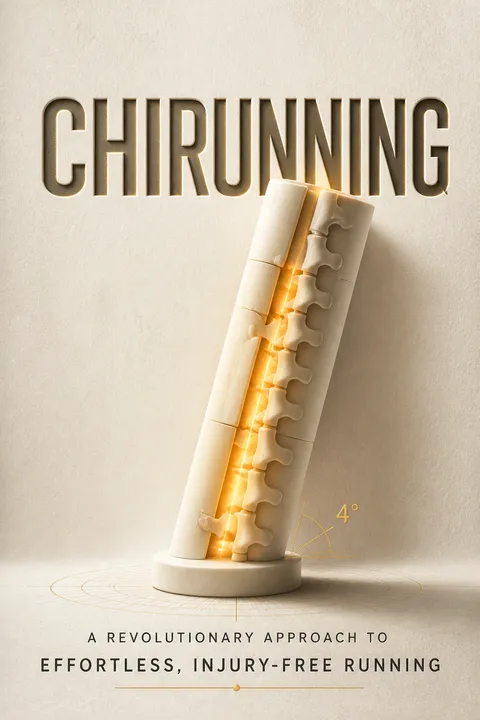
Keep the body organized. ChiRunning calls the upright line from head through torso to feet the Column. The posture should remain aligned as the whole body tips slightly forward from the ankles, rather than folding at the waist. In the book’s model, this small lean moves the center of mass ahead of the supporting foot, so gravity helps carry the runner forward. The legs then take quick supporting steps instead of repeatedly pushing the body ahead.
Land beneath yourself. Reaching forward with the foot can create a braking effect, Dreyer argues. He teaches a soft midfoot landing beneath or slightly behind the body, with the foot moving backward relative to the runner. The lean should be subtle: excessive forward tipping can make the calves and shins tense as they work to prevent a fall.
This is a memorable way to connect posture with mechanics: the aim is not to lean dramatically, but to avoid organizing every step around a reach and push. The distinction between leaning from the ankles and bending at the waist is especially practical. Still, foot strike is not a universal injury switch. Running speed, anatomy, footwear, training history, and comfort all matter. A midfoot landing may suit some runners, but changing a pain-free gait solely to match a prescribed pattern can create new problems.
Let your pelvis rotate so your stride can open behind you.
Connect the legs to the center. Dreyer treats pelvic rotation as a way to coordinate the lower body with the trunk. As one leg travels back, the pelvis is allowed to turn with it, while the shoulders remain generally forward. He identifies the spinal junction T12/L1 as the Pivot Point, a teaching cue for sensing where the lower body’s rotation begins. The pelvis should remain level rather than swaying from side to side.
Learn it at walking speed. The book’s pool-running drill recreates the quick, exaggerated walk children use when trying not to run near a pool. That movement makes the hips’ rotation easier to notice. From there, the runner gradually returns to an easy jog, sensing whether the stride feels freer without forcing the hips to twist.
The value of this cue is coordination, not the promise that one spinal point mechanically powers every stride. Walking drills are a sensible way to explore a movement without the extra demands of running, and trunk-pelvis coordination is relevant across many athletic skills. The risk is over-correcting: a runner who deliberately twists the pelvis or holds it rigidly level may create tension. The cue works best as an invitation to observe movement and comfort, not as a posture rule to impose on every body.
Keep your stride short, and change speed by opening it behind you.
Lift instead of pushing. ChiRunning asks the runner to keep the lower legs relaxed and lift the heels rather than forcefully pushing off with the toes. The book uses a sand-pit drill: run across loose sand and inspect the footprints. Deep craters near the toes suggest pushing off or holding tension; cleaner prints are a sign, in the author’s method, of a softer lift.
Use rhythm as a guide. Dreyer recommends a steady cadence, generally 85 to 90 steps per minute for each leg, while changing speed through stride length. That is about 170 to 180 total steps per minute. He suggests using a metronome and increasing cadence slowly, by one beat per minute each week when needed. In this approach, a quicker rhythm and a short stride are the starting point, not a sprinting style.
The practical strength of this advice is its attack on overstriding: a shorter step can help a runner avoid reaching far ahead and can make rhythm easier to monitor. Cadence is a useful coaching variable, but the book’s target should not be treated as a universal ideal. Natural cadence varies with leg length, speed, terrain, and individual mechanics. Some runners may benefit from a modest increase; others may simply become tense while chasing a number. Comfort and sustainable movement matter more than matching a device.
Build form first, distance second, and speed last.
Let capacity catch up. Dreyer’s training sequence is form, distance, then speed. First, practice the movement at an easy pace. Next, extend the time or distance for which you can maintain it. Only then add faster work. Beginners are advised to start with time rather than mileage, using short run and walk intervals; one suggested pattern is five minutes running followed by one minute walking. The book proposes setting aside 20 to 30 minutes every other day to establish a routine.
Make small upgrades. The author advises against increasing more than two training demands in a week, such as adding speed, distance, or another running day. He gives gradual increases for long runs and intervals, and encourages checking how the body feels before adding more. A breakthrough run is not a reason to immediately raise the next workout’s demands.
This ordering resembles progressive overload in exercise science: tissues and aerobic capacity need time to adapt to increased demands. The key insight is not that speed should be postponed indefinitely, but that training changes should be controlled enough to reveal what the body can tolerate. The book’s exact limits, such as two upgrades per week, are coaching guidelines rather than biological laws. A runner’s recovery, age, health, and training history can make an apparently small increase either reasonable or excessive.
Use bodily sensations as information, not as a dare to push through.
Notice, assess, adjust. Body Sensing is the book’s term for paying attention to physical sensations, judging whether a movement is doing what was intended, and changing it in small increments. A runner might try relaxing the ankles, notice tension in the calves, then reduce the lean or change the foot lift. Dreyer also uses perceived rate of exertion, or PRE, to mean how hard a pace feels, which can vary even when speed stays constant.
Separate adaptation from warning signs. The book distinguishes temporary discomfort during learning or conditioning from pain that suggests something is wrong. It encourages identifying where discomfort occurs and testing gentle form adjustments. It also tells readers to consult health professionals for serious or persistent problems and to stop for chest pain. Pain can be useful information, but it is not a diagnosis.
This approach resembles feedback-based learning: notice a signal, make a small change, and observe the result. That can help runners avoid treating every workout as a test of toughness. The important limit is that pain has many possible causes, including injury, illness, and factors unrelated to form. A sensation that improves after a cue does not prove that the cue fixed its cause. Persistent, worsening, or unusual symptoms deserve professional assessment, especially when they affect ordinary movement.
Train attention, breathing, and relaxation alongside your running mechanics.
Treat attention as a skill. Dreyer groups four capacities under the name Chi-Skills: focusing the mind, sensing the body, breathing deliberately, and relaxing unnecessary tension. These are not separate from technique in his approach. A focused runner notices posture, breathing, and effort, then makes corrections without turning every stride into a conscious checklist. Belly breathing is offered as a way to practice fuller exhalation and a calmer rhythm; the book also suggests trying nose breathing as a check on whether an easy pace feels manageable.
Practice, then let go. The author recommends working on one or two form cues at a time, sometimes using a timer to prompt a check-in. He likens the learning process to practicing an instrument: individual movements become familiar through repetition, then combine more naturally.
The book is strongest when it frames attention as a trainable capacity rather than a motivational slogan. Regular check-ins can make hidden tension or inefficient habits easier to notice. Yet too much internal monitoring can interfere with fluid performance. Motor-learning research often finds that external cues, such as attending to the path ahead, can support movement better than consciously directing each body part. A useful balance is deliberate practice during selected intervals, followed by stretches of relaxed, automatic running.
Change your gears for hills instead of fighting the slope.
Climb with less stride. On moderate uphills, Dreyer advises shortening the stride, leaning into the slope, and using the arms more to reduce the demand on the legs. For very steep hills, he describes turning partly sideways and taking small alternating steps, a technique he calls the Lateral Stride. Walking remains an option when running no longer feels controlled.
Descend without braking hard. On gentle downhills, he recommends relaxing the legs and allowing the stride to lengthen naturally. On steep descents, he advises reducing the lean, taking smaller steps, and using a zigzag when the trail allows. Trails demand quick adjustments to uneven ground, so the book emphasizes soft knees and ankles rather than stiffening up for control. It recommends learning the basic technique on flat ground before adding difficult terrain.
The larger lesson is to match movement to the task. A hill changes the forces and demands of running, so copying flat-ground form mechanically makes little sense. Shortening the stride uphill and controlling speed downhill are intuitive ways to manage effort. The sideways climb is a distinctive option, not a default prescription: it depends on surface, space, balance, and traffic. On technical terrain, safety and stable footing take precedence over preserving a particular cadence or form cue.
Rehearse the course, pace, and logistics before race day.
Prepare for the actual event. Dreyer treats a race as a test of training and planning, not merely a contest of will. He recommends learning the course’s surface, hills, altitude, start conditions, and aid-station arrangements. Training on similar terrain can reduce surprises. He also advises practicing a slower opening pace, rather than letting the starting crowd dictate effort, and rehearsing any food, drink, or equipment intended for race day.
Recover and review. The book places importance on cooling down, drinking to thirst, and reflecting on what felt effective or difficult. Its nutrition chapter favors a gradual shift toward fresh foods, whole grains, fruits, vegetables, and legumes, with less processed food. It also proposes planning meals around training. These are the author’s general preferences, not individualized medical or sports-nutrition guidance.
Specific preparation is a reliable advantage because it reduces avoidable uncertainty: unfamiliar hills, a crowded start, or an untested drink can disrupt even a well-trained runner. The book’s emphasis on reviewing a race as information, rather than a verdict on ability, is equally useful. Its detailed food ratios and hydration advice should be treated more cautiously. Nutrition and fluid needs vary with health, climate, duration, and individual physiology; race preparation is best personalized, especially for endurance events.
Use each run to practice presence, not merely to accumulate miles.
Make movement a practice. Dreyer wants running to develop attention and self-knowledge as well as fitness. A run becomes a recurring opportunity to observe posture, effort, mood, and surroundings, then respond without being ruled by comparison or a fixed time goal. He calls this stance Non-identification: setting aside the ego’s demand to match someone else’s pace and responding to the conditions actually present.
Carry the learning outward. The book extends this approach to walking, daily posture, breathing, and eating. Its story of Eddie, who began running at 56 and gradually took on longer races, illustrates the author’s emphasis on preparation and enjoyment of the process over intimidation by a distant goal. The point is not that every runner should pursue ultradistance, but that small, consistent practice can widen what feels possible.
The book’s deepest contribution may be its insistence that technique can change a person’s relationship with effort. A run can be exercise, but it can also become a structured setting for attention, experimentation, and patience. That transfer is plausible because habits of noticing and adjusting are useful beyond sport. The language of chi gives this experience a spiritual frame, though it should not be confused with a measurable energy source. Readers can retain the practical insight without needing to accept the metaphysics.
Analysis
ChiRunning is part running manual, part memoir of discovery, and part philosophy of movement. Its organizing wager is that many runners rely too heavily on muscular propulsion and too little on alignment, coordination, attention, and patient skill-building. Dreyer builds that case from his own running history and T’ai Chi instruction, then turns it into drills, training plans, troubleshooting advice, and a broader ideal of mindful practice. The narrative helps the method feel embodied: ideas such as a relaxed lower leg become easier to grasp when paired with sand, walking drills, and self-observation.
The strongest practical contribution is pedagogical. The book gives runners a vocabulary for noticing movement, a sequence for practicing changes, and permission to slow down while learning. Its repeated warnings against abrupt transitions are valuable because an unfamiliar gait is itself a training load. Course-specific preparation, gradual mileage increases, and attention to recovery also stand independently of the book’s distinctive theory.
The evidence is less secure than the confidence of the claims. The reported customer survey is self-selected and self-reported, and testimonials cannot separate the method’s effect from coaching, expectation, altered training, or other changes. The book sometimes treats heel striking, muscle use, and injury as if a single form correction explains them. Running injuries are multifactorial, and no foot strike or cadence target suits everyone. Chi is not an established measurable biomechanical force, so its role is most defensible as a traditional explanatory metaphor for integrated movement and attention.
The best reading is neither literal acceptance nor dismissal. Use the drills as experiments, keep cues that improve comfort and efficiency, and change one variable at a time. Treat pain as a reason to investigate, not proof of a technique error. The book’s durable message is that running form can be learned, but its prescribed form is a starting hypothesis rather than a universal law.
People Also Read










Glossary
ChiRunning
Relaxed, alignment-focused runningA running method developed by Danny Dreyer that combines T’ai Chi ideas with running technique. It emphasizes upright alignment, a slight forward lean, relaxed limbs, pelvic rotation, and mindful attention. The method aims to reduce unnecessary muscular effort and make movement more efficient. Its claims about preventing injury should be understood as the author’s approach, not as a guarantee for every runner.
Chi-Skills
Mind-body practice skillsDreyer’s name for four capacities he considers central to learning his running method: focusing attention, sensing bodily movement, breathing deliberately, and relaxing unnecessary tension. He presents them as skills that can be practiced during running and everyday activities, helping a runner notice what is happening and adjust rather than relying only on pace or distance.
Body Sensing
Noticing and adjusting movementA method of paying close attention to physical sensations while moving, assessing whether the body is doing what was intended, and making small adjustments. Dreyer recommends listening without immediately judging sensations as good or bad. The process is meant to help runners recognize tension, discomfort, and changes in effort, although it cannot diagnose the medical cause of pain.
Form Focuses
Technique cues for runningThe book’s name for cues that help runners practice aspects of movement such as posture, leaning, foot lift, pelvic motion, arm swing, and cadence. They are intended to be learned gradually, often one at a time, then combined as they become familiar. Dreyer presents them as practical prompts for improving alignment and reducing unnecessary effort.
Column
Aligned body lineDreyer’s term for the runner’s aligned posture, imagined as a continuous line through the head, torso, hips, and feet. In ChiRunning, this line is meant to remain organized as the whole body tips slightly forward from the ankles. The Column is a teaching image for avoiding a bend at the waist and for coordinating posture with the supporting foot.
Pivot Point
Cue for lower-body rotationThe book’s name for the area around the T12/L1 junction, where the thoracic and lumbar regions of the spine meet. Dreyer uses it as an attention cue for sensing rotation of the pelvis and lower body while the shoulders remain generally forward. The term describes the method’s teaching model rather than a universally accepted single center of running motion.
y’chi
Focused mind-body attentionA term Dreyer uses for directing attention through the eyes toward a point or goal ahead. He suggests that visual focus can organize intention and movement, helping the runner feel drawn forward rather than mentally scattered. The practice is likened to maintaining a clear visual target while moving, not to a separate physical force.
Perceived rate of exertion (PRE)
How hard effort feelsThe book’s term for a runner’s subjective sense of how much effort a pace requires. The same speed can feel easier or harder depending on fatigue, sleep, stress, and other conditions. Dreyer uses PRE to encourage attention to the experience of effort, rather than assuming that pace alone tells the runner how demanding a workout is.
Non-identification
Responding without ego pressureDreyer’s term for setting aside fixed expectations and self-judgments so a runner can respond to present conditions. For example, a runner might choose a slower pace when tired instead of trying to keep up with a group. The method treats this as a way to make decisions based on current capacity rather than comparison or desired results.
Download PDF
Download EPUB
.epub digital book format is ideal for reading ebooks on phones, tablets, and e-readers.








