

Key Takeaways
Treat infrastructure as civilization's shared life-support system
Shared needs create shared systems. Civil engineering provides the common structures and services that let settlements work: roads, bridges, water supplies, drainage, energy systems, and ports. A group can share protection, transport, and clean water more effectively than each household can provide them alone. That practical cooperation is the foundation of infrastructure, from ancient settlements to modern cities.
The boundaries stay blurry. The profession grew out of practical building, scientific investigation, and craft. Its scope has shifted over time, and it still overlaps with architecture, mechanical and electrical engineering, and science. A railway, for instance, depends on civil works, trains, power, and signalling. Most projects are large, visible, and unique, so communication across specialties is part of the work, not an administrative extra.
Infrastructure is easy to notice when it fails and easy to forget when it works. That invisibility can distort public judgment: a road or sewer may appear to be a costly object rather than a shared service that enables other activity. The book's broad definition also resists the temptation to treat engineering as isolated technical expertise. Its scope is determined by interdependence, so good professional boundaries should help specialists collaborate rather than pretend the boundaries are natural.
Expect the ground beneath every project to surprise you
The site is never fully known. Soil and rock vary, and engineers can only infer their properties from investigation and geological history. Soil consists of mineral particles with spaces filled by air or water. In clay, those spaces are tiny, so water escapes slowly. When a building loads clay, the ground can continue settling as water drains away, a process called consolidation that may take centuries in a thick layer.
Pisa makes uncertainty visible. The tower began leaning soon after construction started in 1173 because uneven clay layers settled differently beneath it. By 1990, monitoring showed that its tilt was accelerating. Engineers cautiously removed small amounts of clay from beneath the raised side, bringing the tower back to its earlier inclination and improving its stability. The intervention worked because the team treated the foundation as part of the structure.
The tower is a memorable reminder that a design does not meet a uniform, abstract platform. It meets a particular site whose hidden conditions can change the structure's behavior over time. This shifts the meaning of engineering judgment: calculations matter, but so do investigation, monitoring, and restraint when intervening. The Pisa repair also shows why uncertainty is not a reason to avoid action. It is a reason to make small, informed changes and watch what the system does.
Let each material's weaknesses shape the structure
Materials reward different forms. Stone is strong under compression, which makes arches effective, but an arch pushes sideways and needs firm abutments. Timber can carry compression and tension along its grain, while flexible joints can help timber buildings tolerate shaking. Steel is strong in tension, but long, slender steel members can buckle when compressed. An H-shaped section and shorter unsupported lengths make buckling harder.
Concrete can be tailored. Concrete behaves like artificial rock and can be cast into many shapes, but it is weak in tension. Embedding steel bars gives reinforced concrete tensile capacity. In prestressed concrete, steel cables are tensioned to compress the concrete in advance, allowing it to carry later loads more efficiently. Across these examples, engineering is not simply choosing the strongest material. It is arranging materials and shapes so forces have a safe route through the structure.
This is a practical lesson in matching means to constraints. Materials are not ranked on one scale from weak to strong: their value depends on how they respond to tension, compression, movement, and time. The structural form can compensate for a material's limits, as an arch does for stone or prestressing does for concrete. That logic also discourages technological glamour for its own sake. A material is useful when its behavior fits the job and can be reliably built and maintained.
Keep water clean by managing waste upstream
Water and waste are one system. Cities need dependable water, but used water and sewage can contaminate the same rivers and groundwater people rely on. Ancient towns sometimes built sophisticated drains: Mohenjodaro had brick-lined channels beneath its streets, and Rome used drains and bath water to flush public latrines. Such systems were not adopted everywhere, and in many European cities waste continued to collect in streets.
London learned at terrible cost. As the city grew, sewage entered the Thames, while some drinking water came from the polluted river or wells affected by cesspits. Cholera outbreaks repeatedly killed residents. Engineer Joseph Bazalgette designed intercepting sewers that carried waste downstream, and the construction also created the Victoria and Albert Embankments. The project reduced a major public-health threat while changing the city. Its lesson is not that waste vanishes, but that disposal choices move consequences between people and places.
Water infrastructure reveals an ethical fact hidden inside a technical problem: one community's convenient disposal can become another community's exposure. The story of London makes the cost of treating waste as someone else's problem concrete. It also shows how infrastructure can solve several needs at once, though that does not make the choices value-neutral. Moving waste downstream may protect one place while burdening another. System design must ask who benefits, who bears the risk, and where the material ultimately goes.
Define the need before choosing the bridge
Begin with the real problem. A solution-neutral problem definition describes the need without assuming the answer. If a client asks for a bridge, the underlying need might instead be reliable transport between two communities, or access to services located on one side. A tunnel or another kind of connection could then be considered. The more tightly the client specifies the solution, the less room remains to discover a better fit.
Panama shows the cost of premature certainty. Ferdinand de Lesseps, who had organized the Suez Canal, insisted that the Panama Canal should run at sea level. The region's topography, geology, and climate made that plan a poor match for available technology. Work stalled, financing collapsed, and the original company failed. The canal was eventually built with locks, a lake, and a deep cut through the divide. The need for an ocean link was sound; the imposed form was not.
A well-framed problem creates room for invention without losing sight of what the project must accomplish. Panama distinguishes clarity of purpose from rigidity about means. The risk is that an open-ended brief can become vague, with no agreed test for success. The answer is not to prescribe a bridge at the outset, but to state the required service, constraints, and priorities clearly enough that competing solutions can be judged fairly.
Pair bold concepts with buildable technology and durable organization
A vision needs a route to reality. Civil engineering design links a concept, the technology needed to realize it, and the work of construction. Sydney Opera House began with Jørn Utzon's striking roof concept, but the original thin-shell forms could not be built as drawn without excessive structural demands. Iteration between Utzon and engineer Ove Arup led to a system of concrete ribs and roof sections based on a common spherical geometry. The final building took years and cost far more than the first estimate; political conflict and a breakdown in working relationships also shaped its outcome.
Coordination is part of design. High-speed rail requires compatible track, trains, power, signalling, tunnels, and stations. The Shinkansen succeeded through investment in dedicated routes and coordinated technical systems. Complex projects need clear responsibilities among clients, designers, and constructors, but contracts that push every risk onto one party can encourage blame and expensive caution instead of shared problem-solving.
The Opera House demonstrates that a brilliant image is not yet an engineering solution. The conversion from idea to structure depends on translation between different kinds of expertise, and that translation can be damaged by unstable funding or unclear authority. Contracts can clarify responsibility, but no document can make parties behave as a coherent team. Strong project organization therefore requires both explicit roles and a shared understanding of what the project is trying to achieve.
Design for extreme events without pretending risk disappears
Nature sets the load, not the schedule. Floods, earthquakes, and wind can overwhelm infrastructure, especially when human changes increase exposure. New Orleans, for example, was built in a low-lying delta, and drainage and pumping contributed to land subsidence. When Hurricane Katrina arrived in 2005, levee failures flooded much of the city and disrupted power, roads, water, hospitals, and emergency services.
Probability is not a timetable. A flood described as having a 200-year return period does not arrive on a reliable two-century schedule. The stated probability applies to each year, so a major event can happen in consecutive years. Engineers can use past events to estimate likely loads and design defenses, but they cannot remove risk. The North Sea floods of 1953 prompted major defenses in the Netherlands and southeast England, including barriers designed around estimates of rare tidal surges.
The distinction between probability and schedule matters because people tend to read a long return period as a promise of safety. It is only a description of likelihood, not a countdown. The book also makes clear that natural hazards become disasters through the interaction of exposure, design, maintenance, and preparedness. Defenses reduce risk, but confidence in them can invite settlement in vulnerable places. Sound planning must communicate both the protection provided and the danger that remains.
Build in backups so one failure cannot become catastrophe
Robustness contains damage. A robust structure or system can tolerate the loss of an element without suffering consequences far larger than the original failure. At Ronan Point in 1968, a gas explosion dislodged a wall panel in a high-rise block. The panel's connections were weak, and floors collapsed in succession, killing four residents. The event led to changes in building requirements addressing disproportionate collapse.
People and procedures count too. During construction of the Heathrow Express station tunnels, ground movements were measured, but the warning data were not interpreted until after a collapse. The problem was not just technical: the organization did not turn observation into timely action. A single failed gusset plate also triggered the collapse of Minneapolis's I-35W bridge in 2007. These cases show why redundancy, inspection, competent construction, and clear escalation procedures all belong in a safety design.
A system's safety is only as strong as the links between detecting a problem and responding to it. Monitoring without interpretation is record-keeping, not risk control. Structural redundancy matters, but so does organizational redundancy: more than one person or process may need to notice, challenge, and act on warning signs. The challenge is that extra safeguards have costs and can never cover every imaginable failure. Robustness is best understood as reducing the chance that an ordinary mistake or local defect cascades unchecked.
Judge infrastructure by its full life, not its opening day
Construction is only one cost. Roads, dams, tunnels, and waste facilities have lasting effects on maintenance, energy use, surrounding communities, and the environment. A concrete road may cost more initially than asphalt but have lower full-life costs; repairs and replacement can still be more disruptive. Waste is another long-term obligation: landfills can release harmful gases, and toxic materials can reach soil, water, or food chains if they are not contained.
Sustainability involves choices. The book defines it as meeting current economic, social, and environmental needs without undermining future generations' quality of life. That goal can conflict with immediate convenience or political incentives. The proposed eco-city Dongtan aimed for low emissions, local food, and efficient buildings, but it lacked enough political and financial support to proceed as planned. Infrastructure succeeds only when its social and economic conditions support its environmental ambitions.
A project's opening is a visible milestone, but its less visible obligations may last much longer: upkeep, waste, land use, and exposure to future hazards. Looking across the full life of an asset changes what counts as economical, because the cheapest construction choice may transfer costs to users or future residents. Sustainability is not a single technical score. It requires public decisions about whose needs are prioritized and which long-term burdens are acceptable.
Analysis
The book's deepest argument is that civil engineering is not merely the art of making large objects stand up. It is the practice of making shared life possible under conditions that cannot be fully controlled. That practice joins several kinds of uncertainty: materials do not behave identically, the ground is only partly knowable, extreme events are rare but consequential, and organizations can fail to act on information they possess.
The strongest examples expose the distance between a structure's visible form and the system that sustains it. The leaning tower is not just a masonry curiosity, but a record of uneven soil and changing stability. London's sewers are not simply underground channels, but a public-health intervention shaped by where a city sends its waste. A bridge collapse may begin with one component, yet the scale of the disaster depends on whether the wider structure and its operators can contain the damage.
This perspective also changes how engineering success should be judged. A technically elegant design can fail if it cannot be built, funded, maintained, or governed. Conversely, a robust solution may be less visually dramatic because its achievement lies in preventing cascading harm. That makes civil engineering a political and ethical practice as well as a technical one: decisions about protection, cost, and environmental change distribute benefits and risks among people who may have little say in the project.
The book's caution is especially valuable where confidence is mistaken for control. Defenses can reduce the damage of floods and earthquakes, but they cannot erase the forces involved. The sensible goal is therefore not perfection, but systems that can be inspected, understood, repaired, and adapted when assumptions prove wrong. Its central measure of engineering maturity is not whether a project looks certain on paper, but whether it remains useful and safe when reality refuses to follow the plan.
Review Summary
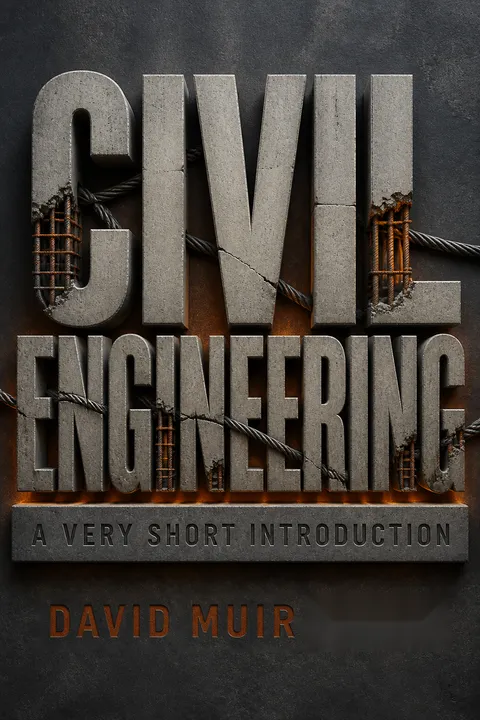
Civil Engineering: A Very Short Introduction receives mixed reviews, with an average rating of 3.59/5. Readers appreciate its concise overview of the field, including historical context, key concepts, and examples of major projects. The book is praised for its readability and broad scope. Some criticize it for lacking depth in certain areas or focusing too much on specific topics. Overall, it's considered a good introductory text for those interested in civil engineering, though opinions vary on its effectiveness in covering all aspects of the field.
Glossary
solution-neutral problem definition
Need stated without prescribing meansA description of the purpose or need behind a project that does not assume a particular solution. Instead of beginning with a demand for a bridge, for example, it might define the need as a dependable connection between communities. This gives designers room to compare bridges, tunnels, or other ways of meeting the goal.
designer soils
Soils prepared for a purposeSoils selected, processed, or compacted to provide particular engineering properties. Unlike naturally occurring ground, whose exact behavior may be uncertain, a road embankment or earth dam can be built from prepared soil chosen to meet design needs. The term emphasizes that soil can be an engineered construction material, not merely something encountered at a site.
prestressed concrete
Concrete compressed before loadingConcrete reinforced with steel cables or rods that are tensioned before the structure carries its working loads. The stretched steel compresses the concrete in advance, helping it resist the tensile forces that would otherwise cause cracking. The amount and position of the prestress must be chosen for the loads the structure may experience.
robustness
Ability to contain failureThe capacity of a structure or system to remain acceptably safe when one or more components stop working. Structural robustness limits disproportionate collapse after local damage. Organizational robustness means the project is not unduly threatened by failures in communication, construction quality, monitoring, or decision-making.
progressive failure
Local damage spreading outwardA sequence in which a limited initial failure causes other parts of a structure to fail in turn, producing damage much greater than the original event. The collapse at Ronan Point began when a gas explosion dislodged a wall panel. Weak connections allowed floors above and below to collapse successively.
volume loss
Ground removed beyond the tunnelThe proportion of a tunnel's volume that is unintentionally lost as excavation causes surrounding ground to move into the opening. This movement can produce settlement at the surface or affect nearby structures. A smaller volume loss generally indicates better control of the tunnelling process.
observational methods of design
Adjust design using observed behaviorA design approach that recognizes uncertainty by observing how the structure or ground actually behaves during construction, then choosing among prepared responses. In tunnelling, engineers may use different levels of support depending on ground movement. The method requires reliable monitoring, timely interpretation, and options that can be applied before conditions become unsafe.
tuned mass damper
Mass that reduces building swayA heavy mass connected to a structure through damping devices and designed to move at a frequency close to the structure's own. Its motion helps reduce oscillation caused by wind or earthquakes. Taipei 101 uses a suspended steel sphere weighing 730 tonnes as a visible example of this system.
Download PDF
Download EPUB
.epub digital book format is ideal for reading ebooks on phones, tablets, and e-readers.








