

Key Takeaways
The book predicts an ethnic breakup, turning demographic change into a countdown to war
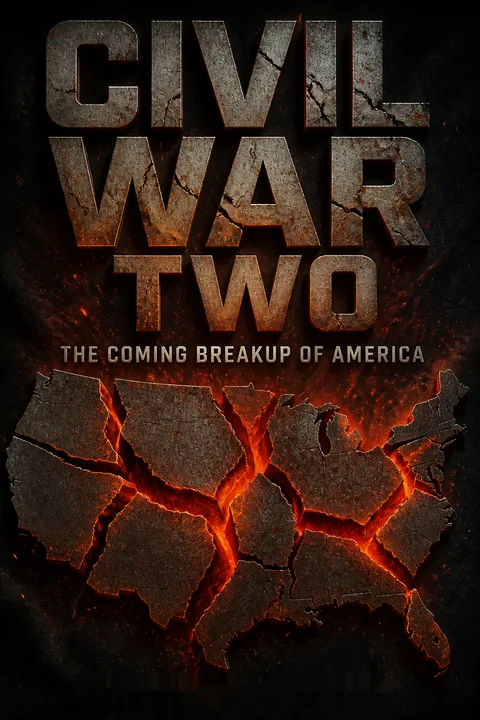
The central forecast. Published in 1996, Chittum argues that the United States is an empire rather than a durable nation, and predicts its breakup into a Hispanic Southwest, a Black South, and a predominantly white North. He imagines urban warfare, mass displacement, food collapse, and ethnic cleansing. His explanation is demographic diversity: as the historically dominant white share declines, he says, the state will lose the force holding it together.
Prediction, not finding. He draws on the Soviet and Yugoslav breakups and presents American civil war as nearly inevitable. But the book offers a polemical scenario, not evidence of a general law connecting diversity to state collapse. Its main claim is best read as the organizing alarm of the book, not as an established forecast.
What's striking is how the book turns a possible risk into a certainty. That move gives the argument urgency, but it also makes counterevidence difficult to register: any sign of integration can be dismissed as temporary, while any conflict confirms the forecast. Political stability depends on more than population categories. State capacity, fair institutions, shared rights, and peaceful ways to resolve disputes can all shape whether diversity becomes a source of cooperation or a political fault line.
Read demographic change as political context, not proof of inevitable national collapse
Numbers become a narrative. Chittum cites 1992 population figures and Census Bureau projections for 2050, which he understood to show a declining white share and a growing Hispanic, Black, and Asian population. He interprets this shift as evidence that the United States is moving from a stable nation toward a fragile empire. He also frames changes in immigration and language use as signs of replacement rather than ordinary features of a changing society.
A projection is conditional. The figures in the book are estimates made in the 1990s, not present-day measurements or proof of what later happened. More importantly, population shares alone cannot establish whether a country will remain democratic or cohesive. The book treats demographic change as a countdown, when the political meaning of change depends on laws, institutions, and public choices.
Demography matters because it changes electoral coalitions, labor markets, language needs, and ideas of national identity. It does not, by itself, dictate conflict. The key analytical question is how groups experience institutions: do people believe their rights are secure, can they influence policy, and do they trust elections to settle disputes? Treating population change as a zero-sum contest can itself harden group boundaries. That risk is real, but it is different from proving that demographic diversity inevitably produces war.
A state loses legitimacy when law and protection appear selectively distributed
The book's tiered society. Chittum describes an emerging hierarchy in which international officials and wealthy elites sit above ordinary citizens, while racial and economic groups receive different rights and opportunities. He treats diplomatic immunity, affirmative action, immigration policy, international agreements, and gun restrictions as signs that American citizenship is being displaced by an imperial system. He also points to police militarization and the use of armored vehicles during the 1992 Los Angeles unrest as evidence that domestic policing is becoming more warlike.
The underlying concern. Beneath the book's inflammatory claims is a recognizable question: what happens when people believe rules protect some groups but not others? Chittum often presents contested policies as parts of a coordinated plot, without establishing that connection. Still, his focus on perceived unfairness identifies a genuine pressure on political trust.
Political legitimacy is partly practical and partly perceptual. A government may follow formal procedures yet lose trust if citizens see enforcement as inconsistent or protection as unequal. The book usefully draws attention to that gap, but its own framework undermines the principle it invokes by describing whole racial groups as unified political camps. A stronger analysis would ask which policies are unfair, who is affected, and what remedies work, rather than treating demographic categories as evidence of a hidden imperial design.
Treat borderland identities as political questions, not evidence of an invasion
The Southwest scenario. Chittum predicts that migration, a growing Spanish-speaking population, and changing local politics will turn the Southwest into a de facto Mexican province, which he calls a “Reconquista.” He points to the proposed homeland name “Aztlan,” the history of the region, and Mexican political statements as signs of a future separatist movement. He then predicts that unrest in Mexico could send refugees north and lead to cross-border military conflict.
Prediction built on suspicion. The argument repeatedly treats bilingualism, immigration, and cultural connection across the border as evidence of impending conquest. It also draws on the Mexican Revolution of 1910 to 1920 to emphasize the possibility of violence. Those episodes provide context for the author's fears, but they do not demonstrate that migrants or Mexican Americans share a separatist or military agenda.
Border regions often have layered identities, economic ties, and family networks that cross national lines. Those connections can create political tensions, but they can also support trade and social stability. The book collapses these possibilities into one story of territorial return, making ordinary cultural change look like military preparation. A more careful approach separates documented political movements from the much larger population whose language, ancestry, or migration history does not establish any particular political allegiance.
Do not mistake racial blocs in a scenario for unified political actors
Three imagined regions. The book sketches different futures for the South and North. It predicts that Black political control in the Deep South could lead to secession, while white residents might flee or form enclaves. In the North, it imagines conflict between Black-controlled cities and largely white suburbs. Chittum describes possible armed clashes, federal intervention, and mass violence, and argues that the outcomes would depend partly on population shares and the timing of conflict.
A racial map is not a forecast. These scenarios treat millions of people as if ancestry determined their political goals and loyalties. They also rely on claims about future voting, migration, and violence that the book does not demonstrate. Its descriptions of ethnic cleansing and total war are warnings within the author's model, not reliable predictions about how Black or white communities would act.
Group-level analysis can reveal how exclusion, segregation, or unequal power shape political life. But categories become misleading when they are treated as internally uniform. People within any racial group differ in class, religion, region, ideology, and interest, and alliances often cross the boundaries a map makes look fixed. The book is strongest when it asks how concentrated political power could exclude a minority. It is weakest when it assumes that ancestry alone can predict collective action.
When public institutions retreat, informal armed groups can acquire political authority
From gangs to militias. Chittum surveys military and police organizations, street gangs, private security groups, religious organizations, and civilian militias. He argues that gangs could become political forces because they have local networks, money, discipline, and weapons. To support this concern, he discusses armed groups in Bosnia and Chechnya, where criminal or local formations took on military roles during state breakdown. He also points to gang involvement in politics and claims of gang infiltration into police and military institutions.
Capacity is not destiny. The book's central warning is that a vacuum in public authority can be filled by organizations already able to enforce rules or provide protection. It does not follow that gangs automatically become armies, or that every militia is a precursor to civil war. The examples show a potential pathway, not a universal pattern.
The connection between governance and informal authority is important. When institutions cannot provide safety, services, or fair treatment, people may depend on local networks that can. Those networks can be protective, coercive, or both. The challenge is to distinguish community organization from armed domination, rather than treating every non-state group as equivalent. Effective, trusted local policing and accountable government reduce the space in which violent groups can claim to be the only providers of order.
Use escalation models to test warning signs, not certify a prophecy
Four proposed phases. Chittum organizes his forecast into a sequence: a foundational period of social and political change, a terrorist phase, a guerrilla phase, and finally continuous open warfare. He places the 1990s in the second phase and treats riots, militia activity, and political violence as evidence of movement toward the next stages. He interprets the Waco siege, Ruby Ridge killings, and Oklahoma City bombing as connected signs of a country entering a period of reciprocal escalation.
The sequence is a lens. This framework helps explain how the author connects events that might otherwise seem unrelated. But it does not establish that each stage must follow the previous one. In particular, the book treats disputed events as proof of a single coordinated process, rather than testing alternative explanations or specifying what evidence would disconfirm its forecast.
Escalation models can be useful for scenario planning because they make analysts ask what changes when protest becomes organized violence or when security forces lose public trust. Their value depends on clear indicators and the possibility of being wrong. Here, the phase labels risk turning a flexible interpretive scheme into a self-sealing prophecy. A careful reader can preserve the useful question, whether events are reinforcing one another, while asking what evidence would show that the pattern is not advancing.
Compare plural societies by institutions and power-sharing, not ethnic percentages alone
Europe as evidence. Chittum compares European countries by the size of their largest ethnic groups and their experience of conflict. He uses Bosnia, Yugoslavia, and the Soviet breakup to argue that multiethnic states are especially unstable. He also discusses Belgium and Switzerland as counterexamples, noting their systems of regional autonomy and shared or decentralized authority. From those cases, he suggests that local control can reduce friction when communities have distinct languages or identities.
Comparison has limits. The book's tables present ethnic percentages alongside conflict, but correlation does not prove that diversity caused war. The countries differ in history, political institutions, external pressures, and state capacity. Chittum's account gives less weight to those factors than to ethnic composition, even when his own examples suggest that institutional design and power-sharing matter.
The institutional comparison is one of the book's more constructive threads. Federal arrangements, local autonomy, and credible minority protections can give groups meaningful influence without requiring borders to be redrawn. Yet autonomy is not a cure-all: it can protect local self-rule, or entrench divisions and empower local strongmen. The important question is whether institutions make political losses tolerable and rights dependable. That question offers more practical insight than treating a country's ethnic percentages as a forecast of its survival.
Build civic resilience instead of preparing for the book's racialized endgame
The author's response. Chittum ranks a second civil war and territorial breakup as more likely than successful reform. He urges readers to monitor political and demographic changes, consider where they live and work, and prepare for disruptions. He also proposes constitutional reforms and local committees focused on public affairs and self-defense. Some of his preparation advice centers on armed confrontation, reflecting his assumption that ethnic conflict is nearly unavoidable.
The safer lesson. The book's fatalism makes individual withdrawal seem more realistic than collective problem-solving. A reader can retain the useful idea of thinking about local resilience without accepting the racial premise or military prescriptions: communities benefit from trusted communication, emergency planning, fair law enforcement, and peaceful ways to contest policy. Those measures address instability without treating neighbors as future enemies.
Preparation is most valuable when it lowers shared risk rather than sharpening suspicion. Emergency planning, local trust, and accountable public services help in many kinds of disruption, while narratives of inevitable group conflict can make ordinary political disagreement feel existential. The book's call for reform sits uneasily beside its conviction that reform is unlikely to matter. That tension is worth noticing: if collective action is dismissed in advance, the forecast can become part of the problem it claims only to describe.
Analysis
Civil War Two is a 1996 political polemic built around a stark forecast: demographic diversity will transform the United States from a nation into an empire, and the empire will break apart in ethnic war. The book's narrative moves from a broad theory of state instability to regional maps, armed-group scenarios, a four-phase timeline, and advice for individual survival. Its force comes from accumulation. Riots, immigration, policing, gangs, treaties, and economic pressures are presented as pieces of one approaching catastrophe.
That structure is also its central weakness. The book often treats its assumptions as evidence: racial categories stand in for political loyalties, demographic projections become measures of national survival, and episodes of violence are folded into a single causal story. Its predictions are frequently specific, but specificity is not the same as reliability. The text does not offer a consistent way to test its claims against alternatives, and it tends to interpret contrary developments as delay or concealment rather than disconfirmation.
The most durable value lies in the questions beneath the polemic. Can citizens trust that law applies fairly? What happens when people lose confidence in elections, policing, or public services? Can decentralized institutions protect local identities while preserving shared rights? Chittum's own comparative discussion of Belgium and Switzerland gestures toward power-sharing, even as his wider argument favors racial separation. That contradiction matters: the book both warns that political exclusion can fracture a state and imagines whole populations as fixed antagonists.
Read today, the work is best approached as evidence of 1990s anxieties about immigration, state authority, and social change, not as a dependable guide to America's future. Its alarmist language and racialized forecasts should be distinguished from its more general insight that legitimacy and institutional trust matter. The practical task is to examine those pressures without accepting the book's claim that conflict between racial groups is inevitable.
Review Summary
Civil War II receives mixed reviews (3.56/5). Supporters praise its prescient analysis of ethnic tension, immigration, and potential civil conflict in America, calling it disturbingly prophetic given current events. Readers value Chittum's military background and practical insights about multi-ethnic civil wars. Critics condemn it as racist, poorly proofread, and overly focused on Mexican reconquista scenarios. Some find it boring or mediocre in historical analysis. Many acknowledge reading it due to recent social unrest, with several hoping the author's predictions prove wrong despite finding the analysis compelling.
People Also Read
Glossary
Empire
Diverse populations under dominationChittum uses empire for a large, diverse political system in which one group rules others through superior power rather than a shared national identity. He argues that such systems are inherently unstable and depend on coercion. This is the book's definition and argument, not a neutral consensus that diverse states must be undemocratic or short-lived.
Nation
A shared national communityIn Chittum's contrast, a nation is a political community dominated by a majority group whose members recognize one another as belonging together. He presents this shared identity as a basis for stability. The book sharply contrasts nation with empire, but this framing treats national identity as more uniform and politically decisive than it often is.
Reconquista
Claimed recovery of territoryChittum uses Reconquista to describe his prediction that Hispanic and Mexican American populations would politically and culturally transform the American Southwest, which he imagined might eventually separate from the United States or join Mexico. The term invokes historical reconquest, making migration and demographic change part of a territorial-conflict narrative that the book does not establish as fact.
Aztlan
Proposed Hispanic homelandThe book describes Aztlan as a name used by a Chicano campus group advocating an independent Hispanic nation in the American Southwest. Chittum treats the idea as evidence of a potential separatist project. The term refers to a political and cultural concept, but its mention does not establish that Hispanic Americans generally support secession or share a single political identity.
Four Phases of Civil War II
A staged conflict forecastChittum's framework divides his predicted conflict into a foundational phase of social change, a terrorist phase, a guerrilla warfare phase, and an all-out warfare phase. He uses the stages to connect developments such as riots, political violence, and militia activity. The framework organizes his forecast; it does not establish that these events form a necessary or empirically validated sequence.
Bandenkreig
Anarchy among armed bandsChittum uses Bandenkreig, his spelling of a German term, for a breakdown into independent armed groups fighting over resources and survival after organized government collapses. He distinguishes it from organized guerrilla warfare, which has a political or military structure. His examples include conflicts in Africa and the Balkans, which he presents as warnings about possible social collapse.
Mao Tse-tung's Rules for Revolution
Three conditions for guerrillasChittum summarizes three conditions that he attributes to Mao's theory of guerrilla warfare: support from a significant portion of the population, secure places for guerrillas to operate, and ongoing assistance from a foreign government. He uses this model to assess the potential of insurgent movements. It is a strategic framework discussed by the book, not evidence that any American group meets those conditions.
Download PDF
Download EPUB
.epub digital book format is ideal for reading ebooks on phones, tablets, and e-readers.








