

Key Takeaways
Treat every tenth of a degree as worth preventing, not as a lost cause.
The outlook has improved. Under policies already in force, warming is projected at roughly 2.5°C to 3°C by 2100. If countries meet their net-zero pledges, projections fall to about 1.8°C. The 1.5°C goal is no longer realistic, but that does not make further action pointless. Each increment of warming adds risk, so 2.1°C is better than 2.5°C, even if neither is safe.
No single planetary cliff. Tipping points are thresholds at which particular systems, such as coral reefs or ice sheets, risk lasting change. They do not all trigger together or suddenly turn the whole planet into a runaway greenhouse. Some changes unfold over centuries. Reducing emissions still limits the damage and gives societies more time to adapt.
What's valuable here is the distinction between a missed target and a futile effort. Climate risk is not a pass-or-fail exam: lower warming generally means less harm, even after an ambitious threshold has slipped out of reach. That framing can support honest communication without turning optimism into reassurance. The counterweight is equally important: a better trajectory than the old worst-case scenarios is not a good outcome. Progress should be measured against avoidable harm, not against the most frightening forecast.
Turn hidden public support into permission for durable climate policy.
The quiet majority matters. Surveys covering 63 countries found that 86% considered human-caused climate change a serious threat, and nearly three-quarters supported climate policies. Another survey across 125 countries found that 89% wanted more political action. People also underestimate how many others agree: Americans guessed that only about a third supported climate action, when the real share was roughly twice that.
Support needs a signal. Clean energy can attract people for different reasons: climate protection, cheaper power, or greater energy independence. Personal choices and public policy reinforce each other. People using public transport, buying electric cars, or installing heat pumps show that demand exists; that evidence can encourage companies and governments to invest. Communication works best when it emphasizes practical benefits and local concerns, not guilt or catastrophe.
What's striking is that perceived opinion can become a political constraint even when actual opinion is more favorable. If citizens assume they are isolated, they speak less; leaders then mistake silence for opposition. Visible local examples can interrupt that loop. The book also avoids treating public support as a blank cheque: climate change rarely outranks immediate concerns such as household costs or health care. Durable policy therefore has to make the transition feel useful in daily life, not simply morally correct.
Judge clean technology against fossil systems, not an imaginary zero-impact world.
Perfect is the wrong test. The author calls the expectation of solutions with no environmental or social costs “perfect solutionism.” Solar panels require mining and manufacturing; wind turbines affect landscapes and wildlife. Those impacts matter, but judging them against a world with no energy use is misleading. The practical comparison is with the energy system people would otherwise use, mostly fossil fuels.
Ask what the numbers mean. Life-cycle analysis estimates impacts across a product’s supply chain, including materials, manufacturing, and operation. The book’s broader fact-checking method asks whether a number is large in context, what alternative it is being compared with, how recent the evidence is, and how the technology could change. Those questions help distinguish a real trade-off from a dramatic image or an outdated claim.
This is a powerful correction to a common reasoning error: comparing an imperfect option with an imaginary impact-free alternative. It also treats criticism as potentially useful rather than automatically dishonest, since many misleading claims begin with a genuine cost. The discipline is to keep the cost visible while choosing a fair baseline. One caution: aggregate comparisons can hide who bears a local burden. A lower overall footprint does not settle questions about a specific community, habitat, or worker.
Electrification makes the replacement job smaller than the fossil-fuel bill.
Burning wastes energy. A coal power plant turns only about one-third of its fuel energy into electricity; much of the rest escapes as heat. Gas plants waste roughly half. Electric cars use about one-quarter to one-third as much energy per mile as gasoline cars, while heat pumps move heat rather than generating it directly. Across sectors that can be electrified, total energy demand could fall by around 40%, even as electricity use rises.
The transition is already measurable. In 2022, renewables met 92% of the increase in global electricity demand. Some countries are replacing fossil fuels; others are using clean power to meet new demand while fossil fuel use still grows. That distinction matters. Solar, wind, and batteries are expanding rapidly, but the speed of the full transition depends on how quickly deployment exceeds growth in energy demand.
The most useful mental shift is from replacing fuels unit for unit to replacing the services people need: mobility, heat, and power. Electrification often provides the same service with less energy, so the scale of new clean generation can be smaller than fossil-fuel totals suggest. Still, efficiency does not erase the need to build. Growing electricity demand is compatible with falling total energy use, but only if grids and clean generation keep pace.
Build grids, storage, and skilled crews alongside generation.
Power needs a pathway. Around the world, ready-to-build solar and wind projects waiting for grid connections amount to five times the capacity added in 2022. In the United States, the connection queue represents roughly twice the power of the existing grid. New projects cannot help households if transmission lines, permits, or trained workers are missing.
Balance changes over time. Batteries can handle short fluctuations, while transmission links can move electricity between places with different weather. Pumped hydropower, heat storage, and other technologies can help over longer periods. Countries will need different combinations, including reliable low-carbon sources such as hydropower or nuclear where they make sense. Smart charging can also shift electric-car demand toward hours with abundant power. There is no single storage recipe for every grid.
This makes infrastructure a central climate solution, not a supporting detail. A solar farm without a connection is an investment waiting in a queue, and a heat pump rollout without installers is a promise without capacity. The same principle applies to permitting and workforce training: institutions shape how quickly technology becomes useful. The challenge is not simply to build more, but to coordinate generation, delivery, storage, and demand so that reliability is maintained.
Count the whole footprint, while refusing to excuse genuine local harm.
The comparisons favor low-carbon power. Including mining and manufacturing, solar produces about 19 times less carbon dioxide per unit of electricity than coal; onshore wind produces about 84 times less. Coal also requires around 30 times more mining than renewables in the comparison described in the book, largely because fuel must be extracted continuously. It produces nearly 50 times more waste than solar and 500 times more than wind.
Lower impact is not no impact. Wind farms can kill birds and bats, and mineral extraction can threaten workers, water supplies, and local communities. The author points to ways to reduce some harms, from changing turbine operation during risky conditions to improving recycling and supply-chain oversight. The relevant question is not whether clean technologies are perfect, but whether their impacts can be reduced while avoiding the larger harms of fossil fuels.
What's persuasive is the insistence on comparing complete systems rather than isolated components. A coal plant’s footprint includes its fuel supply and waste, not just the structure; a renewable system also deserves a full accounting. But the totals cannot stand in for local consent or protection. A policy can be beneficial overall and still distribute costs unfairly. Responsible deployment requires both the broad comparison and attention to the people and ecosystems nearest to the project.
Electrify transport and heating, but make the affordable choice accessible.
The technologies work, with conditions. Electric cars have higher manufacturing emissions than gasoline cars, but their lifetime emissions are lower in the countries examined: about two-thirds lower in the United States and nearly 70% lower in Europe. The manufacturing “carbon debt” is generally repaid after roughly one to three years of average driving. Electric cars also eliminate tailpipe pollution. Heat pumps work in cold climates; measured performance between 5°C and -10°C averaged a coefficient of performance of about 2.7, meaning 2.7 units of heat for each unit of electricity.
Access shapes adoption. Electric cars can cost less to run, but buying one and finding reliable charging can still be difficult. Heat pumps often save on running costs, yet their upfront price remains a real barrier, especially for lower-income households. Better public charging, grants, fair electricity pricing, insulation, and skilled installation matter as much as technical performance.
The book’s strongest consumer argument is that performance and affordability are separate questions. A technology can be effective in principle yet inaccessible in practice because of upfront costs, housing, or charging arrangements. That distinction avoids blaming households for not adopting options they cannot reasonably reach. It also clarifies where policy can help: reduce initial barriers and improve shared infrastructure, rather than relying on individual enthusiasm to overcome structural disadvantages.
Cut animal-product demand to free land rather than expand farms.
Livestock uses land inefficiently. About three-quarters of agricultural land is used for grazing or growing animal feed, while animal products provide 18% of the world’s calories and 37% of its protein. Animals lose much of the food energy they consume: for every 100 calories fed to cattle, only about three return as calories for people. A study cited in the book found that a plant-based global diet could reduce agricultural land use by 75%, including cropland.
Shifts need not be all or nothing. Eating less meat and dairy, especially beef and lamb, can reduce pressure on land without requiring everyone to become vegan. Plant-based meat substitutes generally emit much less than beef and lamb, though they usually cost more than meat and are more processed than beans or lentils. Their nutrition varies by product, so labels and a balanced diet still matter.
Food is a climate lever that is unusually close to daily choice, yet the land numbers reverse a familiar intuition: feeding crops to animals can require more land than growing food for people directly. The practical case is strongest when it avoids a purity test. Traditional legumes are inexpensive options, while substitute products may help people change familiar meals. The transition also depends on prices and culture, so improved products and wider availability matter alongside individual decisions.
Make the clean-energy race deliver development, jobs, and mineral justice.
Energy access comes first. Poorer countries need reliable energy to improve living standards, but that does not mean they must follow the same fossil-fuel path taken by rich countries. The book notes that sub-Saharan African countries, excluding South Africa, contain 14% of the global population but emit 0.6% of global carbon dioxide. Rich countries should avoid dictating development choices while providing fairer finance and helping make clean technologies cheaper.
A fair transition needs workers and suppliers. Clean-energy employment had already overtaken fossil-fuel employment globally by 2021, but workers and fossil-dependent communities still need retraining and support. Mineral extraction also creates serious exploitation risks. Replacing a problematic mineral can help, but indiscriminate boycotts can deprive poor mining communities of livelihoods. Better standards, traceable supply chains, and recycling address the conditions as well as the demand.
The argument widens climate policy from emissions accounting to distribution: who gained from past energy use, who can finance new systems, and who bears the costs of extraction or industrial change. That makes fairness a practical condition of durable progress, not a decorative add-on. A just transition cannot promise that every worker keeps the same job or wages, but it can plan for retraining and regional investment before closures. Likewise, ethical sourcing must improve livelihoods rather than simply move demand elsewhere.
Use carbon removal for residual emissions, never as permission to keep emitting.
Some sectors are harder to decarbonize. Cement releases carbon dioxide through the chemistry of making it, while steel can replace coal with hydrogen or electricity but would require enormous additional power. Aviation and long-distance shipping face costly fuel choices. Options include using less cement, developing alternative production methods, and scaling low-carbon fuels; none is an effortless substitute.
Removal is a backstop, not the main plan. Many pathways assume emissions fall by roughly 85%, leaving a residual amount for carbon removal. Direct air capture currently removes around 10,000 tonnes per year, tiny beside the billions of tonnes some pathways may require. Carbon capture at industrial sites may help selected sectors, but cannot replace broad emission cuts. Solar geoengineering could cool the planet, but uncertain effects on rainfall and other systems make research, not deployment, the prudent position in the book.
This closing distinction separates cleanup from prevention. Carbon removal may be necessary for emissions that remain difficult to eliminate, but its present scale is nowhere near the task imagined in long-term plans. Treating future removal as a license to delay cuts would convert a possible tool into a source of false confidence. Solar geoengineering presents a different governance problem: a relatively accessible intervention could affect people unevenly, so scientific uncertainty and international decision-making matter as much as technical feasibility.
Analysis
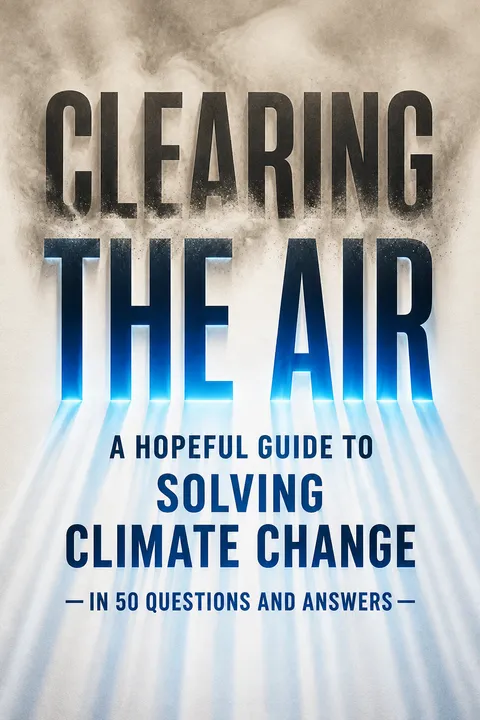
Clearing the Air is an evidence-led guide to climate solutions structured around objections rather than a single master plan. That choice suits its central problem: public debate often presents a technology’s drawback as if it disproves the entire transition. Ritchie repeatedly restores the missing denominator, baseline, or time horizon. A wind-turbine photograph becomes less informative than waste per unit of electricity; an electric car’s battery emissions become a lifecycle comparison; a small country’s emissions become meaningful when small emitters are counted together.
The book’s optimism is strongest when it is conditional. Solar, wind, batteries, and electric vehicles have improved quickly, but deployment depends on grids, permitting, financing, and skilled labor. Those constraints are not mere footnotes to technological progress. They are part of the technology’s real-world performance. A cheap panel that cannot connect to the grid, or a heat pump that a household cannot afford to install, does not yet deliver its promised benefit.
The framework also avoids two political traps. It rejects the idea that personal behavior alone can solve a structural problem, while refusing the opposite claim that individual choices are irrelevant. Public demand, policy, and investment shape one another. And it treats trade-offs as problems to manage rather than reasons to abandon improvement. That is a more demanding form of hope than either technological triumphalism or despair.
The main limitation of a question-and-answer rebuttal is that correcting a misconception can make implementation appear more settled than it is. Forecasts depend on policy, prices, and construction capacity; global averages can obscure concentrated local harms. The book’s own evidence supports a careful conclusion: climate change is technically addressable, but success is neither automatic nor evenly distributed. The right response is to build proven options quickly, fund emerging ones selectively, and scrutinize who benefits and who bears the costs.
Review Summary
Glossary
Perfect solutionism
Demand for impact-free solutionsThe expectation that climate solutions must have no environmental or social costs. The book argues that this standard is unrealistic and can block useful action. A more practical assessment compares a technology with the fossil-fuel system or other available alternatives, while still acknowledging and reducing its harms.
Life-cycle analysis
Full supply-chain impact assessmentA method for estimating the environmental impacts of a product or energy source across its life cycle. It can include mining, manufacturing, transportation, operation, and disposal. In the book, it is used to compare technologies on a consistent basis rather than counting only the emissions produced while they operate.
Energy return on investment (EROI)
Energy gained per energy investedA measure of how much usable energy an energy source provides compared with the energy required to build, fuel, and maintain it. An EROI above one means more energy is returned than invested. The book uses this measure to explain why using fossil fuels to build renewable infrastructure does not make the transition self-defeating.
Coefficient of performance (COP)
Heat produced per electricity unitA measure of heat-pump efficiency, calculated by comparing the heat delivered with the electricity consumed. A COP of 3 means that one unit of electricity enables the pump to provide three units of heat. Performance varies with conditions, especially outdoor temperature, but a COP above one can still outperform direct electric heating.
Vehicle-to-grid (V2G)
Cars supporting the electricity gridA system in which electric vehicles communicate with the electricity grid and can charge when power is abundant or inexpensive, then return stored electricity when demand is high. Drivers can set limits so their cars remain ready for travel. The book presents V2G as a potential way to make electric cars useful for grid balancing.
Carbon capture and storage (CCS)
Capturing emissions before releaseTechnology that captures carbon dioxide from an industrial facility or power plant before it reaches the atmosphere, then transports and stores it, usually underground. It differs from carbon removal, which takes carbon dioxide already in the atmosphere and stores it. The book sees CCS as a possible targeted tool, not a substitute for reducing fossil-fuel use.
Carbon removal
Taking carbon dioxide from airMethods that remove carbon dioxide already present in the atmosphere and store it for a period of time. Approaches discussed in the book include ecosystem restoration and direct air capture, which uses machines to extract carbon dioxide from air. Removal may help manage emissions that remain difficult to eliminate, but current capacity is far below projected needs.
Solar geoengineering
Reflecting sunlight to cool EarthProposed interventions that aim to cool the planet by reducing the sunlight reaching Earth, including putting reflective particles into the stratosphere or brightening marine clouds. The book distinguishes this from cutting greenhouse-gas emissions: cooling would not solve ocean acidification or fossil-fuel air pollution. It supports limited research, not deployment, because climate effects remain uncertain.
Tipping points
Thresholds for lasting system changeThresholds beyond which a particular climate or ecological system risks shifting into a substantially different state. Examples discussed include coral reefs, rainforests, and ice sheets. The book emphasizes that these are not one global switch: different systems have different thresholds, and their consequences do not automatically trigger runaway warming across the planet.
Moral licensing
Small good deeds excuse larger harmsA behavior in which completing a minor positive action creates a sense of having done enough, making a person less attentive to larger impacts. The book uses climate choices to illustrate the risk: focusing on a low-impact gesture such as bringing a reusable bag can distract from higher-impact decisions about travel, home energy, or food.
Download PDF
Download EPUB
.epub digital book format is ideal for reading ebooks on phones, tablets, and e-readers.








