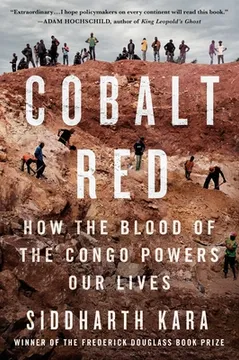


Key Takeaways
Treat every rechargeable battery as a supply-chain question, not a clean-energy answer.
The battery has a birthplace. Cobalt helps lithium-ion batteries store energy densely and remain stable through repeated charging. In 2021, the Democratic Republic of the Congo supplied 72 percent of the world’s mined cobalt, much of it from the Copper Belt around Kolwezi. Demand is being driven by smartphones and laptops, but especially electric vehicles. The book frames the result as a climate paradox: a technology promoted as cleaner can depend on minerals dug from hazardous pits by people living with pollution and poverty.
The transition has tradeoffs. Battery makers are trying to reduce cobalt, but the author says many alternatives still have limits in energy density, safety, cost, or durability. Changing battery chemistry alone would not address the harms already embedded in mining communities or the political economy that repeatedly makes Congolese resources valuable to outsiders.
What's striking is that the book makes the energy transition a question of distribution, not just emissions. A lower-carbon vehicle can still carry heavy human and ecological costs if those costs are excluded from its price. This connects to environmental justice: communities bearing extraction risks should have power over decisions and a share of the benefits. The comparison is not a reason to abandon electrification. It is a reason to evaluate climate technologies across their full life cycle, rather than treating a cleaner tailpipe as proof of a clean system.
Many Congolese cobalt diggers earn $1-$2 daily while buyers capture the value.
Work is priced by the sack. Kara’s interviews describe artisanal miners, locally called creuseurs, digging and washing cobalt-bearing ore with basic tools, often without contracts, safety equipment, or reliable medical care. In many locations, workers earned roughly one or two dollars a day. At Kipushi, one family group of eight produced three sacks in a day and earned about $1.05 per person. Children helped work but did not receive separate wages.
Value rises upstream. Independent traders buy sacks, depots resell them, processors refine the ore, and battery makers turn the refined cobalt into cathode materials. Each link can take a share, while the diggers assume the immediate risks. Some sites paid more, including Shabara, but even its higher wages came with dangerous conditions. The contrast is not simply between poor workers and rich companies. It is a system that assigns most risk to those with the least bargaining power.
This is a distributional problem as much as a labor problem. In global value-chain analysis, the activity that creates the greatest commercial value is not necessarily the activity receiving the largest share of the final price. Workers may be indispensable yet remain invisible because they are classified as informal suppliers rather than employees. That distinction can become a loophole in practice. Still, wage comparisons alone do not capture the full picture: a higher daily income may matter greatly to a family while remaining far too low to offset lethal risk or toxic exposure.
Assume artisanal cobalt enters industrial supply, because depots erase its provenance.
The chain blurs at the depot. Artisanal cobalt commonly moves from diggers to négociants, independent traders who buy and transport ore, then to comptoirs, or mineral depots. These depots often buy without checking where the ore came from or how it was mined. From there, the material can enter industrial processing and be mixed with ore from large mines.
Tracing breaks at the point of mixing. The author estimates artisanal mining may account for up to 30 percent of Congolese cobalt production, but says the true share is difficult to calculate because the sources become inseparable. At Musompo, he watched traders sell sacks of unknown origin to buyers whose trucks belonged to industrial mining companies. Once loads are combined and processed, a company’s claim that its supply is clean becomes difficult to verify from paperwork alone.
A supply chain is only as traceable as its least visible handoff. This resembles a problem in forensic accounting: formal records can appear complete even when the underlying transactions are not independently verified. The book’s strongest point is structural. Blending makes clean sourcing claims fragile, even without proving that every shipment contains abused labor. A useful audit therefore needs more than a certificate from a refinery. It needs reliable site-level information, transparent purchasing records, and a way for workers to report conditions without risking retaliation.
Read today's mines against the Congo's repeated cycles of extraction and capture.
The resource changes, the pattern persists. The Congo has been exploited for ivory, rubber, palm oil, copper, uranium, and now cobalt. Under King Leopold II, forced labor extracted rubber; later, Belgian mining companies used coercive labor in Katanga. After independence, Patrice Lumumba argued that Congolese people should control their resources for public benefit. Belgium and its allies opposed his vision, and he was assassinated in 1961. Subsequent leaders, including Mobutu and Joseph Kabila, presided over mineral deals that enriched political elites while much of the population remained poor.
History is context, not an excuse. Kara does not claim that current cobalt mining matches the scale of Leopold’s mass violence. His argument is that exploitation persists in a different form: opaque deals, weak enforcement, dangerous labor, and wealth flowing out. In Kambove, a United Nations inquiry found that mining concessions sold for $400,000 had a fair market value above $1 billion.
The historical argument is most persuasive when it identifies recurring institutions rather than claiming every era is identical. Extraction, political brokerage, and weak public accountability can survive even as laws and technologies change. This is a form of path dependence: earlier arrangements shape who controls assets and whose interests count. The comparison also needs care. Historical analogy can sharpen moral attention, but it can flatten differences in scale, agency, and political conditions. Kara acknowledges that distinction, allowing the present system to be condemned without equating it mechanically with colonial rule.
Do not call child labor a choice when school costs exceed family means.
Poverty narrows the options. Education in the DRC is supposed to be free through age eighteen, but schools often charge families five or six dollars a month because teachers and classrooms lack public funding. Josephine, a teacher near Likasi, described children who worked before school, arrived hungry and exhausted, or stopped attending when families could no longer pay. In mining communities, digging can be the only way to bring home money that day.
Displacement deepens the trap. Mining expansion has forced families from homes and farmland, sometimes without adequate compensation or relocation support. In Fungurume, residents described being pushed off land later enclosed by a mine, then turning to artisanal mining on that same territory to survive. Children’s work is not made harmless by necessity. But removing children from a site without replacing household income, accessible schooling, and dependable public services can leave families with the same emergency and fewer ways to meet it.
The distinction between consent and constrained choice matters across labor economics and child protection. A family may decide that a child should work, yet make that decision inside a set of options shaped by poverty, displacement, and an underfunded school system. Conditional cash transfers can help in some settings, but this account highlights practical limits: a school may be too distant, or instruction too weak to justify the immediate loss of income. Effective protection therefore requires both enforcement and credible alternatives, not only a rule against child labor.
Track a mine's damage beyond its pit, into water, lungs, and unborn children.
Pollution travels home. The book describes dust, contaminated water, damaged farmland, and chemical emissions near mining operations. In Tenke, residents showed Kara mustard-colored dust they said came from processing chemicals. Near Mupanja, researchers found elevated lead, chromium, cobalt, and industrial acids in river samples. These substances affect people who never enter a mine, including children exposed through their surroundings and family members.
Health evidence raises alarms. A University of Lubumbashi researcher told Kara that miners in his studies had more than forty times the urinary cobalt of control groups, alongside elevated lead and uranium. Dust sampled inside homes averaged 170 micrograms of lead per square foot, compared with the 40 microgram limit cited in the book from U.S. environmental guidance. The researcher also reported respiratory illness, skin problems, and adverse pregnancy outcomes. These findings describe serious risks, while the book emphasizes that local health systems lack capacity to diagnose and treat them.
Environmental exposure makes the mine’s footprint larger than its concession map. Public-health thinking calls this a pathway problem: pollutants move through air, water, food, clothing, and household dust, so the exposed population can extend far beyond workers. The reported measurements are disturbing, but their interpretation depends on study design, sampling, and independent replication. That uncertainty is not a reason to ignore the evidence. It is a reason to fund transparent monitoring and medical surveillance, especially where children and pregnant people may face risks they cannot see or avoid.
Treat tunnel digging as lethal work, not a cheap route to mineral supply.
The richest ore lies underground. In Kolwezi’s Kasulo neighborhood, high-grade cobalt deposits drew thousands of people into hand-dug tunnels. Teams descended through narrow shafts, followed ore veins in cramped galleries, and often worked without adequate supports or ventilation. Some accepted advances for food, wages, or tools, then had to repay them through future production. At Tilwezembe, a boy described being pushed into tunnel work under a debt he could not fairly calculate, with threats against his family if he quit.
Deaths can disappear with the tunnel. On September 21, 2019, a collapse at Kamilombe buried 63 men and boys; only four bodies were recovered. Families were kept behind armed soldiers as others searched for survivors. The author estimates that tunnel collapses in Kasulo occurred regularly, but many accidents were never publicly recorded. The low price of the ore at the surface conceals a devastating cost paid underground.
This is risk transfer in its starkest form. Companies and intermediaries can benefit from mineral output without directly employing the people exposed to collapse, suffocation, or flooding. The result resembles other high-risk labor systems in which contractors absorb danger while firms preserve distance from liability. A serious response must do more than count deaths: it needs safe working standards, emergency capacity, injury support, and transparent incident reporting. Where tunnel mining remains the only livelihood, a ban that simply drives miners elsewhere may relocate the hazard rather than reduce it.
Test ethical-mining labels by following ore, wages, and workers past the gate.
A model mine can still leak. At CHEMAF’s Mutoshi site, Kara saw some meaningful improvements, including cleaner water, toilets, and less harassment of women. Yet he also found a weak fence, teenagers working with falsified age documents, no tagged bags, and ore bought from outside depots and mixed into supply. A local cooperative official said Pact staff did not conduct the regular site visits the author had been told about. Of a plan to enroll 2,000 children in school, only 219 had been enrolled after two years.
A label is not an outcome. The CDM model site in Kasulo allowed tunnel digging, provided little protective equipment, and paid miners through advances and deductions. Meanwhile, the proposed Musompo trading center, promoted as a traceability fix, remained empty during Kara’s visit while the original marketplace continued operating. Audits and pilot programs matter only if their safeguards survive contact with actual purchasing, transport, and worker conditions.
This distinction mirrors a broader lesson from organizational auditing: policies measure intent, while outcomes measure performance. A site can display safety rules and still fail if incentives reward volume, inspections are predictable, or workers cannot speak freely. The Mutoshi example also resists easy cynicism. Some women reported less harassment and better sanitation, gains that matter even amid serious gaps. Credible evaluation should preserve those improvements while testing whether safeguards reach every worker and remain intact through processing and sale.
Make buyers accountable, and let Congolese workers design the remedies.
Responsibility should follow profit. Kara argues that technology and vehicle companies cannot make artisanal miners someone else’s problem when their demand helps sustain the cobalt market. The government, mining firms, processors, and traders also shape the chain, and each can obscure its role by pointing elsewhere. The book calls for more than public promises: miners need safer work, fairer and more dependable pay, access to health care and schooling, and protection from pollution and displacement.
Local voices must have power. In the epilogue, the Congolese ambassador urges support for researchers in the country so its people can document conditions and speak for themselves. That principle extends to policy meetings and supply-chain decisions, where artisanal miners are often absent. A proposed centralized market cannot solve exploitation if workers cannot transport their ore there or negotiate its price. Durable reform must be built with the people expected to live with its consequences.
The demand for accountability becomes more practical when paired with worker participation. People closest to a system often know where formal safeguards fail, which makes their testimony a form of operational knowledge, not merely moral evidence. Yet voice alone is insufficient if speaking carries the risk of arrest, violence, or lost income. Participation requires protection, independent channels, and bargaining power. Buyers can help create those conditions by treating informal production as part of their real supply base, rather than assuming that a distant subcontractor makes the social consequences disappear.
Analysis
Cobalt Red is both investigative reporting and a political history, organized as a journey from Lubumbashi through the Copper Belt to Kolwezi. Its central move is to connect a familiar consumer object to people usually hidden from view, then show how the connection is obscured by traders, depots, processing plants, corporate subsidiaries, and weak government oversight. The narrative accumulates force through specific lives: a child injured in a pit, a parent searching for a son after a collapse, and a miner descending into a tunnel because no safer livelihood is available. These stories make the economic chain legible as a chain of risk as well as value.
The historical argument is not that contemporary cobalt mining reproduces colonial atrocities in identical form. It is that extraction has repeatedly benefited distant buyers and local elites more than the people living atop the resource. Lumumba’s brief vision of public control gives this history a political alternative, while the fate of Gécamines shows that state ownership alone cannot guarantee public benefit if governance and revenue management fail.
The reporting also has limits that matter. Access to sites was dangerous and frequently blocked; many claims rely on protected interviews, local estimates, and observations made during particular visits. Production shares, numbers of workers, and some supply-chain links are difficult to verify precisely in an informal economy. These constraints weaken any claim that a specific consumer product can be traced to a particular abuse, but they strengthen the case against confident claims of clean sourcing without evidence. The book’s most durable contribution is therefore not a perfect map of every shipment. It is a test for corporate credibility: can a company show where its cobalt came from, how workers were treated, what environmental monitoring found, and whether independent local voices can challenge its account?
The broader lesson for the energy transition is that technological improvement and social justice are separate tests. Lower emissions do not automatically produce fair labor, healthy communities, or accountable institutions. Responsible mineral policy must assess those outcomes directly, while ensuring that reforms do not merely ban informal work and push desperate families into more hidden and dangerous sites.
Glossary
Artisanal and small-scale mining (ASM)
Informal, labor-intensive miningMining carried out by individuals or small groups using basic tools and limited mechanization. In the book, ASM usually refers to informal work in pits, trenches, tunnels, and washing areas, often without contracts, reliable safety measures, or access to legal protection. The sector supplies a substantial but difficult-to-measure share of the DRC’s cobalt.
heterogenite
Cobalt-bearing surface oreA near-surface mineral containing cobalt, often alongside copper and other metals. In the Congolese Copper Belt, artisanal miners dig, break, wash, and sort heterogenite before selling it by the sack. Its cobalt grade varies by location, influencing the price paid to miners and traders.
négociants
Independent ore tradersLocal intermediaries who buy cobalt-bearing ore from artisanal miners and transport it to depots or other buyers. They may pay a fixed price per sack or share the eventual sale proceeds. Because many miners lack vehicles, permits, or direct market access, négociants can be an essential route to sale while also capturing part of the ore’s value.
comptoirs
Mineral buying depotsBuying houses or depots that purchase ore from artisanal miners and traders, then sell it onward to processors or mining companies. In Kara’s reporting, many operate with little scrutiny of where ore originated or how it was mined. They form a key junction where informal production can enter formal supply chains and lose a clear record of its source.
Zones d’Exploitation Artisanale (ZEAs)
Authorized artisanal mining zonesAreas designated by the Congolese government for artisanal mining. The book reports that fewer than one hundred such zones had been designated across the Copper Belt, far too few for the large number of people seeking mining work. As a result, many miners worked in unauthorized areas, including on or beside industrial concessions.
debt bondage
Work compelled by unpayable debtA form of forced labor in which an advance or debt is used to bind a worker to employment, often under conditions where the debt cannot be fairly calculated or repaid. The book describes children receiving food or cash while digging tunnels, then being told to repay the advance through ore production, with threats used to prevent them from leaving.
model site
Proposed safer artisanal mineA mining site presented as a controlled, more responsible source of artisanal cobalt, with safeguards such as worker registration, protective equipment, limits on child labor, and separate handling of ore. Kara’s visits to the CHEMAF and CDM sites found some improvements but also major gaps between stated commitments and practices on the ground.
Download PDF
Download EPUB
.epub digital book format is ideal for reading ebooks on phones, tablets, and e-readers.








