

Key Takeaways
Treat brain scans as snapshots of states, not explanations of causes
A scan is not a verdict. PET and fMRI detect changes in blood flow, an indirect sign of neural activity. They also usually compare an experimental task with a control task, subtracting shared demands such as looking at pictures or pressing a button. The remaining signal is more specific, but it still does not reveal why a person is in that mental state. A scan showing activity during sadness cannot establish that a brain defect caused depression: people without depression show similar patterns when asked to think sad thoughts. Likewise, activity during a preferred drink reflects liking, not the origin of the preference. History and circumstances can matter as much as brain processes.
What's striking is how easily a vivid image can be mistaken for a causal explanation. The same distinction appears throughout science: measuring a correlate is not the same as identifying a mechanism. Passingham's emphasis on control conditions is especially useful because it shows that experiments gain meaning through comparison, not color-coded pictures alone. Brain evidence can sharpen psychological explanations, but it does not make psychological questions disappear. A limitation remains: carefully designed imaging still identifies associations, while causal claims usually require additional evidence, such as interventions or well-characterized brain damage.
Separate what vision recognizes from what it equips the body to do
Seeing has distinct jobs. The ventral visual pathway helps identify objects, while the dorsal pathway uses visual information to guide movement. Patient Dee, whose brain injury impaired object recognition, could not report an object's orientation but could still reach for it and grasp it correctly. Her case illustrates how one pathway can fail while another remains useful. The distinction also helps explain why some amputees feel touch in a missing hand: stimulation near the stump can activate the brain's still-present map of the hand. Visual and bodily maps are organized by connections, and different regions can perform specialized operations without working in isolation.
This division offers a powerful alternative to the idea that perception is simply a picture formed in the mind. The brain extracts information in ways suited to different purposes, including recognizing an object and acting on it. That has practical value: an impairment in naming or identifying an object does not necessarily predict an inability to use it. The case also cautions against treating a brain region as a self-contained module. Separate pathways cooperate, and actual abilities depend on how information moves between them.
Attention selects task-relevant signals, while decisions create the multitasking bottleneck
Selection is not simple overload. The brain processes many sensory streams in parallel, but attention boosts information relevant to the current task and suppresses distractions. In experiments, a demanding memory task reduced responses to distracting images. When a painful stimulus was present, mental distraction also reduced activity in the pain pathway and lowered reported pain. Yet parallel perception does not make every task simultaneous. Choosing a response requires transforming sensory input into an action, and competing tasks can depend on the same prefrontal processing stage. That is why talking on a phone may leave the hands free but still delay a driver's response to an unexpected event.
The distinction between processing and selection resolves an apparent paradox: a brain can handle many inputs at once while still being vulnerable to distraction. It also explains why multitasking costs are often hidden until a task demands a choice. Routine driving may feel compatible with conversation, but novelty forces attention back onto a shared decision process. The account is a useful corrective to the idea that hands-free means cognitively harmless. It also suggests that distraction can sometimes be deliberately useful, as when attention changes the experience of pain.
Keep lived episodes distinct from facts you know
Memory is not one store. Episodic memory concerns events from a person's life, while semantic memory holds general knowledge, such as what a tool is for. The hippocampus supports locating oneself in a scene and retrieving personal events. A taxi driver with damage to both hippocampi became lost in familiar London streets despite decades of experience. Another patient, Jon, had hippocampal damage from early life and struggled to recall personal events, yet learned facts at school. Semantic knowledge relies more on temporal-lobe regions including the perirhinal cortex. This separation helps explain why a person can lose autobiographical memories while retaining learned information, although diseases such as Alzheimer’s can damage both systems.
The distinction clarifies why the word memory can conceal very different abilities. Knowing a fact and mentally revisiting the moment it was learned are not equivalent achievements. The hippocampus's role in navigation also links memory to the structure of experience: where an event occurred can help cue what happened. This framework is valuable in interpreting cognitive symptoms, but real memory systems interact. The separation is a guide to different contributions, not a claim that personal experience and general knowledge never influence one another.
Reasoning relies on relational machinery, not necessarily inner speech
Relations can be thought without words. People solving visual pattern problems activate connected parietal and prefrontal regions, even when the puzzles use shapes rather than language. The parietal cortex also helps represent spatial relations, distance, and order, which can support mental rotation, numerical comparison, and logical inference. In experiments, people reasoning through syllogisms did not show the language-area activity expected if they were silently talking themselves through every step. Instead, parietal activity appeared when they compared relations. A broad frontoparietal system is engaged across different demanding tasks, helping explain why scores on varied intelligence tests tend to cluster as general intelligence.
This account makes reasoning less mysterious by connecting abstract thought to operations the brain already performs, such as comparing distances and organizing spatial relations. It also challenges the intuitive belief that thought is always an internal conversation. Language remains important because it transmits knowledge and supports complex culture, but it is not the only medium of reasoning. The account should not be reduced to a claim that all abstract thought is spatial. Rather, spatial and relational systems appear to provide reusable tools across tasks.
Use habits in stable settings, but restore deliberate control when context shifts
Flexibility has a cost. The prefrontal cortex can combine information about the current situation, current needs, possible actions, and likely outcomes. This supports planning and context-sensitive choices. Repeated actions can instead become habitual: after people practiced a sequence of key presses, activity shifted away from the prefrontal cortex toward circuits that linked one movement to the next. Habits save effort when circumstances stay constant. They also cause absent-minded errors when the setting changes, such as turning toward a familiar destination while intending to go somewhere else. More demanding plans, including rearranging objects to reach a goal, recruit prefrontal and parietal regions to generate and check possible steps.
The useful contrast is not between good habits and bad habits, but between a routine that fits the situation and one that has outlived it. Automaticity frees attention, while deliberate control makes behavior responsive to new information. This resembles the balance between efficiency and adaptability in many complex systems: fixed procedures are fast until conditions change. The practical implication is to notice transitions, not to distrust routine itself. A habit can be highly capable, but it cannot independently decide whether its familiar context still applies.
Make distant rewards imaginable before trusting immediate temptation
Future rewards are harder to feel. The prefrontal cortex helps people imagine possible outcomes and compare their value. But an imagined future reward is less vivid than one available now, which can bias choices toward immediate gains. In one experiment, people who showed a stronger brain response while imagining a preferred drink were more likely to wait for a larger monetary reward. The Iowa Gambling task tests a related problem: some card choices offer tempting gains but produce larger losses over time. People with damage involving the ventromedial prefrontal cortex had difficulty avoiding risky choices, and pathological gamblers showed weaker anticipatory bodily responses before risky selections.
This section links decision-making to the vividness of mental simulation, not merely to a person's knowledge of what is prudent. Someone can understand that a delayed reward is larger and still fail to experience it as compelling. Making a future outcome concrete may therefore help bridge the gap between abstract calculation and choice. The evidence does not imply that imagination alone determines behavior: uncertainty, emotion, and circumstance also shape decisions. Still, it explains why information about long-term consequences can lose a contest against an immediate payoff.
Empathy supports moral judgment, but feelings alone cannot justify a rule
Social understanding draws on more than one route. People infer intentions from actions, using both learned knowledge about how others behave and processes that resemble mentally simulating another person's perspective. Brain studies link unexpected movements to the temporo-parietal junction, while judgments about an actor's intentions involve medial frontal regions. The ventromedial prefrontal cortex is also engaged when people consider how others feel. Patients with damage there can show impaired empathy and unusually detached moral judgments. Passingham's distinction is important: the capacity to imagine another person's experience may help people follow moral rules, but a psychological fact about empathy cannot, by itself, prove what anyone ought to do.
The account joins social cognition to moral life without confusing explanation with justification. Empathy can make another person's interests psychologically present, which may support cooperation and restraint. But emotional resonance can be uneven: familiar people may evoke more concern than strangers, and strong feelings do not automatically produce fair principles. The book's distinction between what people can feel and what they should do is philosophically important. It leaves room for moral reasoning to evaluate impulses rather than treating empathy as a complete ethical theory.
Awareness arrives late, yet brain activity does not erase agency
Preparation precedes reported intention. In the Libet task, people moved a finger when they chose and reported when they first noticed the intention. Electrical activity associated with preparing the movement began before that reported awareness. Later experiments found that brain patterns could predict which of two fingers a person would move before the person reported deciding. These results challenge accounts that require conscious awareness to initiate every voluntary action. They do not establish that people are passive: the author argues that a person's actions are still generated by their brain and body. Separate monitoring studies show that the anterior cingulate cortex responds to conflict and errors, helping adjust control on a subsequent attempt.
The distinction between a neural process and a person is central here. If a person is not a separate ghost directing the brain, unconscious preparation is not automatically evidence that someone else is in control. At the same time, prediction before reported awareness is not a complete theory of agency. The task is simple, and a measurable precursor does not settle how responsibility works in complex choices. The strongest insight is narrower: subjective awareness is not a reliable timestamp for the beginning of every action.
Practice automates skills by teaching the brain what sensations to expect
Practice builds predictions. Learning a movement sequence shifts control toward circuits that can cue one action from the previous one. The cerebellum contributes to automating precise movements and comparing expected sensory consequences with what actually happens. When people learned to control a cursor, an unexpected reversal of its movement produced a cerebellar signal associated with prediction error. The same idea explains why self-tickling usually fails: the brain predicts the sensation caused by one's own movement, making it less surprising. A delay or directional change in the touch disrupts that prediction and makes the sensation more ticklish. Unexpected outcomes can therefore signal that a learned model needs updating.
Skill is not simply a stored sequence of muscle commands. It includes expectations about how an action should feel and what result it should produce. This makes the cerebellum's role relevant to both movement and learning: discrepancies provide information for correction. The tickling example is memorable because it turns a familiar oddity into a test of prediction. Still, prediction error is not a complete explanation of every learning process. Attention, motivation, and the structure of the task also matter.
Move beyond brain maps toward timing, circuits, and computational models
Location is only a beginning. PET and fMRI show where blood-flow changes accompany tasks, but blood signals unfold too slowly to reveal the rapid sequence of neural events. Magneto-encephalography can track the timing of activity across the cortex. Electrode arrays and recordings from single neurons provide more direct signals in limited clinical settings, and brain activity has been used to control a simulated arm for a person with tetraplegia. To explain cognition, researchers also need computational models that connect fine-scale neural circuits with the brain's large-scale organization. The book presents cognitive neuroscience as a young field whose findings are powerful but provisional, with future progress depending on methods that explain mechanisms, not merely locations.
The methodological lesson is a useful one for readers of neuroscience: each tool makes some questions visible while leaving others out of reach. A map can identify candidate regions, but timing, connectivity, and interventions are needed to test how a system works. Computational models add a further discipline by requiring researchers to specify how proposed mechanisms could generate behavior. Yet simulations are only as persuasive as their assumptions and biological grounding. Progress depends on combining methods rather than treating any single image, recording, or model as the brain's final portrait.
Analysis
Passingham's central contribution is not a catalogue of brain regions but a disciplined way to connect neural evidence to psychological questions. The book repeatedly moves from a concrete puzzle, such as why a person with hippocampal damage cannot navigate familiar streets, to a proposed system, then checks that proposal against imaging, behavior, or lesions. That method matters because brain images invite a seductive but invalid shortcut: if a region lights up during an experience, the region must explain its cause. The book insists on distinctions between correlation and cause, neural processing and personal agency, and different capacities that ordinary language groups under one label.
Its strongest organizing idea is that cognition depends on interacting systems with specialized roles. Vision separates recognition from action guidance. Memory distinguishes personal episodes from learned facts. Attention selects relevant signals, while decision processes can bottleneck otherwise parallel activity. These distinctions make impairments intelligible without reducing the person to a damaged location. They also make room for the body's needs, prior learning, and social setting, instead of treating the brain as an isolated machine.
The account is necessarily selective. Many claims are built from imaging contrasts, small patient groups, and tasks simplified for scanning. Such evidence can reveal plausible architecture, but it rarely proves that one circuit uniquely performs one psychological function. The book acknowledges that cognitive neuroscience is young and its conclusions can change. Its lasting value is therefore less a final map than a way to reason: ask what a task isolates, what the comparison removes, what alternative causes remain, and whether a proposed neural explanation actually explains the behavior. That skepticism makes the field more credible, not less exciting.
Review Summary
Cognitive Neuroscience by Richard Passingham receives mixed reviews, with an average rating of 3.7/5. Readers appreciate its accessibility and interesting content, especially the questions addressed at the beginning of each chapter. Some find it a good introduction to the field, while others criticize its technical language and lack of depth. The book covers various aspects of brain function, including perception, attention, memory, and decision-making. Critics note that it focuses primarily on brain imaging studies and could benefit from a broader perspective on cognitive neuroscience.
Glossary
Cognitive neuroscience
linking brain and cognitionThe study of how brain systems support human mental abilities, including perceiving, remembering, reasoning, deciding, and acting. Passingham emphasizes experiments that connect psychological tasks with brain imaging and known anatomical connections. The field seeks explanations of capacities and limitations, not just lists of regions that become active.
localization of function
specialized operations across regionsThe principle that different brain areas contribute to different operations because they receive and send distinct patterns of connections. It does not mean that each area works alone. A mental ability typically depends on information moving through several connected regions, and damage can disrupt one operation while sparing another.
ventral and dorsal visual pathways
recognition and action routesTwo major routes that carry visual information beyond primary visual cortex. The ventral pathway contributes to identifying and classifying objects. The dorsal pathway contributes to using visual information to guide actions, such as reaching and grasping. Their partly distinct roles help explain why recognition can fail while visually guided movement remains possible.
multi-voxel pattern analysis
decoding patterns across brain voxelsA method for examining the pattern of signal across many three-dimensional units, or voxels, in a brain image. Rather than asking only how much activity occurs in a region, researchers test whether different patterns correspond to different stimuli, categories, locations, or remembered events. The method can reveal information represented across a region.
episodic memory
memory for personal eventsMemory for events experienced in one's own life, often including a sense of where and when they occurred. In Passingham's account, the hippocampus helps represent spatial context and supports retrieval of these autobiographical events. Episodic memory is distinguished from general knowledge, which can be retained even when personal recollection is impaired.
semantic memory
general facts and meaningsKnowledge about objects, words, categories, and their meanings, rather than recollection of a particular personal event. For example, knowing what a tool is used for is semantic knowledge even if the person cannot remember learning it. The book associates this system especially with temporal-lobe regions, including the perirhinal cortex.
multiple-demand system
network for demanding tasksA connected frontoparietal system that becomes engaged across many cognitively demanding tasks, despite differences in the material or specific operation involved. Its broad involvement helps explain why performance on different intelligence-test subtests tends to correlate. The term is used for a distributed system, not a single intelligence center.
prediction error
a mismatch with expectationA signal associated with a difference between an expected event and what actually occurs. In the book, cerebellar signals are linked to unexpected sensory consequences of movement, while striatal signals are linked to unexpected reward outcomes. Such mismatches can indicate that a learned prediction or action needs adjustment.
Libet task
timing reported intentionAn experimental procedure in which participants make a simple voluntary movement, such as moving a finger, and report when they first became aware of intending to move. Brain activity associated with movement preparation can be measured before that reported awareness. The task is used to examine the timing of intention and action.
remapping factor
relative cortical expansion measureA term Passingham and Jeroen Smaers use for comparing the size of higher-order brain regions with the primary areas that provide their inputs. The comparison estimates how much tissue is available for further processing relative to incoming information. The book uses the measure to discuss differences between human and chimpanzee brains.
FAQ
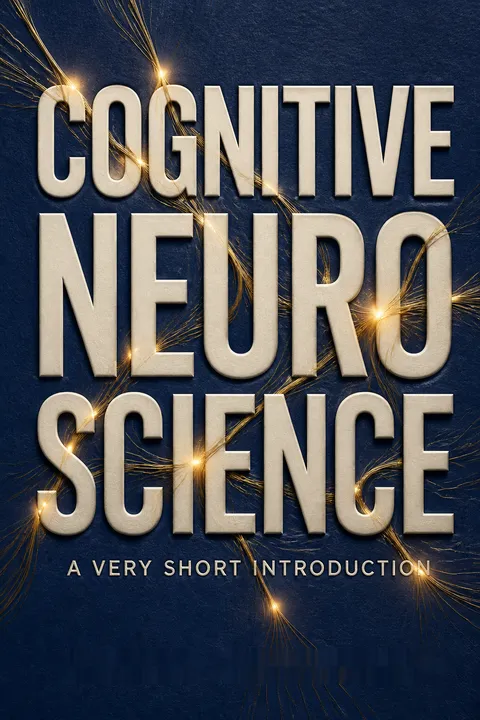
1. What is "Cognitive Neuroscience: A Very Short Introduction" by Richard Passingham about?
- Overview of the field: The book provides a concise introduction to cognitive neuroscience, a relatively new branch of science that explores how brain activity underlies mental processes such as perception, attention, memory, reasoning, and decision-making.
- Focus on brain imaging: Passingham emphasizes the use of brain imaging techniques (like fMRI and PET) to study human cognition, explaining how these methods have transformed our understanding of the mind-brain relationship.
- Structure and approach: Each chapter addresses fundamental questions about specific cognitive functions, using experimental evidence and anatomical diagrams to illustrate key concepts.
- Scope and limitations: The book is intentionally focused on human studies using imaging, omitting detailed discussion of animal research and cellular mechanisms due to space constraints.
2. Why should I read "Cognitive Neuroscience: A Very Short Introduction" by Richard Passingham?
- Accessible expert insight: The book is written by a leading neuroscientist and is designed for readers new to the subject, making complex ideas approachable without oversimplification.
- Critical thinking about brain science: Passingham challenges common misconceptions about brain imaging and the interpretation of neuroscience findings, helping readers become more discerning consumers of scientific news.
- Relevance to everyday life: The book connects neuroscience to real-world issues, such as multitasking, memory loss, decision-making, and moral reasoning, making the science personally meaningful.
- Foundation for further study: It serves as a springboard for deeper exploration, with references and further reading suggestions for those interested in pursuing cognitive neuroscience in more detail.
3. What are the key takeaways from "Cognitive Neuroscience: A Very Short Introduction"?
- Mind-brain relationship is complex: Cognitive neuroscience reveals that mental states correspond to brain states, but brain imaging alone cannot always explain why people are in particular mental states.
- Localization and networks: Different cognitive functions are supported by specialized brain areas and interconnected systems, not by isolated regions.
- Parallel and hierarchical processing: The brain processes information in parallel pathways and through hierarchical stages, enabling complex abilities like object recognition and reasoning.
- Limits of imaging: Brain imaging shows correlations, not causes, and must be interpreted carefully, especially when considering psychological and environmental factors.
4. How does Richard Passingham define cognitive neuroscience in "Cognitive Neuroscience: A Very Short Introduction"?
- Interdisciplinary science: Cognitive neuroscience is defined as the study of how brain activity gives rise to mental processes, bridging psychology, neuroscience, and philosophy.
- Focus on human cognition: The field uses non-invasive imaging to study healthy people performing cognitive tasks, moving beyond animal models and behaviorist approaches.
- Emphasis on mechanisms: Passingham stresses the importance of understanding the flow of information between brain areas and the mechanisms underlying cognitive functions.
- Historical context: The book traces the evolution from behaviorism and dualism to the current scientific approach that seeks to explain the mind in terms of brain activity.
5. What are the main methods and experimental approaches discussed in "Cognitive Neuroscience: A Very Short Introduction"?
- Brain imaging techniques: The book highlights functional magnetic resonance imaging (fMRI) and positron emission tomography (PET) as key tools for visualizing brain activity during cognitive tasks.
- Experimental design: Passingham explains the importance of comparing experimental and control conditions to isolate specific cognitive processes in imaging studies.
- Multi-voxel pattern analysis: Advanced analysis methods, such as multi-voxel pattern analysis, are used to decode information represented in brain activity patterns.
- Future technologies: The book discusses emerging methods like magneto-encephalography (MEG), electrode arrays, and computational modeling for understanding brain mechanisms.
6. How does "Cognitive Neuroscience: A Very Short Introduction" explain the organization of the brain and its functions?
- Parallel pathways: The brain processes sensory information through parallel pathways (e.g., ventral and dorsal visual streams), allowing simultaneous analysis of different features.
- Localization of function: Specific brain areas are specialized for particular operations, such as object recognition (lateral occipital complex) or spatial processing (parietal cortex).
- Hierarchical processing: Information is processed in stages, from simple features in early sensory areas to complex representations in higher-order regions.
- Integration and connectivity: Cognitive functions depend on the integration of information across multiple areas, facilitated by anatomical connections and multimodal regions.
7. What insights does "Cognitive Neuroscience: A Very Short Introduction" offer about perception, attention, and awareness?
- Separate systems for perception and action: The book describes how recognizing an object and knowing how to use it rely on distinct brain pathways.
- Selective attention mechanisms: Attention is controlled by interconnected dorsal and ventral systems, enabling us to focus on relevant information and ignore distractions.
- Phenomenal awareness: Awareness of sensory experiences is linked to activity in early sensory areas and salience networks, but remains a challenging topic for neuroscience.
- Clinical phenomena: Conditions like spatial neglect, synaesthesia, and blindsight are explained in terms of disruptions to specific brain systems.
8. How does "Cognitive Neuroscience: A Very Short Introduction" address memory and learning?
- Episodic vs. semantic memory: The book distinguishes between autobiographical (episodic) memory, dependent on the hippocampus, and factual (semantic) memory, supported by the perirhinal and temporal cortex.
- Role of context and reinstatement: Memory retrieval involves reinstating patterns of brain activity present during the original experience, with the hippocampus providing spatial and contextual cues.
- Aging and disease: Age-related memory decline and disorders like Alzheimer’s and semantic dementia are linked to degeneration in specific memory systems.
- Learning and skill acquisition: The automation of skills involves a shift from prefrontal to cerebellar and striatal circuits, explaining how practice leads to expertise.
9. What does "Cognitive Neuroscience: A Very Short Introduction" reveal about reasoning, intelligence, and language?
- General intelligence (g): Performance on diverse cognitive tasks is linked to a multiple-demand system involving parietal and prefrontal cortex, explaining why different abilities cluster together.
- Reasoning without language: Logical reasoning and problem-solving can occur without inner speech, relying on semantic and spatial processing systems.
- Language and brain specialization: Broca’s and Wernicke’s areas are central to language production and comprehension, with evolutionary links to gestural communication and handedness.
- Human intelligence: The expansion of non-primary cortical areas, especially prefrontal cortex, underpins advanced reasoning, planning, and cultural learning.
10. How does "Cognitive Neuroscience: A Very Short Introduction" explain decision-making, planning, and moral reasoning?
- Prefrontal cortex as decision hub: The prefrontal cortex integrates sensory, motivational, and contextual information to guide flexible, goal-directed actions.
- Habitual vs. attentive control: With practice, actions become automatic and shift to subcortical circuits, but attentive control is needed when situations change.
- Imagination and future planning: The ability to imagine outcomes and plan ahead is linked to prefrontal activity, but immediate rewards are often overvalued due to less vivid future representations.
- Moral reasoning and empathy: Moral judgments depend on the capacity to imagine others’ feelings, with the ventromedial prefrontal cortex playing a key role in empathy and social behavior.
11. What are the limitations and challenges of brain imaging and cognitive neuroscience, according to Richard Passingham?
- Indirect measures: Imaging signals (like fMRI) reflect changes in blood flow, not direct neuronal activity, and must be interpreted cautiously.
- Correlation vs. causation: Brain images show where activity occurs during tasks, but do not necessarily reveal why or how mental states arise.
- Environmental and psychological factors: Cognitive neuroscience cannot fully explain behavior without considering social, developmental, and environmental influences.
- Need for mechanistic understanding: Future progress depends on integrating imaging with methods that reveal the timing and causality of brain processes.
12. What are the most thought-provoking quotes from "Cognitive Neuroscience: A Very Short Introduction" by Richard Passingham, and what do they mean?
- "People are not simply brains." – Passingham emphasizes that understanding human behavior requires considering the whole person, including their body and environment, not just their neural activity.
- "Brain explanations do not necessarily trump environmental explanations." – He cautions against reductionism, reminding readers that brain imaging cannot replace psychological and social research.
- "The brain is not an amorphous mass like a lump of porridge but a patchwork of discrete areas." – This highlights the principle of localization of function, a key theme in the book.
- "It is a mistake to define voluntary action in terms that imply early awareness." – Passingham challenges simplistic notions of free will, showing that brain activity often precedes conscious intention.
- "Cognitive neuroscience lies at the borders between different disciplines, and that is where the excitement so often lies in science." – He celebrates the interdisciplinary nature of the field and its potential for new discoveries.
Download PDF
Download EPUB
.epub digital book format is ideal for reading ebooks on phones, tablets, and e-readers.








