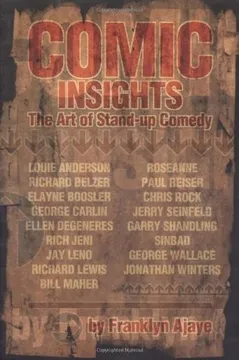


Key Takeaways
Build comedy from your own point of view, not borrowed punchlines
A comic voice is the asset. Ajaye argues that memorable stand-up begins with an individual way of seeing the world. A joke can be copied; the perspective that generated it is much harder to duplicate. The audience comes to recognize not only what a comedian says, but how that comedian notices and interprets ordinary life. Pryor’s candid, personal comedy initially met resistance, yet his commitment helped make that perspective distinctive. Roseanne likewise made familiar family subjects feel new by approaching them from a forceful, unconventional angle.
Honesty beats manufactured funny. Instead of adding a supposedly comic opinion to a subject, identify the real feeling underneath: irritation, wonder, embarrassment, or delight. Then make that reaction clear to strangers. The book’s central argument is that stand-up becomes original when its material grows from a comic’s genuine outlook.
What's striking is that point of view functions both as an artistic signature and as a defense against imitation. This resembles the way a strong brand earns recognition through consistent choices rather than a single memorable slogan. It also changes the writing question from “What joke can be made about this?” to “What detail would this particular mind notice?” That approach can produce originality without chasing novelty for its own sake. The caution is that sincerity alone does not guarantee comedy. A private truth still needs shaping, context, and timing before an audience can share it.
Study comic technique closely, then combine influences without copying
Watch with an analyst’s eye. Ajaye recommends studying strong comedians rather than merely enjoying them. Notice how they move, speak, pause, build a setup, and guide listeners toward a punchline. Audio recordings are especially useful because they reveal whether words alone can create a vivid scene. Writing down a routine can also expose its structure and economy.
Borrow methods, not identities. Ajaye studied Pryor, Carlin, and Robert Klein, taking lessons from their honesty, conversational ease, and willingness to question society. He did not aim to reproduce their material or personas. He also drew inspiration from musicians, filmmakers, and writers. The point is to identify techniques that resonate with a natural sensibility, then recombine them with personal interests and observations.
This is a practical account of apprenticeship: expertise grows through close observation, but originality requires transformation. In music, a student learns a tradition by listening to its masters, then develops a voice by making different choices within that tradition. Comedy works similarly, since delivery and structure can be studied even when the underlying perspective cannot be borrowed. A useful boundary is whether influence expands the performer’s options or replaces their own judgment. Studying a comic should make the student more perceptive about their own habits, not more convincing as an impersonator.
Capture your natural funny before the moment disappears
Notice yourself in real time. Ajaye calls the “third eye” a blend of detachment and alert attention: the ability to observe a moment while also noticing one’s own reaction to it. He uses it to catch spontaneous remarks or unusual details that make friends laugh. Rather than trust memory, he recommends recording the exact wording in a notebook or on a recorder.
Find your “pure funny.” This is Ajaye’s term for the humor that emerges naturally when someone is relaxed, rather than trying to perform comedy. Early in his career, he wrote forced jokes that did not sound like him. He began to improve when he studied the humor that arose in ordinary conversation, saved those moments, and worked out how to make them understandable to an audience of strangers.
The third eye resembles reflective observation used in acting and other creative practices: experience becomes material when attention catches both the event and the person experiencing it. Recording a spontaneous line preserves its original rhythm, which can disappear when someone tries to reconstruct it later. The method also reduces reliance on inspiration, because daily life supplies a continuing stream of details. Yet the private laugh is only a promising signal, not proof that a bit will work publicly. A comedian still has to supply the context that friends already know.
Outline what matters to you, and let writing uncover what you noticed
Give a topic a spine. When Ajaye asked Bob Newhart how he developed material, Newhart advised him to outline the points he wanted to cover. An outline organizes observations around a subject, leaving room for jokes and surprising connections. Ajaye’s first outline began with old monster movies and divided its observations among the different creatures. The structure gave him a way to develop his thoughts rather than simply collect disconnected lines.
Use both patience and effort. Ajaye says the subconscious can continue absorbing details when the writer is away from the desk, so creative blocks are not always solved by forcing a joke. But waiting for inspiration is not the only option. Seinfeld describes deliberately sitting down to wrestle with a premise. Ajaye’s advice accommodates both approaches: stay observant, save ideas, and accept that some writing sessions feel like work.
Outlining is valuable here not because comedy should feel mechanical, but because structure can reveal what a writer already knows. Narrative research often distinguishes a sequence of events from a story: the story emerges when details are selected and connected. A comic outline performs that selection. The contrast between waiting for ideas and deliberately working on them is also useful; creative labor does not have one reliable emotional texture. The main risk is over-structuring too early. A first outline should help discover the material, not force every observation into a predetermined punchline.
Make delivery, movement, and character part of the joke
Help the audience see it. A joke’s delivery carries the audience through the thought behind its punchline. Ajaye emphasizes clarity and economical wording: listeners need enough information to picture the situation, but not so much that the route becomes slow or confusing. Walking across the stage, acting out someone’s mannerisms, or giving a story character a distinct voice can make an idea easier to follow and more vivid.
Use only the tools that fit. Sound effects and vocal characterizations can add depth, as in the storytelling styles of Bill Cosby and Jonathan Winters, but Ajaye treats them as optional abilities rather than requirements. A quiet comic can command a room through conviction and timing; an aggressive delivery is not the only way to establish presence. The performer’s job is to make the thought legible and alive.
The advice treats performance as communication across several channels. Gesture, voice, and movement can reinforce a verbal image, giving an audience more than one route into a scene. This is especially useful in stand-up, where the listener cannot reread a sentence after missing a key detail. The broader lesson is not to add theatrical flourishes indiscriminately, but to make each choice serve comprehension or emphasis. Physical performance can also distract from thin material, so the test is whether a gesture clarifies the comic idea or merely decorates it.
Use silence to sharpen punchlines and let laughter finish
A pause shapes expectation. Ajaye describes timing as the skill of placing silence where it helps an audience absorb an image before a punchline. A pause can build anticipation, much as contrast gives force to a change in rhythm. It also matters after a laugh: rushing into the next bit cuts off the audience and makes a set feel choppy. Let the laughter run its course, then begin again before the room falls completely quiet.
Listen for the kind of response. A small chuckle, a laugh of recognition, and a full-bodied laugh convey different levels of engagement. Ajaye also advises giving a cerebral joke a brief moment to land before moving on. Timing is therefore not a fixed count or a slow delivery. It is the ongoing judgment of when the audience is ready for the next thought.
Silence is an active part of live communication because audiences need time to form an image, anticipate a turn, and respond together. Ajaye’s musical analogy is apt: rhythm depends on rests as well as notes. His emphasis on listening also shifts timing from a performer’s private instinct to a relationship with the room. Still, a pause cannot rescue an unclear premise, and waiting too long can make an audience feel abandoned. The skill lies in distinguishing suspense from confusion and allowing laughter space without surrendering control of the set.
Prepare enough material to improvise without panic
Build a dependable first set. Ajaye urges beginners to prepare for months before their first performance, collecting enough routines to choose the strongest ones. Memorize the material, rehearse it aloud, and record it to check its length and discover possible additions. Put strong material near the end, since a solid finish can recover from a tentative opening. Preparation gives a new performer somewhere to return when nerves make spontaneous thinking difficult.
Measure progress beyond laughter. A beginner can set goals around clear delivery, concentration, or confident pacing, then assess those skills afterward. Ajaye’s own disastrous first appearance left him with no clear plan when the audience stayed silent. Preparation does not eliminate risk; it makes that risk useful. Once a performer has a reliable structure, there is room to deviate when the audience responds well or a fresh idea appears.
Preparation here serves freedom rather than rigidity. A rehearsed structure lowers the mental load of remembering what comes next, leaving more attention available for the audience. That resembles expertise in sports and music, where repetition makes fundamentals dependable enough to support adaptation. The advice is particularly persuasive for beginners, who face the extra burden of stage fright and unfamiliar rooms. Its limit is that memorization can turn into recitation. Rehearsal should secure the route through the material while preserving enough attention to notice the live event.
Listen to the room, including the shape of its silence
Treat the audience as information. Ajaye asks performers to listen not only for laughter, but for its texture and for the quality of silence. Interested silence differs from bored silence, and each response can guide choices about pace and material. A comedian who notices how a room reacts can adjust rather than deliver a set as if every audience were identical.
Keep control without fighting the crowd. Hecklers can disrupt a performance, but most of the room came to hear the comedian. Ajaye recounts a show where he eventually told the audience he would leave; the crowd backed him and turned against the disruptive person. Louie Anderson described coordinating with club staff in advance. These examples suggest a practical order: stay attentive, respond briefly when useful, and rely on the audience or staff rather than letting one heckler take over.
This is a form of real-time feedback, not a demand to obey every reaction. A room’s laughter can signal recognition or surprise, while silence can mean attention, uncertainty, or disengagement. The performer must interpret rather than merely count responses. The heckler advice also recognizes that the audience is a group with its own interests, not a single opponent. There is a useful boundary: adapting to the room should not mean abandoning a distinctive point of view just because one section resists it.
Treat bombing as feedback, not a verdict on your talent
Diagnose the performance. Ajaye presents bombing as an unavoidable part of developing stand-up, particularly at the beginning. Recording a set makes it possible to examine what happened more accurately: perhaps the setup was confusing, the delivery rushed, the pauses misplaced, or the performer’s perspective unclear. The goal is to locate a changeable cause, not to label the whole act or the performer a failure.
Return with a specific adjustment. Ajaye recalls being devastated after his first stage appearance, then studying comedy and trying again. Many of the comedians interviewed describe early struggles too. The useful response is to review the performance, identify one or two elements to improve, and get back on stage. Ajaye also acknowledges that not everyone will discover a lasting comic voice, so persistence should include honest assessment of whether the work itself remains compelling.
The book’s treatment of failure resembles deliberate practice: improvement depends on feedback that is specific enough to guide the next attempt. A recording can turn a vague feeling of humiliation into observable choices about pacing, clarity, or material. That distinction matters because performance outcomes are noisy; one difficult room does not establish a performer’s potential. At the same time, persistence is not automatically virtuous. Ajaye’s qualification that not everyone has the necessary comic instinct leaves space for a candid decision to continue, change approach, or choose another path.
Build a comedy career around craft, not a television shortcut
Treat each format as a different job. A five-minute talk-show set has less time than a club show, and its audience may applaud lines in ways that alter pacing. Ajaye advises performers to focus on the studio audience, trim material that consumes too much time, and arrive early enough to learn the room. He also describes panel appearances as a chance to let viewers encounter a comedian in conversation, not simply repeat a stage routine.
Stay committed to the live craft. The interviews offer sharply different methods: Seinfeld schedules focused writing, Sinbad trusts improvisation, and Elayne Boosler builds material on stage while managing much of her own business. Their paths suggest no universal routine, but a shared investment in continuing the work. Television can create exposure, yet Ajaye and the interviewees repeatedly value the act itself, its development, and the discipline of performing when conditions are imperfect.
The book’s range of working methods is one of its quiet strengths. It resists turning a collection of individual careers into a single formula: disciplined drafting and stage-born improvisation can both serve a performer when matched to temperament. Its career advice also distinguishes visibility from mastery. A television appearance can introduce talent to industry gatekeepers, but a brief slot cannot substitute for a durable act. The broader implication is that performers benefit from building portable skills and independent creative judgment, especially in an industry where opportunities and formats change.
Analysis
Comic Insights is part craft manual, part oral history, and part apprenticeship by proxy. Ajaye begins with a personal failure on stage and uses it to pose the book’s central practical question: how does someone turn a private sense of humor into a reliable public art? His answer is not a recipe for jokes. It is a process of observing, selecting, shaping, rehearsing, performing, and revising, anchored by an individual point of view.
The book’s structure matters. Ajaye’s own instruction provides a usable vocabulary for attention, writing, and performance, while the interviews demonstrate that successful comedians do not all follow the same workflow. Jerry Seinfeld’s scheduled writing, Sinbad’s improvisational confidence, and Elayne Boosler’s stage-based development are not contradictions to resolve. They show that craft is a set of problems to solve, not a personality type to imitate. The interviews with club owners, an agent, and a manager widen the frame from artistic development to professional conditions: opportunity depends on judgment, persistence, relationships, and the ability to keep working.
The strongest idea is that comedy’s raw material is not simply a funny subject. It is a particular mind noticing something and making its interpretation shareable. That premise explains why Ajaye gives so much weight to observation, honesty, delivery, and timing. It also makes the book relevant beyond aspiring comedians: creative work often begins when people learn to attend closely to their own responses rather than borrow a ready-made voice.
The limitation is that the guidance comes primarily from successful performers looking backward. Their accounts offer vivid techniques, but not a controlled comparison showing which method works best, or for whom. Ajaye partly counters this by treating methods as individual and acknowledging that not everyone will become a comedian. Read as practical testimony rather than universal science, the book is most persuasive: it demystifies the work without pretending that preparation can guarantee success, and insists that originality must be built through repeated contact with both the material and the audience.
Review Summary
Most reviewers praise Comic Insights as an essential read for aspiring stand-up comedians, highlighting its insightful interviews with prominent comedians like Seinfeld, Carlin, and Rock. Readers appreciate the conversational tone and the focus on craft over celebrity anecdotes. The interview format, while occasionally repetitive, is widely seen as its greatest strength. Some note the material feels dated, as interviews were conducted in the 1980s and 90s. Overall, it's recommended for comedy enthusiasts and aspiring performers seeking practical knowledge about writing and performing stand-up.
Glossary
third eye
Observant creative distanceAjaye’s term for a state of heightened attention combined with some distance from the moment. A person notices an event and also observes their own reactions, gestures, and words within it. Comedians can use this awareness to preserve specific details or spontaneous remarks that may later become material.
pure funny
Natural personal humorAjaye’s name for the humor a person displays naturally when relaxed, especially in conversation with friends, without consciously trying to perform. He treats this instinctive humor as a useful source of stage material. The comedian’s task is to capture it and provide enough context for strangers to understand it.
structuring your funny
Organizing comic observationsAjaye’s phrase for shaping observations into a coherent routine. A comedian chooses a subject, outlines the points worth exploring, and arranges details so the audience can follow the thought. The outline does not supply the humor by itself; it gives observations and comic turns a structure that can be revised in performance.
afterthought lines
Extra lines after a punchlineAjaye’s term for additional remarks delivered after an initial punchline to extend a routine’s humor. These lines may be subtler than the main laugh and can be missed if the comedian rushes ahead or speaks over the audience’s response. Their success depends on timing and on giving listeners room to hear them.
Download PDF
Download EPUB
.epub digital book format is ideal for reading ebooks on phones, tablets, and e-readers.








