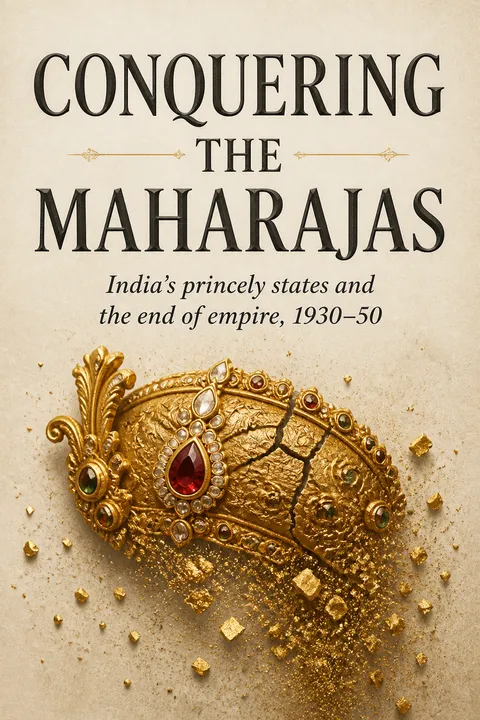


Key Takeaways
Treat India's and Pakistan's borders as unfinished arguments, not inevitable maps
A vast political mosaic. At independence, more than 560 princely states remained outside the British Indian provinces affected by Partition. Together they covered about 600,000 square miles, roughly 40 percent of India’s territory, and held nearly 100 million people. Their rulers were not automatically part of either new country. India and Pakistan still had to negotiate, persuade, or compel them to join.
The ending was uncertain. Several states remained uncommitted after 15 August 1947, so the borders familiar today had not yet taken shape. Jammu and Kashmir, Hyderabad, Junagadh, and Kalat all presented unresolved claims. Akins asks readers to recover that uncertainty instead of projecting today’s map backward and mistaking the outcome for destiny.
What's striking is how a map can conceal political work. Borders often look like facts of nature once institutions, schoolbooks, and daily life settle around them. Here, the apparent solidity of India and Pakistan emerged through bargaining, popular mobilization, and force. The account also challenges a familiar Partition-centered narrative: the division of British India was only part of the territorial settlement. One caution is that the princely-state focus can make consolidation seem like the main measure of success. The map became coherent, but the legitimacy and human costs of how it became coherent remain separate questions.
Recognize that princely autonomy was protected, conditional, and deliberately ambiguous
Authority came in layers. British paramountcy was the Crown’s superior authority over princely rulers, who retained varying degrees of internal control while surrendering or sharing powers such as foreign relations. The arrangement relied on treaties, custom, and political practice rather than one clear constitutional rule. Some princes had treaties with the Crown; others relied on official certificates recognizing their rule and succession.
The ambiguity served power. British officials promised to respect princely sovereignty, yet also claimed the right to intervene over misrule, succession, or security. Viceroy Lord Minto’s 1909 preference for limited interference strengthened princely confidence, but interventions elsewhere showed that autonomy had limits. When British paramountcy ended, princes and successor governments could each cite different parts of this history to defend incompatible claims.
This is a useful case of institutional path dependence: rules built for imperial convenience shaped what political actors later believed they were entitled to do. Ambiguity was not merely a drafting flaw. It let British officials adapt their control to changing circumstances while preserving a language of princely autonomy. That flexibility became dangerous when the imperial referee withdrew. The distinction between legal recognition and effective power is especially important here: a ruler could possess a recognized status without having the capacity to act independently. The book shows why sovereignty is not just a legal label; it is also a contest over who can make decisions stick.
Include princely subjects in the story of who had a right to rule
Subjects organized against autocracy. From the 1920s, Praja Mandals and other political groups pressed rulers for civil rights, representative government, and accountable administration. Their demands mattered even when princes dismissed them as outside agitation. The Indian National Congress initially avoided direct involvement in the states, but in 1938 it declared them part of India’s political future and increasingly supported popular movements there.
Nationalism changed the pressure. Leaders such as Gandhi and Nehru criticized princely rule, while Congress often urged activists to prioritize the wider struggle against British rule. That stance could frustrate people seeking immediate reform in their own states. The Muslim League generally took a more hands-off approach. The resulting conflict was not simply princes against governments: subjects, nationalists, and rulers all advanced competing claims to political legitimacy.
The strongest corrective here is to treat ordinary residents as political participants rather than scenery around royal negotiations. Their campaigns helped make princely authority harder to defend, and their demands exposed the gap between a ruler’s legal status and popular consent. Yet popular mobilization did not produce one unified public will. Religious identity, class, region, and access to government divided communities within individual states. A movement that called itself representative could still speak more effectively for some groups than others. The book’s multi-actor approach is valuable precisely because it resists treating either a prince or a nationalist party as the automatic voice of an entire population.
The failed federation revealed how fiercely princes guarded their powers
A first attempt at accession. In the 1930s, British officials proposed an All-India Federation joining the provinces and princely states under one constitutional structure. Some princes initially welcomed it as a way to clarify their status, but support faded as the details emerged. They disputed representation, the federal government’s powers, financial obligations, and the limits placed on their internal authority.
The terms never won enough consent. The Government of India Act of 1935 authorized the federation, but princely participation was voluntary and the plan required a minimum number of states. In 1939, only 51 of the 101 states that responded agreed to join, some conditionally. The Second World War then put the scheme on hold. The episode foreshadowed the later difficulty of integrating rulers who saw shared institutions as a threat to sovereignty.
The federation’s failure shows why constitutional design cannot be separated from the interests of those expected to enter it. A proposal may promise cooperation while leaving basic questions of control unsettled. The princes’ focus on clauses, revenue, and representation was not simply obstruction: these details determined whether accession meant partnership or subordination. At the same time, their defense of autonomy often excluded the people who would live under their decisions. The impasse therefore involved two competing problems, not one: how to preserve the states’ distinct status, and how to make political authority answerable to their residents.
After Britain withdrew, accession became a test of sovereignty, not paperwork
Paramountcy ended without a successor. The 1947 Indian Independence Act voided the Crown’s treaties with the princes rather than transferring its authority to India or Pakistan. Patel and civil servant V.P. Menon therefore offered a limited Instrument of Accession covering defense, external affairs, and communications. Other powers would remain with the rulers for the time being, an arrangement designed to secure entry into India without reopening every dispute at once.
Most rulers signed, but not all. Mountbatten urged princes to join the appropriate dominion, while Patel and Menon combined reassurance with pressure. Standstill agreements temporarily preserved existing administrative arrangements. Most states acceded, but the unsettled cases of Jammu and Kashmir, Hyderabad, Junagadh, and Kalat demonstrated that the new governments treated independent princely power as a threat to national integrity.
The limited instrument was a pragmatic bridge between radically different political systems. It made immediate cooperation possible without requiring instant agreement on every question of government. But a bridge can postpone a conflict as well as resolve one. The princes understood their retained powers as protection; Indian leaders treated the arrangement as a temporary route toward integration. This difference in expectation explains why a signature did not settle the deeper dispute. The episode also reveals a tension in state-building: a government can defend democratic principles while using concentrated executive pressure to secure the territory in which those principles are meant to operate.
Kashmir shows how accession, consent, and security became inseparable
A ruler delayed while unrest grew. Jammu and Kashmir had a Hindu Maharaja and a largely Muslim population. Hari Singh sought independence, while Sheikh Abdullah’s National Conference demanded political change and grew close to Congress. Rebellion in Poonch and violence across the region sharpened the crisis. In October 1947, Pashtun tribesmen entered from Pakistan, and the Maharaja requested Indian military help.
Accession did not settle the claim. India sent troops after Hari Singh signed the Instrument of Accession, and fighting drew in Pakistan. India and Pakistan disputed the circumstances and legitimacy of the decision. The United Nations proposed a process leading to a plebiscite, but the conditions for holding one were never agreed. The ceasefire left the former state divided, while the unresolved question became a lasting source of conflict between the two countries.
Kashmir makes the book’s central dilemma unusually visible: a government’s claim to protect territory can collide with the demand that political status reflect popular choice. The invasion created an urgent security problem, but emergency decisions also shaped the conditions under which consent could later be assessed. Neither legal accession nor a promised vote alone resolved the dispute. This is a reminder that legitimacy has several audiences: the ruler, the people living in the territory, and neighboring states that contest the outcome. The episode resists a clean story of either democratic choice or simple conquest because security and representation became entangled from the start.
Junagadh exposed the gap between a ruler's legal choice and popular consent
A surprising accession. Junagadh was a Muslim-ruled state with a Hindu majority, surrounded by Indian territory but connected to Pakistan by sea. Its Nawab chose Pakistan in August 1947, arguing that the ruler had the right to decide. India rejected the move, fearing both an isolated Pakistani foothold and a precedent for other states. The dispute intensified as India pressured Junagadh’s surrounding states and a Provisional Government formed among Junagadh’s subjects challenged the Nawab.
Force preceded the vote. After unrest and administrative collapse, Indian forces took control in November 1947. A plebiscite held in February 1948 produced 190,779 votes for India and 91 for Pakistan. The result demonstrated overwhelming support for accession to India among those voting, but the vote followed the Nawab’s flight and India’s takeover.
Junagadh is a sharp test of consistency. Pakistan defended the Nawab’s legal right to choose, while India emphasized geography and the population’s wishes. In Kashmir, the two governments occupied opposing roles and applied arguments differently. The comparison does not make the cases identical, but it reveals how principles were shaped by strategic interest. Junagadh’s plebiscite gave India a compelling measure of popular preference, yet because it came after the state’s effective takeover, it cannot erase questions about the process. The episode shows why a vote is meaningful evidence of consent, but not a substitute for examining how the political conditions around it were created.
Hyderabad's size turned princely independence into a crisis India would not accept
A powerful state resisted accession. Hyderabad covered about 83,000 square miles and had more than 16 million residents. Its Muslim Nizam ruled a largely Hindu population and believed the state could remain independent. The Hyderabad State Congress sought integration and representative government, while the Majlis-e-Ittihad-ul-Muslimeen and its armed Razakars backed the Nizam’s independence and Muslim political dominance. Communal tensions and violence deepened the impasse.
Negotiations gave way to invasion. After more than a year of failed talks, India launched Operation Polo in September 1948. The state’s forces surrendered after about four and a half days. The Nizam then accepted the new reality and remained as a ceremonial ruler for a time. A government inquiry estimated that 27,000 to 40,000 people died during and after the operation, underscoring that rapid territorial integration also brought severe violence.
Hyderabad tests the claim that integration was simply the restoration of order. The Nizam’s government and the Razakars were associated with repression and communal violence, giving India a serious case for intervention. Yet the scale of deaths after the invasion complicates any uncomplicated celebration of a swift resolution. A state can remove an autocratic government and still inflict harm on the population it claims to protect. The episode is a reminder to distinguish the military result from the moral and political assessment of the means used. State security and democratic accountability can support one another, but they are not automatically the same thing.
Kalat shows Pakistan also used pressure when a prince challenged state unity
A frontier ruler claimed a different status. The Khan of Kalat argued that his state was sovereign before British involvement and should remain independent when paramountcy lapsed. Pakistan initially recognized Kalat as independent while negotiating its future relationship, but strategic concerns made separation difficult to accept: Kalat covered a large part of Balochistan and included important frontier territory.
The dispute ended under pressure. Kalat’s legislature opposed accession, and the Khan’s subsidiary states joined Pakistan in March 1948, weakening his position. After a radio report incorrectly suggested Kalat had offered to join India, the Khan declared his decision to accede and signed the Instrument of Accession on 30 March. His brother Abdul Karim then led an armed rebellion. The case shows that conflicts over princely sovereignty were not confined to Hindu-Muslim disputes or to India.
Kalat broadens the story beyond the communal alignments that dominate accounts of Partition. A Muslim ruler and a Muslim-majority state still clashed with Pakistan over who held final authority. The episode suggests that the decisive question was often not religious affinity but whether a new government could tolerate a competing center of sovereignty. Pakistan’s early assurances of noninterference gave way to pressure when territorial control appeared at risk. This pattern makes comparisons with India more illuminating, not less: both new states faced the same structural incentive to consolidate authority, even when their public language and political circumstances differed.
Accession unified territory before it secured democratic rule or settled princely claims
Integration moved quickly. By November 1948, the Indian princely states had been merged into unions, absorbed into neighboring provinces, or made separate states within the Indian Union. Some rulers received privy purses and retained titles, but their governing authority had largely ended. The promised political autonomy of accession proved incompatible with Congress’s goal of democratic institutions across India.
The transition remained contested. Popular movements continued to demand responsible government, and many states lacked the administrative systems needed to support it. India abolished the princes’ titles and privy purses in 1971. Pakistan’s integration of its princely states proceeded more slowly in some frontier areas, and Kalat’s incorporation helped fuel later resistance. The princely order disappeared, but neither state could turn territorial unity into equal political participation simply by ending princely rule.
The book’s title points to a real conquest of competing authority, but its conclusion is more complicated than a victory parade. Political unification removed barriers to a common national government, while the rapid pace of integration left uneven institutions and unresolved grievances. That distinction matters beyond this history: territorial consolidation is an achievement of state capacity, not proof that citizens have equal influence or trust the center. The princes also should not be romanticized; many resisted reforms that their subjects demanded. The most precise judgment is therefore double-edged: ending princely sovereignty enabled a more unified political order, but it did not itself guarantee a democratic one.
Analysis
Akins reframes the end of empire as a struggle over sovereignty rather than a tidy handover from Britain to two already formed nations. The princely states matter because they reveal that colonial authority had never been fully uniform. British rule relied on treaties, intervention, custom, and local rulers, creating political arrangements that could be described as autonomy when convenient and subordination when the imperial government chose to act. Once Britain withdrew, that ambiguity became a live conflict rather than an administrative convenience.
The narrative’s most important contribution is to put rulers, national leaders, and state subjects into the same frame. Princes defended legal recognition and inherited authority; nationalists sought a territorially unified state; organized residents demanded rights and representation. These interests overlapped at times, but they were not interchangeable. Nor did the new governments consistently honor the same standards across cases. Junagadh and Kashmir make that especially clear: legal claims, geographical arguments, population preferences, and strategic needs were invoked selectively by both India and Pakistan.
The book also resists an easy democratic morality tale. Indian leaders argued for popular government while using pressure and military force to establish the state’s reach. Hyderabad’s rapid surrender did not prevent extensive post-operation violence. These details do not make princely autocracy defensible, but they show that the methods of state formation shaped the political order that followed. The contrast between declared principles and coercive practice is not incidental; it is part of the story of how the new states acquired the capacity to govern.
A useful distinction emerges between territorial unity, legal sovereignty, and democratic legitimacy. They can reinforce one another, but one does not guarantee the others. The princely order’s disappearance settled a major institutional question and made a unified India possible. It did not make the path inevitable, erase regional identities, or resolve every demand for self-rule. The book’s history is therefore less about the princes simply losing than about the difficult construction of authority after empire, with consequences that outlasted the rulers themselves.
Review Summary
Glossary
British paramountcy
Crown authority over princesThe British Crown’s superior authority over India’s princely states. Princes retained varying degrees of internal control, but the British government claimed powers over matters such as foreign relations, succession, relations between states, and intervention in cases of serious misrule. The arrangement rested on treaties, custom, and political practice rather than one comprehensive constitutional code.
indirect rule
Govern through local rulersA colonial method in which an imperial government relied on local authorities to administer territory rather than governing every area directly. In princely India, rulers exercised internal authority within a system ultimately overseen by the British Crown. This layered arrangement reduced the need for direct administration while tying local elites to imperial power.
All-India Federation
Proposed federal Indian unionA British-backed constitutional plan, authorized by the Government of India Act of 1935, to bring British Indian provinces and princely states into one federal structure. Princely participation was voluntary, and the scheme required a minimum level of accession. Disputes over representation, jurisdiction, finances, and the protection of princely powers prevented it from taking effect.
Instrument of Accession
Formal act of joiningThe document through which a princely ruler agreed to join India or Pakistan. In the Indian plan developed in 1947, the initial terms covered defense, external affairs, and communications, while other powers remained with the state ruler. The instrument provided a legal basis for accession but did not immediately resolve disagreements about the future scope of central authority.
standstill agreement
Temporary administrative continuityAn interim agreement intended to preserve existing administrative and practical arrangements between a princely state and a successor government after British paramountcy ended. It was not the same as accession and did not settle the state’s ultimate political status. In several cases, the agreement bought time for negotiations while tensions continued.
Praja Mandal
People's political organizationA political organization formed in or around a princely state to press for civil rights, representative government, local accountability, and other reforms. Praja Mandals varied in strength and methods, and their activities could face restrictions or repression from state authorities. They helped make the subjects of princely rulers visible as political actors in the transition to independence.
Razakars
Hyderabad's armed volunteersMembers of the armed organization associated with the Majlis-e-Ittihad-ul-Muslimeen in Hyderabad. Under the leadership of Kasim Razvi, the organization backed the Nizam’s effort to preserve Hyderabad’s independence and the privileged political position of Muslims. Its activities intensified conflict within the state and became a central issue in negotiations with India.
privy purse
Payment to former rulersAn annual payment provided by the Indian government to former princely rulers as part of the settlement for surrendering their governing authority and integrating their states. The payments were initially intended to continue during the rulers’ lifetimes, alongside recognition of their titles. India abolished privy purses and the remaining official privileges of the princely order in 1971.
Download PDF
Download EPUB
.epub digital book format is ideal for reading ebooks on phones, tablets, and e-readers.








