

Key Takeaways
Read your kitchen as technology, because tools decide what becomes food
Tools are not background. Technology here means more than machines. It includes the tools and learned techniques people use to solve cooking problems. A wooden spoon, for instance, is not merely a simple stick: wood is gentle on pans, does not react with acidic food, and stays relatively cool in the hand. Yet cooks keep choosing it partly because it feels culturally right.
A modern breakfast also depends on a web of tools and processes: a grinder and espresso machine, a toaster, a refrigerator, and industrial methods that preserve and transport juice. The ingredients may be centuries old, but this particular breakfast belongs to a brief moment in history. To understand what people eat, look not only at ingredients, but at the equipment and habits that make those ingredients possible.
What's striking is how this shifts attention from invention to everyday use. A tool matters not simply because someone designs it, but because a community adopts it, adapts it, and comes to regard it as normal. That makes the kitchen a useful lens on history: ordinary objects reveal assumptions about taste, work, safety, and comfort. The wooden spoon also shows why function alone cannot explain a tool's life. A metal spoon can stir a modern steel pan, yet may still feel wrong. Familiarity is part of technology's operating system.
A pot did more than boil dinner; it made grains and toxins edible
Pots expanded the menu. Roasting food over fire is much older than pottery. Cooking pots appeared around 9,000 to 10,000 years ago, enabling people to boil and stew food rather than expose it directly to flame. That shift made many plants easier to digest and made porridge from cultivated grains a dependable staple. Pottery also let cooks capture juices and make meals less vulnerable to charring.
Some foods depended on this technique for safety. Cassava contains cyanide in its natural state, and inadequate preparation can cause serious illness. Boiling it properly made it a valuable source of food. Yet pots were never inevitable: Polynesians who knew pottery later chose to cook with heated stones, a better fit for many of their starchy crops. Different cuisines selected tools that matched their needs.
The pot is a reminder that technology can alter the boundary between food and nonfood. Its effect is not just convenience; it can change which plants support a population and how a staple meal is made. The Polynesian example usefully resists a simple ladder of progress: abandoning pottery was not necessarily a failure to modernize, but a choice suited to local ingredients. At the same time, a useful vessel does not explain every cultural change by itself. The same material can serve ritual, storage, or cooking, depending on what people believe it is for.
Cooking fuel determines cuisine, danger, and whose labor gets spent
Heat shapes habits. English cooks developed a strong tradition of roasting large joints over open fires partly because fuel was plentiful. Chinese stir-frying, by contrast, developed around quick cooking that made scarce fuel go further. These are not merely different tastes. They are different answers to the resources available.
Open fires also demanded constant attention and exposed cooks to smoke, heat, and burns. The book reports that indoor cooking smoke kills about 1.5 million people each year in the developing world. Gas cooking offered a major practical improvement: it was cleaner and easier to control than coal ranges, and by 1939, three-quarters of British households cooked with gas. But machines do not automatically erase unequal domestic work. A task becomes less punishing only if the people doing it gain time or share the work differently.
Fuel is a powerful corrective to explanations that treat national cuisines as expressions of taste alone. What looks like tradition may be a long-term adaptation to the cost and availability of energy. The same lens helps explain why a technology can improve health without resolving who carries the work: a cleaner stove changes the conditions of cooking, not necessarily the household division of labor. The book's examples also warn against romanticizing old methods. Open-fire roasting could produce excellent food, but skill and flavor came with smoke, danger, and sustained labor.
A knife can shape a cuisine, a dining code, and even a jaw
Cutting creates cuisines. The Chinese tou, a broad, light kitchen knife, can chop meat and vegetables into uniform pieces that cook quickly in a wok. French cooking developed a different tradition, with specialized blades and precise cuts. In Europe, diners once carried sharp personal knives; later, table knives became blunter as eating manners changed.
Anthropologist Charles Loring Brace proposed that European knife-and-fork dining helped produce the modern overbite. Small bites cut at the table reduced the need for incisors to grip and tear food. His research suggested that overbites appeared earlier in China, where kitchen knives and chopsticks had long prepared food for eating without table knives. This is an intriguing hypothesis, not settled proof: the evidence is incomplete, and a historical coincidence does not by itself establish cause.
This account links cultural practice to the body without treating anatomy as destiny. A utensil changes what hands do, what teeth do, and what counts as polite eating. Brace's theory is most valuable as a testable explanation, not as a final verdict: the proposed timing and cross-cultural comparison make it specific, while the limited evidence demands restraint. The larger insight remains strong even if the dental claim is revised. Repeated habits can leave physical traces, so ordinary manners deserve the same attention as diet when explaining bodily change.
Choose eating tools with culture in mind, not just convenience
Utensils carry rules. Forks were once treated as strange and effeminate in Europe. Their adoption was gradual, helped in Italy by the practical ease of eating pasta with pronged tools. Once forks spread, they changed how people handled food and what they expected from a meal. Chinese cooks, meanwhile, cut food into bite-sized pieces with the tou, leaving diners to eat with chopsticks.
Eating with fingers is not inherently careless. In cultures where it is customary, washing hands and using particular fingers are part of the etiquette. Each system has limits: a fork handles some foods neatly but struggles with rice, while fingers are awkward around very hot or heavily sauced dishes. Tools do not simply move food into the mouth. They express ideas about cleanliness, courtesy, and what food should feel like.
The comparison makes table manners look less like universal standards and more like local agreements about how bodies should meet food. Each method distributes work differently: cooks may do more cutting, diners may do more, or a shared dish may invite coordinated eating. That difference can make another culture's utensils seem clumsy when the real obstacle is unfamiliar practice. The useful challenge is to separate a tool's genuine limits from discomfort with its associated customs. Convenience matters, but so do the skills and expectations built around a meal.
Measure enough to learn, then let senses correct the recipe
Numbers help beginners. Fannie Farmer popularized level cup measures in American cookbooks, offering cooks dependable-looking instructions. But measuring dry ingredients by volume can be unreliable: a cup of flour may weigh anywhere from 4 to 6 ounces, depending on how it is sifted or packed. Scales avoid that problem because the weight stays constant.
Still, accurate equipment cannot control every kitchen variable. Ovens run hot or cool, ingredients vary, and a recipe cannot capture every judgment about smell, texture, or seasoning. A recipe is a starting point for reproducing a dish, not a complete account of cooking. A cook may follow precise quantities the first time, then use experience to adjust. Even a confident cook measures, often with the eyes, hands, and memory rather than a cup or scale.
The distinction between precision and judgment is central. Numbers can make a recipe easier to teach and repeat, but repeatability is only useful when the conditions are sufficiently alike. In an ordinary kitchen, the cook has to respond to variation rather than pretend it is absent. Farmer's approach also reveals the emotional value of measurement: clear instructions can reduce anxiety for someone learning a task. The counterpoint is that too much precision can obscure the purpose of a recipe. A measure should support attention to the food, not replace it.
Use machines to remove drudgery, but notice what skills they erase
Labor-saving changes cooking. For centuries, grinding grain, pounding pastes, and beating eggs depended on human muscle, often that of servants, enslaved people, wives, or daughters. The electric food processor changed more than the speed of these jobs. When it became a household product in the 1970s, it made tasks such as chopping, pureeing, and preparing quenelles accessible to many home cooks.
The shift has costs as well as benefits. A processor can turn ingredients to mush if used indiscriminately, and cooks may lose practice with knives or hand techniques. Texture matters, too. In a study described in the book, rats fed soft pellets became obese over 22 weeks even though the pellets had the same nutrients and calories as the harder food. The author calls attention to this calorie delusion: listed calories do not fully capture how processing and texture affect what the body takes from food. The animal result is suggestive, not a complete explanation of human weight gain.
A labor-saving machine often changes demand rather than simply subtracting effort. Once a task becomes easy, people may cook foods they previously bought or avoided, increasing both pleasure and work in unexpected ways. The processor also makes former elite techniques ordinary, while making some hand skills less necessary. That trade is not inherently bad, but it deserves notice. The rat experiment extends the argument from culture into physiology, while its limits matter: an animal study can raise a question about texture and energy, but cannot alone establish the causes of human obesity.
Refrigeration turned seasonal scarcity into year-round abundance, with new costs
Cold changed the food system. Refrigeration let food travel farther, stay fresh longer, and appear in shops outside its natural season. In 1959, about 96 percent of American households owned refrigerators, compared with 13 percent in Britain. The American fridge was more than a storage box: it helped make weekly shopping, supermarkets, and year-round supplies of meat, milk, and vegetables practical.
The shift also changed taste and business. Cold storage made fresh foods safer to sell, but a chilled tomato can lose the fragrance of one kept at room temperature. Traders and customers in Paris resisted refrigeration, fearing that cold would conceal age or ruin good cheese. Earlier methods such as smoking, salting, and drying had preserved food because there was no alternative. Refrigeration made those foods optional, but old preservation techniques survived as pleasures and traditions.
Refrigeration illustrates how a household appliance can reorganize an entire supply chain. It changes when people shop, how food is distributed, and which businesses can reach customers. Abundance is therefore not produced by the fridge alone; it depends on transport, storage, and commercial systems that the appliance makes useful. The losses matter too. Longer shelf life does not guarantee better flavor, and centralizing distribution can shift power toward large suppliers. The book's Parisian skeptics were not simply irrational: they noticed that preservation and quality are related, but not identical.
Design kitchens around human bodies and tasks, not showroom fantasies
Fit beats spectacle. The Frankfurt Kitchen, designed in the 1920s for public housing, organized storage and work surfaces around the movements of the person cooking. Its drawers could be lifted out and poured from directly, reducing effort and spillage. It was built into more than 10,000 apartments, though some residents disliked the constrained, standardized design.
A later example came from Sam Farber, who redesigned a vegetable peeler after his wife found traditional handles painful to use because of arthritis. The OXO peeler's soft, broad grip made the task easier for her and for many other cooks. Both examples focus on the user's body rather than a fashionable image of the kitchen. A beautiful room may still waste steps, strain hands, or encourage food to be forgotten in deep cupboards. Good design should answer the work people actually do.
These cases make accessibility a design principle rather than a special accommodation. A handle that helps someone with arthritis can improve control for many users, while a thoughtfully placed drawer can reduce small, repeated burdens. Such improvements are easy to overlook because they do not look as dramatic as a large appliance. The Frankfurt Kitchen also shows a tension in efficiency: a space can be meticulously optimized yet feel restrictive to the people living with it. Design succeeds when practical gains fit the user's preferences and social life, not only a planner's diagram.
Keep the tool that serves your cooking, not the one that promises perfection
No tool does everything. A perfect pan would need to heat evenly, resist sticking, stay light, clean easily, last for years, and cost little. Those aims conflict, so every material involves trade-offs. The same is true of cooking methods. Sous-vide, which cooks vacuum-sealed food in carefully controlled water, can produce unusually even, tender results. It also requires specialized equipment, plastic bags, and patience.
Modernist chefs use scientific tools to question established methods, while cooks such as Alice Waters favor familiar pans and fresh ingredients. Neither approach is the only right one. Kitchen tools succeed through use, not novelty. A gas flame, a spoon, or an inexpensive pan may serve a cook better than a costly machine. The practical test is whether the tool improves the food or the work in that particular kitchen.
The strongest conclusion is not that tradition beats innovation, or that precision beats intuition. It is that technologies are valuable in context. A controlled water bath can solve problems a skillet cannot, but it cannot replace the social and sensory pleasures of cooking over a flame. The choice also has material consequences, from cost to disposable packaging. Treating tools as options rather than status symbols makes room for experimentation without turning every meal into a technical project. A kitchen's quality is better measured by what its users can make and enjoy than by how advanced it looks.
Analysis
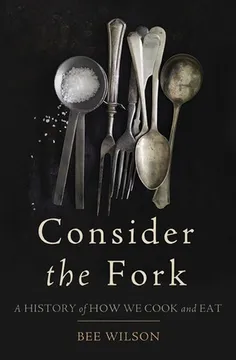
Consider the Fork changes the scale at which food history is usually told. Instead of beginning with ingredients, famous cooks, or national cuisines, it asks how ordinary devices made particular meals possible. This reveals that technology is not a parade of inventions moving toward an ideal kitchen. Its history is uneven: a device may appear long before it is useful, work brilliantly yet disappear, or remain in use because it fits a cultural habit as much as a practical need.
The book's most persuasive method is to connect material design with social life. A pot changes what can be eaten; a knife shapes both preparation and etiquette; a refrigerator reorganizes shopping and distribution. Yet the same account complicates technological optimism. A labor-saving machine may encourage more cooking rather than less, while a more efficient kitchen does not automatically reduce the burden on the person who works in it. Tools distribute effort, risk, authority, and pleasure. Their consequences depend on who owns them, who uses them, and what the surrounding household expects.
The argument also guards against a false opposition between science and tradition. A wooden spoon can be technically apt, an old ice-cream freezer can outperform newer equipment, and an exact thermometer can still offer misleading confidence if its sensor measures the wrong place. Tradition can encode accumulated skill, but it can also preserve avoidable danger or labor. Innovation can solve real problems, but its promise may exceed its benefits.
A useful qualification is that the book's many striking examples do not all carry equal evidentiary weight. Archaeological traces, historical inventories, laboratory findings, and a cook's own experience answer different kinds of questions. The proposed link between table manners and jaw shape, for instance, is intriguing but not definitive. That unevenness does not weaken the central insight. It encourages a more careful history of technology, one that treats everyday objects as evidence while asking what they can and cannot prove. The kitchen emerges not as a finished showroom, but as a living arrangement among tools, bodies, resources, habits, and appetites.
Review Summary
Reviews for Consider the Fork are generally positive, averaging 3.86/5. Readers praise Wilson's engaging exploration of kitchen technology history, from fire and pots to refrigerators and modern gadgets. Many found fascinating details about utensils, food preservation, and cultural cooking practices. Common criticisms include the book's Western-centric focus, lack of cohesive flow between chapters, insufficient illustrations, and occasional unnecessary personal anecdotes. Some readers noted a condescending tone toward American cooking practices. Most agree it's ideal for food history enthusiasts, though casual readers may find it uneven.
Glossary
tou
Chinese all-purpose kitchen knifeA broad, relatively light Chinese kitchen knife used for a wide range of tasks, including slicing vegetables, mincing meat, crushing garlic, and preparing fish. Its flat, broad blade supports an up-and-down chopping motion. Combined with a wok and fuel-efficient cooking, it helps produce evenly cut ingredients that cook quickly.
batterie de cuisine
A coordinated set of cookwareA French term for the collection of pots and pans in a kitchen. The idea became prominent in professional cooking as cooks acquired vessels suited to particular tasks, such as sautéing, poaching, or making sauces. It contrasts with one-pot cooking, where a limited number of vessels shaped the meal.
stuff-and-cut
Holding food while biting and cuttingAnthropologist Charles Loring Brace's name for an older way of eating chewy food. A diner held a piece of food in the hand, gripped it with the front teeth, and tore or cut off a mouthful. Brace proposed that eating smaller pieces with a knife and fork reduced this use of the incisors and contributed to the later appearance of the overbite.
the calorie delusion
Calories ignore food textureThe book's label for the idea that calorie counts alone do not fully describe how much energy the body obtains from food. Processing and texture affect digestion. The cited rat experiment found weight gain on soft pellets despite matching nutrients and calories, but this animal evidence does not by itself explain human obesity.
Frigophobia
Suspicion of refrigerationA term used for resistance to refrigerators and cold storage, notably among French food traders and consumers. Critics worried that refrigeration could disguise old food, damage delicate flavors, or give sellers more control over supply. Such concerns sometimes reflected genuine changes in taste, even as refrigeration improved preservation and distribution.
sous-vide
Cooking sealed food in controlled waterA technique in which food is sealed in a bag and cooked in a water bath held at a carefully controlled temperature. The method can produce evenly cooked meat, fish, fruits, or vegetables and limit the loss of juices. It requires specialized equipment and does not provide the browning of a pan, so food may need searing afterward.
modernist cooking
Experimental, science-led cookingA contemporary approach that tests established cooking assumptions and uses tools such as sous-vide baths, centrifuges, and freeze-dryers to create new textures and effects. It treats cooking as an experimental practice, but is one culinary option rather than a universal replacement for familiar techniques or home cooking.
mini-max
Maximum use from minimal meansAnthropologist E. N. Anderson's phrase for extracting extensive usefulness from a small number of tools. The tou is an example: one knife can perform many kitchen jobs, reducing the need for specialized utensils. The idea reflects practical frugality rather than a rule that every cuisine should use as few tools as possible.
Download PDF
Download EPUB
.epub digital book format is ideal for reading ebooks on phones, tablets, and e-readers.








