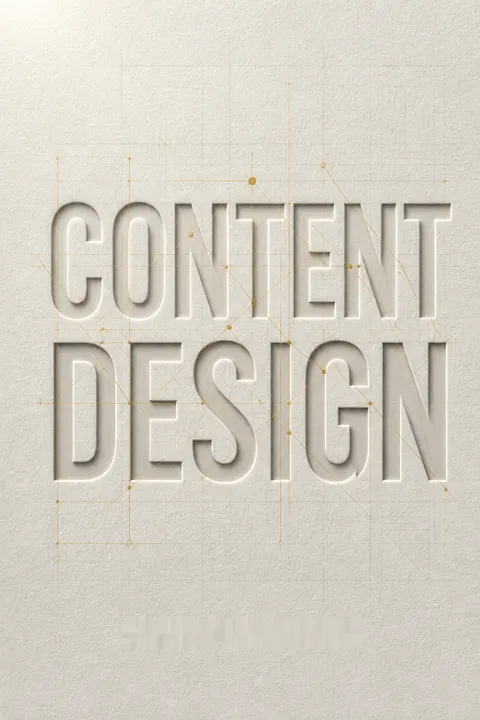


Key Takeaways
Design the answer users need, not merely the words your organization wants to publish
Start with the need. Content design means researching what people need to accomplish, then choosing the most useful way to help. That might be prose, a map, a video, a calculator, or a combination. The question is not simply how to write a page, but what form of content will solve the problem. A person facing debt may want a quick fix, while what helps is a clear sequence of steps and perhaps a repayment calculator.
Translate, do not broadcast. The book distinguishes push content, which an organization sends out, from pull content, which people actively seek. Effective digital content makes organizational information relevant to a user's task. This can serve business aims too, but only after the user's actual need is understood.
What's powerful here is the shift from content as an asset to content as a service. It changes the team's first question, and therefore its budget, skills, and measures of success. A calculator may be more useful than a beautifully edited page, while a short answer may be enough. The approach also limits a common institutional temptation: treating every message leadership wants to publish as a user need. Serving users and meeting organizational goals can overlap, but the overlap has to be demonstrated rather than assumed.
Use the words people search for, not the labels experts prefer
Vocabulary determines findability. A government page about finding a GP was hard to find because people searched for a doctor, not a GP. Changing the wording moved the page from among the site's least visited to one of its most visited. The same mismatch appears in the book's fictional energy-company case: people searched for fracking, while the company described its work as hydraulic fracturing. Search trends and forum discussions exposed the gap.
Listen in different places. Search terms, internal site searches, and public forums reveal different parts of users' language and concerns. Spoken language may differ from search language: someone may type a few keywords rather than a complete question. Use observed patterns, not a single anecdote, and explain technical terms when they matter.
This is a practical form of linguistic humility: the organization does not own the meaning of its services just because it names them internally. Search language can reveal the distance between professional categories and everyday problems. But search volume is not a complete portrait of an audience. It can miss people who do not search, people using assistive technology, or questions that are hard to phrase. The strongest vocabulary research combines search behavior with conversations and task observation, then checks whether the revised content actually helps.
Write for eyes that skim, not readers who absorb every line
Reading is selective. The book explains that eyes pause at fixations, where visual information is taken in, and jump between pauses in movements called saccades. Readers often skip words and rely on context to fill gaps. Citing Jakob Nielsen's online reading research, Richards reports that people read only about 20 to 28% of a typical page. The book also reports that mental effort rises as pages grow longer, and that unfamiliar words take longer to process.
Reduce needless friction. Familiar vocabulary, clear structure, and readable line lengths help people grasp information quickly. This is not a demand to remove every technical term or make every page short. It is a reason to make each sentence and detail earn its place, especially when readers are busy or distracted.
The useful insight is not that every reader skims in precisely the same way, but that attention is limited and web pages compete with real life. That makes structure a form of respect, not decoration. Cognitive psychology supports the general point that unfamiliar material demands more effort, although reading speed varies by expertise, disability, device, and purpose. A specialist may need detail; a person checking a deadline may need one date. Design should accommodate both without confusing brevity with completeness.
Research the task before you choose a page, tool, or message
Discovery is shared investigation. A content discovery brings together people who know the audience, service, subject, or approval process to understand the problem before proposing a solution. It can take a few hours or several days. The aim is a common view of the evidence and agreement about next steps, not a room full of people immediately designing a page.
Read metrics in context. Analytics can show visits, referrals, search terms, and where people go next. Yet a quick exit is not automatically failure. On a UK bank-holiday page, people often wanted only the date of the next holiday. Finding it and leaving within seconds meant the page had worked. Forums can reveal concerns and vocabulary, but they cannot reliably establish audience demographics.
Discovery is valuable because it makes assumptions visible before they become expensive design decisions. It also distributes knowledge: service experts may know recurring questions, while analytics show what people actually do. The combination resembles triangulation in research, where different methods test the same account from different angles. Still, a workshop can amplify the most senior voice unless facilitation deliberately makes room for quieter participants and actual user evidence. Data informs judgment; it does not eliminate it.
Define the user's goal before letting a solution take over
Write the task, not the interface. A user story describes a role, what that person wants to do or learn, and the goal behind it. A job story instead begins with a situation, then identifies the task and desired outcome. For example, someone who hears that fracking may happen nearby needs to find out where, so they can decide what to do. The story clarifies the need without assuming the answer is a postcode tool.
Test completion by outcome. Acceptance criteria describe what must be true for a story to be done. In this case, the person must be able to find the nearest relevant site, not necessarily enter a postcode. That distinction keeps teams from mistaking a favored feature for a user benefit. Split stories when one apparent task contains separate goals.
These story formats are modest tools with an important governance effect: they make teams explain why a proposed feature exists. This is closely related to requirements engineering, where observable outcomes are more robust than implementation instructions. A postcode lookup might be ideal for hundreds of locations, but a short list could serve a handful. The caveat is that stories can flatten complex people into tidy tasks. They should guide inquiry, not substitute for research into context, constraints, and competing needs.
Bring decision-makers into the evidence before they rewrite the work
Make agreement early. Content decisions often involve lawyers, subject experts, managers, marketers, and people with formal sign-off. If they see the work only at the end, it may return heavily rewritten and trigger repeated delays. A focused decision-making session brings those people together to review research, user stories, and a proposed content structure before detailed drafting.
Facilitate, do not ambush. State what the group needs to decide, share the evidence openly, and invite people with authority to delegate someone who can make decisions. The facilitator represents the researched audience, keeps discussion tied to the task, and ensures quieter voices are heard. The aim is shared responsibility for a useful result, not winning an argument for a preferred draft.
The book treats organizational alignment as part of design, not administrative clutter. That is realistic: content cannot serve users if it never gets approved or if sign-off reverses its logic. Early involvement can build trust by giving stakeholders a chance to shape the problem rather than merely veto the solution. Yet participation alone does not make a decision fair. Power differences remain, so evidence, clear decision rights, and a record of what was agreed help prevent consensus from becoming a polite name for hierarchy.
Choose the smallest format that fully solves the user's problem
Format follows scale. If a company has a dozen relevant sites, a list of addresses and a map may answer the question. If there are thousands, a postcode lookup could be more useful. Format is part of content design: tools, maps, calendars, and calculators communicate information just as words do.
Prioritize and limit. Richards recommends starting with what research shows people need, then considering content that reduces reputational risk and work that requires more development time. Not every topic belongs on every organization's site. The fictional energy company could link to government information about regulation instead of reproducing it. Publishing less can reduce maintenance and keep the team's attention on the value it uniquely provides.
This principle is a useful antidote to both tool fetishism and the institutional urge to publish everything. A format should earn its cost by reducing effort or improving understanding. The advice to prioritize complex development early also reflects a sound project-management instinct: long lead times can block a whole service. The harder question is who owns accuracy when content combines information from multiple organizations. A map that includes rival companies may help users, but it creates an ongoing data responsibility, not merely a one-time design task.
Make headings answer the reader's first question: am I in the right place?
Orient before explaining. A page title and opening paragraph should quickly confirm what the page covers and what the visitor can do. Headings should put the central subject early, so a reader searching for fracking facts can recognize the page without decoding a clever slogan. Subheadings break up dense material and let people preview its structure.
Make clarity concrete. Put the most sought-after information first, using the book's 80/20 rule as a practical guide: foreground what most visitors need, while keeping other important material findable. Use common words where possible, explain jargon on first use, and prefer direct sentences. A page can be brief and still be dull, so remove needless prose rather than imposing an arbitrary word limit.
Scannable structure is a kind of wayfinding. Readers make quick judgments about whether a page is relevant, and headings reduce the cost of those judgments. The idea also aligns with information foraging: people continue along a path when signs suggest useful information is ahead. However, an 80/20 hierarchy should not turn the minority's needs into invisible needs. Search, accessible navigation, and clear links can keep secondary information available without forcing every visitor through it.
Pair expertise with plain language, then critique the content safely
Write with complementary knowledge. Pair writing means creating content alongside another person, often a subject expert. The expert helps ensure accuracy; the content designer helps make the explanation understandable and focused on the user's task. In the book's example, an energy expert and designer shape an answer about whether nearby fracking could damage a house, while separating the immediate answer from deeper technical explanation.
Review the work, not the writer. A crit is a structured review of draft content. Participants should be respectful, offer constructive feedback, and discuss the content rather than the person. No one should have to defend every choice. Designers and developers may spot format problems that writers cannot see alone, such as repeated information better handled by a shared component or tool.
Pairing and critique turn quality from an individual virtue into a team process. This is especially important where expertise creates a curse of knowledge: specialists know so much that basic explanations can feel unnecessary to them. A structured review can surface assumptions before publication and help different disciplines improve one service together. Psychological safety matters, but safety is not the same as avoiding disagreement. The best critique preserves candor while making its target specific, testable, and separate from anyone's professional worth.
Give each published page an owner, success measure, and expiry date
Publication starts maintenance. Online content can be copied, archived, or kept alive long after its original purpose has passed. Before publishing, agree what success means, who will review the page, and when it should be archived. The measure depends on the page: a task page may be judged by successful completion, while another may depend on visits, sign-ups, or link use.
Interpret metrics by purpose. Set a baseline and a review threshold, then assign named people to check whether the page is still accurate and useful. A high bounce rate or short reading time may indicate failure on one page and success on another. If a page misses its target, investigate whether its language, structure, or purpose is wrong before deleting it.
This lifecycle view connects editorial quality to operations. A page is not finished when it goes live; it remains a promise that the information is current and the route still works. Named owners and review dates make that promise actionable. The deeper challenge is measurement: traffic is easy to count, while resolved needs are harder. Teams should avoid rewarding attention for its own sake. Sometimes the best result is that a person gets a trustworthy answer quickly and never needs to return.
Analysis
Content Design presents digital writing as a disciplined chain of decisions: discover the problem, understand the audience, define the task, choose a format, draft and test, then maintain the result. Its strongest contribution is not a particular sentence rule. It is the insistence that content choices be traceable to evidence about what people are trying to do. The fictional energy company makes this operational. A search mismatch, public concern, and a question about nearby sites become different content needs, formats, and responsibilities.
The method also reveals that content design is organizational design. Research has little effect if legal approval, subject expertise, product decisions, and maintenance remain disconnected. Shared discovery, decision sessions, pair writing, and critique create channels through which evidence can change what an organization publishes. This helps explain why the approach mattered in the GOV.UK context, where hundreds of separate government websites were consolidated into a more focused digital service. Simpler language alone could not accomplish that transformation; teams needed shared priorities and authority to remove or reorganize material.
The framework's central risk is treating available evidence as a complete representation of users. Search terms privilege people who already know how to search, analytics record behavior without explaining every motive, and forum participants may be unusually engaged. Metrics can also reward organizational visibility rather than successful task completion. Richards's own insistence on combining sources and judging measures by page purpose is therefore essential, not optional.
The book is most useful when read as an iterative practice rather than a formula. It encourages specific hypotheses, such as whether a familiar term improves discovery, then observation of whether the page performs better. Its standards of plain language and useful structure make content more accessible, but clarity is not merely shorter prose. It also means accurate evidence, honest organizational claims, understandable choices, and a clear route to action. Content design earns trust when all four align.
Review Summary
Content Design receives mostly positive reviews, with an average rating of 4.31/5. Readers praise its concise, practical approach to content strategy and design principles. Many find it helpful for structuring and planning content, especially for websites. Some criticize the book for being too basic or lacking in-depth information. The layout and typography are generally well-received, though a few readers found the formatting distracting. Overall, it's recommended for content creators, UX writers, and those new to content design.
People Also Read




Glossary
Content design
Research-led content problem-solvingAn approach that starts by researching what users need to do or understand, then selects the content and format most likely to meet that need. The answer may be text, a tool, a map, a video, or several formats together. It is broader than copywriting because it includes deciding what to create and what not to publish.
Push content
Content sent outwardCommunication an organization places in front of an audience, such as a poster, announcement, or press release. The audience may encounter it without actively searching for it. In digital publishing, the challenge is to make organizational messages relevant to what people need, rather than simply broadcasting what the organization wants to say.
Pull content
Content users seekContent people actively look for by entering a search, choosing a link, or navigating to a page. Because finding it takes effort, it needs to match the user's vocabulary and purpose. The book treats converting organizational messages into useful answers to real audience questions as a core content-design task.
Fixation
A pause in eye movementA moment when the eye rests on part of a page and the reader takes in visual information. Reading is not a smooth sweep from one word to the next. The locations and duration of fixations affect which parts of a page people notice and how quickly they can understand it.
Saccade
A rapid eye jumpA quick movement of the eye from one fixation point to another. The book explains that readers do not take in text during the movement itself, and that the brain uses context to infer some skipped material. Familiar vocabulary and clear structure can help readers move through text more efficiently.
User story
A role-based user needA concise description of a particular user's role, what they want to do or learn, and the goal they hope to achieve. It helps a team identify whose need it is addressing without prescribing a specific design solution. Different roles may need different content even when they are interested in the same subject.
Job story
A situation-based taskA description organized around a situation, the action or information needed in that situation, and the desired outcome. Unlike a user story, it emphasizes what is happening rather than who the person is. It can be useful when different kinds of people face the same task, such as finding out whether an activity is planned near their home.
Acceptance criteria
Conditions for task completionSpecific statements describing what must be true for a user story or job story to count as complete. Good criteria name the outcome a user must achieve, not the feature the team assumes it should build. For example, the user can identify the nearest site, rather than being required to use a particular postcode tool.
Scent of information
Signals of useful informationThe cues that lead users to believe a link, heading, or next step will help them find what they need. When those cues fit the user's expectations, people may continue through several steps rather than abandon a task after a fixed number of clicks. Clear labels and a logical structure strengthen that signal.
Pair writing
Collaborative content draftingA method in which two people create or revise content together at the same time. The partners may bring different strengths, such as subject expertise and skill in explaining information clearly. Working side by side can expose missing questions, improve accuracy, and bring people responsible for approval into the drafting process.
Crit
Structured content reviewA short, facilitated critique in which a group reviews draft content to improve the product. Discussion focuses on the work, not the people who created it, and feedback should be respectful and constructive. A crit can help writers, designers, developers, and experts notice different problems before publication.
How Little Do Users Read?
Online reading behavior studyA study by Jakob Nielsen cited in the book for the finding that people read only a fraction of the text on a typical web page, estimated there as roughly 20 to 28%. Richards uses the finding to argue for concise, structured content. The result supports a design principle, but should not be treated as a fixed reading rate for every page or audience.
FAQ
What's "Content Design" by Sarah Richards about?
- Focus on user needs: The book explains how to design content that meets the actual needs of users, rather than just what they say they want.
- Content design vs. copywriting: It differentiates content design from traditional copywriting by emphasizing research and user-centered approaches.
- Practical guidance: The book provides a step-by-step guide through the content design process, using real-world examples and fictional scenarios.
- Not about content strategy: It clarifies that content design is distinct from content strategy, which involves planning what to publish and why.
Why should I read "Content Design" by Sarah Richards?
- User-centered approach: It offers insights into creating content that truly serves the audience, which is crucial for effective communication.
- Proven methods: The book is based on successful practices used in the development of GOV.UK, a benchmark for user-centered content.
- Practical tools: Readers gain access to a flexible set of tools for identifying and meeting user needs.
- Industry relevance: It is highly relevant for content strategists, designers, and anyone involved in digital communication.
What are the key takeaways of "Content Design" by Sarah Richards?
- Content design definition: Content design involves choosing the best format to meet user needs, which may include words, images, or interactive elements.
- Research importance: Good content design is grounded in thorough research and understanding of user behavior and needs.
- Iterative process: Content design is an ongoing process of testing, learning, and improving based on user feedback and data.
- Collaboration: Successful content design often involves collaboration across different teams and stakeholders.
How does Sarah Richards define content design?
- Beyond words: Content design is not limited to text; it includes any format that best meets user needs, such as images, videos, or tools.
- Research-driven: It starts with research to understand what users actually need, rather than relying on assumptions.
- User-focused: The goal is to create content that is easy to find, understand, and use, putting the user at the center of the design process.
- Flexible approach: Content designers must be open to using various formats and methods to deliver the best user experience.
What is the difference between content design and content strategy according to Sarah Richards?
- Content strategy: Involves planning what content to publish, where, and why, focusing on the broader goals and objectives.
- Content design: Focuses on the execution of content, ensuring it meets user needs and is presented in the most effective format.
- Complementary roles: While content strategy sets the direction, content design ensures the content is user-friendly and effective.
- Separate disciplines: Richards emphasizes that content design is a distinct discipline that requires its own set of skills and approaches.
What are user stories and job stories in "Content Design"?
- User stories: These are narratives that describe what a user wants to achieve, helping teams understand user needs without prescribing solutions.
- Job stories: Focus on specific tasks and are used when there is a single audience, emphasizing the context and motivation behind user actions.
- Purpose: Both types of stories help guide the content design process by clarifying user needs and desired outcomes.
- Application: They are used to prioritize content creation and ensure that the content aligns with user goals.
How does Sarah Richards suggest handling jargon in content design?
- Avoid assumptions: Do not assume all users understand specialized language; always consider newcomers or those unfamiliar with the topic.
- Explain terms: Introduce and explain new terms the first time they appear to ensure clarity and understanding.
- Respect the audience: Using plain language respects the user's time and intelligence, making content more accessible.
- Balance: While some technical terms may be necessary, they should be used judiciously and always with the user's comprehension in mind.
What is the role of pair writing in content design?
- Collaborative writing: Pair writing involves two people working together on content, combining expertise and writing skills.
- Efficiency: It allows for faster content creation and can lead to quicker sign-off if one of the pair is a decision-maker.
- Improved accuracy: By pairing with subject matter experts, content designers can ensure accuracy while maintaining readability.
- Relationship building: It fosters better working relationships and trust within the organization.
What are crits, and why are they important in content design?
- Content critique: Crits are sessions where team members review and provide feedback on content drafts.
- Constructive feedback: They are designed to be respectful and focused on improving the content, not criticizing the creator.
- Team alignment: Crits help ensure consistency and quality across content, aligning team members on style and approach.
- Idea generation: They can spark new ideas and solutions, enhancing the overall content design process.
What are some best practices for writing headings and subheadings in content design?
- Front-load important words: Place the most important words at the beginning to aid quick comprehension.
- Clarity over cleverness: Avoid overly clever or humorous headings that might confuse users; clarity is key.
- Guide the reader: Use headings and subheadings to tell a story and guide the reader through the content.
- SEO considerations: Ensure headings are relevant and targeted to improve search engine rankings.
How does Sarah Richards suggest measuring the success of content?
- Define success criteria: Establish clear metrics for success, such as traffic, engagement, or conversion rates.
- Regular review: Set review dates to assess content performance and make necessary updates or improvements.
- Archiving: Plan for content lifecycle management, including archiving outdated content to maintain relevance.
- Continuous improvement: Use data and feedback to iterate and enhance content over time.
What are some of the best quotes from "Content Design" by Sarah Richards and what do they mean?
- "Content design isn’t just a technique, it’s a way of thinking." This emphasizes that content design is about adopting a mindset focused on user needs and data-driven decisions.
- "Respect your readers, you will make the content work for them." It highlights the importance of prioritizing user experience and clarity in content creation.
- "Assume nothing, question everything and test until you are sure." This encourages a rigorous approach to content design, where assumptions are challenged and decisions are validated through testing.
- "Because of you, the internet is getting better." A motivational reminder that content designers play a crucial role in improving online experiences for users.
Download PDF
Download EPUB
.epub digital book format is ideal for reading ebooks on phones, tablets, and e-readers.








