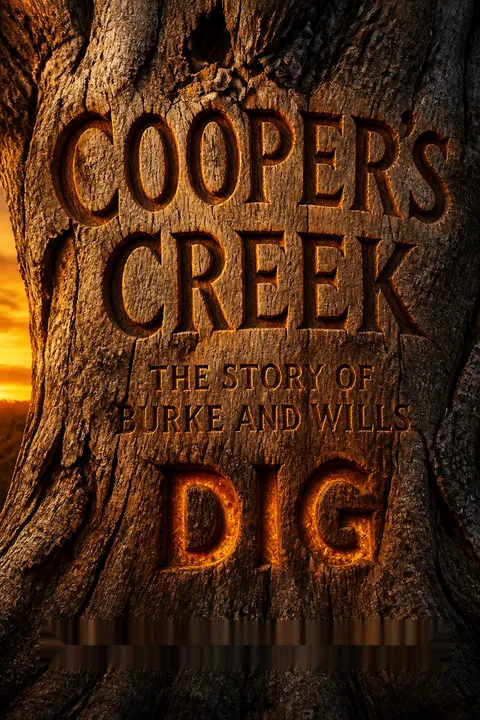


Key Takeaways
Treat the map's blank as unknown, not empty
A settler's map was not the land. In 1860, Melbourne's prosperous colonists occupied a narrow edge of a vast continent. Its interior was unknown to them, but it was inhabited: Indigenous communities knew its waters, foods, routes, and seasons. Europeans imagined a hidden inland sea and new grazing country, then described the unmapped territory as blank. That language exposes the expedition's double purpose: to learn what lay inland, and to claim it for a growing colony.
The terrain resisted simple stories. The interior could swing from drought and lethal heat to flood, while long distances separated waterholes. The explorers were not entering an empty stage for heroism. They were crossing a living country whose ecology and human knowledge they only partly understood.
What's striking is how a map can make ignorance look like absence. The phrase 'blank' describes the limits of European records, not the condition of the land or its peoples. That distinction matters in histories of exploration, where surveying often served settlement and extraction as much as curiosity. Moorehead's attention to Indigenous communities helps correct the map's silence, though the book sometimes describes them through the settlers' patronizing assumptions. Reading against those assumptions restores their agency as knowledgeable inhabitants, not scenery around a European adventure.
Sturt's hard-won routes made the interior legible, not safe
Earlier journeys offered warnings. Charles Sturt had traced the Murray and Darling river system and, in 1844, led a large expedition north from Adelaide in search of an inland sea. His party endured a summer in which temperatures reached 132 degrees in the shade and 157 in the sun. They found watercourses, but also the Stony Desert, punishing heat, and a landscape where a creek could be dry on one visit and flooded on another.
His maps were valuable, not reassuring. Sturt named Cooper's Creek and showed future explorers where water might be found. He also learned that summer travel could become a trap and that surface water was unreliable. His discoveries narrowed the unknown, but they could not turn the interior into a predictable route.
Sturt's experience illustrates a basic limit of precedent: a route is not a guarantee when conditions vary sharply from year to year. In modern risk planning, historical data are useful only when their uncertainty travels with them. Here, the explorers inherited place names and observations, but not control over rainfall, heat, or flooding. The book's contrast between Sturt's patient reconnaissance and later haste is persuasive, while also reminding readers that even excellent field judgment cannot eliminate environmental risk.
A race for prestige made speed outrank field judgment
Publicity changed the expedition's mood. Victoria wanted a route across the continent, partly to connect by telegraph with the north and the wider world. The rival explorer John McDouall Stuart was preparing to cross from South Australia, and newspapers turned the competing journeys into a race. Burke, chosen despite having no exploration experience, faced pressure to make progress and secure Victoria's prestige.
Equipment could not compensate for judgment. The expedition began with 27 camels, horses, and about 21 tons of baggage. The load proved unwieldy. Burke discarded stores, dismissed men, and ordered scientists to do manual labor. At Menindie, rather than wait for the full party and supplies, he sent a small group ahead. The problem was not a shortage of gear at the start. It was the mismatch between ambition, organization, and the conditions ahead.
A race can make a slow, uncertain task feel like a contest with a finish line. That framing rewards visible progress while hiding the costs of haste, especially when decision-makers far from the field set the status incentives. The expedition's equipment also shows why resources alone do not create capability: coordination, experience, and a sound operating plan matter just as much. The comparison should not make Burke a simple victim of pressure, though. He made consequential choices himself, including advancing without waiting for support.
Do not split a supply chain before its backup exists
The first split created dependence. At Menindie, Burke divided the expedition. He took a lightly equipped advance party toward Cooper's Creek while William Wright was supposed to bring the remaining men and stores after him. Wright did not follow promptly. Confusion over his appointment, delayed messages, inadequate animals, and his own poor decisions kept the rearguard on the Darling for months.
The next split raised the stakes. At Cooper's Creek, Burke left William Brahe and three companions at a depot while he, Wills, Gray, and King pushed north toward the Gulf of Carpentaria. They expected the depot to be reinforced and Burke expected to return within roughly three months. Instead, the two groups became isolated from each other, and every delay in the chain weakened the chance that food and people would be in place when needed.
In logistics, a plan is only as resilient as its weakest handoff. The expedition's depot system could have reduced risk, but only if the rear party arrived, understood its role, and had enough supplies to sustain it. Splitting teams is not inherently reckless; it can extend reach and preserve resources. The danger appears when a split depends on an unverified promise and there is no reliable communication or contingency. The expedition had several such dependencies, but treated them as though good intentions made them dependable.
Put orders and contingencies in writing before men disperse
Verbal instructions left room for incompatible beliefs. Burke left no clear written orders for Brahe about exactly how long to hold the Cooper's Creek depot. At the inquiry, witnesses recalled different understandings: three months, longer if provisions lasted, or until the explorers returned. Burke's own letter to the Melbourne committee said he expected to return within three months and wanted the party to remain until then or until its supplies ran short.
The uncertainty had practical consequences. Brahe stayed for four months and five days, then left when a companion was gravely ill and the party's health was failing. Burke and Wills, returning exhausted, understood the depot to be a secure rendezvous. Each side acted on a different picture of the plan, and the gap between those pictures became deadly.
Written protocols are not bureaucratic decoration when teams are separated by hundreds of miles. They preserve shared expectations after memory, stress, and changing conditions begin to distort them. The case also reveals a limit: even clear instructions need an exception process for illness, dwindling supplies, or lost contact. Brahe faced a genuine moral dilemma, not a simple choice between obedience and betrayal. A good plan would have specified both the expected waiting period and what to do if the depot party could no longer safely wait.
In the bush, Indigenous knowledge was survival infrastructure
Local help mattered more than European equipment. The explorers often met Indigenous people with fear and suspicion, and some leaders used firearms to drive them away. Yet people along Cooper's Creek gave Burke's party fish and nardoo cakes, showed Wills how to find food, and sheltered him. After Burke and Wills died, members of the local community fed and cared for King for weeks until Howitt's rescue party arrived.
Knowledge travelled through relationships. Sturt had also found that respectful dealings could bring assistance and information. The expedition's reliance on Indigenous food and shelter became clearest when its own stores and animals failed. The book records real generosity, but also shows how quickly explorers could misread unfamiliar customs and treat people as obstacles or risks.
This story makes a strong case that survival depends on social knowledge as well as technical skill. The explorers' maps, weapons, and instruments could not replace the local expertise that made food, water, and shelter accessible. The narrative is most valuable when it shows Indigenous people acting as decision-makers and caregivers. Its language sometimes filters them through colonial stereotypes, however, and that lens can flatten the very knowledge the story documents. Their help was not a scenic detail or an automatic resource; it was a choice made by people with their own priorities.
Nardoo filled stomachs without restoring strength
A staple was not a complete diet. Nardoo is a local plant whose spores could be gathered, pounded into flour, and made into cakes. Burke, Wills, and King increasingly relied on it after their animals died and their provisions ran out. Gathering and grinding enough took hours, and Wills recorded that the food seemed to satisfy hunger without giving them the strength they needed.
The physical decline was easy to misread. On the return from the Gulf, the men suspected Gray was pretending to be ill when he complained of weakness. He died before they reached the depot. At Cooper's Creek, the explorers also suffered from a lack of fresh food and developed symptoms associated with scurvy. Their ordeal was not simply about finding something edible. It was about getting enough nourishment to keep working.
The distinction between food and nourishment is central here. A survival staple can prevent immediate hunger while failing to provide what a body needs over time. The episode also shows how scarcity damages judgment: symptoms look like laziness, mistrust replaces diagnosis, and exhausted people have little capacity to investigate. Modern nutrition science can clarify why a narrow diet is dangerous, but the account itself does not establish a precise mechanism for nardoo's shortcomings. Its strongest evidence is experiential: the men ate it, yet continued to weaken.
A one-day miss, and an unread campsite, separated rescue from loss
The timing was devastatingly close. Brahe left the Cooper's Creek depot on April 21, 1861. Burke, Wills, and King arrived that evening, after burying Gray and struggling across the final miles. They found a message and a cache, but not the party. Brahe's note said the group and animals were in good condition, so Burke judged that his exhausted men could not catch them and chose a different route toward Mount Hopeless.
Later evidence went unnoticed. Brahe and Wright returned to the depot on May 8, while Burke's party was only about 30 miles away. They did not recognize signs that Europeans had camped there, and left without following the tracks. Months later, Howitt found King alive. The missed encounters were not fate alone: ambiguous signals, assumptions, and a brief search all mattered.
Near misses are powerful because they expose the difference between a plan that seems safe and one that can recover from error. Burke could not know that Brahe had just departed, and Brahe could not confidently interpret every trace at the camp. Still, a systematic search for tracks, a fresh note, or a clear record of each visit might have changed what followed. This is a classic human-factors problem: people tend to see evidence that fits their expectations. The tragedy's timing is haunting, but its practical lesson is about verification.
The inquiry found shared failure, not one convenient villain
The Royal Commission traced a chain of mistakes. Its report criticized Burke for dividing the expedition, leaving Cooper's Creek before the rearguard arrived, and attempting the crossing with too little food. It condemned Wright's long delay at Menindie as the main cause of the disaster. It also faulted the Melbourne committee for failing to act on messages that showed the delay, and censured Brahe's departure while recognizing the pressure created by illness and diminishing strength.
Leadership failures compounded one another. Burke kept no regular journal and gave few written instructions. Wright did not provide the promised support. The committee assumed matters were moving without checking. Brahe's return visit missed signs of Burke's party. No single decision explains the deaths; the commission's account shows how separate errors accumulated into a catastrophe.
The commission's analysis resembles modern systems thinking: outcomes emerge from interactions among people, procedures, and information, not only from one person's character. That does not erase individual responsibility. Wright's delay and Burke's decisions had unusual weight. But a search for one villain can distract from the committee's silence, the poor communication, and the lack of contingencies. The story is also a warning about hindsight. A fair judgment must distinguish what participants knew at the time from what became obvious only after the deaths.
Its nearly £60,000 cost bought knowledge, not a neutral legacy
The expedition failed and the rescue parties advanced exploration. Howitt found King and returned the survivors' records. Other parties crossed the interior, and McDouall Stuart reached the northern coast. Their journeys helped establish routes later used for settlement and the 1,800-mile overland telegraph. Exploration also helped reveal valuable mineral deposits, including the resources around Broken Hill and Cloncurry. The combined bill for the expedition, rescues, funeral, monuments, and payments came to nearly £60,000.
The consequences were unequal. The Victorian government promised 200 square miles on Cooper's Creek to Indigenous people who had helped King, but the grant was later forgotten. Contact brought disease and disruption, and the communities described in the book dwindled. The adventure became a national legend, while the people whose country sustained the explorers were pushed from the center of the story.
The book's ending refuses a tidy balance sheet. Exploration produced geographic knowledge and helped build communications and industries, but those gains were not shared equally. The promised land grant is especially revealing: gratitude could be publicly celebrated while Indigenous ownership remained politically disposable. A national myth can preserve courage and grief, yet also center the settlers who arrived and obscure the communities already there. Remembering both outcomes gives the expedition's legacy more accuracy than treating its discoveries as an uncomplicated public good.
Analysis
Moorehead builds the book around a cruelly simple structure: a prosperous colony imagines a hidden interior, sends a conspicuous expedition to conquer uncertainty, and then discovers that its real test is not reaching the Gulf but managing the return. The opening contrasts Melbourne's confidence with the environmental volatility beyond its settled edge. Sturt's earlier journeys supply both geographic knowledge and warnings. Burke's party then turns those warnings into a race, a sequence of divided teams, and a chain of assumptions that no one reliably checks.
The strongest explanation of the disaster is cumulative rather than monocausal. Burke's inexperience and impatience matter. So do Wright's delay, the committee's passivity, the failure to write clear orders, Brahe's constrained decision to leave, and the errors made when the depot was revisited. Heat, distance, scurvy, and unreliable water convert administrative weakness into physical danger. The narrative's central irony is that the expedition reaches the continent's northern edge, yet the crossing itself cannot protect its members from the failures behind them.
The account also makes landscape and story inseparable. Cooper's Creek is at once a source of water, a place of waiting, and the site where a few hours change the meaning of an entire expedition. The survivors' records and the inquiry let Moorehead reconstruct this near miss with unusual precision. That precision supports a powerful tragedy, though the book's occasional language about Indigenous communities reflects the colonial viewpoint it is trying to describe. The Indigenous people who supplied food, shelter, and care are not incidental to the story. They expose the limits of the explorers' claims to mastery.
The resulting legend holds two truths together: extraordinary endurance and avoidable failure. Its later consequences include new routes, communications, and mineral development, alongside dispossession and cultural loss. Treating the expedition as either heroic triumph or foolish blunder misses the more useful account: an ambitious system failed because its people, institutions, and environment were never brought into reliable alignment.
Review Summary
Cooper's Creek receives mostly positive reviews, with an average rating of 3.83/5. Readers praise Moorehead's gripping storytelling and vivid descriptions of the Australian outback. Many find the Burke and Wills expedition fascinating, comparing it to other famous explorations. Some criticize the dated language and racist remarks, while others appreciate the historical context. The book is commended for its comprehensive account, including the aftermath and official inquiry. A few readers find parts of the narrative slow or confusing, but overall, it's considered a valuable historical work.
People Also Read


Glossary
Nardoo
Local plant flourA plant whose spores could be gathered and pounded into flour, then mixed and baked into cakes. Indigenous people in the Cooper's Creek region used it as food, and the stranded explorers came to depend on it when their provisions ran out. The book describes its preparation as laborious and suggests that it sustained hunger without providing enough nourishment for continued strength.
Depot LXV
Cooper's Creek supply campThe expedition's main depot on Cooper's Creek, identified by its camp number and marked at a large coolibah tree. Burke left Brahe and several men there with supplies while he travelled north. The depot was intended to serve as a secure base and rendezvous, but delayed reinforcements, unclear orders, and Brahe's eventual departure made it the setting for the explorers' fatal near miss.
Barcoo Rot
Local deficiency illnessA sickness named for the Barcoo, another name for Cooper's Creek. Moorehead associates it with sores and swollen gums among people living in the region and links it to the vitamin deficiency that affected members of the expedition. The term connects the explorers' experience to a broader danger of surviving for long periods on a restricted diet without fresh food.
Pitchery
Chewed native stimulantA substance made by roasting stems of a native shrub and chewing them. John King described feeling unusually cheerful and unconcerned after trying it, comparing its effect to strong drinks. The explorers initially misunderstood the practice, but the offering of pitchery was a sign of hospitality from people they encountered along Cooper's Creek.
Download PDF
Download EPUB
.epub digital book format is ideal for reading ebooks on phones, tablets, and e-readers.








