


Plot Summary
The Key Beneath the Mint
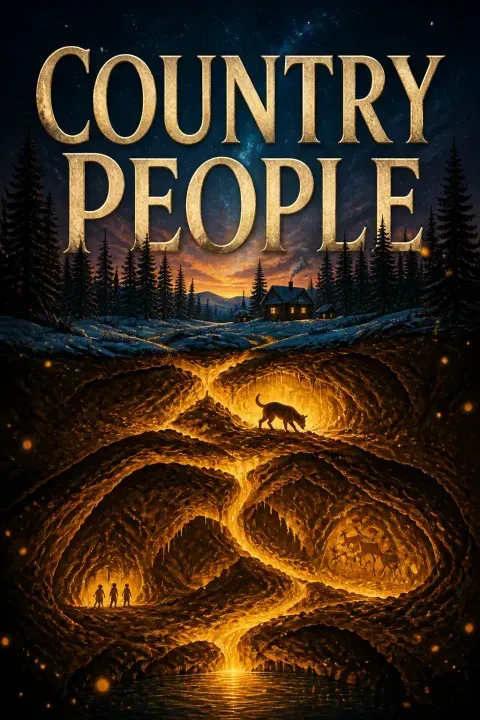
The Krzelewski-Petrosian family arrives at a borrowed house on Farm Road after driving from California with a dog in the driver's lap. Kate,2 a Milton scholar, has a one-year visiting professorship. Miles,1 her husband, has been working on his dissertation for fourteen years. Their children, Wesley4 and Olive,3 sleep in the car.
The key waits beneath a pot of mint, nestled among roots between a beetle and an earthworm. The house belongs to Norbert Rumphius, an economist now in Portugal after a scandal with a finance minister. He needs house sitters to watch for leaks and keep animals away.
The couple tiptoes inside alone, half-expecting bodies or inappropriate art. Instead they find pristine white carpets, real curtains, two couches that are not futons. Their dog Giuseppe,5 a truffle-hunting Lagotto Romagnolo, immediately vanishes into the night, returning soaked and dirt-caked, grinning as if he knows a thousand secrets.
The Krzelewski-Petrosians' arrival at the Rumphius house exemplifies the novel's central dynamic: educated urbanites stepping into a world whose codes they cannot read. The free house, the hidden key, the dog's immediate disappearance all signal that nothing comes without hidden costs. The pristine carpets and absence of bodies are the comic inverse of the Gothic tradition they half-expected, but Giuseppe's knowing grin suggests the house has secrets the humans have not yet begun to fathom. Miles's fourteen-year dissertation and Kate's hard-won career are introduced as the fundamental asymmetry the novel will test.
So Much Green
The family's first week overwhelms their California sensibilities. At a gas station, they discover cuisine previously unknown to organic-fed children: Slurpees, Slim Jims, and Flamin' Hot Limón Cheetos. A trip to a sheep farm is thwarted by a fallen tree; some merciful force, the narrative hints, spared them from a terrifying neighbor.
At a swimming hole, Kate2 presses her bare shoulder against Miles1 and he remembers what desire feels like, but the moment breaks when Olive3 panics about river parasites. They accumulate more free zucchini than any human family has ever possessed, a milestone passed without fanfare.
Olive3's crayons, exhausted of every brown crossing the continent, now grind through forest green and asparagus as she tries to capture a landscape so lush it seems fictional. Miles1 finds a 1993 guidebook and drags the family to defunct attractions. They get library cards without renouncing their California ones and discover ice-cream punch cards whose honor system actually works.
The family's first encounters with Vermont expose the gap between fantasy and reality that structures the entire novel. Olive's desperate crayoning of green after a continent of brown is a child's intuitive response to abundance, while the zucchini overload becomes a running joke about rural life's actual economics—you cannot refuse what is freely given, even when it becomes absurd. Their California organic sensibilities collide with gas-station cuisine in a clash played for comedy but revealing a deeper truth: the country is not the pastoral fantasy any of them imagined, and their fantasies were always more about themselves than about Vermont.
Olive's Camouflaged Teacher
Olive3's third-grade teacher Kayleigh Swan6 is pregnant, recently married to a man who pretended to drop her engagement ring into a reservoir, and an accomplished archer with both compound and crossbow. At the parent-teacher conference, Kayleigh6 praises Olive3's art while displaying other children's owl paintings as evidence of national decline.
On a family hike in November, the Krzelewski-Petrosians encounter Kayleigh6 rising from the underbrush in full camouflage. She is not hunting but patrolling the Vermont-Massachusetts border against pro-Massachusetts sympathizers, a generations-old territorial dispute. Wesley4 correctly identifies hunting seasons and rattlesnake habitats, earning Kayleigh6's respect.
Kate2 worries about Olive3's teacher. Miranda, their sociologist friend, explains that Kayleigh6 scores low on violence-prediction scales, patrols for ley lines and wild-man nests, and is exactly the person you want when society collapses. The family shares fig bars and rabbit jerky on the trail.
Kayleigh Swan embodies the novel's refusal to reduce rural people to stereotypes. She is simultaneously a nurturing teacher, a skilled hunter, a border separatist, and a believer in ley lines and wild men. Her character challenges assumptions about what constitutes dangerous belief versus harmless eccentricity. Miranda's violence-prediction scales provide a sociological framework that the narrative both deploys and subtly undermines, suggesting that human complexity resists academic taxonomy. Kate's maternal anxiety about Olive's teacher mirrors the reader's own uncertainty: how do we judge the beliefs of people entrusted with our children?
Whiskey's Hollow Earth
At the Greensbury Land Conservancy's Autumn Ramble, the guide Hugh8 transforms from celebrity gossip (he once gave Beyoncé moleskin for blisters, and still carries the evidence) to hollow Earth evangelist.
He tells the story of Jeremiah Wylkes, a 19th-century pastor whose dog Whiskey disappeared into a cave, leading Wylkes to an inscription reading 'Passage to the Outer World' and eventually to a hidden civilization with golden cities, mammoths, pterodactyls, and a beautiful princess named Gabalor. Hugh8 volunteers for the Jeremiah Wylkes Society, searching Quadrangle 45 for the fabled portal.
Wesley4 corrects Hugh8 on Joe Pye weed's Mohican origins and Vermont's timber rattlesnake populations, earning glares. The conservancy director, Serena Rubin,15 openly scoffs. But Olive3 is transfixed and asks what happened to Whiskey. Hugh8 points to his battered collie, who lifts her head at the sound of her name.
The Autumn Ramble establishes the novel's central epistemological question: how do we distinguish between knowledge and belief? Wesley's fact-checking represents Enlightenment rationalism, Serena Rubin's eye-rolling represents institutional science, and Hugh's hollow Earth evangelism represents the seductive power of mystery. The Wylkes legend becomes the book's organizing metaphor for the human need to believe there is more beneath the surface. That Hugh's battered dog is supposedly the same immortal Whiskey—a claim so absurd it wraps back toward something like pathos—suggests the novel's interest is not in debunking but in understanding why people need such stories.
The Serpent Scythe
Kate2 arranges for Miles1 to meet Andrei Abramov,9 a Russian-born biochemist who abandoned academia after his promised lab space fell through. Andrei9 now tends an orchard and scythes his meadow. He found salvation watching a man cut grass with hypnotic rhythm, bought a three-foot scythe blade marked with a serpent, and cured his melancholy swing by swing.
Miles,1 who once taught Anna Karenina's scything scene as class metaphor, discovers through practice that the scene is simply about scything: the whetstone's scrape, the stalks settling, the taste of water from a tin cup. He becomes obsessed, dreaming of scything, telling bedtime stories about a serpent-sword hero.
However, Kate2 later reveals that Andrei9's orchard success owes everything to a secret arborist named Osgood who drenched the trees in chemicals while Andrei9 was visiting his parents. Paloma, Andrei9's wife, engineered the whole deception to preserve her husband's happiness.
Scything provides Miles with something his dissertation never could: embodied knowledge. The novel suggests that academic interpretation can become a form of avoidance from direct experience. Andrei's story of finding salvation in physical labor, and Paloma's deception to preserve his happiness, introduces the book's recurring theme of necessary illusions. The orchard that succeeds only through hidden chemicals is a miniature of the larger hollow Earth question: does it matter if something is true, or only that believing it makes life bearable? Paloma's moral calculus (a little indoxacarb against a husband's restored soul) is both comic and genuinely unsettling.
Bjorning Season
Winter brings the cross-country ski league, coached by Bjorn Nordqvist10 in red-white-and-blue spandex. Bjorn10 lost his foot parachuting onto an oil platform to rescue hostages, then had it reattached in Trondheim, earning Norway's War Cross. Local mothers and some fathers come specifically to watch him, a practice called 'Bjorning.10
'Wesley4 raises his hand to inform Bjorn10 that the Norse god Ullr was Thor's stepson, not his son, and that a female ski goddess named Skadi also exists. Bjorn10 wisely ignores the correction. Miles1 becomes a parent 'sweeper,' following the youngest group to collect stragglers.
The children obsessively eat snow despite offerings of candy. When a rogue child nearly flies into a frozen lake, Bjorn10 shoots across the snow at impossible speed, catches her mid-flight, and tows her back by his pole basket. Miles1 watches his own children flush with joy and feels tears rise, telling himself it is only from the cold.
Bjorn represents the collision of genuine heroism with human ordinariness. His Olympic medal and war cross are objectively impressive, yet he is revealed as emotionally exhausting. The ski league becomes a site where the family's separate trajectories become visible: Miles struggling and eventually injured, Kate finding joy and escape, the children flourishing independently. 'Bjorning' as a verb captures the novel's anthropological eye, treating even small-town lust as worthy of sociological study. Wesley's compulsive fact-checking, even of a war hero, shows him becoming the family's awkward conscience.
Snowflake Bentley's Ambulance
On Valentine's Day, Miles1 tears his MCL attempting to pass Olive3 on skis. At the emergency room, surrounded by vomiting cupids from a costume party, he meets Reginald 'Snowflake' Bentley,7 a 328-pound man in a motorized scooter who photographs snowflakes and claims to be possessed by the ibbur of Wilson 'Snowflake' Bentley, the famous Vermont photographer.
While they wait for hours, Kate2 texts photos of Giuseppe5 having torn through the carpet into the subfloor. Bentley7 offers Miles1 a ride home in his converted ambulance, equipped with a shiatsu foot massager, a telescope, the full Oxford English Dictionary, and floor-to-ceiling card catalogues containing his 'Encyclopedia of Foolish Errors': a systematic catalogue of every wrong idea humans have ever held, from alien sex abductions to celery-juice cleanses, assembled to prove that if everyone else is wrong, his ibbur might be right. A tree branch falls across the driveway, trapping Bentley7 at the house for three days.
The emergency room scene on Valentine's Day is the novel's most concentrated rendering of human vulnerability. Miles's torn knee, the vomiting cupids, and Bentley's peculiar condition create a temporary community of the broken. Bentley's Encyclopedia represents a radical epistemology: if everyone believes nonsense, then no one has the authority to dismiss anyone else's beliefs. His ibbur is no more ridiculous than heroic bleeding or frequent-flier miles. The tree branch that traps him at the house is the novel's version of grace: an inconvenience that forces connection, transforming a stranger into a friend.
The Mountain Catch
While Miles1 sinks into post-injury depression, an unsigned postcard invites him to a meeting of the Jeremiah Wylkes Society. He lies to Kate2 about attending a film screening and drives through snow to the Mountain Catch, an abandoned seafood restaurant. Two dozen believers have gathered. Hugh8 presents updates on cave surveys across New England.
Earl Blossfeldt,13 an elderly cab driver, reveals newly discovered love letters confirming that the museum director who published the Colloquies genuinely believed the manuscript was authentic, not a hoax. Andrei9 presents dowsing maps of underground water. Farm Candy,12 a YouTube homesteading star, unveils romantic paintings of Princess Gabalor.
Later, Bentley7 explains the taxonomy of believers: Hugh8 believes everything, Andrei9 is working through academic betrayal, Candy12 is lonely, Kayleigh6 sees the Colloquies as political. Miles1 feels he has found his people, however improbable their beliefs, and begins telling Olive3 bedtime stories about Wylkes and the cave.
The Wylkes Society meeting reveals that belief is never monolithic. Bentley's taxonomy of members shows a spectrum from full credulity to strategic self-deception. Earl's archival research represents the humanist's faith that documentary evidence matters, even when describing impossible things. Farm Candy's paintings suggest that longing for connection, not geological conviction, drives many toward the Society. The meeting transforms Miles from amused observer to participant, a shift that mirrors his wider trajectory from detached academic to engaged community member. His decision to hide this from Kate, however, introduces a fissure that will widen dangerously.
Velvet Breeches and Spaniels
Miles1 volunteers for the third-grade production of A Midsummer Night's Dream. The director is Nausicaä Torres-Lakeman,11 a recent drama-school graduate who wears velvet pumpkin breeches, rose-embroidered stockings, and a Renaissance beret. She explains that the play is thick with eros, citing lines about spaniels and ivy enringing elm.
She asks Miles1 what he thinks of when he sees a donkey. During rehearsals, she transforms forty-six children into prowling lions and fluttering butterflies with nothing but a cowbell. Afterward, she invites Miles1 for a drink at the Greensbury Arms.
She tells him about her bad breakup, her mother's warning that she falls too quickly. Beneath the booth, her foot presses against his, then her calf, then his knee. Miles,1 flattered and flustered, does not pull away quickly enough to send a clear message. He tells himself the flush he feels is harmless, the appreciation of beauty merely aesthetic.
Nausicaä functions as a test of Miles's commitments. Her theatrical interpretation of Midsummer Night's Dream, emphasizing its erotic subtext, clashes with the elementary-school context, creating comedy from the gap between her intentions and the children's innocence. Miles's temptation is not really about Nausicaä but about escape from his foundering life: the fantasy that another version of himself, desired by a younger woman, is still possible. The donkey-head prop in his lap literalizes the question she is asking: what animal desires lurk beneath the domesticated husband and father? His failure to say no is a moral threshold approached but not yet crossed.
Bjorn's Midnight Message
One morning, Miles1 discovers a text on Kate2's phone from an unlabeled 802 number: 'I need 2 talk R u awake?' sent at 12:48 a.m. He traces it to Bjorn Nordqvist.10 Jealousy crashes over him. He recalls two previous crises: the handsome Byron scholar who once invited Kate2 swimming alone in Santa Cruz, and her high school boyfriend Nick, whom she encountered at a conference and whose death years later left her sobbing.
Miles1 drives aimlessly through the snow, imagining his marriage collapsing. He nearly follows Nausicaä11 home from the grocery store, watching her walk away through a blizzard with flowers in her bag, her velvet breeches replaced by stockings beneath the Red Sox jacket.
He believes his life's genre is shifting from Comedy to Tragedy. Only a frantic phone call from Kate2 stops him: Olive3 is missing. She left the house during an argument with Harper and has not been seen for hours. A blizzard is intensifying.
The Bjorn text message crystallizes the novel's investigation of marriage under asymmetric pressure. Miles's jealousy activates his deepest insecurity: that he was only valuable to Kate when she was sick and needed care, and that her health has made him obsolete. His near-decision to follow Nausicaä represents a moral threshold where resentment nearly becomes action. The novel's refusal to let him cross, interrupting with Olive's disappearance, is both narratively convenient and psychologically acute: crisis has always been the force that pulls the Krzelewski-Petrosians back together. The emergency reorders all priorities, making the question of Bjorn's intentions suddenly irrelevant.
Olive Goes Underground
Olive3 had been arguing with Harper over the cave her father1 described in bedtime stories. Harper called her a liar and bragged about her father shooting bear cubs. Olive3 used the F-word and stormed outside. Earlier, she had discovered a real cave near the house: Giuseppe,5 driven by the Super-Rat-Line beneath the property, had been excavating it for weeks.
She had gone inside once before with her keychain flashlight, followed a ledge to a waterfall, and slipped in the dark. Now, determined to prove Harper wrong, she returned alone. Snow was falling heavily. She intended only to go a little farther, to document evidence with her sketchbook.
But she slipped again, lost her light, and could not find the way out. Giuseppe,5 who had followed her, stayed in the darkness, giving her hope. When Harper finally admitted Olive3 had left, hours had passed, the snow was deepening, and night was falling. Kate2 called Miles,1 her voice unrecognizable with fear.
Olive's disappearance literalizes the metaphorical caves the adults have been exploring all year: the hollow Earth, the buried truths in the marriage, the hidden chemicals in the orchard. A child following her father's stories into actual danger is the Humbaba nightmare realized—the dark side of Miles's storytelling gifts. Yet Olive's agency matters: she is not a passive victim but an explorer testing belief against reality, exactly as her father taught her. Her keychain flashlight, a gift from her parents, becomes a talisman that fails her. Giuseppe's loyalty in staying with her transforms the comic nuisance dog into something approaching a guardian spirit.
Giuseppe's Fourth Try
Hugh Lamoreaux8 arrives with maps of nine known caves in the Claymore sector. The entire Wylkes Society mobilizes: Kayleigh Swan6 despite her third trimester, Clem the Rat Man,14 Earl13 the cab driver, Farm Candy,12 Andrei,9 and Serena Rubin,15 the Land Conservancy director who has apparently converted.
They fan out through the blizzard in formation. Giuseppe5 has been running between the house and the cave entrance all evening, barking frantically, but no one understood. On his fourth trip back, Bentley7 notices the dog is smeared with clay and orders the others to follow. Ten minutes later, they reach the mouth of Cave A-76.
They call Olive3's name and she answers immediately. Miles1 and Kate2 crawl inside and find her wet, cold, and alive, clutching her keychain light. The Wylkesians, meanwhile, turn their attention to a corridor vanishing into the darkness at the back of the cave. A Search and Rescue volunteer scolds everyone about zoonotic diseases.
The search mobilizes the entire improbable community the novel has assembled. The Wylkes Society, mocked as cranks and conspiracy theorists, becomes the only group with the practical knowledge to find Olive. Giuseppe's four attempts to communicate, ignored until Bentley notices the clay, dramatize the novel's thesis about the limits of human understanding and the wisdom available if we pay attention to non-human messengers. The dog who was a comic nuisance becomes the hero. The novel here cashes out every seemingly throwaway detail: the Society's cave maps, Giuseppe's obsessive digging, Bentley's observational skills acquired through years of cataloguing human error.
A Looping Corridor
While Olive3 reunites with her sobbing parents, the Wylkes Society pushes deeper into the cave. The corridor narrows, descends steps cut into stone, winds past a drop-off. Miles1 gives Giuseppe5 permission to dig through a gravel blockage, and the party enters a vaulted chamber lit from above by pulsing silver, sapphire, and ruby light.
Wesley,4 the smallest, is first inside. He realizes what the others have not: their long, winding path has looped back to where they started. The magical lights are police beacons reflecting off polished marble. But he waits to tell the grown-ups, letting them bask in the possibilities.
The Society members are crushed, yet Hugh8 quickly reinterprets: the cave's existence proves they are close. The discovery, he announces, means they should focus on the newly named Rumphius sub-sector. Snowflake Bentley7 files another card. The Society gains four new human members and one canine, including Kate,2 who finds the whole thing resonant with her work on Blake and Milton.
The looping cave corridor is the novel's most elegant structural joke and its deepest philosophical statement. The Wylkesians' disappointment is real, yet Hugh's immediate reinterpretation demonstrates how belief systems absorb contrary evidence. Wesley's decision to delay revealing the truth shows his emotional maturity: he understands that people need their illusions. The novel refuses to endorse either pure skepticism or pure credulity, instead locating value in the community that belief creates. Kate's unexpected appreciation—connecting Wylkes to Blake and Milton, the poets she has dedicated her life to—brings the novel's two worlds into unexpected harmony.
Mr. K., Third-Grade Teacher
In the aftermath, Kate2 and Miles1 have the honest conversation they have been avoiding for years. Kate2 explains that Bjorn10 was merely confiding about his crumbling marriage; he was a needy man who called too often, not a lover. She shows Miles1 the entire text chain as proof.
Miles1 confesses his flirtation with Nausicaä11 and his deeper truth: he will never finish his dissertation. He has started eleven different topics and loved each one, but the writing was always a form of private worship, not a career. Kate2 accepts this. When the elementary school principal calls to offer Miles1 a third-grade teaching position (Kayleigh Swan6 is running for Congress), he accepts.
Kate2 receives a permanent endowed chair in English. They buy Rumphius's house. Miles1 sharpens his chainsaw, repairs his snath, and tells his children stories that no longer need hidden worlds to be magical. The country has become home.
Miles's decision to quit his dissertation represents not failure but a redefinition of purpose. The novel has spent a year demonstrating that he is, in fact, an extraordinary teacher: of his children through stories, of third-graders through the play, of himself through scything and skiing. His domestic skills are not distractions from a scholarly life but the substance of a different kind of life entirely. Kate's acceptance of this transformation completes the arc: the 'Slight Disappointment' dissolves into something that looks like love accommodating reality. The couple's mutual confession (her Bjorn, his Nausicaä) functions as a marital reset, an acknowledgment that temptation exists but commitment matters more.
Epilogue
On May Day, the entire town gathers for the third-grade production of A Midsummer Night's Dream. Nausicaä11 has created an improbable spectacle: ten Pucks, eight lovers, twelve players, and a green light that transforms the auditorium. The audience passes from bepuzzlement to acceptance to awe. Squirming siblings go still in their parents' laps.
Arguing couples clasp hands. Olive3 dances with particular grace among the ten Pucks, moving with an inside knowledge of magic. In the bleachers, Miles1 sits with Kate2 and Wesley,4 spotting every character from their year: Miranda with Clem the Rat Man,14 Earl13 and his wife, Farm Candy12 talking to the former sheep-farm owner, Andrei9 hunched over Anna Karenina, Bjorn,10 the vet, the principal, the hunter who once threatened Miles.1
Margie has arrived with an unknown gentleman. Snowflake Bentley7 is home cooking risotto for a woman who paid forty-seven dollars for organic wrinkle cream and whose delusion he chose not to correct. The Pucks apologize for shadows, and the crowd rises in thunderous applause.
---
Don Martel hosts a special 'Pools and Pool Care' episode of The Miscellaneous Minute. A caller named Todd in Wilmington, who has been trying to get through for months using fake names and voices, finally tells his story. His pool cracked open, revealing a staircase-like cave beneath.
He lowered himself inside, followed winding passages through chambers of colored marble, and found a castle door. When he opened it, he saw a whole world: caribou, elk, dodos, chestnut trees, and kind civilizations living in harmony. The cell service is not great, he says, but he cannot go back, not after where he has been.
He asks Don to tell his wife he loves her. The call cuts out mysteriously. The pool experts are baffled. Don, unflappable, pivots to the next caller, who has a question about a dog. He barks twice into the microphone and declares, 'This is America!'
The school play epilogue performs the novel's closing argument: that community art, however chaotic, is genuinely magical. The multiple Pucks, the hidden cue screens, the braces and mumbling, all generate an enchantment no slick professional production could match. Listing every character in the audience suggests that the novel's true subject has not been hollow Earths or academic careers but the dense web of human connection that constitutes a place. Each brief cameo acknowledges a life that intersected with the family's and continued on its own arc. The epilogue is a benediction, a demonstration that the Krzelewski-Petrosians are no longer visitors but threads in the fabric.
Analysis
[Country People] is a novel about the stories we tell to survive. Its apparent subject is the hollow Earth legend of Jeremiah Wylkes, but its real investigation concerns the necessary fictions that sustain marriages, communities, and individual identities. Andrei9's chemical-free orchard that is secretly drenched in pesticides, Miles1's perpetually unfinished dissertation, Bentley7's ibbur, the Wylkes Society's shared belief in an inner world: each represents a story that makes life bearable whether or not it corresponds to fact. Daniel Mason treats belief not as a binary between truth and delusion but as a spectrum on which everyone locates themselves somewhere, usually without examining their own position.
The novel's structural genius lies in its refusal to resolve its central mystery. The cave Olive3 discovers is real, with limestone chambers, a waterfall, and cut steps. But it does not lead to Gabalor's crystal palace. Yet Todd from Wilmington, in the final pages, claims to have found exactly that world beneath his swimming pool. Mason leaves both possibilities open: the hollow Earth exists and does not, belief is both foolish and essential, the magic is both real and a trick of police lights reflecting on marble.
Miles1's journey from detached ironist to engaged participant in a community of believers mirrors the reader's own trajectory. We begin by laughing at Hugh8 and the Wylkesians; by the end, we understand why they gather in abandoned seafood restaurants on Tuesday nights. The novel suggests that this is not so different from what literature itself offers: a shared belief in people and places that do not exist, which nonetheless shapes how we live.
The book's title is both descriptive and quietly ironic. These 'country people' include a Russian-born biochemist, a YouTube star with a Potemkin homestead, a sociologist who studies them all, and a California family that wandered into their midst. Country people, Mason implies, are wherever you find them, and the line between insider and outsider, believer and skeptic, is thinner than anyone likes to admit. The novel's greatest achievement is to make the case for enchantment without abandoning intelligence, to honor the longing for hidden worlds while keeping its feet planted in the soil of this one.
Review Summary
Characters
Miles Krzelewski-Petrosian
Perpetual ABD Grad Student[Miles] has spent fourteen years on an unfinished dissertation, drifting from troubadours to Rabelais to Russian folktale peasants. He is warm, distractible, and possessed of an almost pathological curiosity about people's eccentricities. His greatest gift is storytelling: every night he invents bedtime tales for his children, populating their world with shape-shifting Humbabas and heroic dogs. Beneath his cheerful aimlessness lies a deep insecurity about his purpose and a fear that his wife2's patience is wearing thin. He married Kate2 knowing her multiple sclerosis could return at any time, and being needed by her during illness gave his life a shape his academic career never provided. His willingness to believe in almost anything makes him vulnerable to both wonder and folly, but it also makes him the ideal candidate to stumble into Vermont's hollow Earth underground.
Kate Krzelewski-Petrosian
Milton Scholar and Mother[Kate] is a full professor of English who teaches Milton and Blake with such passion that students report weeping in her lectures. Her multiple sclerosis, diagnosed in college after years of dismissed symptoms, has been in sustained remission thanks to modern infusion drugs, but the memory of wheelchairs and steroid-bloated months haunts her. She is ambitious, brilliant, and exacting; her classes are called simply 'Milton' because, as she says, if you need first names perhaps you should take another class. She loves Miles1 deeply but has grown weary of his professional paralysis, a feeling she privately names the 'Slight Disappointment.' Her history of illness makes her acutely aware of time's fragility and the precariousness of the life they have built. She is practical about dangers but not immune to wonder, as her eventual embrace of the Wylkes Society demonstrates.
Olive Krzelewski-Petrosian
Nine-Year-Old Artist[Olive] is a third-grader whose gap-toothed smile and protruding ears (inherited from her father1) conceal a fierce artistic talent. Her teacher declares she is 'mopping the floor' with her classmates in art. She draws constantly, cataloguing the family's cross-country journey in crayon and producing owl paintings that make other children's efforts look like accidents. She believes in her father1's stories with a devotion that worries her mother2, but she is not credulous: she tests the tales against reality, which is how she discovers Giuseppe5's cave. She names her stuffed animals Hegemony and Freudenschade, absorbing vocabulary she does not fully understand. Her determination to prove her boast to Harper drives the novel's climax, and her keychain flashlight becomes a talisman in the darkness.
Wesley Krzelewski-Petrosian
Twelve-Year-Old Fact-Checker[Wesley] survived night terrors at age three, a destructive alter-ego phase as 'King Damij' at five, and a months-long paranoid episode at seven when Miles1's Humbaba stories made him suspect his parents were shape-shifting imposters. Now, at twelve, he has channeled his intensity into Cosmos, a role-playing game where he creates entire galaxies from atomic scratch. He is a compulsive corrector of misinformation, challenging nature guides on botany and ski coaches on Norse mythology. His investigative instincts lead him to probe local mysteries for the school newspaper, using fake email accounts and official-sounding organizations. Despite his surface skepticism, he shares his father1's deep capacity for immersion in imagined worlds, building universes with the same meticulous attention he applies to debunking other people's errors.
Giuseppe
Truffle-Hunting Rescue Dog[Giuseppe] is a Lagotto Romagnolo acquired during the pandemic after the family was rejected by breeders in five states, bred for truffle hunting, giving him a genetic drive to locate secret, pungent morsels underground. He arrived with the family from California riding in Miles1's lap and has been the source of constant chaos ever since, from destroying the rental carpet to excavating the yard. His obsession with digging leads him to discover the Super-Rat-Line beneath the house and eventually the cave where Olive3 becomes trapped. In the novel's climax, he tries four times to lead the rescuers to Olive3 before anyone understands. He wears an expression of knowing secrets he cannot communicate, and his truffle-hunting nose may be the most reliably truth-seeking instrument in the entire book.
Kayleigh Swan
Pregnant Bow-Hunting Teacher[Kayleigh Swan] is Olive3's young third-grade teacher who is pregnant, recently married, and skilled with compound and crossbow. She patrols the Vermont-Massachusetts border in camouflage, searching for ley lines, burial mounds, and wild-man nests as part of a generations-old family feud over the true state line. At parent-teacher conferences, she praises Olive3's art while displaying other children's inferior work as evidence of national decline. She is a devoted member of the Jeremiah Wylkes Society who gives enthusiastic whoops during presentations and ignores medical advice against third-trimester spelunking. She later runs a successful environmental campaign by arguing a contested zone is Bigfoot habitat, then runs for Congress, her trajectory from eccentric local to political candidate embodying the novel's refusal to mock what it does not understand.
Reginald 'Snowflake' Bentley
Possessed Photographer of Folly[Reginald 'Snowflake' Bentley] is a 328-pound man confined to a motorized scooter, who believes he was possessed at twenty-two by the ibbur (a Kabbalistic benign spirit) of Wilson 'Snowflake' Bentley, the famous Vermont snowflake photographer. He has spent decades compiling an 'Encyclopedia of Foolish Errors' in card catalogues inside his converted ambulance, systematically documenting every wrong idea humans have ever held, from alien abductions to flat-Earth theory, to prove that if everyone else is deluded, his ibbur might be reasonable. He lives alone since his wife Valerie's death and goes to emergency rooms on holidays for conversation. Despite his bizarre belief, he is one of the novel's most reliable voices, a shrewd observer of human folly who ultimately helps save Olive3 by noticing the clay on Giuseppe5's paws.
Hugh Lamoreaux
Hollow Earth Society President[Hugh Lamoreaux] is a burly nature guide with a ponytail and Indiana Jones hat who works at an exclusive wellness resort. He believes the Earth is hollow with both an Inside and Outside surface. He volunteers his tracking skills to search Quadrangle 45 for the portal Jeremiah Wylkes described. He is an unsettling mix of meticulous empiricist and complete crank: rigidly careful about Wylkesian scholarship while believing his rescue collie is the original Whiskey, still alive after two centuries. His celebrity anecdotes (he once gave Beyoncé moleskin) alternate with disquisitions on geology that contradict everything known about the planet. Yet when Olive3 disappears, Hugh8's detailed cave maps and organizational skills prove essential, transforming his esoteric obsession into practical heroism.
Andrei Abramov
Biochemist Turned Orchardist[Andrei Abramov] is a Russian-born immunologist who abandoned academia after broken promises. He found salvation in a scythe. He teaches Miles1 the art of cutting grass, describing how each swing cured his midlife melancholy. His orchard, which he believes he grows organically through heroic daily labor, is secretly maintained by a chemical arborist named Osgood, hired by his wife Paloma, who cannot bear to watch him fail again. He is a devoted Wylkesian who uses dowsing rods to map underground water, searching for the hollow Earth with the same earnest intensity he once applied to curing disease. His story embodies the novel's central question about whether necessary illusions are a form of love or betrayal.
Bjorn Nordqvist
One-Footed Olympic Hero[Bjorn Nordqvist] is a Norwegian cross-country skier who won a medal at Sochi before losing his foot parachuting onto an oil platform during a hostage rescue. His foot was reattached, earning him Norway's War Cross and, some say, saving Western Europe's petrochemical supply. He now coaches children in Greensbury in his patriotic spandex, the object of local lust known as 'Bjorning.' Beneath the heroic exterior, he is going through a painful marital separation and is emotionally needy to the point of exhausting his confidantes. His midnight texts to Kate2, which Miles1 discovers and misinterprets as evidence of an affair, turn out to be the lonely pleas of a man who has no one else to talk to about his crumbling marriage.
Nausicaä Torres-Lakeman
Theater Director in Breeches[Nausicaä Torres-Lakeman] is a recent drama-school graduate hired to direct the elementary school's Midsummer Night's Dream. She wears velvet pumpkin breeches, rose-embroidered stockings, and a Renaissance beret, and sees eros everywhere in Shakespeare. She develops a crush on Miles1, pressing her leg against his in a pub booth and telling him about her bad breakup. She once performed every role in a one-woman Cherry Orchard and wrote a feminist Anna Karenina adaptation. Her flirtation with Miles1 represents the temptation of an alternate life, a path not taken. She directs the chaotic school production into something genuinely enchanting, demonstrating that her theatrical pretensions have substance.
Candace 'Farm Candy'
YouTube Homesteading Sensation[Candace 'Farm Candy'] is a single mother who built an enormous social-media following by filming her farm failures in revealing clothing. She is lonely despite her fame. Her husband left after growing tired of being the butt of her content. She finds community in the Wylkes Society, where she paints romantic portraits of Princess Gabalor that Hugh8 gently critiques for historical inaccuracy. Her homestead is a disaster zone in person, a fact her camera angles carefully conceal.
Earl Blossfeldt
Cab Driver and Wylkes Historian[Earl Blossfeldt] is an elderly cab driver and descendant of loggers who has spent years researching the Colloquies in archives across New England. He discovered love letters proving the museum director who published the manuscript was not the hoaxer some claimed. His basement is filled with vintage saws, lanterns, and photos of his great-grandfather balanced on river log jams. He drives Miles1 to school the morning after the Wylkes meeting and insists on retrieving the stranded car as a family favor.
Clem 'The Rat Man'
Exterminator and Band Teacher[Clem 'The Rat Man'] is Greensbury's band teacher who moonlights as the universally beloved Rat Man of Vermont. He looks uncannily like Garfield the cat, with ginger whiskers, a flat nose, and long sharp nails he claims God gave him for the profession. He has been called to Rumphius's house by every previous renter but never warns them about the Super-Rat-Line, preferring the drama of pretending to discover it fresh each time.
Serena Rubin
Land Conservancy Director[Serena Rubin] is a Ph.D. biologist who runs the Greensbury Land Conservancy and gives Olive3 her own field notebook during the Autumn Ramble. She initially dismisses Hugh8's hollow Earth theories with open scorn but, after attending a Society meeting, begins to reconsider, sitting next to Miles1 and whispering that she thinks they are onto something. Her conversion from skeptic to cautious believer mirrors the novel's broader argument about the porous boundary between knowledge and faith.
Plot Devices
The Colloquies of Jeremiah Wylkes
Hollow Earth ManuscriptA 461-page manuscript left on the steps of the Southern Vermont Historical Museum in 1897, purportedly dictated by a 104-year-old recluse named Jeremiah Wylkes to an anonymous forester called X. It describes Wylkes's discovery of a cave portal leading to an inner world with golden cities, mammoths, pterodactyls, and a beautiful princess named Gabalor. The Colloquies are the sacred text of the Jeremiah Wylkes Society, whose members debate its authenticity, search for the portals, and build community around its promises. The manuscript's ambiguous provenance (hoax or revelation?) drives the novel's central epistemological question about belief, evidence, and the human need for mystery. It also provides the bedtime stories Miles1 tells Olive3, which inspire her fateful expedition into the cave.
Giuseppe's Truffle-Hunting Instinct
Underground CompulsionGiuseppe is a Lagotto Romagnolo, a breed genetically selected over centuries to hunt truffles by scent. This means he is hardwired to detect and excavate secret, pungent things buried underground. Throughout the novel, his obsessive digging (through the carpet, into the subfloor, across the yard) is played for comedy and domestic frustration. But his instinct serves a crucial narrative function: it leads him to discover the Super-Rat-Line beneath Rumphius's house and, ultimately, the cave entrance where Olive3 becomes trapped. His inability to communicate what he knows to his oblivious human family becomes a running joke that pays off catastrophically and then heroically during the rescue.
The Super-Rat-Line
Rodent Highway Under HouseAccording to Clem the Rat Man14, the world is crisscrossed by invisible Rat-Lines, migratory channels along which rodents have traveled for millennia. The Rumphius house sits on a rare Super-Rat-Line, a convergence point of extraordinary rodent density that explains both the constant mouse infestation and Giuseppe5's obsessive behavior. The Rat-Line is a geological and biological phenomenon that connects to the solutional cave network beneath the property. It serves as a comic version of an inner world mythology: a real subterranean system that is less glamorous than Wylkes's golden cities but equally hidden from human perception. Every previous renter has fled because of it.
Miles's Unfinished Dissertation
Perpetual Academic LimboMiles has been working on his dissertation for fourteen years, cycling through eleven different topics from troubadours to Rabelais to monsters to Russian folktales. His current project on Russian folktale peasants has stalled completely. The dissertation functions as the external measure of his failure and the internal source of his shame, the 'Slight Disappointment' his wife Kate2 tries not to feel. It is the ghost that haunts their marriage, the unfinished business that brought them to Vermont (supposedly so Miles could write about country people by living among them) and the thing he must finally abandon to become who he actually is: a teacher, a storyteller, a country person himself.
The Humbaba Precedent
Warning About StorytellingWhen Wesley4 was seven, Miles1 invented a bedtime character called the Humbaba, a shape-shifting creature who could impersonate anyone, including parents. When Wesley4 asked if Miles1 and Kate2 could be Humbabas, Miles1 answered playfully: 'Perhaps. But how would you know?' This triggered a months-long paranoid episode in which Wesley4 barricaded his bedroom door, believing his parents might be imposters. The incident became the family's shorthand for the dangers of Miles1's storytelling and Kate2's justification for caution. It haunts the novel as the dark potential of imagination: the stories that delight children can also terrify them, and the father who tells tales of hidden worlds may inadvertently send his daughter3 into one.
Download PDF
Download EPUB
.epub digital book format is ideal for reading ebooks on phones, tablets, and e-readers.








