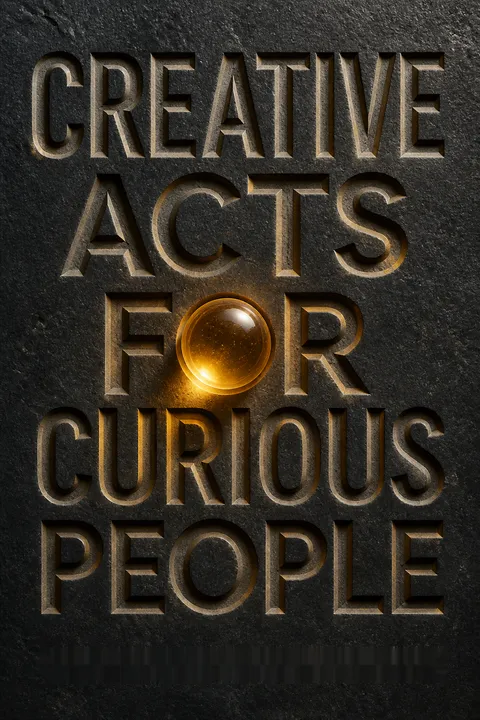


Key Takeaways
Treat creativity as a learnable practice, not a talent reserved for designers
Creativity is practiced. Sarah Stein Greenberg presents design not as a specialty limited to making attractive objects, but as a way to learn and act when the answer is unknown. The book’s many short assignments train habits such as noticing, listening, making, and reflecting. They are practice, not recipes for guaranteed breakthroughs.
Beginners can make real change. Four graduate students entered an Indian hospital project expecting to improve patient flow. By listening to patients’ families, they found a more urgent need: help families care for loved ones and feel less frightened. Their work became Noora Health. By the end of 2020, it had trained more than 5,000 nurses and 1 million family members in 160 hospitals across India and Bangladesh. The enduring result was not just a service, but a repeatable way to approach unfamiliar problems.
The book makes creative agency tangible by tying it to behaviors that can be rehearsed, rather than to a mysterious gift. This fits experiential learning: practice, feedback, and reflection build skill in ways passive explanation often cannot. Noora Health gives the claim weight because the team’s work moved from classroom exercise to a large service. Still, creative confidence is not a substitute for medical knowledge, funding, or local authority. The practical lesson is not that anyone can solve any problem alone, but that more people can contribute meaningfully when they learn how to inquire, collaborate, and test.
Begin with people’s lived problems, not the solution you arrived carrying
Reframe before solving. The Noora Health team could have defined its hospital challenge as reducing readmissions. Instead, conversations with families revealed fear, expense, and uncertainty around caring for a hospitalized relative. That emotional reality pointed toward teaching family members practical care skills. The team’s initial idea of the problem and the need it uncovered were not the same.
Describe needs as actions. A need stated as a noun, such as a ladder, already hints at a solution. A verb, such as reaching, learning, or feeling secure, leaves room for many possible responses. The book’s exercise about a girl standing on a chair demonstrates the distinction: she might need to reach something, explore, or get someone’s attention. Those are hypotheses, not facts, and should be checked with the person concerned.
This approach resembles a useful distinction in problem solving: separate the observed situation from the explanation imposed on it. Replacing a proposed object with an underlying activity broadens the set of possible interventions. Noora Health also illustrates why emotional language can be strategically precise: fear is not a softer substitute for a measurable outcome when it reveals what people are actually navigating. But an evocative story can overrepresent one person’s experience. Interviews should generate hypotheses, while observation, additional voices, and testing help determine whether those hypotheses travel.
Slow your attention until ordinary details start revealing the system
Observation takes time. Familiar settings teach the mind to filter out details. The book counters that habit with practices such as shadowing someone through a workday, following one sensory feature on an unplanned walk, or staying in one place for three hours and recording what changes. These exercises make routine behavior newly visible.
Look beyond the obvious. A team examining public benefits applications tried the process themselves with a strict twenty-five-minute limit, using a phone or public computer. Most could not finish. They encountered repeated questions, confusing instructions, and barriers for people without reliable computer access. The exercise offered insight, but the book cautions that a short simulation cannot reproduce the stakes for someone who depends on the benefit. Observation opens questions; it does not confer full understanding.
Slowing down is a method for countering selective attention, not merely a call to be more mindful. In systems work, small frictions can accumulate: a confusing form, a timed-out session, and a limited device may together prevent access to an essential service. That is why the book’s insistence on seeing a process from end to end matters. A simulation can expose design obstacles, but it cannot reproduce poverty, disability, or the consequences of failure. The most responsible use of immersion is to let it sharpen questions and motivate partnership, not to claim the participant’s experience as one’s own.
Let rough ideas breathe before your inner critic decides they are impossible
Make first, judge later. A blind-contour drawing asks someone to sketch a person for a minute or two without looking at the paper. The result is usually awkward, which is the point: the exercise lets participants notice the voice that urges them to correct, hide, or stop. Judgment remains valuable, but it can be turned down while ideas are being generated and turned back up during evaluation.
Combine what does not fit. The book also introduces bisociation, a way to generate ideas by pairing concepts that seem unrelated and inventing a third possibility from their tension. The objective is not to force every strange result into a project. It is to interrupt familiar thinking and create material worth exploring. Separating exploration from evaluation gives unusual ideas time to become visible before they are assessed.
The distinction between generating and evaluating is a practical response to a common cognitive trap: applying feasibility tests before there is anything substantial to evaluate. A deliberately imperfect drawing or an unlikely idea pairing makes self-censorship easier to see because the stakes are low. This does not mean that criticism should disappear. It means timing matters. Without later evaluation, novelty can become indulgence; without early room to explore, competent teams may produce only variations on what they already know.
Build a rough version early, because materials expose what imagination misses
Test the physical world. In the Monsoon Challenge, teams had about seventy-two hours and a twenty-dollar budget to build devices that collected sprinkler water. Some teams planned extensively but built late. Others tested quickly and discovered problems, including water pooling in a tarp until the structure collapsed. The failure was useful because it revealed a physical constraint that discussion had obscured.
Make several versions. Prototypes do not have to be polished or technically complete. A chair sketched on paper, then made from cardboard, pipe cleaners, and other materials, changes as each material makes different qualities easier to see. The goal is not to defend the first idea, but to use making as a way to think, discover assumptions, and decide what to try next.
A prototype is most valuable as an instrument of inquiry. Handling a material can expose weight, balance, scale, and usability that are difficult to reason through abstractly. This is close to the idea of distributed cognition: some thinking happens in the interaction between a person and an external object, not only inside the person’s head. Yet a convincing mock-up can also mislead. A test should isolate what it is meant to learn, and a successful demonstration should not be mistaken for evidence that a design is safe, scalable, or useful to the people it concerns.
Create trust and room for difference before asking a team to take creative risks
Design the social conditions. The book treats collaboration as something shaped by the room, the activity, and the group’s habits. A playful handshake or a sequence of conversations that moves from introductions to more personal questions can help strangers connect. In Talkers and Listeners, participants compare how they contribute and examine assumptions about why others speak or stay quiet. The aim is not to label people permanently, but to make participation patterns discussable.
Make feedback safer to hear. In I Like, I Wish, people name what helped and what they would change. A leader listens without defending the work, records responses visibly, and considers what to act on afterward. These routines can make disagreement more useful, particularly when status or speaking confidence would otherwise give some voices disproportionate influence.
Psychological safety is not simply friendliness. It is the confidence that a person can offer an unfinished idea, ask a basic question, or disagree without being humiliated. Rituals can help make that norm concrete, and structured turn-taking can counter the tendency for confident speakers to dominate. Still, a playful exercise cannot erase hierarchy or guarantee safety. Personal disclosure should be optional, and facilitators need to notice whose comfort is being prioritized. Trust grows when the group’s everyday decisions match the welcoming tone of its warm-ups.
Test the problem frame and the proposed fix as separate questions
Separate need from solution. Frame & Concept distinguishes the underlying need a project addresses from the particular design proposed to meet it. A concept may be appealing but miss the need, or it may fail while revealing that the original need was understood well. Keeping the two categories distinct helps teams decide whether to refine the prototype or rethink the problem.
Watch before explaining. In the Test of Silence, a creator lets someone use an unfinished design without explaining how it works. The user’s actions, confusion, and comments reveal what the design communicates on its own. Teams can then reflect using What? So What? Now What?: first describe what happened, then interpret its significance, and finally decide what to try. Reflection turns an experience into a better next experiment.
Separating the frame from the concept is a strong defense against sunk-cost thinking. A team can admit that a prototype is weak without discarding the human need, or recognize that a clever object solves a problem no one has. Silent testing also approximates an important real-world condition: the designer will not always be present to explain the product. Still, a confused user may be reacting to the test setup, not the idea itself. The method is most informative when teams record observations carefully and test competing explanations rather than treating one reaction as a verdict.
Account for power, access, and consequences beyond the person using your design
Design distributes effects. A design decision can shape who feels welcome, who gets access, and who carries the burden when a system fails. The book asks creators to consider both the client paying for the work and the people who must live with its results. Stakeholder mapping makes allies, opponents, and people absent from the conversation visible. A Futures Wheel extends the inquiry by tracing possible consequences from an initial change.
Inspect what the system encodes. The book’s AI exercise shows how image searches for CEOs can mirror a workforce dominated by White men while also reinforcing the assumption that leadership belongs to them. Data choices are design choices. Similarly, a product that works beautifully but cannot reach its intended users has not solved the whole problem. Distribution, implementation, and unintended effects belong in the design brief.
This is the book’s most important correction to a narrow, user-centered view: helping a direct user can still shift costs onto workers, communities, or people excluded from the dataset. The two-client lens makes accountability harder to evade, while consequence mapping helps teams surface indirect effects before they become entrenched. Such maps are not forecasts; they are disciplined prompts for imagining possibilities. Nor can a workshop fully represent absent stakeholders. Ethical design requires ongoing consultation and a willingness to change course when affected people describe harms the team did not anticipate.
Use difficult feelings as signals, then reflect and choose your next experiment
Struggle can teach. The book calls productive struggle the effortful part of learning that can deepen understanding, as long as the challenge remains manageable and support is available. A student designing an irrigation pump in Myanmar felt that the work was inadequate shortly before presenting it. After testing with farmers and working with local engineers, the team improved the design; 1,500 lower-cost pumps were later in use. Discomfort did not prove the idea was good, but it signaled that the work was demanding new learning.
Make learning visible. A learning journey map charts both how much someone feels they are learning and how they feel emotionally over time. A personal project can turn that insight into action: name a change that matters, set a time frame, and ask a trusted person to help maintain accountability. Then review what happened and adapt.
The useful distinction is between difficulty that stretches capacity and distress that overwhelms it. Learning research often describes the value of challenges that are just beyond current ability when guidance is available; the book translates that principle into a practical attitude toward creative work. Reflection helps separate a temporary emotional trough from evidence that a project is failing. But discomfort is not inherently virtuous. Excessive workload, poor support, or an unsafe team can produce suffering without learning. The right response is not to endure everything, but to diagnose what the feeling is telling the learner about the task and its conditions.
Analysis
Creative Acts for Curious People is both a design primer and a collection of deliberately constructed learning experiences. Its structure resists the usual promise of a universal five-step method. Instead, dozens of short assignments let readers rehearse particular capacities, including noticing, interviewing, prototyping, critique, reflection, and ethical judgment. The book then recombines those capacities in projects of increasing complexity. Its narrative anchor, Noora Health, shows why this matters: a team entering a hospital with a broad service-improvement brief discovered an overlooked need among patients’ families and built an organization around it.
The book’s strongest contribution is its account of creativity as a social and material practice. Ideas are not treated as private flashes of genius. They emerge through attention to people, physical making, shared interpretation, and repeated tests. The assignments are memorable partly because they make abstract lessons bodily: a silent prototype test teaches more vividly than a lecture about user experience; a constrained rain-catching challenge makes the cost of delayed experimentation visible.
The approach also contains productive tensions. Human-centered design can reveal needs that institutional abstractions miss, but empathy exercises do not grant access to another person’s lived reality. A brief simulation of a benefits application can illuminate barriers while leaving the stakes radically unequal. The book acknowledges this gap and repeatedly calls for humility, consent, and continued engagement. That caution is essential, because design activity itself is not automatically ethical. A better-designed system can still serve the wrong interests or distribute harms unevenly.
The method is also resource-intensive. Deep interviews, observation, iteration, and collaboration require time and access that many workers or communities do not have. The book is most useful when its exercises are adapted rather than treated as rituals, and when participants ask who has power to decide what counts as success. Its central promise is therefore not that creativity guarantees good outcomes. It is that structured curiosity can help people find better questions, make assumptions visible, and learn their way toward more responsible action.
People Also Read



Glossary
Bisociation
Unexpected idea combinationA method of generating ideas by combining two concepts that are not usually associated. Participants pair existing ideas and develop a third that draws on both, often emphasizing their differences rather than looking only for common ground. The purpose is to disrupt habitual thinking and create new possibilities, not to treat every combination as a viable solution.
Frame & Concept
Need and solution distinctionA way to sort feedback into two categories. The frame is the underlying need or opportunity a project aims to address. The concept is a particular proposed response to that need. Evaluating them separately helps a team identify whether a weak prototype needs improvement or whether its understanding of the problem needs to change.
Futures Wheel
Map possible consequencesA structured exercise for exploring the implications of a current trend, policy, or design. Participants write possible first-order effects around the central change, then extend each effect into further consequences. The map is not a prediction. It helps people imagine positive and negative possibilities, identify concerns, and consider which actions might encourage a preferred future.
point of view
Focused design directionA clear statement of whom a project serves, what need it addresses, and what perspective guides the work. A useful point of view is specific enough to focus exploration, but does not prescribe the solution. It can change as research reveals new needs or a more compelling direction.
productive struggle
Effortful, supported learningA challenging phase of learning in which a person works through uncertainty and develops understanding rather than receiving an immediate answer. The struggle is productive when the task stretches current abilities but remains manageable with appropriate support. Overwhelming difficulty, fear, or inadequate resources can prevent learning and should not be mistaken for useful challenge.
psychological safety
Safety to take interpersonal risksA shared sense that people can ask questions, express uncertainty, offer ideas, and disagree without being humiliated or punished. In creative teams, this matters because exploration requires exposing unfinished thinking. It depends on everyday behavior and group norms, not on a single warm-up exercise or a leader’s stated intention.
reflection-on-action
Learning from past performanceA practice of looking back at an experience after it has occurred to understand what happened, evaluate its effects, and improve future action. In the book, structured reflection helps learners notice patterns in their own behavior and identify which conditions supported or obstructed their progress.
zone of proximal development
Reachable next learning zoneA learning range in which a person can accomplish more than they can independently manage at present, provided they have suitable guidance or support. The concept, associated with psychologist Lev Vygotsky, helps distinguish a useful stretch from work that is either already easy or so difficult that progress is unlikely.
Download PDF
Download EPUB
.epub digital book format is ideal for reading ebooks on phones, tablets, and e-readers.








