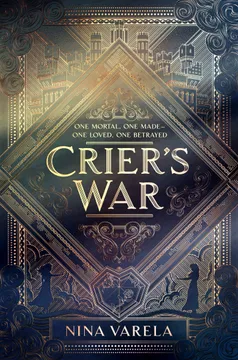


Plot Summary
Prologue
Before Automae rule Zulla, Queen Thea cannot bear a child. She offers immense wealth and political favor to any Maker who can create one, and Thomas Wren succeeds with Kiera, a being built to imitate human life.
The queen makes Kiera her daughter and heir, setting in motion the creation of an entire people. The prologue presents this origin as both a marvel and a bargain: Automae society begins with a human ruler’s longing, a Maker’s ambition, and a child whose existence depends on another’s blood.
The origin story makes power feel intimate before it becomes political. Automae civilization begins not with a public revolution but with Thea’s private grief and Wren’s hunger for recognition. Kiera is simultaneously a child, a creation, and a solution to a monarch’s need, so the story’s central question is already present: can someone designed for another person’s purpose become fully their own? The prologue also complicates the later conflict between humans and Automae. The ruling Kind is not born from pure independence, but from human desire and human craft, a history its descendants will struggle to acknowledge.
Crier Finds a Fifth Pillar
Crier, the Automa heir of Sovereign Hesod, joins her fiancé Kinok on a ceremonial Hunt, where he tells her that Midwife Torras once falsified a noble child’s Design. Torras helped Make Crier, and the possibility that her own construction was altered unsettles the dutiful heir.
Kinok has already become a political force through the Anti-Reliance Movement, which seeks to sever Automae from human society, and Hesod intends their marriage to bind that influence to his court.
When Kinok obtains Crier’s old Design papers, she studies them alone and finds a fifth pillar labeled Passion. Believing herself Flawed and potentially liable to termination or political blackmail, she hides the discovery, unsure whether her mind or her future can still be trusted.
Crier’s first crisis is not that she feels different, but that she has no framework for interpreting difference except defect. Her education has trained her to treat design as destiny, so an unexplained fifth pillar threatens both her identity and her political usefulness. Kinok’s apparent assistance deepens this trap: information arrives through the person who may benefit most from her fear. The scene makes self-knowledge inseparable from power. Crier is not simply asking what she is; she is calculating who might control her if the answer becomes public.
Ayla Enters the Palace
Ayla, a human servant, has spent years near Hesod’s palace because his forces destroyed her village and killed her family, including the twin brother she believes died saving her. Rowan rescued Ayla from starvation and trained her to fight, while Benjy became her closest friend and fellow servant.
One night, Ayla finds Crier hanging from a crumbling sea cliff and pulls her to safety, despite wanting revenge on Hesod’s family. Crier spares Ayla for wearing an illegal Maker-made locket, then appoints her as her personal handmaiden. Ayla accepts the post as a route inside the palace. After learning Kinok once guarded the Iron Heart, the source of Automae’s heartstone, she agrees to spy on him for Rowan’s Resistance.
Ayla’s decision to save Crier exposes the difference between an intended action and an ingrained one. Her revenge has given her direction, yet at the cliff’s edge she acts before calculation can intervene. Crier’s appointment converts that contradiction into a strategy: proximity can serve the Resistance, but it also places Ayla beside the person she means to kill. Rowan offers a collective purpose, Benjy a personal attachment, and Ayla’s own grief a demand for repayment. The palace becomes a place where motives overlap rather than neatly align.
Kinok Maps the Servants
At Crier and Kinok’s engagement celebration, the public ritual binds the pair while Kinok quietly tells Crier he knows about her supposed Flaw. His followers display black armbands, making the Movement’s reach impossible to ignore.
During the festivities, Ayla slips into Kinok’s room and discovers a chart linking human servants through family, friendship, and affection. Her own face is connected to Benjy’s, while Faye’s dead sister Luna has been scratched out. Ayla’s handkerchief is left behind.
The next morning, Nessa, the head servant, is dead after guards accuse her of trespassing and she resists their attempt to take her child. Her shoes and Ayla’s bloodstained handkerchief are hung in the orchard as a warning, leaving Ayla convinced her carelessness helped cause the killing.
Kinok’s chart turns relationships into information that can be exploited. The threat is not merely surveillance of where people go, but a calculated understanding of whom they cannot bear to lose. Ayla’s guilt over the handkerchief gives this system a personal cost: her attempt to gather useful knowledge leaves evidence that can be weaponized against someone else. Meanwhile, the engagement ceremony makes Crier’s private vulnerability part of a public alliance. Both young women discover that intimacy, whether freely chosen or politically mapped, can be made into an instrument of rule.
Kinok Takes Reyka’s Seat
At her first Red Council meeting, Crier expects to learn how power works from inside. Instead, Hesod leaves her standing by the doorway while Kinok takes the empty chair of the missing Councilmember Reyka. Crier speaks against the council’s casual violence toward humans, but Hesod dismisses her as inexperienced. Kinok argues that humans are an existential threat, and most Hands accept his nomination.
The meeting also reveals that Queen Junn of Varn plans a diplomatic tour and specifically wants to meet Crier. Reyka’s disappearance troubles Crier, who had looked to her as a mentor and hoped she would support Crier’s political ideas. The council’s decision leaves Crier excluded from the role she was made to inherit.
The council meeting converts Crier’s abstract frustration into a visible hierarchy. She is literally present but denied a seat, while Kinok gains authority by occupying the space left by someone who once represented a different political possibility. Her father’s dismissal is especially destabilizing because it suggests that being designed as an heir does not guarantee recognition as one. Crier’s brief defense of humans marks an emerging ethical judgment, but the institution answers it with ridicule. Her first encounter with governance teaches her that access is not the same as agency.
The Tide Pool Bargain
During the servants’ secret Reaper’s Moon celebration, Crier finds Ayla dancing among masked humans and promises not to tell Hesod. Away from the crowd, Ayla admits that she is worried about Faye, whose distress seems tied to the palace’s sun-apple shipments.
Crier shares a human folktale beside a tide pool, and Ayla challenges its bleak ending, drawing Crier into an unfamiliar exchange of feeling rather than instruction. Later, Crier breaks into Kinok’s study to search for her Design papers.
Instead, she finds notes about Yora’s heart and Thomas Wren’s research, clues she cannot yet interpret. Her private investigation establishes that Kinok’s political program is tied to a hidden experiment, while her connection to Ayla has begun to alter what she notices.
The tide-pool encounter does not erase the power imbalance between Crier and Ayla; it gives each a brief chance to act outside the roles imposed on them. Crier chooses secrecy over obedience, while Ayla shares a worry without surrendering her caution. Their disagreement about the folktale’s ending also reveals different survival habits: Crier can accept a story’s inherited conclusion, while Ayla insists that its consequences matter. The unexplained notes in Kinok’s study join this emotional opening to the political plot. Curiosity becomes a form of resistance for Crier, even before she understands what she has found.
The Queen Names the Wolf
Queen Junn arrives at Hesod’s palace with her human adviser, Storme, and a retinue from Varn. Ayla recognizes Storme as the twin brother she believed had died in the raid on their village. Faye, now living in the palace, mutters to Ayla about sun apples and a man who has used her.
In private, Junn tells Crier that Kinok once courted her too, and describes his larger project: a new Automa capital, human exclusion, stronger future Automae, and freedom from dependence on the Iron Heart. Junn asks Crier to help stop him. Later, Crier realizes that Junn and Storme are lovers, and the discovery of their intimacy awakens questions about her own desire and the human feeling she believes her fifth pillar represents.
Junn’s visit collapses the easy categories Crier has relied on. The feared queen is a thoughtful political actor, while the respected fiancé’s reform language conceals a program of forced exclusion. Storme’s appearance similarly unsettles Ayla’s tidy division between the dead and the living. Each woman faces evidence that inherited stories are inadequate: Junn is not simply mad, Kinok is not merely a philosopher, and family history may not be finished. The scene also links political coexistence with private intimacy. Crier’s awakening is not separate from the question of who gets to live beside whom.
Ayla Finds Her Brother
Ayla confronts Storme in the palace corridors and demands to know why he never returned after the raid. He says he was taken in by a group that forced him to promise never to search for her, but he will not explain the group’s purpose. Now he serves as Junn’s adviser and urges Ayla to leave Kinok’s affairs alone, then invites her to come to Varn.
Ayla refuses, wounded by his allegiance and his departure. Later that night she goes to Crier, who lets her sleep in her bed. As Crier handles Ayla’s locket, a drop of blood activates its stored memory of a burning city, a woman named Siena, and a child called Clara. The distress triggers Crier’s guard chime, and guards seize Ayla.
Storme’s return gives Ayla what she once wanted, but not the reassurance she expected. His survival cannot repair the years of grief because he arrives with loyalties and choices she does not understand. Their reunion dramatizes how trauma can preserve a relationship as an ideal while reality makes it newly difficult. By contrast, Crier’s quiet invitation offers Ayla immediate refuge, though it carries its own danger. The locket turns a personal keepsake into an unstable archive: the past is no longer only what Ayla remembers, but something other people can enter and interpret.
The Safe Behind the Books
Hesod agrees to keep Ayla near Crier only after Crier publicly wears Kinok’s black armband, a gesture of apparent support that protects Ayla from being handed over for questioning. Kinok interrogates Ayla about her family and her village, then unexpectedly releases her.
During the encounter, Ayla spots her locket in his study and notices where his attention shifts before he leaves. Searching the room, she finds a hidden safe built into a bookshelf, but its Maker symbols are beyond her knowledge. Malwin passes Ayla a green feather from Storme.
When Rowan returns from the South, she reveals that the promised uprising was a fabrication designed to trace Resistance connections. Benjy has also found palace crates labeled as sun apples but packed with black powder, and the group begins planning a theft from Kinok’s safe.
This sequence turns objects into competing forms of evidence. The black armband is a public lie that buys Ayla safety; the green feather is a private sign whose meaning she cannot yet fully test; the hidden safe is a material promise of answers. Kinok’s questioning shows that he is interested in Ayla’s ancestry, not merely her supposed misconduct. Rowan’s false uprising then enlarges the threat from individual surveillance to networked manipulation. The Resistance has been mapped in the same way as the servants, making secrecy itself a scarce resource.
Nightshade Reaches the Council
After Crier secretly names Kinok’s supporters in a message to Junn, three of them are found dead: Councilmembers Laone and Shasta, and Lord Foer. Crier suspects her information enabled the killings, then persuades Hesod to let her travel south and comfort Rosi, Foer’s promised wife.
At the estate, Rosi appears physically ravaged by Nightshade, the black powder Kinok has distributed as a substitute for heartstone. She reveals that Foer was researching Thomas Wren’s collaborators and believed the first Automa design came from a woman, not Wren.
In Elderell, Crier seeks Reyka and finds a box of green feathers left at the inn where the councilmember was last seen. The clue links Reyka to Junn and makes Kinok a possible threat to her disappearance.
Crier’s attempt to act politically produces consequences faster than she can control. The deaths force her to confront the difference between providing intelligence and choosing what another person will do with it. Rosi’s condition gives Nightshade a bodily cost, while Foer’s research suggests that the official history of Automa creation may conceal appropriation. The feathers also expand Crier’s suspicion beyond Kinok: Junn’s alliance may offer resistance, but it is not necessarily safe. Political knowledge here is neither neutral nor protective. Every discovery creates another person who can be harmed by its use.
The Elderell Riot
When Ayla sees the feathers, Crier admits she has been working with Junn. Together they connect Kinok’s relationship chart, the false reports of rebellion, and Faye’s coded sun-apple shipments: Kinok has manipulated uprisings to justify violence and strengthen his influence.
Ayla and Crier kiss, then use Ayla’s locket to witness a memory of her grandmother Siena meeting Leo in a forest. Before they can make sense of it, a human mob surrounds their carriage as they try to leave Elderell.
Rowan stands among the rebels, attempting to restrain a man with a club, when an Automa guard kills her. Ayla watches her mentor fall. With the Resistance leader gone and Nightshade spreading, Ayla returns to Benjy determined to act before the Iron Heart loses its strategic importance.
The intimacy between Ayla and Crier arrives alongside a political recognition: both understand that Kinok has been engineering the conditions that make human violence seem inevitable. Their kiss does not dissolve their conflicting loyalties; it makes betrayal more costly. The riot then forces private feeling into public consequence. Rowan’s attempt to prevent escalation cannot overcome the state’s reflex to treat a human crowd as a threat. Her death strips Ayla of the mentor who helped her imagine justice beyond revenge, leaving the next choice to a young woman whose grief has again become combustible.
A Knife at Midnight
Crier explores the locket again and sees Siena caring for Yora, a Made girl whose existence seems tied to Kinok’s notes about Yora’s heart. She sends Junn intelligence about Kinok’s allies, hoping the coming wedding will gather them in one place. Ayla and Benjy organize a raid: rebels set fire to the stables to draw guards away while others enter Kinok’s study.
Ayla reaches Crier’s bedchamber with a knife, but sees Crier asleep holding her returned locket and cannot strike. She flees. The others escape with a scrap bearing the names Leo, Siena, and Tourmaline, not the compass they expected. The attack fails to deliver the Resistance’s key to the Iron Heart, and Ayla and Benjy become fugitives with more questions than answers.
The planned assassination tests whether Ayla’s identity can survive without revenge as its organizing principle. She has rehearsed the killing as justice, yet the sight of Crier’s care for the locket interrupts the script. Her refusal is not a clean moral conversion; she still flees rather than explain herself. The failed raid also shifts the story’s center of gravity. The rebels expected a map to a vulnerable resource and instead find a family history encoded in three names. Their strategic problem may depend on a secret older than the Resistance itself.
Yora’s Heart Revealed
After the attack, Crier persuades Hesod to let her visit the Midwifery where she was Made. Midwife Jezen compares the original records with the papers Kinok gave her and confirms that Crier’s supposed fifth pillar was forged; her true Design contains the standard four. Crier’s feelings for Ayla are not an engineered defect.
Using the locket, she then sees Siena return toward the burning city for Yora, leaving Leo with a blue stone called Tourmaline, Yora’s heart. Crier realizes it may be a source of power that frees Automae from heartstone. A letter from Junn confirms that Junn killed Reyka and insists Crier proceed with the wedding as a chance to strike at Kinok. Crier must choose between Junn’s plan and finding Ayla before Kinok does.
The final revelations separate biological origin from moral identity. Crier’s passion was never a mechanical error, yet its reality does not guarantee that she will act well; it only makes her choices genuinely hers. Tourmaline could liberate Automae from dependence while concentrating unprecedented power in whoever controls it, so technological independence is not automatically freedom. Junn’s confession further complicates the promised alliance: a rebellion against Kinok may be built on another leader’s willingness to kill. The book closes not with a victory, but with Crier recognizing that every available path carries political and personal costs.
Analysis
Crier’s War treats political order as a story people tell about who deserves power. Hesod describes human customs as useful models for stability, while Kinok claims that Automae must escape human influence altogether. Both positions preserve Automa superiority, though they dress it in different language. Junn’s coexistence offers another possibility, but her willingness to use lethal force shows that a just objective does not purify every method used to reach it.
Ayla and Crier are the novel’s clearest challenge to inherited categories. Their relationship begins inside an extreme hierarchy: one is a servant trained by grief to seek revenge, the other an heir trained to see hierarchy as natural. Their attraction does not erase that history. It makes them more accountable to it. Ayla must recognize that hatred can become a structure of its own, while Crier must learn that sympathy without material change can become another form of self-congratulation.
The book also questions the authority of official memory. The story of Automa creation credits Thomas Wren; the locket and Foer’s research suggest that this account may conceal Siena’s work. History is not merely background here. It determines whose invention is celebrated, whose dependence is hidden, and which people are permitted to claim kinship. The final reveal of Tourmaline sharpens the danger: liberation from a resource can create a new concentration of power rather than equality.
The ending refuses the comfort of a solved conflict. Crier discovers that her emotional life is real, but she remains caught between Junn’s plan, Kinok’s ambition, and Ayla’s uncertain safety. Ayla survives her first chance to kill Crier, but survival is not reconciliation. Their unfinished choices make the novel’s central demand concrete: feeling across a political boundary matters only if it changes what the characters are willing to risk, expose, and repair.
Review Summary
Crier's War receives mostly positive reviews, with praise for its diverse representation, engaging world-building, and slow-burn romance between the two female protagonists. Readers appreciate the political intrigue, complex characters, and exploration of themes like humanity and oppression. Some critics find the pacing slow or the plot predictable, but many eagerly anticipate the sequel. The book is often described as a compelling blend of fantasy and dystopian elements, with strong LGBTQ+ representation and an enemies-to-lovers storyline that resonates with many readers.
People Also Read




Characters
Crier
The questioning Automa heirCrier is the daughter and intended heir of Sovereign Hesod, created to inherit his authority and trained in history, science, and political theory. Her curiosity about human life makes her perceptive, but her sheltered education has also taught her to treat hierarchy as natural and orderly. She wants a place in government because she believes study should lead to responsible action, not merely private knowledge. Her relationship with Ayla draws her toward experiences she cannot categorize in advance, while Kinok and Hesod both treat her as a political instrument. Crier’s central tension is between the identity her society has designed for her and the judgments she begins to make for herself.
Ayla
The palace’s human infiltratorAyla is a human servant shaped by the destruction of her village and the deaths of her parents. She survives through discipline, quick observation, and a fierce attachment to the revenge that has kept her moving. Rowan trains her to fight and gives her a cause, while Benjy offers a closeness Ayla fears because she associates love with loss. Working as Crier’s handmaiden places her inside the palace and near the people she wants to oppose. Ayla is not simply hardened: she is also attentive, protective, and capable of acting against her own plans. Those qualities make her a valuable spy and complicate the certainty she has built around vengeance.
Kinok
The reformer with a hidden designKinok is a Scyre, a scholar of Automae design and history, a former Watcher of the Iron Heart, and the founder of the Anti-Reliance Movement. His composure and intellectual fluency make him persuasive in court, where he can frame exclusion as security and ambition as necessary preparation. He seeks influence through alliances, research, and carefully managed secrets rather than open force alone. Kinok’s interest in human relationships suggests that he understands emotional bonds as sources of leverage. To Crier he can appear like an ally who recognizes her intelligence; to the Resistance he is a political and physical threat whose ultimate purposes remain difficult to see.
Benjy
Ayla’s steadfast companionBenjy is a human servant, Ayla’s closest friend, and a committed supporter of the Resistance. Rowan once took him in, and he has grown into a hopeful, sociable young man who values community more openly than Ayla does. He is physically capable, emotionally direct, and more willing to risk himself for a cause or a person. His attachment to Ayla makes him both her ally and a vulnerability she tries to conceal from herself. Benjy’s faith in a shared future often collides with Ayla’s belief that survival requires keeping people at a distance.
Hesod
The sovereign who calls control careHesod rules Rabu and is Crier’s Automa father by commission. He values Traditionalism, adopting human customs as a source of order while maintaining human subordination. Charming and politically skilled, he can make authority feel paternal, but his laws and punishments expose the coercion beneath that manner. He wants Crier to serve the stability of his rule, even as she longs to participate in shaping it. Their relationship is affectionate in its rituals yet unequal in its expectations, leaving Crier to question whether his care extends to her independent judgment.
Rowan
The Resistance’s fierce guardianRowan is a seamstress in public and a mentor, organizer, and protector to humans who have been left without family or safety. She rescued Ayla and later took Benjy in, teaching both practical skills and the language of rebellion. Her warmth does not make her naïve: she understands the dangers of organizing under Automa rule and continues despite repeated setbacks. Rowan believes justice must be pursued collectively, while Ayla increasingly narrows justice to personal repayment. Her role in the Resistance gives the younger characters a model of courage rooted in care for others.
Queen Junn
Varn’s dangerous young rulerJunn is the young queen of Varn, a neighboring Automa realm whose policies challenge Hesod’s authority and Traditionalist assumptions. Public rumor paints her as unstable and cruel, but she is politically sharp, self-possessed, and willing to pursue an alliance with humans. She uses stories and symbols to test what others believe, and she understands how fear can clarify a person’s priorities. Junn’s pursuit of coexistence exists alongside hard-edged tactics, making her neither a simple liberator nor a safe ally. Crier is drawn to her independence and unsettled by the costs of her methods.
Storme
Ayla’s twin and missing pastStorme is Ayla’s twin brother, once her closest childhood companion. Their shared history includes the raid that shattered their family, and his memory remains central to Ayla’s understanding of loss, protection, and loyalty. Storme is practical and quick to read danger, traits that once made him a source of safety for Ayla. The distance between what she remembers and what she can understand about him gives their relationship emotional weight. He represents the possibility that surviving the same catastrophe does not mean emerging with the same beliefs.
Faye
The haunted palace servantFaye is a human servant whose fractured speech and fearful behavior make clear that she has endured something she cannot safely explain. Ayla recognizes her distress and tries to understand its connection to the palace’s shipments and Kinok’s influence. Faye’s vulnerability contrasts with the careful secrecy demanded of every servant. She is not simply a source of clues: her condition shows how political coercion can make a person appear unreliable, even when her fragments of information are important.
Reyka
Crier’s absent council mentorReyka is the longest-serving member of Hesod’s Red Council and someone Crier has long admired. She has encouraged Crier’s curiosity and shown concern for the human population, making her an unusual model within a government organized around Automa power. Her absence leaves both a political vacancy and a personal uncertainty for Crier. Reyka’s influence is less about formal instruction than about the possibility of serving the state while questioning its accepted boundaries.
Nessa
The servants’ capable overseerNessa is the palace’s head servant, a demanding and resourceful worker who manages the human staff while caring for her infant daughter. She is accustomed to solving practical problems without expecting recognition from the Automa household. Her marriage to Thom and her devotion to her child give Ayla a view of ordinary human life that persists despite the palace’s restrictions.
Plot Devices
The Four Pillars
Design made ideologyAutomae are built around four mental pillars, two associated with human capacities and two with Automa reasoning. Their Designs are treated as both technical blueprints and explanations of personality, giving the state a language for deciding what counts as normal or defective. Crier’s supposed fifth pillar makes that system personal: she fears her feelings may be evidence that she was Made wrong. The later discovery that the papers were forged separates her authentic emotional life from the design authorities use to define her.
The Iron Heart
Power’s hidden supplyThe Iron Heart is the mine in the western mountains that produces heartstone, the substance Automae need to function. Its location is guarded by Watchers, and its supply routes give it immense political and military significance. Human rebels hope that reaching the mine could break Automa power, while Kinok’s research seeks a replacement that would make the Automae independent of that vulnerability. The conflict over the Iron Heart turns a mining site into the strategic center of Zulla’s future.
Siena’s Locket
Memory carried in bloodAyla’s forbidden gold locket holds recorded memories that become visible when blood touches its red stone. Ayla has kept it as her last family heirloom without understanding its purpose. When Crier activates it, memories of Siena, Leo, Clara, and Yora reveal a hidden history behind Automa creation and a substance called Tourmaline. The locket changes family inheritance from a symbolic object into evidence, giving both women access to a past the official records have obscured.
Nightshade Shipments
A substitute that bindsKinok sends black powder disguised as the sovereign’s sun apples. Called Nightshade by its users, it replaces heartstone for a time but damages those who consume it. Its distribution allows Kinok to cultivate followers and conceal the scale of his experiments beneath ordinary palace commerce. Faye’s connection to the shipments and Benjy’s discovery of powder in the crates help the Resistance connect Kinok’s research to his growing political influence.
Green Feathers
A coded sign of allianceJunn’s green feathers serve as covert markers for people working with her against Kinok. Storme gives one to Ayla, and Crier later finds a box of them at the inn where Reyka was last seen. The signal links people across political borders without requiring a written confession, but it also makes every alliance a source of risk. The feathers help Crier and Ayla recognize that their separate investigations touch the same secret network.
Download PDF
Download EPUB
.epub digital book format is ideal for reading ebooks on phones, tablets, and e-readers.








